
Billionaires usually do not keep cash in one bank account. I’d sum it up this way: they split money across private banks, T-bills, money market funds, bank sweeps, cash management accounts, offshore banks, and family office treasury setups so they can balance access, safety, yield, and control.
Here’s the short version:
- Bank deposits alone are a weak setup at high balances. FDIC coverage is usually capped at $250,000 per depositor, per insured bank.
- T-bills are often the main home for reserve cash because they’re liquid and have recently paid around 4.50% to 5.00%.
- Money market funds are often used for near-term cash needs like taxes, payroll, and capital calls.
- Sweep programs and CMAs help spread deposits across banks and keep cash easier to use.
- Offshore accounts are about legal-system and currency spread, not just yield.
- Family office treasury rules tie all of it together, with limits, approvals, and cash buckets.
If I were reducing the article to one idea, it would be this: the rich don’t ask “Where should I put my cash?” They ask “What job does this cash need to do?”
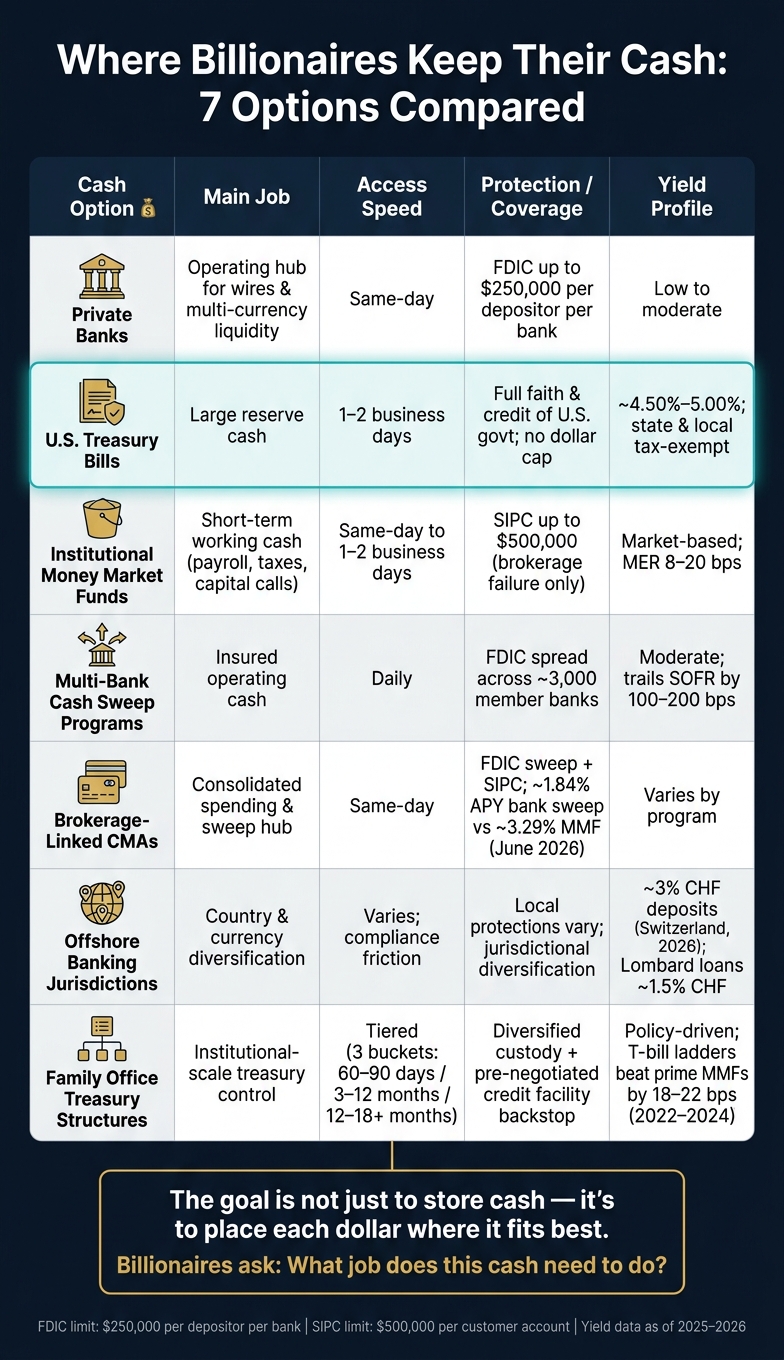
Quick comparison
| Option | Main job | Access | Main trade-off |
|---|---|---|---|
| Private banks | Main banking hub | Same day | Big uninsured bank exposure |
| U.S. T-bills | Reserve cash | 1–2 business days | Not checking-account cash |
| Money market funds | Working cash | Same day to 1–2 business days | Fund structure risk |
| Multi-bank sweeps | Insured bank cash | Daily | Lower yield |
| Brokerage CMAs | Spending + sweep in one place | Same day | Coverage overlap risk |
| Offshore banks | Jurisdiction and currency spread for offshore asset protection | Varies | More reporting and friction |
| Family office structures | Rules, control, and cash planning | Tiered | More setup and admin |
Bottom line: if you have a lot of cash, the goal is not just to store it. It’s to place each dollar where it fits best.
sbb-itb-39d39a6
How Billionaires Think About Cash Risk
Cash feels safe. But once balances get big, cash brings a different set of problems.
At billionaire scale, those problems are material. Wealthy families don’t treat cash as a passive parking spot. They look at the risks one by one and set up each piece on purpose.
The first issue is bank failure and counterparty exposure. Once deposits go above the $250,000 FDIC limit, that money can become an unsecured claim in a receivership. Access can also get cut off for days or more. Recent bank failures made that painfully clear. Large cash balances that seemed stable suddenly became hard to reach. In a failure, regulators may also convert uninsured deposits into equity. So instead of relying on one account, billionaires pair each risk with a different cash tool.
Inflation is a slower problem, but it keeps working in the background. Cash needs to earn a return. If it doesn’t, it loses purchasing power year after year. Over long periods, a cash-heavy portfolio can give up a large share of what that money can buy. That’s why liquid reserves are often held in yield-bearing near-cash assets instead of sitting idle.
Capital controls add another layer of risk. In some jurisdictions, local cash can get trapped, limiting access when families need it most. Lawsuit and creditor risk matter too. That helps explain why wealthy families often hold cash through legal entities rather than personal accounts.
The seven options below deal with these risks in different ways.
| Risk Category | Private Banks | U.S. T-Bills | Money Market Funds | Multi-Bank Sweeps | Brokerage CMAs | Offshore Jurisdictions |
|---|---|---|---|---|---|---|
| Bank Failure | High (Concentrated) | Low (Govt Backed) | Moderate (SIPC) | Low (FDIC Spread) | Low (FDIC Spread) | Diversified |
| Inflation | High Risk | Moderate Risk | Moderate Risk | High Risk | High Risk | Currency Dependent |
| Lawsuits | Low Protection | Low Protection | Low Protection | Low Protection | Low Protection | High Protection |
| Capital Controls | High Risk | Low Risk | Moderate Risk | High Risk | Moderate Risk | Low Risk |
| Sovereign Risk | Single-Country | Single-Country | Single-Country | Single-Country | Single-Country | Multi-Country |
That’s why billionaires split cash across banks, instruments, and jurisdictions. First: systemically important private banks.
1. Systemically Important Private Banks
Keeping $1 billion in plain insured deposit accounts would mean 4,000 separate $250,000 balances. That’s a lot to juggle. Major private banks cut through that mess by rolling it into one main relationship, with teams that handle wires, multi-currency transfers, and portfolio coordination. That’s why many people use a private bank as the operating hub rather than the only place to park cash.
Portfolio-Backed Credit
A securities-backed line of credit (SBLOC), also called a Lombard loan, lets clients borrow against an investment portfolio at about 50% to 70% loan-to-value without selling those holdings. In practice, a prearranged credit line works as a liquidity backstop. It’s there for access and timing, not because the client needs to lean on debt.
Bank Failure and Deposit Protection
Big banks can still fail. The March 2023 collapses of Silicon Valley Bank, Signature Bank, and First Republic Bank were a sharp reminder of how fast stress can hit large institutions. And when deposits sit above insurance limits, that money can get stuck in receivership for months.
Yield Potential
Private-bank deposit rates often trail money market funds and Treasury yields, although larger clients can sometimes negotiate tighter spreads.
Control and Account Structure
Some clients use zero-balance accounts, where day-to-day operating balances stay close to zero and cash shifts in automatically from a master account.
For cash reserves alone, the next move often points to Treasury bills or other near-cash instruments.
2. Short-Term U.S. Treasury Bills
When cash needs to stay liquid but earn more than a bank deposit, T-bills are often the next stop. U.S. Treasury bills are short-term U.S. government debt with maturities from 4 to 52 weeks, and many people use them as cash-like reserves. They’re sold at a discount, and the gap between the purchase price and face value is the return.
For balances that are too large for insured deposits, T-bills are a standard place to park liquid reserves. They carry no meaningful credit risk, and there’s no FDIC-style dollar cap on protection.
Yield Potential
T-bills have recently yielded about 4.50% to 5.00%. They’re also exempt from state and local income taxes, which can improve after-tax returns for investors in high-tax states by about 30 to 70 basis points versus high-yield savings accounts.
That tax edge can matter more than it first appears. Two options may look close on paper, but after taxes, the T-bill can come out ahead.
Warren Buffett’s Berkshire Hathaway held nearly $190 billion in short-term U.S. Treasury bills as of late 2025, treating them as strategic dry powder rather than idle cash.
Liquidity Access
T-bills usually settle on the secondary market by the next business day. That makes them liquid enough for many reserve-cash needs, even if they don’t work like a checking account.
A common setup is a ladder using 4-, 8-, and 13-week bills. As one bill matures, cash becomes available while the rest stays invested. That steady rollover helps keep funds accessible without forcing an early sale.
During the 2022 to 2024 rate cycle, laddered T-bill portfolios outperformed prime money market funds by an average of 18 to 22 basis points per year.
Custody and Control
Ultra-high-net-worth individuals often hold T-bills through a private bank acting as custodian. In some cases, the setup is tied to a zero-balance account structure. Some private banks hold T-bills in custody and link them to zero-balance accounts, so only the cash needed for payments is sold.
That setup gives families a bit more control over idle cash. Money stays invested until it’s needed, instead of sitting in a low-yield account.
3. Institutional Money Market Funds
If T-bills are the reserve sleeve, institutional money market funds are the working-cash sleeve.
Think of institutional money market funds as a larger cash bucket built for big balances. These funds put money into high-quality, short-term debt, including U.S. Treasuries, certificates of deposit, and commercial paper. Institutional share classes usually come with management expense ratios of just 8 to 20 basis points. At eight- and nine-figure balances, that gap adds up fast.
The tradeoff is pretty straightforward: you get more convenience than T-bills, but you also take on more fund structure and more counterparty exposure than you would with direct Treasury bills.
As of January 31, 2026, total assets in U.S.-based money market funds topped $7 trillion. For cash balances far above the $250,000 FDIC limit, institutional money market funds can scale without leaving all of that money parked at one bank.
Liquidity Access
Redemptions are usually available the same day or the next day, with settlement to an operating account in 1 to 2 business days. That makes these funds a practical fit for cash needed over the next 60 to 90 days, especially for outflows like payroll, tax installments, and capital calls.
Counterparty and Sovereign Risk
Not every money market fund carries the same type of risk. Prime funds hold commercial paper and short-term corporate notes, so they come with corporate credit exposure. Government and Treasury funds hold U.S. Treasuries and agency securities, which swaps corporate credit risk for Treasury risk.
Many ultra-wealthy investors have moved toward Treasury funds to remove private credit exposure, even if that means giving up a bit of yield. That choice can look boring on paper, but boring is often the point when cash is there to stay liquid and stable.
The 2008 collapse of the Reserve Primary Fund shows why this split matters. After the fund took losses on Lehman Brothers commercial paper, its NAV fell to $0.97 per share, an event known as "breaking the buck." The fallout helped push the SEC reforms in 2020 and 2023. After the 2023 reforms, automatic redemption gates were removed, though mandatory liquidity fees can still apply to certain institutional funds during periods of market stress.
Yield Potential
Institutional funds tend to track short-term market rates closely, so yields usually move with the Fed. For investors who want a competitive yield without managing a T-bill ladder themselves, these funds offer a low-effort option.
Privacy, Structure, and Control
Ultra-wealthy investors often get access to these funds through private banks or family offices that hold the assets in the client’s own name, not on the bank’s balance sheet. That detail matters for asset protection and day-to-day control. If the bank fails, the fund shares remain separate from the bank’s balance sheet.
For very large balances, some private banks negotiate contractual minimum yields for institutional sweep setups, such as SOFR minus 25 basis points. When these funds are held at a brokerage, SIPC covers up to $500,000 per customer account, including a $250,000 sub-limit for cash, against brokerage failure. It does not cover market losses.
When cash needs to be spread across multiple banks, the next layer is sweep programs.
4. Multi-Bank Cash Sweep Programs
When cash needs bank-style access instead of market exposure, sweep programs can do the job. They spread cash across a group of insured banks so no single deposit goes over the FDIC limit. For liquid cash that still needs daily access, multi-bank sweep programs move idle balances across a network of FDIC-insured banks, which spreads coverage across many banks.
Programs like IntraFi‘s Insured Cash Sweep (ICS) use proprietary algorithms to sweep idle cash each day into partner banks, with each deposit kept just under the FDIC cap. IntraFi’s network includes about 3,000 member banks.
Liquidity Access
ICS is built for daily liquidity. That makes it a good fit for operating cash, such as payroll, tax installments, and capital calls. CDARS (Certificate of Deposit Account Registry Service) works through certificates of deposit with fixed terms and a maturity ladder, so it fits term-based balances better.
Counterparty and Sovereign Risk
These sweep programs cut exposure to one bank failure, but they don’t remove custodian concentration risk. If a family office holds hundreds of millions through one custodian, a custodian failure can still interrupt access even when the deposits themselves are FDIC-insured.
There’s also the sovereign risk piece. U.S.-based sweep programs stay inside the U.S. regulatory system, so they don’t diversify that risk away. Families that want that extra layer often pair domestic sweeps with offshore accounts.
Yield Potential
The convenience isn’t free. Bank sweep rates often trail the overnight SOFR rate by 100 to 200 basis points. On large cash balances, that gap can eat into returns in a meaningful way.
For family offices with balances above $25 million, custodians may negotiate contract minimums like SOFR minus 25 basis points. That can help, but the drag may still matter if cash sits there for long stretches.
Privacy, Structure, and Control
The main draw is easy to see: one relationship and one consolidated statement. Clean, simple, and easier to track.
The tradeoff is less control over where each dollar ends up unless exclusions are set up and monitored. That matters if you already have a direct deposit at one of the network banks. An overlap could push total deposits above the $250,000 FDIC cap and leave the extra amount uninsured.
For families that want similar cash access inside a brokerage platform, the next option is a brokerage-linked cash management account.
5. Brokerage-Linked Cash Management Accounts
If a family wants brokerage convenience instead of setting up a separate bank relationship, a CMA can act as the main cash hub. A brokerage-linked cash management account combines spending access and idle-cash handling in one place. Unlike a standalone sweep program, a CMA puts cash access and the sweep feature inside the same account. Any uninvested cash is moved automatically into either FDIC-insured bank deposits or money market funds, depending on how the account is set up.
Liquidity Access
CMAs usually include debit cards, bill pay, and wire transfer access, which makes them useful for day-to-day cash management instead of just sitting there as a parking spot for funds. At higher balances, the big draw is simple: spending and cash sweep happen in the same account, so there’s no need to move money back and forth between platforms by hand.
Counterparty and Sovereign Risk
Cash swept to partner banks is covered by FDIC insurance up to $250,000 per bank. Money market fund balances are treated as securities under SIPC if the brokerage fails, with protection of up to $500,000 per customer account, including a $250,000 sub-limit for cash claims. SIPC covers brokerage failure, not market losses.
Both forms of protection sit inside the U.S. system. So if a family wants to keep cash outside U.S. regulators, a CMA doesn’t solve that problem.
Yield Potential
The bank sweep option gives deposit insurance, but it often pays much less than the money market sweep option. As of June 2026, the gap between the two was about 145 basis points. And yes, some older brokerage platforms still pay as little as 0.01% APY on default cash sweeps.
Privacy, Structure, and Control
The main structural upside is consolidation: one login, one statement, and cash that moves on its own. That’s neat and tidy.
The main issue is overlap. If a family already has a direct account at one of the sweep program banks, the total held at that bank could go over the $250,000 FDIC limit. Many large brokerage platforms let clients exclude certain banks from the sweep list to help avoid that. It also makes sense to sweep a bit below the FDIC cap so there’s room for accrued interest.
| Feature | FDIC-Insured Bank Sweep | Money Market Fund Sweep |
|---|---|---|
| Primary Protection | FDIC (up to $250k/bank) | SIPC (up to $500k total) |
| Yield (June 2026) | ~1.84% APY | ~3.29% 7-day yield |
| Risk Profile | Bank credit risk | Market/interest rate risk |
| Coverage at Scale | Extends across multi-bank network | $250k cash cap |
For cash held outside the U.S. system, the next option is offshore banking jurisdictions.
6. Offshore Banking Jurisdictions
When families want liquidity outside the U.S. system, offshore banks often become the next layer. The point is simple: keep cash under more than one legal system, not just one country. That gives billionaires both jurisdiction and currency diversification. In early 2025, the U.S. dollar lost about 10% against major currencies. That’s the basic case for offshore banking: spread risk across borders instead of keeping everything tied to one place.
Liquidity Access
Offshore accounts are usually reserve cash accounts, not day-to-day spending accounts. Access can be slower, wire transfers may take more time, and debit card or ACH access is often limited.
Counterparty and Sovereign Risk
One detail matters a lot: whether the bank has U.S. branches, subsidiaries, or correspondent banking ties. If it does, those links can pull assets closer to U.S. court reach.
That’s why families tend to look at places like Switzerland and Singapore. Switzerland manages about 25% of all global offshore wealth, and Swiss banks held a record CHF 9.28 trillion in assets under management in late 2024. Singapore has a strong banking track record and is often used as a hedge against EU/U.S. regulatory risk. Smaller jurisdictions, such as Belize or Dominica, can face more pressure if banks cut ties to higher-risk regions or if correspondent banking access gets squeezed.
Jurisdiction matters, but the reporting burden still follows the owner.
Yield Potential
Yield usually isn’t the main reason billionaires bank offshore. The first goal is preservation, along with currency diversification. Still, there can be some income. Liquid Swiss deposits averaged around 3% annually as of 2026.
A common tool here is the Lombard loan. It’s a loan backed by the offshore investment portfolio, often priced at about 1.5% for CHF-denominated loans in 2026. In plain English, that gives families a way to get liquidity without selling assets.
Privacy, Structure, and Control
Bank secrecy isn’t what many people think it is. Today, offshore privacy mostly shields account holders from third parties, not from tax authorities. U.S. persons still have to file FBAR and FATCA reports.
The main filings are:
- FBAR (FinCEN Form 114) for foreign accounts that go over $10,000 in total at any point during the year
- FATCA Form 8938, with filing thresholds that change based on residency and filing status
The penalty risk is steep. A willful failure to file FBAR can lead to a penalty of up to 50% of the account balance per violation.
| Jurisdiction | Primary Strength | Typical Minimum Deposit | Recognizes U.S. Civil Judgments |
|---|---|---|---|
| Switzerland | Global reference for private banking and wealth preservation | CHF 1M+ | No |
| Singapore | "Switzerland of Asia"; insurance against EU/US regulatory risk | $200,000–$500,000 | No |
| Cook Islands | Maximum jurisdictional isolation for trusts | Varies (often lower) | No |
| Channel Islands | Tied to London markets; strong trust law | $100,000–$250,000 | Not automatically |
For families that want tighter control, offshore banking often sits inside broader trust structures for asset protection.
7. Family Office Treasury Structures
External diversification only works if the cash plan inside the family office is tight. In multi-entity families, the treasury function manages liquid cash across the whole balance sheet. That means setting rules for what stays at private banks, what goes into T-bills, what sits in funds, and what is held offshore.
At the center is a written Treasury Policy Statement (TPS). It sets liquidity minimums, approved instruments, counterparty limits, and signing authority. Put simply, it turns cash management into a repeatable system instead of a string of one-off calls. As the Family Office Advisory editorial team put it:
"A treasury policy is not a bureaucratic constraint. It is the document that prevents a $10 million concentration in a failing bank from being described, after the fact, as an oversight nobody is responsible for."
Liquidity Access
Family offices often divide cash into three buckets:
- Operating liquidity for 60 to 90 days
- Reserve liquidity for 3 to 12 months
- Longer-term liquidity for 12 to 18+ months for deal opportunities or escrow
That setup helps match cash to actual use. If a capital call shows up at the wrong moment, an SBLOC can act as a backup source of liquidity. Undrawn committed credit facilities usually cost 25 to 40 basis points per year.
Counterparty and Sovereign Risk
Formal treasury policies often limit how much cash can sit with one institution. Many aim to keep no more than 60% of liquid assets at a single systemically important bank. Family offices also use LLCs and trusts to spread deposits across ownership categories and cut down concentration.
Bad cash placement has a real price tag. If uninvested cash earns 150 basis points less than the risk-free rate, a $40 million balance leaves $600,000 a year on the table in lost yield.
Yield Potential
Treasury teams often use T-bill ladders so maturities line up with expected cash needs. It’s a simple idea: money comes due when you’re likely to need it. From 2022 to 2024, this method beat prime money market funds by an average of 18 to 22 basis points a year. A dedicated treasury function usually costs 20 to 35 basis points of the cash portfolio each year.
Privacy, Structure, and Control
LLCs and trusts add discipline around titling and keep personal ownership off the personal account record. Family offices also use dual-approval wires and preauthorized emergency withdrawal instructions, so funds can still move when one signer is unavailable. In many cases, co-signers are placed in different time zones to avoid delays.
Those tradeoffs stand out more once the seven options are compared side by side.
How the 7 Options Compare
No single cash tool fixes every problem. Each one comes with a trade-off, and the table below lays those trade-offs out side by side.
| Option | Main Exposure | Access Speed | Protection / Coverage | Yield Profile | Ideal Use Case |
|---|---|---|---|---|---|
| Private Banks | Concentrated bank exposure above insurance limits | Same-day | FDIC only on insured deposits, up to $250,000 per depositor, per bank, per ownership category | Low to moderate | Operating hub for wires and multi-currency liquidity |
| U.S. Treasury Bills | Sovereign | 1–2 days | Full faith and credit of the U.S. government; no dollar cap | Competitive; state and local tax-exempt | Large reserve cash |
| Institutional Money Market Funds | Low if Treasury-only | Same-day | SIPC protection applies only if the brokerage fails, not against fund losses | Market-based, net of low fees | Short-term working cash |
| Multi-Bank Cash Sweep Programs | Distributed across a bank network | Daily access or fixed term | FDIC-insured deposits spread across multiple banks | Moderate; bank spread applies | Insured operating cash |
| Brokerage-Linked Cash Management Accounts | Program bank and broker mix | Same-day | FDIC sweep coverage plus SIPC | Varies by program | Consolidated spending and sweep hub |
| Offshore Banking Jurisdictions | Jurisdictional and currency risk | Varies; compliance friction | Local protections vary; legal and jurisdictional diversification | Varies by currency and institution | Country and currency diversification |
| Family Office Treasury Structures | Counterparty-aware; policy-controlled | Tiered across three buckets | Diversified custody plus a pre-negotiated credit facility backstop | Policy-driven and negotiated | Institutional-scale treasury control |
The big split here isn’t just yield. It’s how much control, privacy, and jurisdictional spread each option keeps or gives away.
And in practice, yield gaps are often small. What matters more is how each setup handles access, protection, and control when you need cash to move fast.
Then there’s the legal layer. Who owns the cash, where it sits, and how control is documented can matter just as much as the rate on the page.
Where Global Wealth Protection Fits In
Cash location matters, but ownership structure matters just as much.
Legal structuring helps clients sort out ownership, control, and reporting by using entities like offshore trusts and holding companies. The goal is simple: separate cash from personal liability exposure and spread jurisdiction risk across more than one place.
But this only works if the structure stays compliant with FBAR, FATCA, and CRS reporting rules. Mistakes here can lead to penalties.
That legal layer is what turns cash storage into a controlled wealth-protection system.
Practical Lessons for Affluent U.S. Entrepreneurs and Investors
Once the legal setup is done, the next step is simple: decide where each dollar belongs.
You don’t need $1 billion to use this kind of playbook. The main issue is the job of the cash. Is it operating cash, reserve cash, or cross-border cash? That one distinction changes the answer.
For operating cash, multi-bank sweeps can make sense. They help spread deposits across banks instead of leaving too much in one place. It’s also smart to leave a buffer below the FDIC cap so accrued interest doesn’t push the balance over the line.
For reserve cash, short-term U.S. T-bills are often a strong fit. You can ladder maturities so cash comes due when you expect expenses or other outflows. That also helps you pick up state-tax savings.
For spending and near-term liquidity, brokerage-linked cash management accounts can work well. They’re handy and flexible, but there’s a catch: don’t let balances pile up past one custodian’s protection limits.
For cross-border cash, or situations with creditor or political risk, offshore accounts or domestic asset-protection trusts may be worth a look. But they only make sense when that extra layer of reporting and complexity is justified. If the risk isn’t there, the paperwork and hassle usually aren’t worth it.
Conclusion
No single account, bank, or instrument can handle every cash need at the same time. That’s why billionaires spread money across more than one place. The better question isn’t where they keep cash. It’s what job each bucket is supposed to do.
These tools work best as a system, not as one-off picks. Together, they cover the main cash jobs: insured operating cash, reserve liquidity, yield, diversification, and control. For U.S. readers, the next step is knowing which type of protection applies to each account.
Three details matter most in the United States: account titling determines FDIC coverage, while SIPC applies only when a brokerage fails – not when investments lose market value.
Cash can look safe on the surface and still lose ground if the yield is weak or the setup is poor.
Titling, coverage, and cash purpose matter more than the headline balance.
FAQs
How much cash is too much to keep at one bank?
Any amount above $250,000 per depositor, per ownership category, at one bank goes past standard FDIC insurance. If that bank fails, money over the limit turns into an unsecured claim against the bank.
To handle larger cash balances, people often:
- spread money across more than one bank
- use deposit-network programs like ICS or CDARS
- buy direct U.S. Treasury securities
When should I use T-bills instead of a money market fund?
Use T-bills when you need cash on a known date, like a tax payment or a capital call. They also fit if you want to skip fund expense ratios and own government securities directly instead of through a pooled fund.
Use a money market fund when you want daily liquidity for expenses that can pop up at any time, or if you’d rather keep your cash in a managed, diversified vehicle.
Do offshore accounts actually improve cash safety?
Yes. Offshore accounts can improve safety by adding geographic redundancy.
Put simply, you’re not keeping all your cash in one place. Spreading funds across Tier-1 jurisdictions such as Switzerland, Singapore, or the U.S. can lower your exposure to any single economy or legal system.
They can also give you multi-currency exposure, which may help hedge against currency-specific volatility.
That said, holding funds abroad often comes with extra compliance work. In the United States, for example, you may need to file FinCEN Form 114.
