
Switzerland stays near the top for one simple reason: it helps rich families spread risk across banks, laws, and currencies. It manages about 25% of global offshore wealth, and Swiss wealth-management assets are projected to reach $5.57 trillion in 2025.
If I had to sum up the article in plain English, it comes down to this:
- People use Switzerland to avoid having too much tied to one country
- The Swiss franc (CHF) gives another currency option beyond the U.S. dollar
- Swiss private banks offer centralized custody, reporting, and portfolio management
- Privacy still exists, but under tax-reporting rules like FATCA and CRS
- For U.S.-connected families, the setup only works when legal, tax, and banking advice match
This is not about hiding money. It’s about control, diversification, and long-term wealth preservation across borders.
A Swiss setup usually means one private bank relationship, one custody structure, and a clear choice between discretionary, advisory, or execution-only management. The account can hold USD, CHF, EUR, GBP, and other assets in one place, which cuts the mess of scattered records across countries.
| What wealthy families want | Why Switzerland is used |
|---|---|
| Less exposure to one country | Stable legal and political system |
| Less U.S. dollar concentration | Access to CHF and multi-currency custody |
| Cleaner reporting | One custody framework for global assets |
| More control in family planning | Banks, trusts, foundations, and cross-border coordination |
| More privacy without breaking rules | Client confidentiality within FATCA/CRS reporting |
The core idea is simple: Swiss banking supports wealth preservation, but the legal structure does the asset protection work. That’s why families often pair the bank account with offshore trusts, foundations, or holding companies when the facts fit.
The main wealth risks Switzerland helps reduce
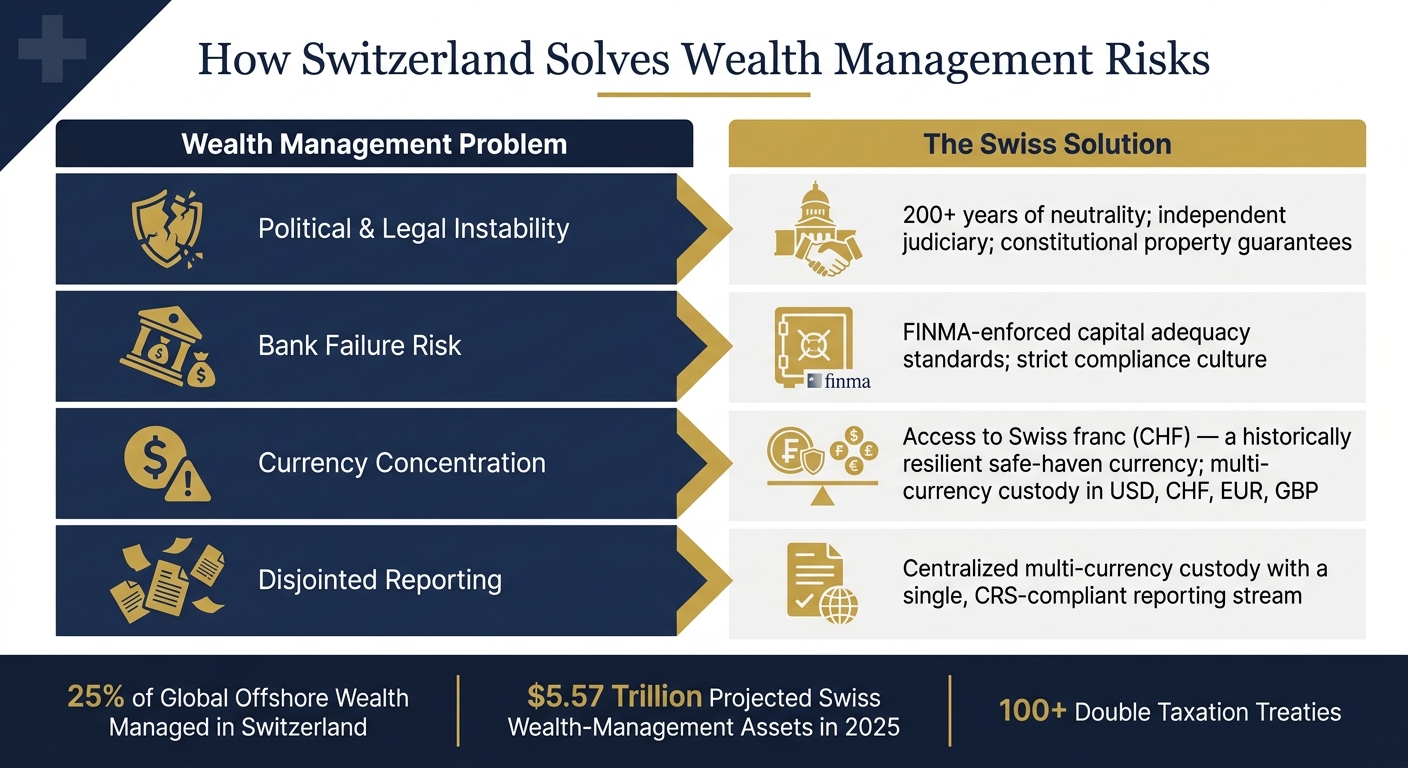
Wealthy families often use Switzerland to cut concentration risk across jurisdiction, currency, and banking relationships. From there, the focus shifts to something more practical: how that stability helps protect wealth in day-to-day life.
Political, legal, and banking instability
The main problem isn’t just one risk. It’s having too much tied to one system.
Wealthy families plan over decades, not quarters. A country can look steady today and still change a lot over a 10-, 20-, or 30-year horizon. Policy swings, political division, and changing government priorities can all create exposure when legal structures, banking relationships, and property rights depend on one jurisdiction staying predictable.
Bank failure is part of that picture too. The 2023 collapse of Credit Suisse was a blunt reminder that even large banks can fail. That event pushed many ultra-high-net-worth families to look harder at jurisdictions known for stability and strict controls, not just secrecy.
Switzerland combines strict capital rules with a disciplined compliance culture.
Currency concentration and assets spread across jurisdictions
When assets sit across many jurisdictions, control can weaken and risk can grow. For U.S.-connected families, heavy concentration in U.S. dollars creates a clear point of exposure. Switzerland helps reduce that by giving clients access to multi-currency custody in USD, CHF, EUR, and other major currencies.
There’s also a second issue: reporting.
Families with businesses, real estate, or investments in several countries often deal with scattered records. Assets held in different jurisdictions and currencies, without one custody structure tying them together, can create documentation gaps. And those gaps can become a problem fast. In disputes, they may lead to account closures or asset freezes.
Switzerland’s centralized multi-currency custody is built to deal with that. It creates one organized reporting stream instead of a patchwork of statements and records.
Comparison table: wealth-management problems and the Swiss solution
The table below shows how common wealth risks line up with Switzerland’s day-to-day response in each area.
| Wealth Management Problem | The Swiss Solution |
|---|---|
| Political/Legal Instability | 200+ years of neutrality; independent judiciary; constitutional property guarantees |
| Bank Failure Risk | FINMA-enforced capital adequacy standards; strict compliance culture |
| Currency Concentration | Access to the Swiss franc (CHF), a historically resilient safe-haven currency |
| Disjointed Reporting | Centralized multi-currency custody with a single, CRS-compliant reporting stream |
These risks help explain why the next step isn’t just custody. It’s the structure used to manage assets every day.
sbb-itb-39d39a6
How Switzerland addresses those problems in practice
Those risks become easier to handle only when a jurisdiction offers working tools, not just stability on paper.
Political stability and long-term legal predictability
This matters most when wealth needs to last across generations. Swiss courts are independent, and property rights are strongly protected. In day-to-day terms, Swiss legal independence helps shield long-range planning from political swings. For families with assets linked to places where policy can change fast, Switzerland can serve as a stable anchor.
That kind of predictability matters a lot in intergenerational planning. Succession structures, family governance frameworks, and liquidity reserves all depend on a legal setting that is less likely to be rewritten halfway through the plan.
That legal predictability is what makes long-horizon mandates and succession planning workable.
Swiss private banks and discretionary portfolio management
Swiss private banks often offer two main setups: discretionary mandates and advisory mandates. With a discretionary mandate, the manager can act within an agreed strategy. With an advisory mandate, the client keeps the final say on each decision. Discretionary management can cut down on reactive moves and help keep the portfolio in line with the plan.
Swiss private banks also support disciplined rebalancing and give access to a broad mix of assets, including listed securities, alternative investments, and precious metals, all within institutional-quality custody. Many Swiss private banks ask for at least $1 million in liquid assets, and fees vary by bank and by mandate.
Once the mandate is in place, Swiss custody turns that plan into day-to-day administration.
Multi-currency custody and global asset administration
Swiss custody accounts can hold assets across currencies and markets under one reporting framework. A client can keep liquidity in Swiss francs (CHF) while also holding exposure to U.S. dollars (USD), euros (EUR), British pounds (GBP), and other currencies at the same time. The CHF works as a safe-haven reserve, backed by Switzerland’s low debt and trade surplus.
Assets held in Switzerland fall under Swiss property law, which creates legal separation from disputes in the asset owner’s home country. One reporting system can track a global asset base, instead of forcing the client to piece together scattered statements from several jurisdictions.
From there, the next question is how ownership is held and who can see it.
Privacy, asset protection, and cross-border family planning
Once custody is in place, the next question is simple: who gets to see what, and how do assets pass from one generation to the next? That’s where Switzerland often stands out for ultra-high-net-worth families. The draw isn’t just investment returns. It’s the mix of stable ownership structures, tight control over access, and a clear path for intergenerational transfer.
Financial confidentiality and client discretion
Swiss financial privacy now means regulated confidentiality, not total secrecy. Switzerland shares information under CRS and FATCA, but it still limits access by competitors, litigants, and family members. In practice, that level of discretion can matter a lot during disputes or in sensitive family and ownership matters.
That kind of confidentiality tends to work best when it sits inside a formal legal structure.
Trusts, foundations, and other asset protection structures
Trusts and foundations are common tools for succession and estate planning. They can help families cut the risk of probate and family disputes. Swiss holding companies (AGs) can also separate reserve capital from operating risk.
But there’s a catch: these structures need real substance. That means:
- a Swiss office
- a qualified local director
- documented decision-making
If that substance isn’t there, the structure can be challenged under Swiss rules and OECD anti-abuse rules.
Which setup makes sense depends on tax residence, citizenship, and reporting duties.
Cross-border planning for U.S.-connected families and entrepreneurs
For U.S. persons, Switzerland works only with careful coordination. FATCA means Swiss banks report account balances and income directly to the IRS. At the same time, Switzerland’s network of more than 100 double taxation treaties, along with multi-currency accounts, can make global income easier to manage across jurisdictions without creating reporting conflicts, as long as legal, tax, and compliance advice are aligned.
For families spread across several countries, or entrepreneurs earning income in more than one jurisdiction, Switzerland can act as a central coordination point for succession and international reporting planning. In that setup, the account, custody, and mandate structure becomes the main decision.
What a Swiss wealth-management setup looks like and when it makes sense
A practical setup: bank, custody account, and discretionary mandate
Once the legal structure is in place, the next step is simple: how does the account run day to day? In Switzerland, that usually comes down to one main relationship – the private bank.
Swiss private banks handle safekeeping, reporting, and trading. From there, the client decides how much control to keep over investment decisions.
| Mandate Type | Who Decides | Best For |
|---|---|---|
| Discretionary | Professional portfolio manager | Clients who want full delegation within agreed limits |
| Advisory | The client | Clients who want to stay involved in decisions |
| Execution-Only | The client entirely | Clients who self-manage and need custody only |
In many cases, the setup also includes lawyers, trustees, and family-office staff. They help with governance and cross-border paperwork.
When Switzerland is the right fit
This model matters most for families that need centralized control, not just a place to park assets.
Switzerland fits families that need centralized control across jurisdictions. That’s the sweet spot. It’s less practical for clients chasing an aggressive, high-growth portfolio.
As asset protection attorney Gideon Alper notes:
"Switzerland’s contribution is banking quality, not legal protection. Standalone asset protection comes from the legal structure (like a trust) that holds the account."
That line gets to the point. Swiss banking supports the setup. The legal structure does the protecting.
Conclusion: Why the super rich choose Switzerland for wealth management
The reasons ultra-high-net-worth individuals use Switzerland for wealth management come down to a few plain facts. Political neutrality for more than 200 years, a private banking system built around discretion and multi-currency flexibility, and custody governed by Swiss law create a base that is hard to match elsewhere.
For global families, the appeal isn’t secrecy. It’s a structure that can hold up across borders and over time.
FAQs
Is Swiss banking still private for U.S. families?
For U.S. families, the days of using Swiss banks to keep assets hidden from the IRS are over. Under FATCA, Swiss banks have to report U.S. account details to the IRS. So Switzerland is no longer a place where Americans can stash money out of sight of tax authorities.
That said, Swiss banking still offers privacy from non-state actors. Swiss banks usually don’t comply with U.S. civil subpoenas. In plain English, that can help shield account details from private litigants, creditors, and competitors.
Do I need a trust to protect assets in Switzerland?
No. You do not need a trust to protect assets in Switzerland.
Trusts can play a role in broader wealth management and succession planning. But in Switzerland, asset protection rests mainly on the country’s stable legal system, strong property rights, and advanced custody infrastructure – not on any single legal structure.
How much money do I need for a Swiss private bank?
A Swiss private bank will usually want to see at least $1,000,000 in liquid assets. Some banks do work with a broader client base, but the specialized custody and personal wealth management they provide usually don’t make much sense below that mark.
There are also ongoing costs to plan for. In many cases, annual fees run from CHF 1,500 to CHF 5,000, with custody fees of 0.1% to 0.5%.
