
If you bank in only one country, one freeze, one closure, or one currency drop can disrupt your cash fast. I’d build this setup around three account roles, at least two currencies, and clear U.S. reporting from day one.
Here’s the short version:
- I’d keep one core account for income, taxes, and cash reserves
- I’d use one multicurrency account for transfers, card spending, and FX conversion
- I’d keep one local account where I live for rent, bills, and local debits
- I’d separate personal money and business money
- I’d keep backup access with at least two cards from different issuers
- I’d track foreign account values because FBAR starts at $10,000 and FATCA can start at $200,000 for some U.S. filers abroad
That’s the whole idea: don’t depend on one bank, one country, or one payment rail.
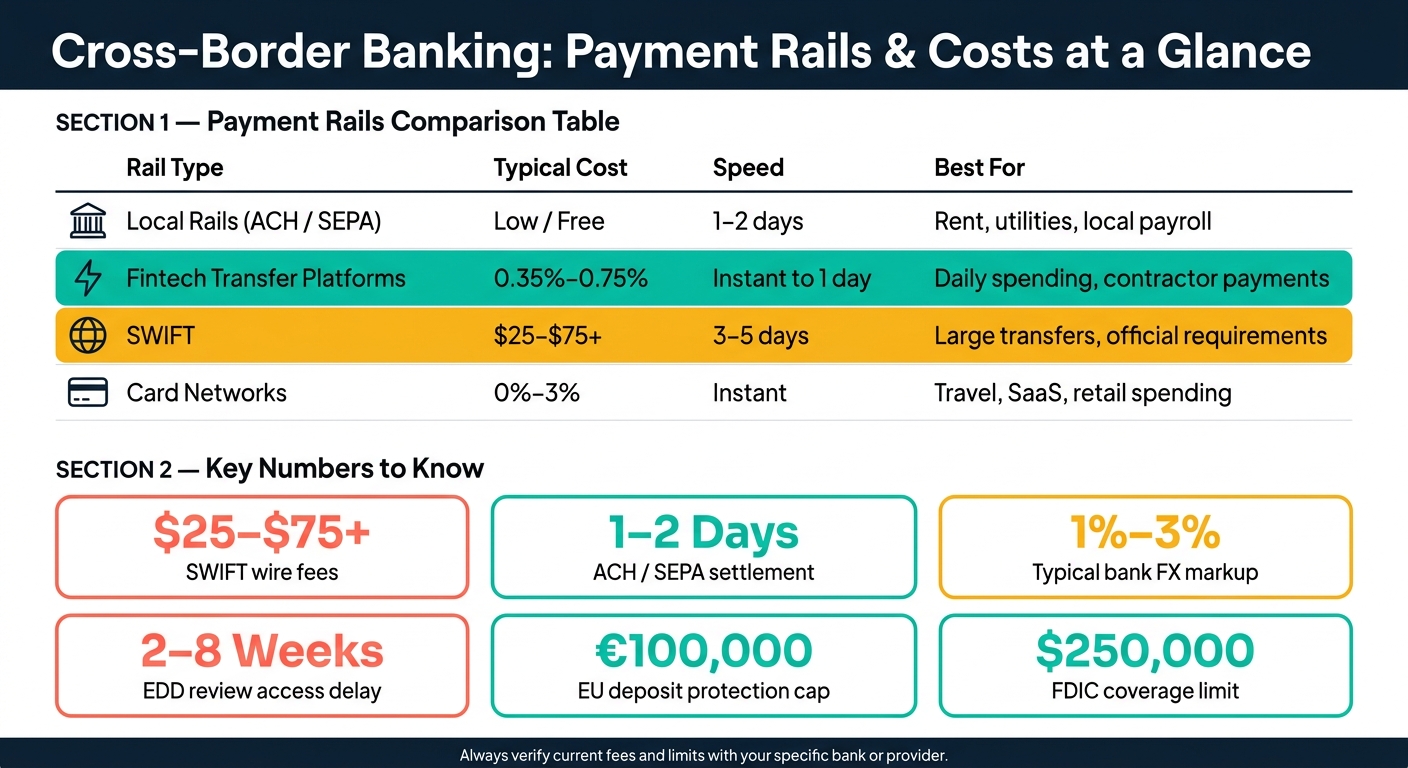
A few numbers stand out:
- ACH and SEPA: often low-cost and usually 1–2 days
- SWIFT: often $25–$75+ and about 3–5 days
- Bank FX markup: often 1%–3%
- EDD reviews: can tie up access for 2–8 weeks
- EU deposit cover: often capped at €100,000
- FDIC cover in the U.S.: up to $250,000
Quick comparison
| Part of the setup | What I’d use it for | What to watch |
|---|---|---|
| Core bank account | Income, taxes, reserves | Country risk, deposit cover, remote access |
| Multicurrency account | FX, transfers, travel spending | Safeguarding is not the same as bank insurance |
| Local residence account | Rent, utilities, local tax debits | Keep 1–2 months of expenses there |
| Business account | Client revenue and company costs | Keep it fully separate from personal spending |
| Backup card/account | Travel and emergency access | Use different issuers and card networks |
My takeaway is simple: the best multi-country banking setup is not the one with the most accounts. It’s the one where each account has one job, your backup path is tested, and your records are ready if a bank asks questions.
That’s what this guide is about.
sbb-itb-39d39a6
Step 1: Choose the right countries and banks
Treat the country and the bank as two separate choices. A steady country doesn’t mean every bank in that country will work for U.S. persons, nonresidents, or people who need to handle everything from afar. You need both screens.
How to evaluate a banking jurisdiction
Start with the basics: political stability, deposit protection, capital controls, sanctions exposure, and whether U.S. persons can bank there at all. Some places look strong on paper but become a headache in practice if outbound wires are limited or if the state has a track record of stepping into private accounts.
Capital controls need close attention. Even a well-known jurisdiction can turn hard to use if FX conversion or outbound transfers get restricted during a crisis. Panama works well for dollar-based banking. Georgia is known for easy nonresident onboarding. Singapore fits people looking for higher-standard, higher-balance banking.
Today, offshore banking is about access, resilience, and currency flexibility, not secrecy.
The table below gives a simple first pass for a multi-country setup:
| Jurisdiction | Stability | U.S. Accessibility | Primary Use Case |
|---|---|---|---|
| Switzerland | Very high | Low for U.S. persons | Long-term reserves |
| Singapore | Very high | Moderate | Wealth management and Asia-linked banking |
| Georgia | Moderate | Very high | Low-barrier entry and operational banking |
| Panama | Moderate | Moderate | International business banking |
| UAE | High | Moderate | Entrepreneurs and zero-tax residency |
Use this as a first filter. Then check the bank’s own onboarding rules and day-to-day limits.
How to evaluate a specific bank or provider
Once you’ve picked a jurisdiction, look at the institution itself. The main questions are simple: Does it accept U.S. persons? Can you open and run the account from afar? What documents does it want?
In most cases, expect to provide:
- Identification
- Proof of address
- Source-of-funds documents
- Tax forms
- Entity documents for business accounts
After that, get into the nuts and bolts. Check the online banking experience, support for international wires, multicurrency features, and fees. FX markups are easy to miss. Old-school bank cards often tack on 1% to 3% in FX markup, while lower-cost transfer services tend to charge less. If you move money across borders often, that spread can eat into your balance fast. Also look at minimum balance rules. Some international banks set them much higher than what you’d see with a U.S. domestic account.
| Provider Type | Protection | FX Cost | Best For |
|---|---|---|---|
| Traditional bank | Deposit insurance up to the local cap | Higher | Core reserves and long-term balances |
| Fintech / e-money | Safeguarding, not bank insurance | Lower | Transfers, travel spending, currency conversion |
| U.S. bank / neobank | U.S. deposit protection | Lower | U.S. operating funds and revenue receipt |
| International / private bank | Strong, varies by country | Moderate | Higher-balance clients needing cross-border access |
"An account you cannot manage remotely defeats the purpose." – Escape Artist
How U.S. persons should interpret foreign bank protections
Foreign deposit insurance is not the same as FDIC coverage. In the EU, bank deposit protection is usually capped at €100,000 per depositor, which is well below the $250,000 FDIC limit many U.S. depositors know.
Fintech and e-money accounts follow a different model. They are not old-style banks, so their protection is not the same as FDIC-style bank insurance. Safeguarding keeps client funds separate from company assets, but it does not offer the same payout certainty as state-backed insurance if the firm becomes insolvent.
That makes the use case pretty clear. These platforms are strong for transfers, currency conversion, and working liquidity. For core reserves and larger balances, a chartered bank with clear deposit insurance is the better fit.
Once you’ve picked the right jurisdictions and banks, the next move is to give each account a specific job.
Step 2: Build a layered account structure across jurisdictions
Give each account one clear job. A multi-country banking setup tends to work best in three layers: a core layer, an operational layer, and a backup layer.
Use one account for each layer. Add another only if it serves a different purpose. The point is simple: each layer should solve one problem only.
Core, operational, and backup accounts
The core layer is your main bank. It handles USD income, tax payments, and reserves.
The operational layer handles cross-border payments and currency conversion. This is where a multicurrency account or payment platform fits. It’s built for international payments, FX conversion, and transfers between countries. Many of these platforms are e-money institutions, not full banks, so they’re better for moving money and day-to-day spending than for holding long-term reserves.
The backup layer is a local account in the country where you physically live. It covers rent, utilities, and local tax direct debits. It also helps with residency support and local banking proof.
Real backup comes from different functions, not from piling up more accounts. Three logins that all rely on the same transfer rail aren’t much of a backup at all.
Keep personal and business money separate so each layer stays clean and easier to audit.
Personal accounts, business accounts, and entity-based banking
Personal and business flows should stay in separate accounts.
If you run a U.S. LLC, that company should have its own business account in the core layer. Revenue should come in there, and business expenses should go out from there. Personal spending should sit in the operational layer or the local layer instead.
That separation lowers the risk of account closure, tax mix-ups, and audit friction.
Currency allocation inside the banking portfolio
Separate spending balances from reserve balances.
Keep spending money in the currency you actually use. Keep reserves in the currency you want to hold. The goal here isn’t yield. It’s spending access and protection for reserves.
Next, add payment tools and access rules that keep each layer usable across borders.
Step 3: Add payment tools, redundancy, and operating rules
Once each account has a clear job, the next step is making sure money can move fast and keep moving if one route goes down. If a country, bank, or payment rail becomes unavailable, you don’t want the whole setup to stall. The aim is simple: send each payment through the lowest-cost rail that still fits the job.
Multicurrency accounts and cross-border payment rails
Not every transfer should go through SWIFT. The rail should match the transfer’s size, speed, and destination.
Local rails like ACH in the U.S. and SEPA in Europe are often low-cost or free, and they usually settle in 1-2 days. That makes them a good fit for rent, utilities, and other recurring local bills. SWIFT is slower and costs more, with combined sending and receiving fees often landing around $25 to $75, so it makes more sense for larger transfers or cases where a bank specifically asks for it. For contractor payouts and currency conversion, multicurrency platforms often beat bank FX spreads, which can add a 1.5% to 3% markup on wire transfers.
| Payment Rail | Typical Cost | Speed | Best For |
|---|---|---|---|
| Local Rails (ACH, SEPA) | Low/Free | 1-2 days | Rent, utilities, local payroll |
| Fintech transfer platforms | 0.35%-0.75% | Instant to 1 day | Daily spending, contractor payments |
| SWIFT | $25-$75+ | 3-5 days | Large transfers, official requirements |
| Card Networks | 0-3% | Instant | Travel, SaaS, retail spending |
One small habit can save money fast: decline Dynamic Currency Conversion at ATMs and payment terminals. Pay in the local currency instead. That lets your bank or fintech do the conversion, which is usually cheaper than the terminal’s built-in markup.
Once these rails are set up, the next job is making sure there’s always a backup path.
Backup access plans for travel, relocation, and emergencies
Redundancy is about separating functions, not opening duplicate accounts. If one account gets frozen, it can stop incoming revenue, contractor payouts, and tax payments all at once if everything runs through that single point. A backup account only counts if it can work without leaning on the same bank, card network, or transfer route as your main one.
A simple setup goes a long way:
- Carry at least two cards on different networks, ideally one Visa and one Mastercard, issued by different institutions.
- For processors like Stripe, pre-verify a second bank account before there’s a problem, so you don’t lose time during a freeze.
- Keep one to two months of expenses in your local residence account as a spending buffer, so rent and utilities stay covered if your multicurrency platform goes into a compliance review.
- Move small recurring transfers between account layers to keep backup accounts active and to test that the transfer paths still work.
That last point matters more than it seems. Banks may close inactive accounts after just a few months of no activity. A backup path that hasn’t been tested can fail right when you need it most.
Write these fallback steps down. When stress hits, you do not want to rely on memory.
Simple rules for managing multiple accounts
Name each account by function, not by bank. Labels like "USD Revenue", "FX Bridge," and "Local Residence" tell you what each account is for at a glance. A plain one-page account map should list the purpose of each account, the rail it uses, and what role it plays if another layer fails. If something breaks, that page becomes your cheat sheet.
Review fees, terms, residency rules, and access limits on a regular basis. An account that worked six months ago may no longer fit the job today. If one layer stops doing what it was meant to do, swap out the function instead of assuming the number of accounts alone will protect you.
The final step is keeping the portfolio compliant and monitored.
Step 4: Manage compliance, monitor risk, and review the portfolio
A multi-country banking setup only works if you stay on top of reporting, records, and risk checks. The structure matters, but the upkeep matters just as much.
U.S. reporting and documentation discipline
For U.S. taxpayers, the two big filings are FBAR and FATCA. You can’t treat these as last-minute tasks. Track thresholds all year and file on time.
FBAR (FinCEN Form 114) is required if the combined value of all foreign financial accounts goes over $10,000 at any point during the calendar year. That includes bank accounts, investment accounts, and multicurrency fintech balances.
FATCA (IRS Form 8938) covers specified foreign financial assets and, for single filers living abroad, usually starts at $200,000 at year-end or $300,000 at any point during the year.
The penalties are steep. Non-willful FBAR violations can reach $10,000 per violation. Willful violations can reach $100,000 per violation or 50% of the account balance.
A simple habit helps here: track month-end balances and yearly peak values in U.S. dollars.
Each account should also have a clean paper trail. That means clear ownership records, source-of-funds documents, and a stated business purpose. For business accounts, authorities also want to see real management and a legitimate operating purpose, not just a registered address.
Once your records are in order, the next problem is access risk.
How to assess sanctions, closure, and disruption risk
Good paperwork doesn’t guarantee smooth banking. Banks can still de-risk accounts or freeze access with little warning.
Non-resident account holders face higher compliance review frequency and longer resolution timelines than domestic customers. If you get pulled into an Enhanced Due Diligence (EDD) review, access can be tied up for two to eight weeks.
That’s why the layered setup from Steps 2 and 3 matters. If one layer fails, the others should still cover:
- revenue collection
- operating expenses
- tax payments
Pay attention to early warning signs. If a bank starts asking for more and more documents, or if a country comes under new sanctions or political pressure, move funds before a freeze hits. Waiting can leave you stuck.
A spread-out setup lowers the odds that one freeze, policy change, or de-risking event cuts off all liquidity. Over 100 countries now take part in the Common Reporting Standard (CRS), which automatically shares financial account data with the account holder’s country of tax residence.
Conclusion: Sample portfolio setups and key rules to follow
The same basic framework looks different depending on how you live and work.
A U.S. expat keeps a U.S. anchor account with a provider that clearly supports foreign addresses, adds a multicurrency account as a bridge for cross-border transfers, and uses a local bank account for day-to-day spending.
A digital nomad uses the same three-layer setup, but leans more on the multicurrency layer for daily spending and batches bigger conversions to cut FX costs.
A globally mobile entrepreneur adds an entity-based account in a stable jurisdiction for client invoicing and operating expenses, while keeping personal and business banking fully separate.
The core rules are pretty simple: don’t rely on one country or one bank, separate personal and business banking from day one, keep liquidity in at least two currencies, maintain a tested backup access path, and review account limits, residency status, and filing thresholds at least once a year.
FAQs
How much money should I keep in each account layer?
Use each account layer for what it’s meant to do, not by sticking to some fixed percentage.
- Your local residence account should handle your month-to-month life: rent, utilities, groceries, and other day-to-day costs.
- Your multi-currency transactional layer should hold a working balance for money coming in and payments going out.
- Your offshore savings or custody accounts should keep reserves and long-term capital separate from day-to-day operating risk.
What should I do if a foreign bank suddenly freezes my account?
Respond to any request for information or updated compliance documents right away. Account freezes often show up during enhanced due diligence or periodic reviews, and even a short delay can push the bank toward permanent closure.
Keep digital copies of your passport, proof of address, and recent bank statements ready to go. That way, if the bank asks for them, you’re not scrambling at the last minute.
If the bank requires an in-person branch visit, you may have to travel there. It’s not ideal, but it does happen.
It also helps to keep backup accounts in other jurisdictions. If one account gets frozen, you’ll still have a way to move money and handle day-to-day banking without everything grinding to a halt.
Do I need to report multicurrency and local foreign accounts to the IRS?
Yes. In most cases, U.S. persons must report foreign financial accounts to the IRS.
Here’s the key threshold: if the combined value of all foreign financial accounts goes over $10,000 at any point during the calendar year, you must file FinCEN Form 114 (FBAR).
You may also need to file Form 8938 under FATCA, depending on the total value of your specified foreign financial assets.
