
If you hold a financial account outside your tax home, CRS may already be sending your data to a tax authority. As of 2026, more than 126 countries use CRS to swap account data each year. In plain English: your bank, broker, insurer, or some trust-related setup may report your name, tax residence, TIN, account balance, and some income data without you filing a CRS form yourself.
Here’s the short answer on whether CRS may apply to you:
- Yes, likely if you have a foreign bank, brokerage, fund, or cash-value insurance account
- Yes, often if you use a foreign company, trust, or foundation that holds a financial account
- Yes, sometimes even with a U.S. tie if you live abroad and are tax resident in a CRS country
- No, not usually for direct ownership of physical assets alone, like real estate held outside a financial account
A simple way I’d check it:
- Where am I tax resident?
- Is my account in another country?
- Is the account held by me, a company, or a trust?
- Do my bank records, address, phone, and TIN all match my tax filings?
If those records do not line up, CRS risk goes up fast. And if you use a passive company or trust, the bank may look through the structure and report the people behind it.
| Topic | Short answer |
|---|---|
| What CRS is | A global tax reporting system run through local tax authorities |
| What triggers it | Tax residency, not citizenship alone |
| Who reports | Banks, brokers, funds, some insurers, and some trust-related entities |
| What gets shared | Name, address, TIN, date of birth, account number, balance, and some income data |
| Who gets flagged most | Expats, digital nomads, offshore company owners, trust parties, and people with mixed residency records |
| How it differs from FATCA | CRS is multi-country; FATCA is tied to U.S. person rules |
So if you have cross-border money, the main question is not “Did I file CRS?” It’s “What is my financial institution already reporting about me?”
How CRS works: the reporting process, main rules, and how it differs from FATCA
How CRS reporting moves from a bank to a tax authority
The CRS reporting chain usually moves in four stages.
When you open an account with a bank, broker, or insurer in a participating jurisdiction, you fill out a self-certification form. That form states your tax residency, address, and Taxpayer Identification Number (TIN). If the information is false, local law can impose penalties.
Next, the institution checks for red flags. It looks for signs that don’t match what you stated on the form, like:
- a foreign mailing address
- a phone number tied to another country
- standing payment instructions to an overseas account
If those signs show up, the account gets flagged for review. That review helps decide which accounts are reportable and what data the institution must send.
Then the institution reports the prior year’s data to its local tax authority. Later that same year, the tax authority exchanges that data with foreign counterparts. After that, tax authorities compare incoming CRS data with domestic tax returns.
The next section shows which institutions, accounts, and holders fall within CRS.
CRS vs. FATCA: tax residency vs. U.S. person status
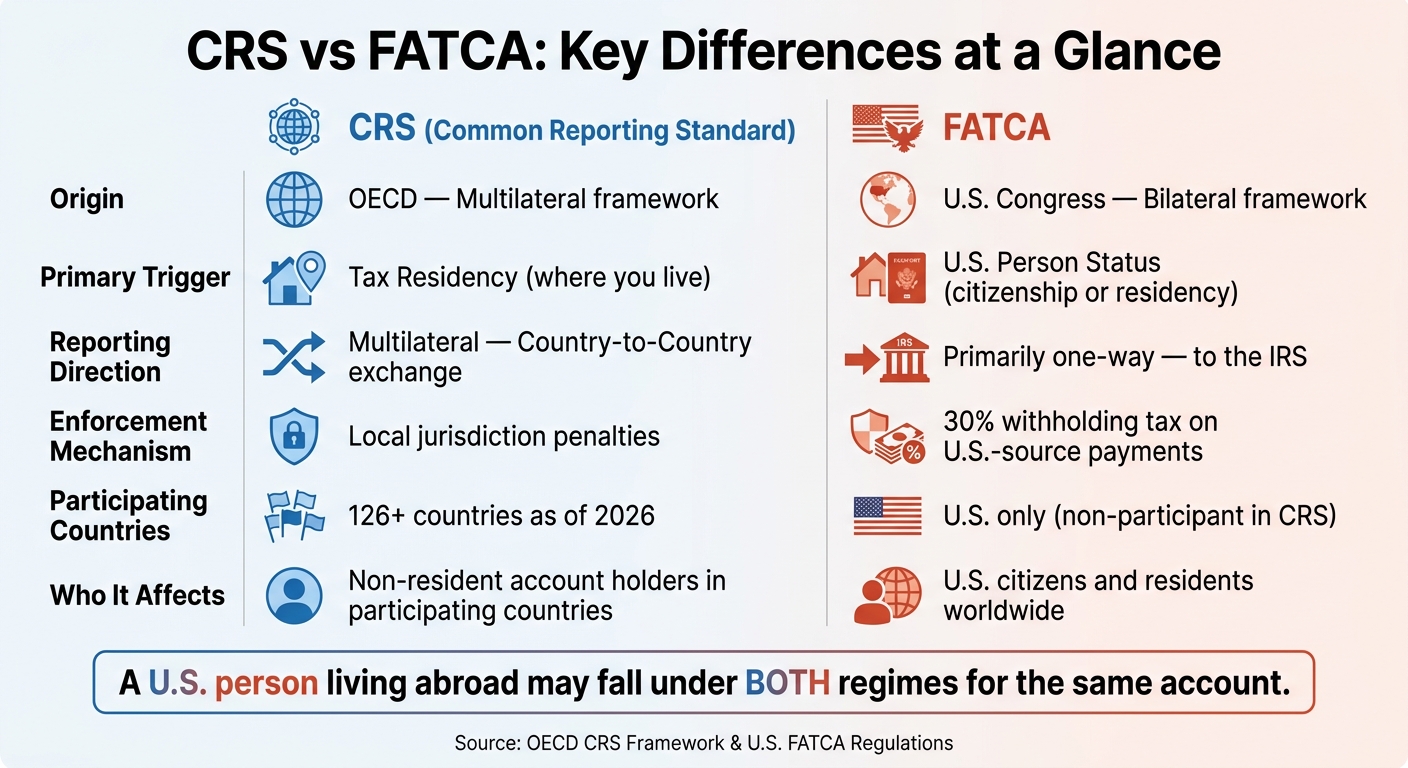
CRS and FATCA can look similar at first glance. But they’re built on different triggers.
CRS is based on tax residency. If you’re a tax resident in a participating country and hold accounts in another country, those accounts may be reportable under CRS.
FATCA works differently. It is based on U.S. person status, so it applies to U.S. citizens and residents no matter where they live or bank. A foreign bank that fails to comply with FATCA can face a 30% withholding tax on its U.S.-source payments.
CRS is multilateral. FATCA is mostly a one-way reporting system to the IRS. The United States is the best-known non-participant in CRS and relies instead on its bilateral FATCA regime.
| Feature | CRS | FATCA |
|---|---|---|
| Origin | OECD (Multilateral) | U.S. Congress (Bilateral) |
| Primary Trigger | Tax Residency | U.S. Person Status (Citizenship/Residency) |
| Reporting Direction | Multilateral (Country-to-Country) | Primarily one-way (to the IRS) |
| Enforcement | Local jurisdiction penalties | 30% withholding on U.S.-source payments |
A U.S. person who is also a tax resident abroad may end up under both regimes for the same account. That split is what decides whether a foreign account is reported under CRS, FATCA, or both.
sbb-itb-39d39a6
Who reports under CRS and what information is usually shared
Which institutions and account types are usually covered
Once CRS flags an account as reportable, the next step is figuring out who has to report it and what kind of account falls within the rules.
CRS says four types of financial institutions must report reportable accounts. In plain English, the main ones are banks, brokerages, funds, and some insurance companies.
More specifically, these include:
- Depository institutions that accept deposits
- Custodial institutions that hold securities and other financial assets for clients
- Investment entities such as hedge funds, private equity funds, and certain professionally managed trusts or investment platforms
- Specified insurance companies that issue cash-value life insurance or annuities
If your account sits with one of these institutions, CRS may apply. That often means:
- bank accounts
- brokerage accounts
- investment fund holdings
- cash-value insurance products
The key point is simple: CRS usually covers financial accounts, not direct ownership of physical assets.
What information is reported for individuals, entities, and controlling persons
For an individual account holder, CRS usually reports three groups of data: identity, account details, and income and balance.
Identity data usually includes your full legal name, residence address, tax residency jurisdictions, TIN, and date of birth. Account details usually include the account number and the name of the reporting institution. Income and balance data usually includes the year-end account balance plus key income amounts, such as gross interest, dividends, and gross proceeds from sales or redemptions.
Entity accounts work a bit differently because CRS can look through the legal structure to the people behind it. If a company, trust, or foundation is passive, CRS reports the controlling people behind it.
For example, a trust settlor can still be reported even when the account is held in the trust’s name.
Next, check whether your own accounts, company, trust, or foundation fall into one of these reporting categories.
How to tell if CRS applies to you or your structure
Use these checks to see if CRS reportable accounts or structures apply to you. The fastest way to gauge CRS exposure is to look at your tax residence, account type, and ownership setup. If you’re tax resident in more than one participating jurisdiction, reportable accounts may be shared with each of them.
A simple check for accounts, companies, trusts, and foundations
Start with three basic checks:
- Do you have a foreign financial account?
- Do you own a foreign company that holds a reportable financial account?
- Do you have a role in a foreign trust as settlor, trustee, protector, or beneficiary?
Banks then test those answers against account data. They compare self-certifications with CRS indicia. These include a foreign residential or mailing address, a foreign phone number, standing instructions to transfer funds abroad, foreign signatory authority, or an in-care-of or hold-mail address in another jurisdiction. Just one of these can trigger a review.
For entities, the big test is whether the entity is active or passive. If it’s passive, the bank looks through the structure to identify and report the controlling persons behind it, not just the entity itself. A holding company with no operating business is usually treated as a passive NFE.
Comparison table: how CRS applies to common account and entity setups
The examples below show how CRS handles the most common setups.
| Account/Entity Setup | Classification | Who Is Reportable? | Information Usually Reported |
|---|---|---|---|
| Personal foreign bank account | Individual account | The individual account holder | Name, address, TIN, date of birth, account balance, gross interest and income |
| Foreign operating company | Active NFE | The entity itself (owners are typically not reported) | Entity name, address, TIN, and account balance |
| Foreign holding company | Passive NFE | The entity and all controlling persons with 25%+ ownership | Entity details plus name, address, TIN, and date of birth for each controlling person |
| Foreign trust | Investment entity / Passive NFE | Settlors, trustees, protectors, and beneficiaries | Identifying details for all parties plus account balance and distributions |
For pre-existing entity accounts, the review threshold is $250,000, though banks may use stricter internal limits. Individual accounts have no threshold.
Who is most likely to be affected and what to do next
Profiles most often exposed to CRS reporting
Once the CRS rules make sense, the next step is figuring out who tends to get flagged.
In practice, CRS often affects expats, digital nomads, second-residency holders, and people who own offshore structures when residency records don’t line up. An expat with accounts in a former home country can run into trouble. So can a digital nomad who ends up reportable in more than one jurisdiction because different records point to different tax homes. The same goes for second-residency holders who open accounts linked to a new jurisdiction. The pattern is the same each time: conflicting residency data can trigger reporting.
Owners of offshore companies also get pulled in when a passive entity leads to look-through reporting to the controlling persons.
Trust and foundation participants face similar exposure. Under CRS, reporting can extend to settlors, trustees, protectors, and beneficiaries.
One cross-border setup needs extra care: a U.S. LLC that holds a foreign account. The U.S. does not take part in CRS, so a U.S. bank account held by a U.S. LLC is generally outside CRS. But if that same LLC holds a foreign account, the foreign bank may treat it as a Passive NFE and look through to the owner’s tax residency.
Risk matrix and conclusion: warning signs and next steps
These profiles become reportable for a few repeat reasons: residency mismatches, passive structures, and ownership that isn’t clearly documented.
The table below shows the usual CRS classification for each profile, along with the warning signs that tend to spark a review.
| Profile Type | Likely CRS Classification | Common Red Flags |
|---|---|---|
| Long-term expat | Individual Account Holder | Home-country phone or address on file; missing local TIN |
| Offshore trust beneficiary | Controlling Person (Passive NFE) | Undisclosed trust interest in home-country filings; distributions that do not match tax filings |
| Passive holding company owner | Controlling Person (Passive NFE) | Passive entity marked as "Active" on self-certification |
| Digital nomad | Individual Account Holder | Conflicting self-certifications at different banks; multiple indicia of residency |
| Non-U.S. resident using a U.S. LLC + foreign account | Controlling Person (via look-through) | Foreign bank treats the LLC as a Passive NFE; mismatched self-certification |
The practical test is pretty simple: if your residency records, entity classification, or TINs don’t match across institutions, your CRS risk goes up.
A few steps can lower that risk right away:
- Review every self-certification on file with your banks. Make sure your tax residency and TIN match your actual filings.
- If you moved to a low-tax jurisdiction such as the UAE or Cyprus, get a Tax Residency Certificate to support that move.
- Check whether any offshore entity you own or control is classified as Active or Passive, since misclassification is a common compliance issue.
FAQs
Does CRS apply if I live in one country but bank in another?
Yes, CRS will often apply if you live in one country and keep your bank account in another.
That’s because CRS works on tax residency, not just where the account is located. So when a financial institution reviews an account, it looks at where the account holder is tax resident.
If your bank is in a CRS-participating jurisdiction, it may ask for your tax residency details. It can then report your account information to its local tax authority, which may share that information with the tax authority in your country of tax residence.
Can a company or trust hide you from CRS reporting?
No. A company or trust can’t hide you from CRS reporting. CRS is built to stop that by requiring financial institutions to identify the people behind legal entities.
If a company or trust holds an account, the institution must identify its controlling persons and report them along with the entity. That can include beneficial owners, settlors, protectors, or beneficiaries.
What should I do if my bank records don’t match my tax residency?
Tell your financial institution right away if its records don’t match your actual tax residency. And when it asks, provide your correct tax identification number and tax residency details.
CRS reporting is based on tax residency, not citizenship or visa status. So if those details don’t line up, your account may be reported the wrong way, which can draw attention from tax authorities.
If you spot past errors, speak with a qualified tax professional about voluntary disclosure options.
