
If I had to sum it up in one line: Singapore and Switzerland lead for core storage, New Zealand works as a far-off backup, Canada is the easiest for many Americans, Dubai fits regional access, Liechtenstein leans private, and Hong Kong is more about trading than deep storage.
If I were comparing offshore bullion storage in 2026, I’d focus on five things first:
- legal stability
- property rights
- tax treatment
- reporting risk for U.S. persons
- how easy it is to access or move the metal
This article covers 7 jurisdictions:
- Singapore
- Switzerland
- Liechtenstein
- United Arab Emirates
- New Zealand
- Canada
- Hong Kong
A few points stand out right away:
- Singapore is a top all-around pick for many people.
- Switzerland still has deep vaulting and refining depth.
- Liechtenstein is a lower-profile option with a strong legal setup.
- Dubai is built for movement and regional access.
- New Zealand is far away, which is both a plus and a drawback.
- Canada is simple for U.S. investors, but it gives less legal distance.
- Hong Kong has trading appeal, but long-term policy risk is harder to ignore.
And one more point matters a lot: the vault itself is only part of the story. I’d care just as much about who holds title, whether storage is allocated and segregated, what the insurance covers, and whether the setup may trigger FBAR, FATCA, or other U.S. reporting.
Quick Comparison
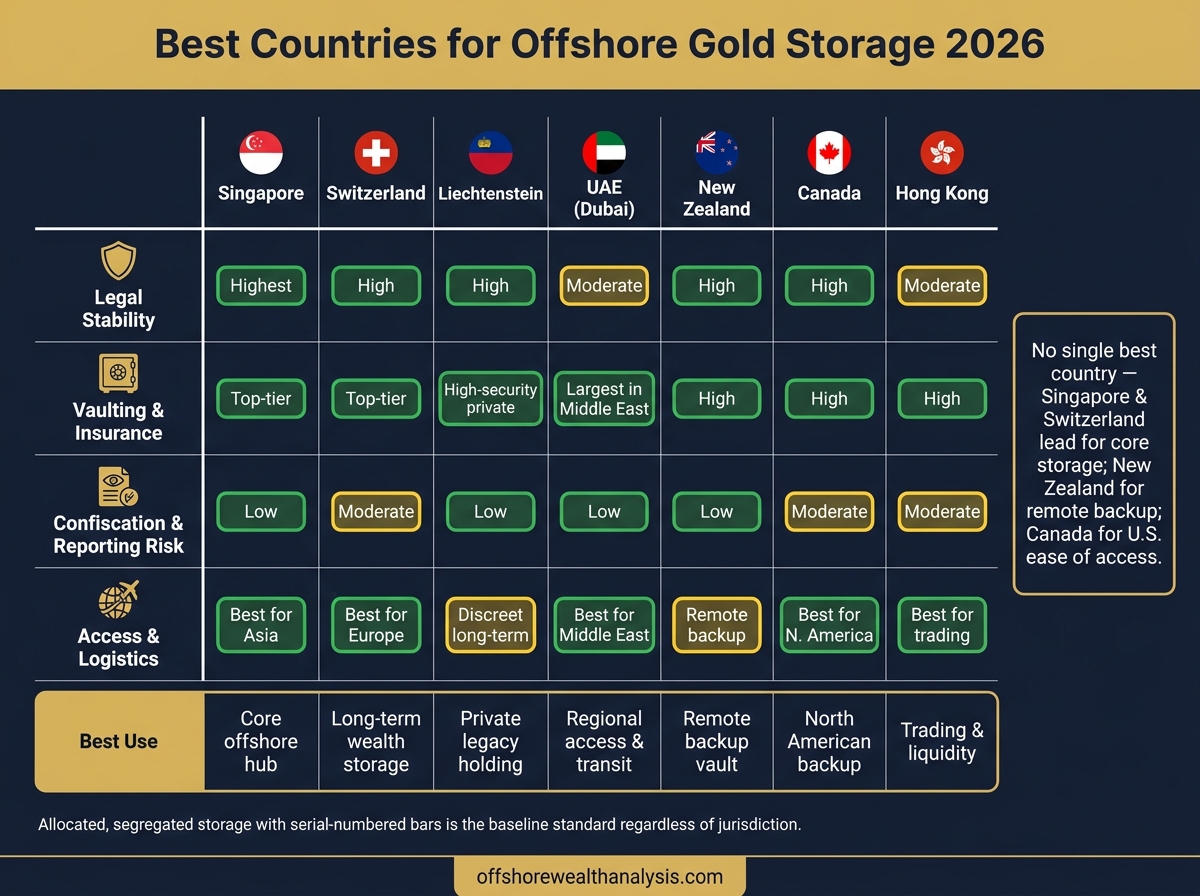
| Country | Best Use | Main Upside | Main Trade-Off |
|---|---|---|---|
| Singapore | Core offshore storage | Low tax drag, common-law system, top vaulting | U.S. reporting still needs review |
| Switzerland | Long-term wealth storage | Deep refining and vault network | More reporting friction in some setups |
| Liechtenstein | Private long-term holding | Low profile, strong ownership focus | Smaller market, fewer vault choices |
| UAE | Regional access and transit | Zero-rated VAT on qualifying bullion, strong logistics | Shorter legal track record |
| New Zealand | Remote backup vault | Distance from major conflict zones | Harder and slower to reach |
| Canada | North American backup | Easy access for U.S. investors | Less jurisdictional separation from the U.S. |
| Hong Kong | Trading and liquidity | Fast market access, no VAT on gold | Higher long-range policy risk |
My short take: there is no single “best” country for everyone. If I wanted one main hub, I’d start with Singapore or Switzerland. If I wanted a backup outside the main lanes, I’d look at New Zealand. If I wanted easier access from the U.S., I’d keep Canada on the list. If I cared more about trading flow than deep storage, I’d look harder at Hong Kong or Dubai.
That’s the core idea of the article: pick the jurisdiction first, then pick the storage structure with care.
sbb-itb-39d39a6
1. Singapore
Singapore sits near the top for offshore bullion storage in 2026 for a simple reason: it brings together common-law protections, low tax drag, and high-end vaulting in a stable jurisdiction. And that standing isn’t just about sleek facilities or polished brochures. It’s built on the legal and operating setup behind the vault doors.
Legal Stability
Singapore’s legal system is based on English common law, with strong property rights, low corruption, and a neutral foreign-policy stance. That mix keeps drawing institutions, including central banks. In fact, the Monetary Authority of Singapore (MAS) plans to roll out official gold-vaulting services for foreign central banks by October 2026, which says a lot about trust in the jurisdiction. For many investors, that matters more than vault size or marketing language.
Vaulting & Insurance
That legal backdrop helps support a mature vaulting market. The best-known site is Le Freeport, a 30,000-square-meter high-security complex next to Changi Airport. Singapore also has vaulting facilities in the Central Business District.
In most cases, storage is allocated. That means you own specific bars rather than a pooled paper claim. Insurance is often set up through well-known providers, including Lloyd’s of London, and may cover theft, fire, loss, and in-transit movement. Annual storage fees for allocated bullion in Singapore usually fall between 0.5% and 1.0% of the metal’s value.
Confiscation & Reporting Risk
Singapore has no capital gains tax and no estate tax. It also removed GST on Investment Precious Metals in 2012, though gold must be at least 99.5% pure to qualify. Private vault operators usually aren’t classified as financial institutions, so physical holdings stored there often aren’t directly subject to automatic CRS or FATCA reporting. That said, U.S. investors still have domestic reporting duties, even when the metal is stored offshore.
Access & Logistics
For most investors, the last piece is access: how easy is it to move or sell the metal when needed? Singapore’s location puts it close to major shipping and trading routes, and qualifying bullion can move duty-free. Most professional vaults also support physical withdrawal or insured shipping.
2. Switzerland
If Singapore is the modern benchmark, Switzerland is the old-school one. It sits outside the EU and EEA, which helps shield it from EU policy changes and gives investors another layer of legal protection.
Legal Stability
Switzerland’s direct democracy and strong property rights help keep the legal system steady and predictable. Add its long record of neutrality, and you get a jurisdiction that has held up well for asset protection. That’s a big reason it keeps drawing institutional gold holders.
Vaulting & Insurance
Switzerland is one of the main centers for gold refining. It’s home to four of the world’s largest LBMA-accredited refineries: Metalor Technologies, Argor-Heraeus, Valcambi, and PAMP. For investors storing metal nearby, that matters. Recasting is simple and efficient.
Many private vaults operate outside the banking system. Security often includes biometrics, armed guards, and seismic sensors. Insurance usually covers theft, fire, and damage. Annual storage fees tend to run from 0.25% to 1.00% of the metal’s value.
Confiscation & Reporting Risk
Switzerland’s neutrality is a strong hedge against government seizure risk. Investment gold is VAT-exempt under the Swiss VAT Act. Silver, platinum, and palladium get similar tax treatment in the right setup: Switzerland has seven bonded warehouses, including sites in Embrach, Geneva, and Basel, where those metals can be stored VAT-free as long as they do not enter the domestic market.
For U.S. investors, reporting hinges on how the metal is held. Gold you hold physically and directly is generally not reportable to the IRS. Gold held through a custodian or in a commingled account is usually reportable as a foreign account. Private, non-bank vaults are often outside automatic CRS or FATCA reporting, though U.S. tax duties still apply.
Access & Logistics
Being close to major refineries helps keep liquidity deep and recasting simple. Most professional vaults also support withdrawal, insured shipping, and serial-number audits. The safer setup is allocated, segregated storage, where specific bars are registered in your name.
That mix of legal stability, refining capacity, and vault infrastructure keeps Switzerland near the top, though smaller jurisdictions may suit investors looking for a different set of trade-offs.
3. Liechtenstein
Liechtenstein is a small constitutional monarchy tucked between Switzerland and Austria. On paper, it looks quiet. In practice, it offers unusually strong offshore storage protection. It sits outside the EU, but inside the EEA and Schengen, which helps with access without taking on full EU exposure.
For investors who want Swiss-style legal protection in a smaller, less visible jurisdiction, Liechtenstein can be a good match.
Legal Stability
Liechtenstein has no emergency legislation, which puts clear limits on ad hoc expropriation during a crisis. It has also posted steady budget surpluses, which lowers the odds of pressure for crisis-era state action. That legal setup fits well with hardened private vault infrastructure.
Vaulting & Insurance
Independent private vaults are common in Liechtenstein, including former military bunkers. That matters because it keeps custody separate from bank risk. Insurance is usually placed with major international carriers, including Lloyd’s of London, and commonly covers theft and fire.
Annual storage fees usually fall between 0.1% and 1.0% of the stored value. Most professional vaults also set a minimum holding. In many cases, that starts around $5,000 to $10,000 to make storage cost-effective, while some premium facilities may require $50,000 or more.
That setup tends to matter most for investors who care most about ownership structure and reporting rules.
Confiscation & Reporting Risk
Investment gold is VAT-exempt in Liechtenstein. The country also operates duty-free warehouses where precious metals can be stored without automatic tax-reporting triggers. Physical gold held in private, non-bank vaults is often not directly subject to CRS or FATCA automatic reporting. That said, U.S. investors still have to meet their own home-country tax duties.
Access & Logistics
Schengen access and Swiss logistics links make transfers fairly efficient. For some investors, Liechtenstein works best as a Swiss alternative without the same level of attention. If you go this route, use allocated, segregated storage with serial-numbered bars to help protect title if the provider fails.
4. United Arab Emirates
Compared with Singapore or Switzerland, the UAE gives up some old-world legal standing in exchange for better regional access and modern vault infrastructure. If convenience matters more to you than legacy-name jurisdictions, the UAE stands out. It scores well for access and vault quality, though it still trails Singapore and Switzerland when it comes to long-term legal predictability.
Legal Stability
The DMCC Free Zone allows 100% foreign ownership of assets. Dubai also offers solid rule of law and investor-friendly regulation. That said, it doesn’t have the same long track record as Singapore or Switzerland.
Vaulting & Insurance
On the storage side, the main facility is the DMCC Vault in Almas Tower, operated by Brink’s Global Services. It is the largest non-sovereign vault in the Middle East. Dubai also has added high-security sites inside the Dubai Airport Free Zone (DAFZ), including vaults run by Transguard and G4S.
Most well-known Dubai vaults include full-value insurance in the storage fee. That coverage is usually underwritten by Lloyd’s of London or major commercial carriers. Annual storage fees for institutional-size positions tend to run from 0.4% to 0.7% of the metal’s value.
Before signing anything, check the policy details closely. Some coverage excludes war risk or government confiscation, and you may need separate riders for that. It’s also smart to use allocated, segregated storage with serial-numbered bars, backed by annual independent audits, photos, and serial-number checks.
Confiscation & Reporting Risk
The tax side is favorable, but the legal setup still matters. Investment-grade gold at 99% purity or higher is zero-rated for VAT. Still, storing metal offshore in the UAE does not remove your home-country tax or reporting duties. In some cases, the custody structure itself can trigger disclosure rules.
Access & Logistics
Dubai’s location makes international transfers efficient. It’s a strong fit for movement into Gulf and Asian markets. For U.S. investors, though, there’s more distance and a bit more friction around wiring and shipping than in closer jurisdictions.
The UAE works best for investors who want proximity to regional markets, smooth logistics, and institutional-grade storage, even if they place less weight on headline legal prestige or the long legal track record found in Singapore or Switzerland.
5. New Zealand
New Zealand is a remote diversification jurisdiction, not a major trading hub. Its appeal is pretty simple: stability, privacy, and distance from major geopolitical trouble spots. The real test, though, is whether that distance comes with clean ownership and clear title.
Legal Stability
New Zealand runs on a British-based common law system, has a stable parliamentary democracy, and has a strong record of respecting private property rights. It also has no modern history of gold confiscation. That sounds good on paper, but it only matters if the storage setup keeps legal title clear and direct.
Vaulting & Insurance
The standout option is New Zealand Vault, which has operated since 1931 and has locations in Wellington and Auckland, outside the banking system. Top-tier vaults provide full replacement-value insurance for risks like theft and fire.
Annual storage fees at established providers are about:
- 0.59% for gold
- 0.88% for silver and platinum
Allocated and segregated storage is the standard if you want direct legal ownership of specific bars.
Confiscation & Reporting Risk
New Zealand does not charge GST, VAT, capital gains tax, or import/export duties on bullion. For U.S. persons, private vault boxes with sole-key control are usually outside FBAR and FATCA reporting.
There is one point privacy-minded investors often pause on: New Zealand is part of the Five Eyes intelligence-sharing program. That doesn’t change ownership rules, but it can matter if privacy is high on your list.
Access & Logistics
Here’s the trade-off: distance. New Zealand’s remoteness means that physical retrieval or an in-person audit often requires long-haul travel or insured international shipping. If you want fast access to your metal, that’s a clear downside.
In practice, New Zealand makes more sense for long-term storage than for active trading. Its main weakness is simple and hard to get around: retrieval takes time.
6. Canada
Canada offers a strong rule of law and steady politics, but there’s a catch for U.S. investors: its close relationship with the United States means less legal distance. That trade-off matters if you want simple access to your gold without giving up the point of using a foreign jurisdiction in the first place. So Canada is dependable, but it’s not the most insulated offshore option.
Legal Stability
Canada’s banking system is widely regarded as stable. The issue isn’t bank strength. It’s proximity. The U.S. and Canada work closely together, so U.S. persons who store gold in Canada get less jurisdictional separation than they would in Singapore or Switzerland.
Vaulting & Insurance
Canada’s main draw is simplicity. Private, non-bank vaulting is available through established providers such as Brinks, IDS, SWP, and Loomis, with major hubs in Toronto and Vancouver.
Insurance is usually bundled into the annual storage fee and underwritten through Lloyd’s of London. Annual fees for allocated, segregated storage usually fall between 0.4% and 1.0% of the metal’s market value.
Confiscation & Reporting Risk
Canada has no history of private bullion confiscation and did not follow the U.S. gold nationalization order of 1933. For U.S. taxpayers, physical gold held outside the banking system is generally outside automatic reporting. That said, Canada’s close relationship with the U.S. may mean more exposure to future disclosure rules.
Gold still has to be declared at the Canadian border, even though private ownership is unrestricted.
Access & Logistics
Canada’s biggest advantage is access. Physical visits, personal audits, and secure transport are all simpler and less expensive than shipping metal to Europe or Asia.
Canada works best if convenience is your top goal, not maximum legal distance. If you want more market depth and a different legal profile, Hong Kong offers another path.
7. Hong Kong
If Canada is the easy North American pick, Hong Kong is the fast-moving Asian one. It tends to make more sense for liquidity and active trading than for quiet, long-term storage. That difference matters when you’re deciding where it belongs in your setup.
Legal Stability
Hong Kong runs on a common law legal system and has a long free-port history that goes back to 1910. That legal base and free-port status help with market access. But recent political shifts make Hong Kong a less solid primary jurisdiction than Singapore or Switzerland. In plain English, it can work well for trading access, but it’s harder to view it as your only long-term legal shelter.
Vaulting & Insurance
Major vault operators in Hong Kong include Brink’s and Malca-Amit. Vaulted bullion usually follows LBMA Good Delivery standards. For institutional-size holdings, annual storage and insurance often fall between 0.5% and 0.9% of the metal’s value.
One practical point for 2026: higher gold prices have pushed some vault coverage caps above what many buyers expected, so it’s smart to confirm the actual limits before placing a large position.
Confiscation & Reporting Risk
Hong Kong has no VAT, sales tax, or capital gains tax on physical gold, and it remains a duty-free port for gold imports and exports. There is also no modern precedent for private gold confiscation in Hong Kong. At the same time, CRS rules may apply based on how the custody setup is arranged.
To cut counterparty risk, use allocated, segregated storage with serial-numbered bars.
Access & Logistics
This is where Hong Kong shines most: speed. It is rated excellent for trade access, and its infrastructure supports fast movement of assets. That makes it a strong fit for investors who want to buy, sell, and collateralize on short notice.
Hong Kong is also tightly linked to international wholesale markets and mainland China. Its appeal grew after the November 2025 VAT reform, which also made Hong Kong more attractive for cross-border bullion flows. For most investors, Hong Kong works best as the liquidity sleeve, not the core vault.
How Each Country Ranks on the Criteria That Matter Most
After the country-by-country profiles, this scorecard shows which jurisdictions come out ahead on the factors people usually care about most.
Quick comparison by criterion:
| Country | Legal Stability | Vaulting & Insurance | Confiscation & Reporting Risk | Access & Logistics |
|---|---|---|---|---|
| Singapore | Highest | Top-tier | Low | Best for Asia access |
| Switzerland | High | Top-tier | Moderate | Best for Europe access |
| Liechtenstein | High | High-security private vaults | Low | Best for discreet long-term storage |
| UAE (Dubai) | Moderate | Largest in the Middle East | Low | Best for Middle East/South Asia |
| New Zealand | High | High | Low | Best as a remote backup |
| Canada | High | High | Moderate | Best for North American backup |
| Hong Kong | Moderate | High | Moderate | Best for active trading/Asia gateway |
Legal Stability
Singapore and Switzerland sit at the top here, with Liechtenstein close behind as a AAA-rated, non-EU jurisdiction. Canada and New Zealand also score well. They are stable democracies with strong property rights. Hong Kong ranks lower because its long-term political path brings more uncertainty.
Vaulting & Insurance
Switzerland still has the deepest legacy vaulting setup, supported by refineries such as Metalor, Argor-Heraeus, Valcambi, and PAMP. Singapore’s Le Freeport is the modern rival. In Dubai, the DMCC Vault is the largest non-sovereign vault in the Middle East.
Wherever you store, the baseline should be allocated, segregated storage with serial-numbered bars. That’s the minimum standard, not a nice extra.
Confiscation & Reporting Risk
New Zealand and Liechtenstein rank best on this factor. New Zealand has a plain geographic edge because of its distance. Liechtenstein stands out because its lack of emergency legislation makes ad hoc expropriation harder during a crisis.
Switzerland takes a hit here because it participates in automatic information exchange, which can increase reporting exposure for privacy-focused investors. Hong Kong carries added uncertainty due to its closer political integration with mainland China. Canada lands in the middle.
Access & Logistics
Singapore and Dubai lead on ease of access. Both are major international hubs, which makes audits and transit more straightforward. New Zealand is the trade-off choice: strong as a remote backup, but slower to reach. Canada is the easiest fit for North American investors who want jurisdictional diversification without intercontinental travel.
No single country wins every column. Singapore comes closest for many internationally minded investors in 2026, but the right choice still depends on where you live, what you hold, and what kind of risk you’re trying to guard against. Next: the practical pros and cons of each jurisdiction.
Pros and Cons by Country
Use this summary to line up each jurisdiction with what matters most to you: tax treatment, privacy, access, and how well the setup may hold up over time.
| Country | Main Pros | Main Cons | Best For | Watchouts |
|---|---|---|---|---|
| Singapore | No GST on investment-grade bullion; strong rule of law; English documentation | CRS reporting and strict AML rules add compliance friction; tax exemptions depend on purity | Asia-Pacific investors; anyone wanting a tax-clean, politically stable primary hub | Gold must be at least 99.5% pure to qualify for the GST exemption |
| Switzerland | VAT-free gold; deep refining and vaulting ecosystem | Banking secrecy is limited; fees are higher; CRS reporting applies | Long-horizon wealth preservation; investors who want proximity to European markets | VAT applies to silver and platinum if metal leaves bonded storage zones |
| Liechtenstein | Non-EU jurisdiction; strong privacy tradition; good for discreet ownership structures | Fewer dedicated vaults than Switzerland; relies partly on Swiss infrastructure; smaller market | Multi-generational legacy planning; European investors who prioritize discretion | Less recognized internationally than Switzerland; limited standalone vaulting options |
| UAE (Dubai) | Zero-rated VAT on bullion; no income or capital gains tax; strong position for international transit | Legal rules differ from common-law hubs; geopolitical risk is higher | Active traders; Gulf, South Asian, and East African clients | Shorter track record than Singapore or Switzerland |
| New Zealand | Remote location away from major conflict zones; stable democracy; solid regulatory framework | High logistics costs; slow physical access from most markets; smaller precious metals marketplace | Investors who want a true "Plan B" backup vault far from geopolitical flashpoints | Distance works both ways: getting to your metal quickly in an emergency takes real planning |
| Canada | Strong rule of law; no restrictions on private gold ownership; familiar legal system for U.S. investors | Less jurisdictionally remote than other offshore hubs; less jurisdictional distance for U.S. investors; comprehensive reporting rules | North American investors seeking geographic diversification | Bullion must be declared when crossing borders |
| Hong Kong | No VAT, no GST, no capital gains tax; duty-free import and export; deep trading liquidity | Greater long-term policy risk than Singapore | Active traders; investors with existing China business connections | Long-term political risk profile remains the key concern despite recent reforms |
The big takeaway is pretty simple: there isn’t one perfect jurisdiction for everyone. Singapore stands out if you want a stable main base in Asia. Switzerland still has pull for people focused on long-term wealth storage near Europe. Liechtenstein leans more toward discreet ownership and legacy planning. Dubai fits people who move metal often and care a lot about tax treatment. New Zealand is the far-off backup option. Canada feels familiar for many U.S. buyers. Hong Kong still works for trading and liquidity, but the long-range policy picture matters more there.
No matter which country you pick, the core checklist doesn’t change. You still want allocated, segregated storage, serial-numbered bars, verified insurance, and annual third-party audits. After that, it comes down to trade-offs: how much reporting you’re willing to deal with, how fast you may need access, and how much control you want over custody. One vault can look cheap on paper and still be the wrong fit if access or reporting rules don’t match your situation.
Conclusion
The comparison leads to a simple takeaway: there isn’t one best country for offshore gold storage in 2026.
Singapore and Switzerland stand out for stability and legal depth. New Zealand gives you distance. Canada is often easier for U.S. investors. Dubai stands out for regional access.
If you’re a U.S. person, review FBAR and FATCA exposure before moving bullion offshore. Custodial and service-based setups can trigger reporting.
After you pick the jurisdiction, the vault setup becomes the main control point. Before choosing a vault, confirm these four items:
- Allocated, segregated storage with serial-numbered bars
- Clear title outside the custodian’s balance sheet
- Insurance that explicitly covers full replacement value, transit, and confiscation risk
- Independent third-party audits with physical reconciliation
Jurisdiction sets the legal frame. Structure protects the asset.
FAQs
How do I choose the right country for my goals?
Pick a jurisdiction that matches your risk profile and money goals. Look closely at political stability, property rights, the tax setup, and the quality of the vault.
Start with the main issue you want to guard against. That could be confiscation, banking-system risk, or privacy concerns. Your citizenship and tax residency matter too, since they can affect what you need to report.
A lot of investors split holdings across two or three countries instead of keeping everything in one place. And within any country, put allocated and segregated storage at the top of the list, along with full insurance, third-party audits, and clear access and withdrawal procedures.
What storage setup best protects my ownership?
Choose allocated and segregated storage.
With allocated storage, your gold stays off the custodian’s balance sheet. With segregated storage, your bars or coins are kept separate from other clients’ holdings. That matters more than it might seem at first glance. If the provider becomes insolvent, this setup helps protect your legal title.
You’ll also want to confirm that the metals are held in a private, non-bank vault in a politically stable jurisdiction. Check for third-party audits, full-value insurance, and clear procedures for accessing, auditing, or selling your holdings.
Could offshore gold storage trigger U.S. reporting?
It depends on how your gold is held.
Physical gold stored directly in your own name in a private, non-bank vault is usually outside the scope of reporting rules like FATCA.
That said, reporting can apply if the assets are held through certain financial institutions or through reportable structures. These rules can get tricky fast, and the answer often turns on the details of your setup. Because of that, it’s smart to check with a professional to confirm your reporting status.
