
If I had to sum it up in one line: Singapore is usually the better pick for active cross-border banking, while Switzerland is usually the better pick for long-term wealth storage.
In 2026, offshore banking is not about secrecy. Both Singapore and Switzerland follow CRS rules, and U.S.-connected clients still face FATCA, FBAR, and Form 8938 reporting. So if you’re choosing between them, the main question is simple: Do you need movement, or do you need preservation?
Here’s the short answer:
- Choose Singapore if you want:
- Asia access
- multi-currency banking
- lower entry points for some account types
- easier access for many international clients, including many U.S. persons
- Choose Switzerland if you want:
- long-term custody
- CHF exposure
- private banking depth
- succession and family wealth structures
- Use both if you want:
- Singapore for banking flow and market access
- Switzerland for custody and family wealth planning
A few numbers make the split clear:
- Singapore basic or multi-currency accounts may start around S$5,000 to S$50,000
- Singapore private banking often starts around S$1,000,000+
- Swiss foreign-client banking often starts around CHF 50,000 to CHF 250,000
- Swiss private banking often starts around CHF 500,000+
- Both systems protect deposits up to 100,000 in local currency limits
- Switzerland often takes weeks to months for onboarding
- Singapore can be much faster for simpler cases
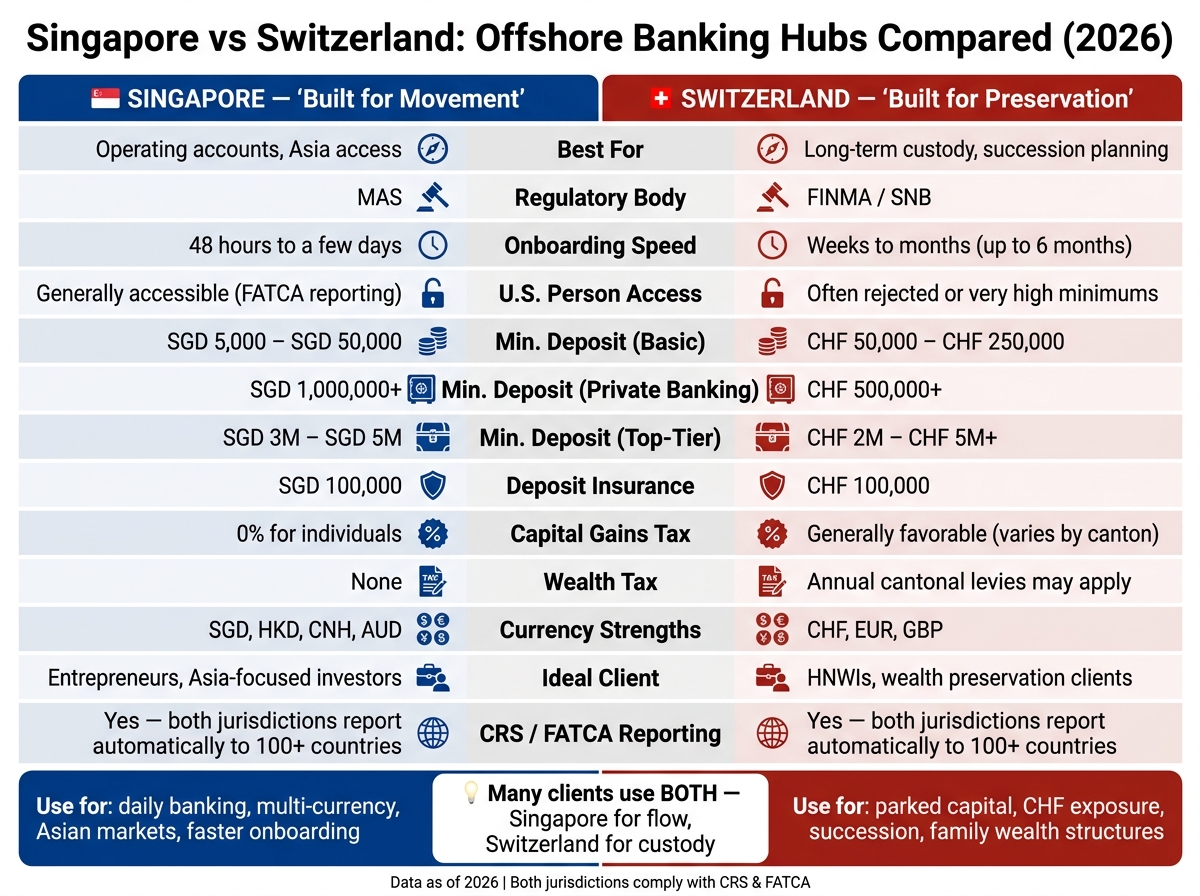
Quick comparison
| Factor | Singapore | Switzerland |
|---|---|---|
| Best fit | Banking use, Asia access | Wealth storage, succession |
| Main strength | Multi-currency access and easier day-to-day use | Private banking and long-term custody |
| U.S. client access | Often easier | Often harder or declined |
| Onboarding | Often faster | Often slower |
| Main currency edge | SGD, CNH, HKD, AUD | CHF |
| Tax angle | No capital gains tax for individuals; no wealth tax | Often good for held wealth, but cantonal wealth tax may apply |
| Privacy | Confidential, but reported under CRS/FATCA | Confidential, but reported under CRS/FATCA |
Bottom line: if you run a business, move money across regions, or invest in Asia, I’d lean toward Singapore. If your main goal is to park a large portfolio in a stable banking system with deep private-bank service, I’d lean toward Switzerland.
That’s the decision most readers need to make before they go any further.
sbb-itb-39d39a6
Singapore as an offshore banking hub
Singapore is the stronger pick for investors who want offshore banking that stays within the rules while keeping close access to Asia and a modern private-banking setup. It holds a AAA credit rating, hosts more than 2,000 single-family offices, and attracts a large share of Asia’s private wealth. That points to a deeper shift in where serious capital is being placed and managed.
Regulation, privacy, and reporting in Singapore
The Monetary Authority of Singapore (MAS) acts as both the central bank and the main financial regulator. That setup gives Singapore one center of control for prudential policy, market development, and supervision.
Singapore is not a secrecy jurisdiction. It takes part in CRS, applies strict AML and KYC rules, and keeps beneficial ownership records. For U.S. persons, FATCA reporting also applies, including Form 8938 and FBAR filings. Put simply, Singapore offers confidentiality, not secrecy. Banks protect client information, but they still report to tax authorities under CRS and FATCA. That compliance-first approach also affects who gets approved, how long reviews take, and what account terms look like. For a deeper dive into global options, see our offshore banking report.
Account opening, minimum deposits, and banking features
For non-residents, banks will usually ask for a passport, proof of address, bank references, and source-of-funds documents. Corporate applicants should expect a closer review. Banks often want a detailed business plan and proof of real economic substance.
Typical minimums are:
| Banking Tier | Minimum Deposit |
|---|---|
| Basic / Multi-currency | SGD 5,000 – SGD 50,000 |
| Entry-level Wealth Management | SGD 200,000 – SGD 300,000 |
| Priority / Private Client | SGD 1,000,000+ |
| Full Private Banking | SGD 3,000,000 – SGD 5,000,000 |
| Family Office (Section 13O) | SGD 20,000,000 |
Accounts often support SGD, USD, EUR, GBP, AUD, HKD, and CNH. In some cases, digital onboarding can be done in as little as 48 hours. More complex non-resident applications can take months.
Who should use Singapore for offshore banking
Singapore tends to fit three groups especially well:
- Entrepreneurs running Asia-facing operations
- Globally mobile professionals who need multi-currency flexibility
- Investors looking at Southeast Asian, Indian, or Greater China markets
It also makes sense for people setting up family office structures under Section 13O or 13U.
The contrast with Switzerland starts with a different priority: preservation over operational convenience.
Switzerland as an offshore banking hub
If Singapore is the operating hub, Switzerland is the preservation hub. It’s built for continuity, conservative custody, and long-term wealth.
That focus shapes the banking market. Most major Swiss banks lean toward private banking, so the system is built more for stewardship than for everyday cash movement.
Regulation, banking secrecy, and current transparency rules
Switzerland now reports account data under CRS/AEOI, and the old model of numbered accounts without identified owners is gone. Beneficial ownership must be declared, and automatic data exchange now reaches more than 100 countries.
For U.S. persons, FATCA applies in full. Swiss institutions report U.S. account holders directly to the IRS, and many top-tier Swiss banks avoid U.S. clients because compliance costs are too high. If you’re a U.S. citizen, FBAR filing is required when aggregate balances go over $10,000, and Form 8938 applies when balances exceed $50,000.
So what does Switzerland still offer? Confidentiality, not anonymity. Swiss law protects client data from unauthorized third parties, and FINMA enforces a strict compliance framework, including sanctions enforcement.
That’s also why Swiss onboarding tends to move more slowly. There’s more paperwork, more checks, and less room for shortcuts.
Account opening, minimum deposits, and wealth management services
Opening a Swiss private banking relationship usually takes time. Introducer-led applications can take 30 to 60 days, while independent applications can stretch to 6 months or longer. Banks ask for passport verification, source-of-funds documents, and proof of identity. Physical presence is still common for initial identification, although structured introduction channels can help with remote onboarding.
The minimums also tell the story. Switzerland is aimed at private banking clients, not casual account holders.
| Banking Tier | Minimum Deposit |
|---|---|
| Basic foreign client onboarding | CHF 50,000 – CHF 250,000 |
| Standard private banking relationship | CHF 500,000+ |
| Top-tier institutions (e.g., Pictet, Lombard Odier) | CHF 2,000,000 – CHF 5,000,000+ |
A structured introducer can lower minimums and help with remote onboarding.
That setup makes Switzerland a stronger fit for parked capital than for operating cash.
At this level, core services usually include discretionary portfolio management, Lombard lending, cross-border credit facilities, and global custody for both standard and alternative assets, including precious metals. Swiss banks also bring deep experience with foundations, foreign-law trusts, and multi-generational succession planning. Few other jurisdictions match that level of institutional depth.
Who should use Switzerland for offshore banking
Switzerland fits a narrow client profile. If your main goal is long-term capital preservation, political neutrality, and stable institutions, it stands out.
The Swiss Franc (CHF) holds safe-haven status, and the Swiss National Bank (SNB) defines price stability as consumer price inflation below 2% per year . For clients trying to hedge macro volatility, holding CHF-denominated assets in Switzerland can be a deliberate move.
This setup works best for high-net-worth and ultra-high-net-worth individuals focused on intergenerational wealth planning, conservative multi-asset portfolio management, and a jurisdiction that is unlikely to change its legal or political framework without warning. On November 30, 2025, Swiss voters rejected a proposed federal inheritance and gift tax on large-scale transfers . That result added to the country’s reputation for fiscal continuity.
It’s a weaker fit for entrepreneurs who need fast digital banking, frequent international transfers, or active business accounts. For those needs, Switzerland works better as an anchor for the core portfolio than as a day-to-day operating bank.
The trade-offs versus Singapore become more obvious in the direct comparison below.
Direct comparison: Singapore vs Switzerland
Stability, compliance, and ease of banking
Both jurisdictions are stable. But they play different roles.
Singapore is usually the better fit for active banking. Switzerland tends to fit long-term custody better. Put simply, Singapore is built for movement. Switzerland is built for safekeeping.
That shows up fast during onboarding. Singapore banks often offer faster digital onboarding, while Swiss banks move more slowly and often ask for in-person identification. For U.S. clients, Singapore is also usually easier to access. Switzerland often sets a higher bar or declines the relationship altogether.
Multi-currency access, tax reporting, and practical use cases
Singapore has an edge for clients who need access to SGD, HKD, CNH, and AUD. Switzerland is stronger for CHF-based preservation.
There’s also no bank secrecy loophole here. Neither jurisdiction offers anonymity. Both take part in CRS and FATCA, and account data is automatically shared with tax authorities in more than 100 countries.
That same banking gap carries over into tax use. Singapore works well for operating businesses, with 0% capital gains tax, 0% dividend tax, and double-tax treaties covering more than 85 countries. Switzerland is often a better match for parked wealth, although cantonal wealth taxes can apply each year for long-term holders.
Pros, cons, and who should choose each
The table below makes the split pretty clear.
| Factor | Singapore | Switzerland |
|---|---|---|
| Regulatory body | MAS | FINMA / SNB |
| Onboarding speed | 48 hours to a few days | Weeks to months |
| U.S. person access | Generally accessible; FATCA reporting | Often rejected or high minimums |
| Minimum deposit (private banking) | Often starts around SGD 1 million | Often starts around CHF 500,000 |
| Capital gains tax | 0% for individuals | Generally favorable, but treatment varies by canton |
| Wealth tax | None | Annual cantonal levies can apply |
| Multi-currency strength | SGD, HKD, CNH, AUD | CHF, EUR, GBP |
| Deposit insurance | SGD 100,000 | CHF 100,000 |
| Best use case | Operating accounts, Asian market access | Long-term custody, succession planning |
| Ideal client | Entrepreneurs, Asia-focused investors | Wealth preservation clients, European HNWIs |
A lot of clients don’t treat this as an either-or decision. They split functions between both hubs: Singapore for day-to-day banking and market access, Switzerland for custody and offshore asset protection. In practice, the choice comes down to use case, not prestige.
Conclusion: which offshore banking hub is better?
Once you weigh access, compliance, and wealth-management use cases, the decision comes down to function, not prestige. Singapore is the stronger fit for globally mobile entrepreneurs, Asia-focused investors, and anyone who wants efficient multi-currency banking with faster onboarding. Switzerland is the better match for larger portfolios, long-term wealth preservation, and intergenerational succession planning.
Both hubs now exchange information under CRS and FATCA, so the real value is compliant, predictable banking, not secrecy.
The minimums make that split pretty clear. Singapore tends to suit higher-access private banking, while Switzerland is geared toward larger private relationships. Many Swiss banks reject U.S. persons outright, while Singapore is still generally easier for international clients to access.
The smart move is to match the jurisdiction to your residency, entity structure, and asset-protection goals before you apply. Singapore fits VCCs and family offices built for growth. Switzerland fits trusts and foundations built for preservation. That’s the real split: Singapore for operating flexibility, Switzerland for preservation and succession.
FAQs
Should I use Singapore and Switzerland together?
Yes. For many high-net-worth individuals, using Singapore and Switzerland together can work very well.
They don’t have to be either-or choices. In many cases, they play different roles.
Switzerland is often the place for conservative, rules-based long-term wealth preservation and legacy planning. Singapore, on the other hand, can serve as a modern operating hub, with diversification outside Europe and direct access to Asia-Pacific growth.
Used together, they can create a stronger setup with more institutional backup and less exposure to regional regulatory or political swings.
How do I know if I qualify for private banking?
Private banking usually comes down to how much liquid wealth you have, and the bar changes from one country to another.
In Switzerland, entry-level private banking often starts at around $1 million to $3 million. In Singapore, full private banking usually begins at SGD 1.5 million, while some major banks set the minimum at $5 million.
That said, the asset minimum isn’t the only thing banks look at. They may also review:
- Your residency
- Your local ties
- Your source of wealth
- Your professional background
It also helps to separate private banking from priority or premium banking. They aren’t the same thing, and priority or premium tiers usually come with lower minimums.
What should I prepare before applying as a U.S. person?
If you’re a U.S. person, expect FATCA checks to be a big part of the process. In plain English, that usually means IRS-related disclosures, a W-9, and paperwork that shows your financial profile.
You should also expect close background screening. Some Swiss banks limit access for U.S. citizens or residents. And since many of these banks don’t offer public application forms, getting in often depends on a professional introduction.
