
If I had to give the short answer first: the highest headline rate in this list is 7.10% on India FCNR(B) deposits, but most U.S.-linked savers will care just as much about lock-up periods, local deposit cover, and whether the bank accepts U.S. persons.
So when I look at offshore savings, I don’t just ask “Who pays the most?” I ask:
- What currency is the rate in?
- How long is the money locked up?
- What is the minimum deposit?
- Is there local deposit protection?
- Will the bank take U.S. customers under FATCA?
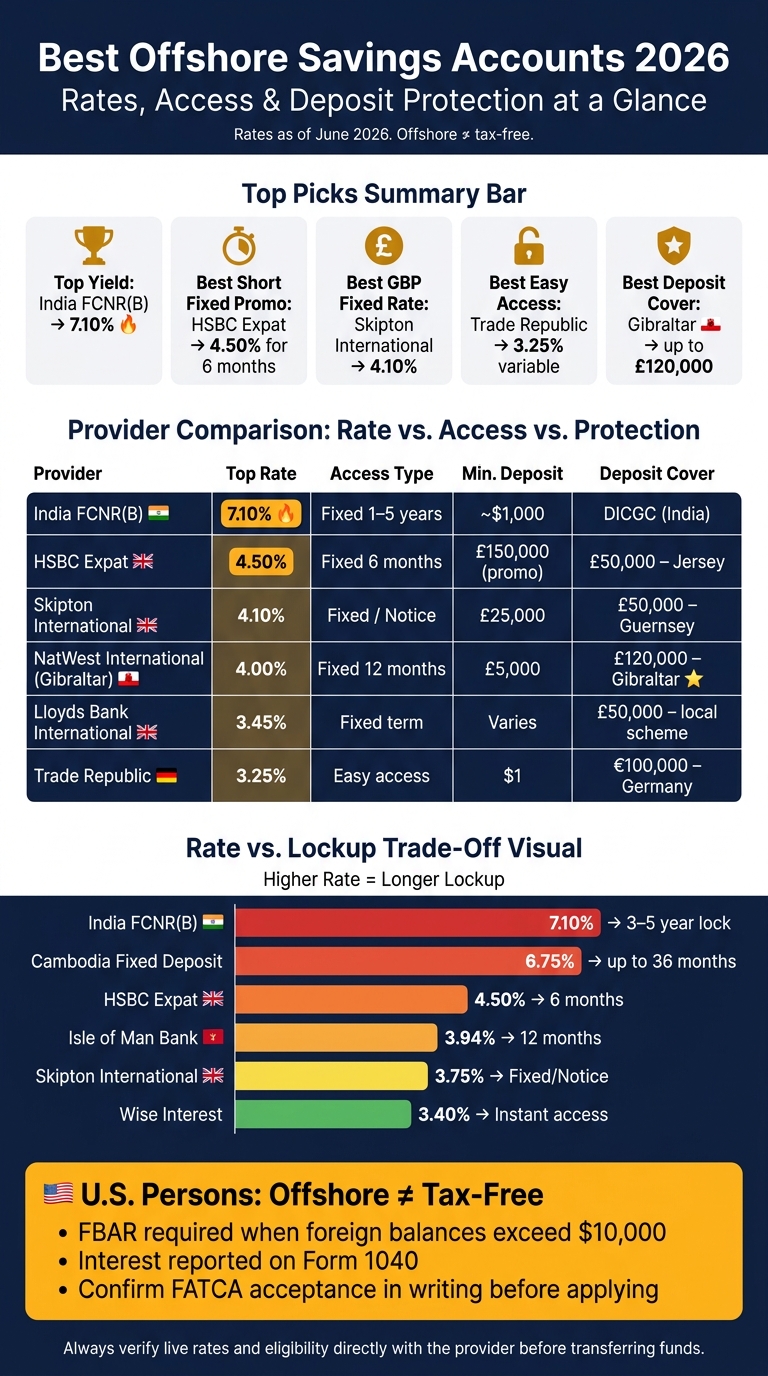
For a quick read, here’s the shortlist:
- Top yield: India FCNR(B) at 7.10%
- Best short fixed promo: HSBC Expat at 4.50% for 6 months
- Best GBP fixed rate in the offshore hubs listed: Skipton International at 4.10%
- Best easy-access rate in the list: Trade Republic at 3.25% variable
- Best deposit cover in the offshore hubs listed: Gibraltar at up to £120,000
Quick Comparison
| Provider / Type | Top Rate | Access | Minimum Deposit | Deposit Cover |
|---|---|---|---|---|
| India FCNR(B) | 7.10% | Fixed, 1–5 years | From about $1,000 | India scheme / local rules |
| HSBC Expat | 4.50% | Fixed, 6 months | £150,000 for promo | £50,000 in Jersey |
| Skipton International | 4.10% | Fixed / notice | £25,000 total to start | £50,000 in Guernsey |
| Standard Chartered | 2.75%–5.50% headline | Easy access or term, depends on market | Varies | Depends on country and currency |
| Lloyds Bank International | 3.45% | Fixed term | Varies | £50,000 local scheme |
| Trade Republic | 3.25% variable | Easy access | $1 | €100,000 in Germany |
A few points matter right away for U.S. readers. Offshore does not mean tax-free. If your foreign accounts go over $10,000 at any point in the year, FBAR filing can apply. And interest still goes on your Form 1040.
My bottom line is simple: the best offshore savings account is usually not the one with the biggest number on the page. It’s the one you can open, understand, report, and live with if rates drop or you need cash early.
sbb-itb-39d39a6
1. Skipton International Offshore Savings Accounts
Skipton International is based in Guernsey and supervised by the Guernsey Financial Services Commission. It’s also a subsidiary of UK-based Skipton Building Society.
Interest Rate
Skipton stands out more for fixed-rate returns than for flexible access. Put simply, the less access you need, the more interest you can earn.
For GBP accounts, the top rate is 4.10% gross on fixed-rate bonds maturing in September 2027 or September 2028. By comparison, the easy-access option pays 3.15% gross. So if you’re a GBP saver and don’t mind locking money away, Skipton looks much stronger on yield than on day-to-day flexibility.
| Currency | Account Type | Term / Access | Gross Rate |
|---|---|---|---|
| GBP | Fixed Rate Bond | Maturing September 2027 | 4.10% |
| GBP | Fixed Rate Bond | Maturing September 2028 | 4.10% |
| GBP | Personal Saver 200 | 200 days’ notice | 3.60% |
| GBP | Personal Saver 120 | 120 days’ notice | 3.50% |
| GBP | Personal Saver 40 | 40 days’ notice | 3.40% |
| GBP | Personal Easy Saver | Easy access | 3.15% |
Currency and Term
The fixed-rate bonds lock your funds until maturity. If you choose a notice account instead, you’ll need to give 40, 120, or 200 days’ notice before taking money out.
Eligibility and Minimum Deposit
New customers need £25,000 to open an account. Each product must then keep at least £10,000, and any balance below that earns no interest.
On eligibility, the United States is not on Skipton’s restricted-country list. But EU residents and Australian residents can’t open new accounts.
This setup makes Skipton a better match for savers who are happy to leave cash alone for a while, not people who want regular access to offshore bank accounts.
Safety and Access
Eligible deposits are covered by the Guernsey Banking Deposit Compensation Scheme up to £50,000. Interest is paid gross.
That means the deal is pretty clear: higher rates come with higher minimum deposits and less access.
2. HSBC Expat Fixed Term Deposit
If you want more currency options and you’re fine with a higher bar to get in, HSBC Expat sits a step above many other offshore choices. It’s a Jersey-based offshore bank regulated by the Jersey Financial Services Commission. In plain English: this option fits savers who want multi-currency access and can clear stricter entry rules.
Interest Rate
HSBC Expat’s standard GBP fixed-term rates start at 2.35% gross for 1 month on deposits of £5,000+ and go up to 4.13% gross for 3 years on £100,000+
| Term | £5,000+ | £50,000+ | £100,000+ | £500,000+ |
|---|---|---|---|---|
| 1 Month | 2.35% | 2.54% | 2.54% | 2.60% |
| 3 Months | 3.01% | 3.21% | 3.21% | 3.26% |
| 6 Months | 3.23% | 3.43% | 3.43% | 3.76% |
| 1 Year | 3.38% | 3.58% | 3.93% | 3.93% |
| 2 Years | 3.50% | 3.70% | 4.05% | 4.05% |
| 3 Years | 3.58% | 3.78% | 4.13% | 4.13% |
GBP gross rates as of June 24, 2026.
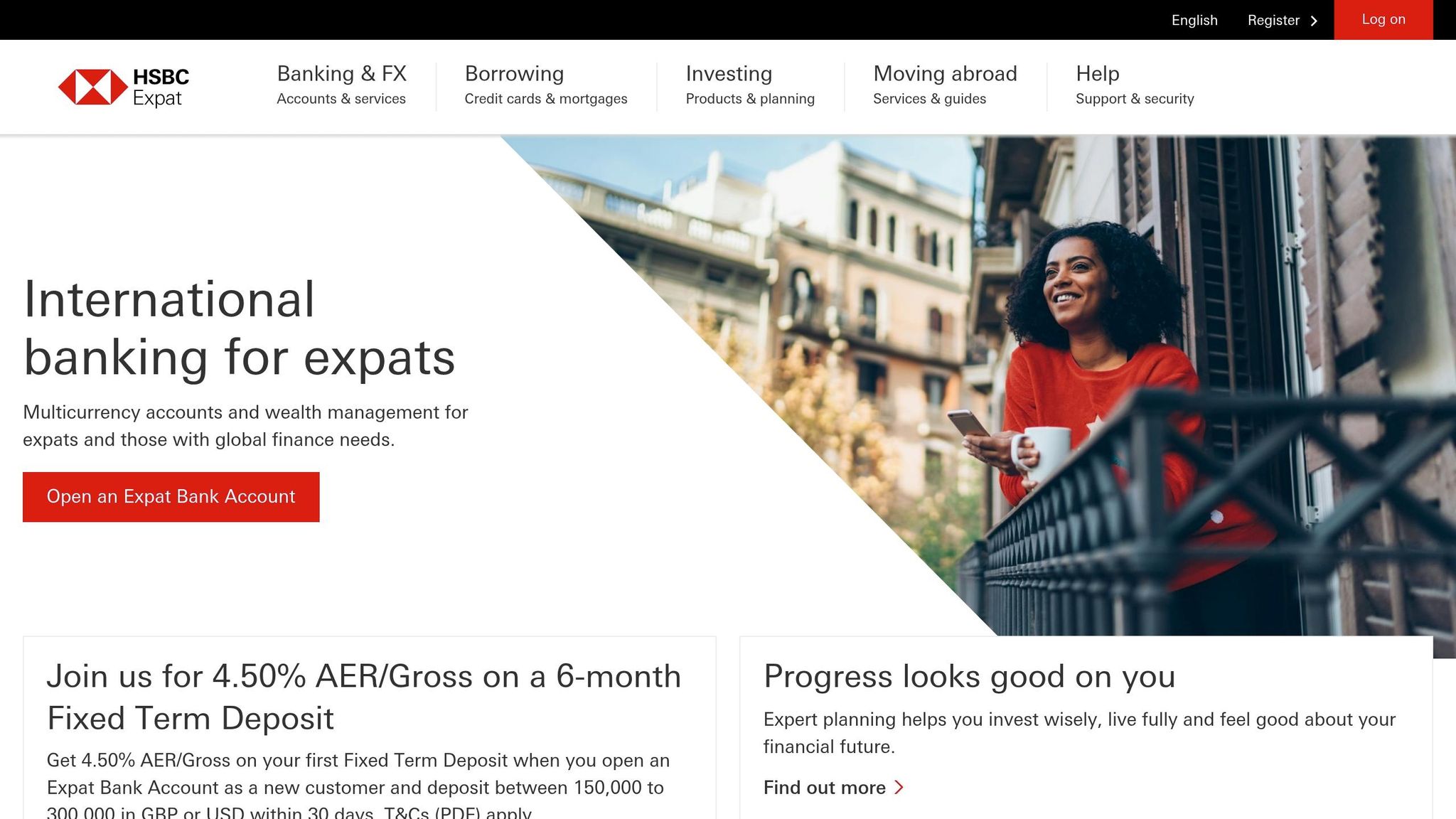
There’s also a promo for new customers: 4.50% AER/gross for 6 months on deposits from £150,000 to £300,000, as long as the money is placed within 30 days of joining
Currency and Term
One of the main draws here is currency range. HSBC Expat offers fixed term deposits in 19 currencies, including USD, EUR, GBP, SGD, HKD, AUD, CAD, and ZAR, with terms from 1 month to 3 years
Eligibility and Minimum Deposit
Before you can open the fixed term deposit, you need an HSBC Expat Bank Account. To get that account, you must meet at least one of these entry rules:
- £75,000 in savings or investments
- £120,000 annual salary
- HSBC Premier status
The fixed term deposit itself has a lower minimum, which depends on the currency: £5,000, $5,000, or €10,000
Safety and Access
Early withdrawals are allowed, but they can cut into your return. In some cases, early exit can mean getting back less than your original deposit That’s the trade-off with fixed-term products: more yield up front, less room to change your mind later.
Eligible deposits are covered by the Jersey Bank Depositors Compensation Scheme up to £50,000 They are not covered by the UK FSCS
One more detail worth watching: funds roll over at maturity unless you opt out at least 2 days before the maturity date
For savers who want rates tied less to relationship status and more to local jurisdiction, the next option is Standard Chartered.
3. Standard Chartered International Savings or Term Deposit

Standard Chartered doesn’t run on one flat global rate. What you get changes by market, balance size, and whether you’re bringing in fresh funds.
Interest Rate
In Singapore, the USD$aver account offers up to 5.50% p.a. on balances up to $3 million. But the better way to judge the offer is the EIR: 1.71% p.a. on that same balance, not just the headline figure.
In Hong Kong, online time deposits pay up to 3.30% p.a. on 3-, 6-, or 12-month USD or GBP terms. In Malaysia, foreign currency fixed deposits pay up to 4.80% p.a. on a 12-month AUD placement.
There’s a catch across all three markets: the top promo rates apply only to fresh funds. That means money not already sitting with Standard Chartered and not redeposited within the past 30 days.
Currency and Term
| Jurisdiction | Product | Key Currencies | Top Rate (p.a.) | Term |
|---|---|---|---|---|
| Singapore | USD$aver | USD | 5.50% | No lock-in |
| Hong Kong | Online Time Deposit | USD, GBP, AUD, CAD, NZD, EUR, RMB, HKD | 3.30% | 3, 6, or 12 months |
| Malaysia | Foreign Currency FD | AUD, USD, GBP, SGD | 4.80% | Up to 12 months |
Eligibility and Minimum Deposit
In Singapore, foreigners need a valid passport, an employment pass, and proof of address from the last 3 months. The USD$aver account can be opened with $1, which sounds easy enough, but there’s a catch: you need a $10,000 average daily balance to avoid the $10 monthly fee.
In Hong Kong, online time deposits start at USD 2,000 or HKD 10,000. In Malaysia, both residents and non-residents can open foreign currency accounts, and fixed deposits start at the equivalent of USD 10,000.
Safety and Access
In Malaysia, deposits are protected by PIDM up to RM 250,000 per depositor. In Singapore and Hong Kong, foreign-currency accounts usually don’t come with blanket deposit insurance, so the bank’s financial strength carries more weight. This is a core consideration for offshore asset protection when choosing a jurisdiction.
The USD$aver account in Singapore has no lock-in, so funds can be accessed at any time. Malaysia fixed deposits allow early withdrawal with no penalty fee, but you won’t earn any interest if you pull out before the term ends. In Singapore and Hong Kong, early withdrawal from time deposits can lead to penalty charges and replacement costs.
One more thing worth noting: opening through the app or online often gets you a better rate.
For a broader rate screen, compare these offers with the jurisdiction-by-jurisdiction leaders below.
4. Citi International Savings Option
Citi’s International Personal Bank (IPB) in Singapore gives offshore savers a place to hold money in different currencies. The catch is simple: the savings returns are weak.
Interest Rate
Citi’s Multi-Currency Savings Account pays 0% on USD, GBP, EUR, AUD, and HKD. Only SGD balances earn anything, and even then the rate is just 0.01% to 0.10%. So if you’re looking for yield, the savings account isn’t doing much heavy lifting.
That shifts attention to Citi’s fixed-term product. In practice, Citi’s Multi-Currency Time Deposit is the only option here that matters for yield. It offers fixed rates across 11 currencies for terms from 1 week to 12 months. Citi does not publish retail rates on its summary sheets.
Eligibility and Minimum Deposit
The savings account requires a minimum opening deposit of US$5,000 or the foreign-currency equivalent. For SGD, the minimum is S$5,000.
The time deposit bar is much higher. You need at least US$50,000 or the equivalent, and Citi also requires you to open a linked checking or savings account at the same time.
Safety and Access
SGD deposits are insured by SDIC up to S$100,000. Foreign-currency balances do not get that insurance cover. If you’re holding a large amount in foreign currency, that leaves you taking direct bank risk.
On the access side, funds can be managed 24/7 through the app, online banking, and phone banking. Time deposits are less flexible, though. If you end one early, you will usually earn zero interest. Partial withdrawals are allowed only if you take out at least US$5,000 and still keep a US$50,000 balance in place.
So Citi works better as a multicurrency banking hub than as a top pick for yield. The next section compares Citi with the strongest offshore rates by jurisdiction.
5. Moneyfacts Offshore Rate Leaders by Jurisdiction
At this point, the main issue isn’t only who pays the top rate. It’s which jurisdiction gives you the best balance of yield, access, and deposit cover.
Moneyfacts’ offshore rate leaders are grouped across Jersey, Guernsey, the Isle of Man, and Gibraltar. As of June 2026, headline rates sit at roughly 3.5% to 5.5% AER, depending on the product, currency, and term.
Interest Rates
Right now, Skipton International leads the listed fixed-rate offshore choices in Guernsey, HSBC Expat leads on promotional yield, and Gibraltar offers the highest deposit cover of the jurisdictions shown.
The table below pulls out the top current options by jurisdiction.
| Jurisdiction | Top Provider | Account Type | Rate (AER) | Protection Limit |
|---|---|---|---|---|
| Jersey / Isle of Man | Santander International | 12-Month Bond / Regular Saver | 4.00% | £50,000 |
| Guernsey | Skipton International | 2-Year Fixed Rate Bond | 4.10% | £50,000 |
| Isle of Man | Isle of Man Bank | Savings Builder (Variable) | 3.82% | £50,000 |
| Gibraltar | NatWest International | 12-Month Fixed Term (GBP) | 4.00% | £120,000 |
| Jersey (Global) | HSBC Expat | 6-Month Fixed (New Customer) | 4.50% | £50,000 |
Minimum Deposit and Eligibility
This is where the small print starts to matter. A strong rate can look great on the page, but access often depends on how much money you can place and what kind of banking relationship the provider wants.
NatWest International starts fixed-term accounts at £5,000, but it also requires a £25,000 total relationship balance. Skipton International asks for at least £10,000 per product and £25,000 overall for new customers. Barclays International sets the bar even higher, requiring a £100,000 relationship balance to avoid a £40 monthly fee.
So the headline rate is only part of the story. In practice, eligibility rules can make one account far more usable than another.
Protection
Gibraltar stands out for deposit cover. It protects up to £120,000 per person, compared with £50,000 in Jersey, Guernsey, and the Isle of Man.
For anyone holding a larger cash balance, that difference isn’t small. It can shape where you place funds, even when rates look similar. U.S.-linked savers still need to factor in FBAR reporting. For a deeper dive into these regulations, see our offshore banking report.
6. Global Wealth Protection
Once you’ve compared the headline rates, the next step is simple: make sure the account actually works for your residency, currency needs, and reporting duties.
Global Wealth Protection is not a bank. It’s an educational and advisory resource that helps savers spot the gap between published minimums and the amount a bank may ask for when you try to open an account. Start with eligibility. Then check whether the rate still makes sense once you factor in currency and access.
Confirm in writing that the bank accepts U.S. persons and will provide year-end interest statements. Match the account currency to your liabilities. Confirm the product is a deposit account, not a fund. Bank jurisdiction also shapes creditor reach, so check the legal protections before you move any money.
Those checks are not just paperwork. A high nominal rate means little if you can’t open the account or get to your funds when you need them.
Rate, Access, and Protection: Key Trade-Offs
The headline rates can look strong at first glance. But the real value changes once you factor in access and term length.
For offshore savers, the highest yields usually come with the longest lockups. Fixed-term deposits in India can pay up to 7.10% on USD FCNR(B) accounts for 3- to 5-year terms, and Cambodian commercial banks can reach 6.75% on 36-month USD deposits. There’s a catch, though: early withdrawal will usually wipe out most of the interest.
If you want easier access, you’ll usually have to accept a lower rate. HSBC Expat’s 6-month fixed deposit reaches about 4.50% with a £5,000 minimum. Wise Interest pays about 3.4% net with instant access. That’s why rate alone doesn’t tell the whole story. Currency exposure can matter just as much.
Currency choice also affects how well an account fits into the rest of your portfolio. USD deposits are often among the strongest offshore options on rate. Skipton International’s top rate is in GBP, while HSBC Expat offers 19 currencies, which gives savers more room to match deposits to their needs.
Then there’s protection. After yield and currency, this is often the next hard limit. Jersey, Guernsey, and Isle of Man schemes each cover eligible deposits up to £50,000 per depositor. Singapore’s deposit insurance covers up to S$100,000, but foreign-currency deposits are generally left out. Wise operates as an Electronic Money Institution, so client funds are safeguarded in segregated accounts instead of being covered by standard deposit insurance. If you’re holding a large balance, that limit can matter just as much as the headline rate.
The table below condenses the main trade-offs.
| Option | Top Rate | Access | Min. Deposit | Protection |
|---|---|---|---|---|
| India FCNR(B) | 7.10% | Fixed (1–5 years) | Varies ($1,000+) | DICGC (India) |
| Cambodia Fixed Deposit | 6.75% | Fixed (1–36 months) | ~$1,000 | CGCC framework |
| HSBC Expat | 4.50% | Fixed (6 months) | £5,000 | Jersey Bank Depositors Compensation Scheme (£50,000) |
| Isle of Man Bank | 3.94% | Fixed (12 months) | $10,000 | Isle of Man Deposit Compensation Scheme (£50,000) |
| Skipton International | 3.75% (GBP) | Fixed/Notice/Easy | £25,000 | Guernsey Banking Deposit Compensation Scheme (£50,000) |
| Wise Interest | 3.40% | Easy access | None | Safeguarding only (no deposit insurance) |
Minimum deposits can narrow the field fast. Skipton International requires £25,000 in total. Barclays International requires a £100,000 minimum overall balance, or it charges a £40 monthly underfunding fee. On the other end, ICBC in Singapore accepts USD fixed deposits from as little as $500 through e-banking. Put all of these filters together, and the shortlist gets much smaller very quickly.
Pros, Cons, and Best Fit for Each Option
No offshore savings account comes out on top in every category. One account may offer the best rate. Another may give you easier access, more currency choices, or a lower bar to get started.
So the better question is simple: what matters most to you?
The table below turns the top rate picks into practical use cases.
| Option | Pros | Cons | Best Fit | Watchouts |
|---|---|---|---|---|
| Indian FCNR(B) (e.g., AU Small Finance Bank) | Highest yield on the list | Premature closure before one year can forfeit interest | NRIs and expats who can lock funds for 3 years or more | Fully taxable for U.S. citizens on Form 1040 |
| HSBC Expat | 19 currencies supported; HSBC Premier eligibility | Requires £75,000 in savings/investments or a £120,000 annual salary, or existing HSBC Premier status; fees apply if balances fall below the minimum | High-income expats who need multi-currency banking | New customer promo rate of 4.50% AER requires deposits of about £150,000+ within 30 days |
| Skipton International | Strong GBP fixed and notice rates | £25,000 minimum total deposit; balances below £10,000 earn 0% | British expats with established GBP savings | EU residents cannot open new accounts after July 11, 2026 due to CRD VI |
| Standard Chartered International | Broad currency support and strong regional access in Asia, the Middle East, and Africa | Priority Banking requires SGD 200,000; Private Banking requires SGD 1.5 million | Expats already banking in Asia, the Middle East, or Africa | Foreign-currency deposits in Singapore are not covered by SDIC insurance |
| Lloyds International | Low opening minimum and easy access, but rates trail specialist offshore banks | Top USD fixed rate is 3.45% | Savers who want a low-minimum entry point with a familiar bank brand | Rates lag behind dedicated offshore savings specialists |
A quick read of the table shows the trade-off. Indian FCNR(B) leads on yield, but you give up flexibility if you may need the money early. HSBC Expat gives you broad currency choice, though the entry bar is steep. Skipton International works better for people with a solid GBP balance already in place. Standard Chartered International makes more sense if your banking life is already tied to Asia, the Middle East, or Africa. And Lloyds International is the easier on-ramp, even if the rates don’t lead the pack.
Eligibility is the next screen, and for U.S.-linked readers, this part can narrow the field fast. Many offshore banks limit FATCA-sensitive accounts. FBAR filing kicks in once aggregate foreign balances go above $10,000. And any offshore interest is taxed as ordinary income for U.S. persons.
That means the best-looking rate on paper may not be the best choice in practice. If access rules, tax reporting, or account minimums get in the way, the account stops being a fit no matter how good the headline number looks.
Conclusion
The shortlist gets short in a hurry once you compare yield with access, currency, and protection. No offshore bank comes out on top in every area. The right account depends on what matters most to you: yield, currency, access, or jurisdiction.
The best pick balances rate, access, eligibility, and the tax and filing load. A 7.10% USD FCNR(B) rate may sound strong, but it can also mean locking up your money for 3 to 5 years. Use the tables to narrow the field, then check the live terms with the bank. Before you apply, confirm the current rate, eligibility rules, and the post-promo rate. Rates move fast, so it’s smart to verify the live offer before sending funds.
For U.S. persons, get FATCA compliance confirmed in writing. FBAR kicks in once your combined foreign balances go over $10,000. For U.S. persons, tax reporting comes before yield.
FAQs
How do I choose between rate and access?
Balance easy access to cash with the return you want.
Easy-access accounts make it simple to pull out money for emergencies or near-term expenses. That convenience comes with a trade-off: they usually pay lower interest.
Fixed-term deposits often pay higher rates. But there’s a catch – your money stays locked up for a set period. If you take it out early, you may face penalties or lose interest. So they make the most sense for money you’re confident you won’t need anytime soon.
Which offshore accounts accept U.S. persons?
Yes. Some offshore banks and global banking platforms do accept U.S. persons. That said, the list is pretty short because FATCA rules make compliance more demanding for foreign banks.
Examples often mentioned include Caye International Bank in Belize, banks in the Channel Islands, and banks in Singapore. Whether you can open an account usually comes down to a few basics:
- Your residency status
- The bank’s minimum deposit
- The documents you can provide
For U.S. persons, the reporting side matters just as much as account access. If the combined value of foreign accounts goes over $10,000 at any point during the year, those accounts must be reported.
How safe are offshore deposits?
Offshore deposits are regulated financial products. But how safe they are comes down to two things: the strength of the country or territory where the account is held, and the local deposit protection plan behind it.
That’s the big difference from a U.S. bank account. In the United States, deposit accounts are backed by the FDIC. Offshore accounts don’t use that system. They depend on local insurance frameworks instead, and those rules can differ a lot from one place to another.
For example, some Channel Islands accounts may be protected up to £50,000. In some places, there’s also a trade-off worth noting. A jurisdiction may offer strong asset protection by staying outside the reach of U.S. court judgments, while offering less deposit insurance than a U.S. account holder might expect.
