
If I’m a U.S. person with offshore accounts, FATCA can put me on the IRS reporting list fast. I may need to file Form 8938, my foreign bank may report my account too, and missing the rules can lead to $10,000+ penalties, account limits, or 30% withholding tied to noncompliant foreign institutions.
Here’s the short version:
- FATCA is a U.S. law from 2010 aimed at offshore tax evasion.
- It can apply to U.S. citizens, green card holders, tax residents, and some entities.
- I may need to file Form 8938 if my foreign assets pass set limits.
- I may also need to file an FBAR, which is separate and starts at just $10,000 across foreign accounts.
- My bank may already be sharing my name, TIN, account number, balance, and income details with the IRS.
- Penalties can reach $60,000 per year for Form 8938 filing failures, plus FBAR penalties and tax penalties.
This means offshore accounts are not hidden just because they are outside the U.S. The main job is simple: know what counts, check the filing limits, and match my tax return to what my bank may report.
What FATCA is and why it was created
FATCA is a 2010 U.S. law meant to cut down offshore tax evasion and improve reporting on foreign assets. It works through a two-layer reporting system: U.S. taxpayers report certain foreign financial assets to the IRS, and foreign financial institutions report details about U.S. account holders straight to the IRS.
There’s also a sharp enforcement hook. Foreign institutions that don’t comply can face 30% withholding on certain U.S.-source payments. That setup is a big reason offshore accounts now face routine reporting and review. And that same system helps decide which offshore assets count as reportable.
Who FATCA applies to
FATCA applies to both U.S. taxpayers and the foreign institutions that hold their offshore accounts and investments. Put simply, it reaches both the person with the account and the institution holding the money.
FATCA covers U.S. citizens, green card holders, U.S. tax residents, and certain U.S.-owned entities. It also puts reporting duties on foreign financial institutions, including banks, brokers, funds, and some insurers.
Some foreign companies and trusts can also fall under FATCA when U.S. persons have ownership or control over them.
How FATCA changed offshore banking privacy
For offshore account holders, FATCA means less privacy and more automatic disclosure to the IRS. It marked a global shift away from old-school banking secrecy and toward automatic cross-border reporting.
The United States has signed FATCA Intergovernmental Agreements (IGAs) with countries around the world, which helps make that data sharing possible. As a result, foreign financial institutions now identify U.S. account holders and report account balances and identifying information to the IRS, often before the taxpayer files their own return.
Next comes the practical part: which offshore accounts and assets FATCA treats as reportable.
sbb-itb-39d39a6
When your offshore accounts become reportable under FATCA
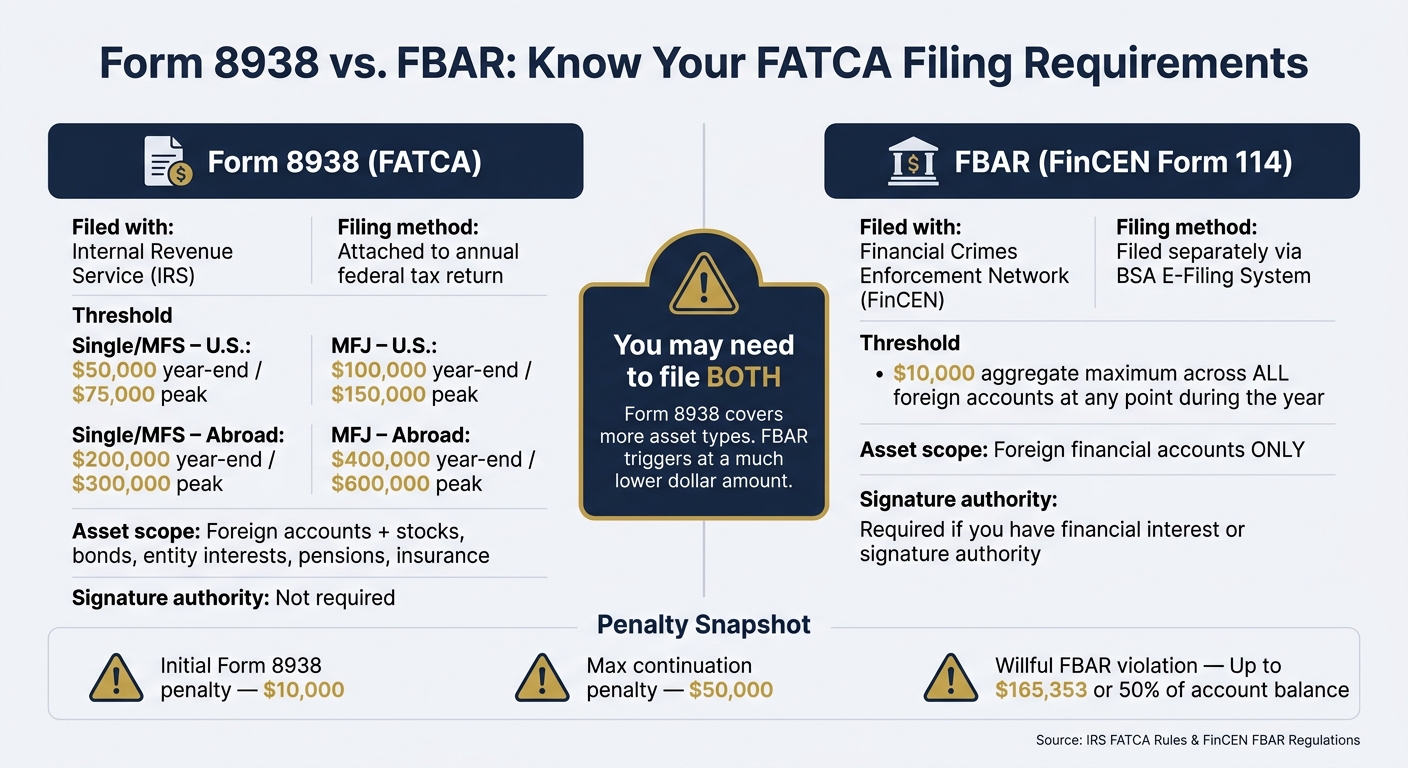
Form 8938 is the taxpayer-side FATCA filing for certain foreign assets. Once FATCA is in play, the key question is simple: which foreign assets count, and do they push you over the filing limit?
Whether you need to file depends on two things:
- the type of foreign asset you own
- the total value of all specified foreign financial assets combined
In plain English, you add up all specified foreign financial assets and compare that total to the filing threshold.
Which offshore assets count as specified foreign financial assets
Form 8938 covers foreign financial accounts and some other foreign investment assets that aren’t held in an account. That includes foreign stocks, securities, interests in foreign entities, trusts, estates, and other foreign financial contracts. Foreign life insurance and annuity contracts with cash value count too. Foreign pension plans and deferred compensation plans are reportable as well.
Directly owned foreign real estate is not reportable. But if you own an interest in a foreign entity that holds that real estate, that interest is reportable.
Form 8938 filing thresholds for U.S. residents and Americans abroad
The filing thresholds change based on your filing status and where you live. You need to look at both your year-end value and the highest value during the year. If you go over either one, you have a filing duty.
| Filing Status | Residency | Year-End Threshold | Peak Value During Year |
|---|---|---|---|
| Single / Married Filing Separately | Living in the U.S. | $50,000 | $75,000 |
| Married Filing Jointly | Living in the U.S. | $100,000 | $150,000 |
| Single / Married Filing Separately | Living Abroad | $200,000 | $300,000 |
| Married Filing Jointly | Living Abroad | $400,000 | $600,000 |
| Specified Domestic Entities | N/A | $50,000 | $75,000 |
The higher thresholds for people abroad apply only if you have a foreign tax home and meet either the bona fide residence test or the 330-day physical presence test. So this isn’t just about living outside the United States for part of the year. You have to meet the IRS rules for those higher limits.
Form 8938 vs. FBAR: when you may need to file both
Form 8938 does not replace FBAR. A lot of people with offshore accounts end up filing both. FBAR is a separate filing, and its threshold is much lower.
| Feature | Form 8938 (FATCA) | FinCEN Form 114 (FBAR) |
|---|---|---|
| Filing Authority | Internal Revenue Service (IRS) | Financial Crimes Enforcement Network (FinCEN) |
| Threshold | $50,000 to $600,000, depending on status and residency | $10,000 at any time during the year |
| Asset Scope | Accounts plus stocks, bonds, and entity interests | Foreign financial accounts only |
| Filing Method | Attached to annual federal tax return | Filed separately via BSA E-Filing System |
| Signature Authority | Not required | Required if you have financial interest or signature authority |
The FBAR’s $10,000 threshold is flat. It applies to the aggregate maximum balance across all foreign financial accounts at any point during the year. So if someone has three foreign accounts and each one peaked at $4,000, that person still crosses the FBAR threshold.
That’s the big split: Form 8938 covers more types of foreign assets, but FBAR kicks in at a much lower dollar amount.
Once you know your filing duties, the next question is how foreign banks identify U.S. account holders and report their data.
How foreign banks and investment firms report your information
Foreign banks and investment firms have to screen offshore bank accounts, collect tax forms, and report U.S.-linked accounts under FATCA. That review shapes what the institution can ask you for and what it may report.
How institutions identify U.S. account holders
Foreign institutions check both new and existing accounts for U.S. indicia. That can include a U.S. birthplace, address, phone number, citizenship, residency, or transfer instructions to a U.S. account.
If a bank spots those signs, it will usually ask for a self-certification form. That means IRS Form W-9 if you’re a U.S. person, or Form W-8BEN if you’re certifying non-U.S. status. These forms are signed under penalty of perjury.
If you don’t provide the required documents, the bank may treat the account as noncompliant. In plain English, that can mean restrictions on the account or even closure.
What account information may be shared with the IRS
Once a bank identifies a U.S. account holder, the reporting path depends on the country. Foreign financial institutions use IRS Form 8966 to report account details. That report can include your name, address, TIN, account number, year-end balance, and interest, dividends, and other income.
| Feature | Model 1 IGA | Model 2 IGA |
|---|---|---|
| Reporting Path | FFI reports to local tax authority, which shares data with the IRS | FFI reports account information directly to the IRS |
| Consent | Reporting is generally required under local law; individual consent may not be needed | FFI generally obtains account holder consent |
| Common Jurisdictions | UK, Canada, France, Germany | Switzerland, Japan, Bermuda |
"FATCA will also require certain foreign financial institutions to report directly to the IRS information about financial accounts held by U.S. taxpayers or by foreign entities in which U.S. taxpayers hold a substantial ownership interest." – Internal Revenue Service
Why non-compliant institutions face 30% withholding
Banks register with the IRS for a GIIN to show FATCA compliance. If they don’t comply, they can face 30% withholding on certain U.S.-source payments. That’s a big reason some foreign institutions would rather block U.S. clients than deal with the risk.
Those rules don’t just affect reporting after an account is open. They can also shape account opening, renewals, and periodic reviews.
How FATCA affects offshore accounts in practice
Account opening, certifications, and ongoing reviews
When a bank spots a U.S. link, FATCA changes what happens at account opening and long after that. For U.S. persons, opening an offshore account usually means more paperwork. Foreign banks often ask for your SSN or TIN, and they may also want ownership details for foreign entities before they’ll open the account.
And it doesn’t end once you’re in the door. If your file later shows a new U.S. address or a U.S. power of attorney, that can set off a new round of FATCA paperwork.
Common account restrictions and access issues
All of that paperwork can lead to slower approvals, tighter access to products, and account limits. Many foreign banks now limit or turn away U.S. clients. And if documents are missing, onboarding can stall or certain products may be blocked.
If you don’t send back a FATCA certification request, the financial institution may freeze transactions or shut down the account.
How FATCA applies to offshore companies, trusts, and other entities
The same look-through rules apply when offshore assets are held through companies or trusts. Putting assets inside a foreign company, trust, or partnership does not get them outside FATCA reporting. FATCA requires foreign financial institutions to look through foreign entities to identify U.S. taxpayers with a substantial ownership interest. So the bank isn’t just reviewing the name on the account. It’s also reviewing the structure behind it.
Depending on how the structure is set up, other U.S. reporting forms may apply too. If the asset is held through a foreign entity, the ownership interest may still need to be reported under FATCA.
Penalties, enforcement risk, and steps to take now
Once the reporting rules are clear, the next thing to look at is the price of getting them wrong.
What non-compliance can cost you
If you fail to file Form 8938, the IRS can hit you with an initial $10,000 penalty. If the IRS sends a notice and you still don’t file within 90 days, it can add another $10,000 for each 30-day stretch of continued non-compliance, up to $50,000. That means total exposure can reach $60,000 per year.
Undisclosed foreign assets can also lead to a 40% accuracy-related penalty on any tax understatement. On top of that, failing to file Form 8938 keeps the statute of limitations open on your entire return until you do file. If you leave out more than $5,000 of income from a specified foreign asset, that statute of limitations stretches to six years.
Willful non-compliance can lead to criminal charges, fines, and prison time.
| Penalty Type | Amount |
|---|---|
| Initial failure to file Form 8938 | $10,000 |
| Continuation penalty (per 30 days, after IRS notice) | $10,000, capped at $50,000 |
| Accuracy-related penalty on undisclosed foreign assets | 40% of tax understatement |
| Non-willful FBAR violation (2026) | Up to $16,536 per report |
| Willful FBAR violation (2026) | Greater of $165,353 or 50% of account balance |
A FATCA compliance checklist for offshore account holders
Use this checklist before filing season so your return lines up with what your bank may already be sending.
Start with a full review of your offshore holdings each year before you file. That means every foreign bank account, brokerage account, foreign pension, and any interest in a foreign entity you hold.
Then convert all values to U.S. dollars using the Treasury’s December 31 exchange rates. Use those rates the same way across all assets. After that, check whether your totals meet the Form 8938 thresholds for your filing status and residency. Also check FBAR on its own. It’s a separate filing with its own $10,000 limit.
Make sure your foreign financial institutions have the right SSN or ITIN on file so what they report matches your return. Keep at least six years of backup records, including statements, valuation documents, and source-of-funds records.
If you missed prior filings and the failure was non-willful, the Streamlined Filing Compliance Procedures may let you catch up on three years of tax returns and six years of FBARs with reduced or waived penalties, as long as the IRS has not already contacted you.
Conclusion: Key FATCA rules every U.S. offshore investor should know
Offshore accounts can be fully legal and still reportable. Foreign institutions may already be sending your account data to the IRS through intergovernmental agreements. Non-compliance can lead to penalties or account restrictions, even if the assets were not intentionally hidden. If your offshore holdings include entities or trusts, review those setups before filing.
FAQs
Do I need both Form 8938 and an FBAR?
Yes, you may need to file both. Form 8938 and the FBAR are separate reporting requirements. They serve different purposes, go to different agencies, and use different filing thresholds.
The FBAR (FinCEN Form 114) is filed with FinCEN if the total value of your foreign financial accounts goes over $10,000 at any point during the year. Form 8938 is filed with the IRS as part of your tax return if your specified foreign financial assets go over higher thresholds.
What is a reportable foreign asset under FATCA?
Under FATCA, you must report specified foreign financial assets on IRS Form 8938 if their total value is above the filing threshold that applies to you.
This covers foreign financial accounts and some assets held outside an account. That can include:
- Non-U.S. stock or securities
- Interests in foreign entities
- Foreign pension plans
- Foreign life insurance or annuity contracts with cash value
Directly owned foreign real estate does not need to be reported on Form 8938. But if that real estate is held through a foreign entity, it does.
What should I do if I missed a FATCA filing?
If you missed a FATCA filing, talk to a qualified tax professional as soon as you can. They can help you figure out the best next step and work to limit any penalties.
For non-willful violations, you may qualify for a streamlined filing program. If the failure is considered willful, you may need to make a voluntary disclosure through IRS Criminal Investigation. Acting early matters.
