
Yes – I can legally own an offshore bank account as a U.S. citizen. The problem starts if I fail to report it, leave out income, or use the account to hide money.
Here’s the short version:
- Owning a foreign bank account is legal
- Hiding it from the IRS or FinCEN is not
- I may need to file an FBAR if my foreign accounts total more than $10,000 at any point in the year
- I may also need to file Form 8938 under FATCA if I pass higher asset limits
- I must report foreign interest, dividends, and capital gains on my U.S. tax return
- Civil penalties can be steep: up to $16,536 for a non-willful FBAR violation and the greater of $165,353 or 50% of the account balance for a willful one, based on the figures cited in the article
- In some cases, criminal penalties can include up to 5 years in prison and $250,000 in fines
What this means in plain English: if I use an offshore account for life abroad, business, or currency spread – and I file the right forms – the account is lawful. If I use it to keep money off the books, that is where legal trouble starts.
A few points matter most:
- FBAR and Form 8938 are not the same thing
- The account balance itself is not taxed just because it exists
- The income it earns usually is taxed
- Even a small or dormant foreign account can still trigger reporting
If I had to sum up the whole topic in one line, it would be this: <u>offshore accounts are legal for U.S. citizens, but non-disclosure is where the risk lives.</u>
Offshore bank accounts and U.S. law
The legal issue comes down to compliance: how the account is opened, how it’s reported, and how it’s used. That’s where the line is.
What counts as an offshore bank account
A foreign financial account counts as an offshore account. That includes checking accounts, savings accounts, CDs, brokerage cash accounts, and business accounts. It doesn’t matter whether the account is in your name alone, held jointly, or owned through a business entity.
Even a dormant account with a small balance still counts for reporting if it’s held at a foreign institution.
When offshore banking is legal
Offshore banking is legal when the money comes from a lawful source, you give honest disclosure to the IRS and FinCEN, and you stay current with your tax filings.
Common lawful uses include:
- Living abroad
- Running international business operations
- Holding funds in more than one currency
The trouble starts when someone uses the account to hide ownership, income, or transactions.
When offshore banking becomes illegal
Things cross the line when a person uses a foreign account to hide who owns or controls it, uses a nominee to mask control, leaves the account off required disclosures, or fails to report interest, dividends, or capital gains to the IRS.
Trying to spread accounts across different institutions to avoid reporting or scrutiny can also be treated as intentional evasion.
Failing to disclose your U.S. status can create reporting issues and fraud risk. Why? Because foreign banks must identify U.S. account holders under FATCA.
That’s the key point: owning a foreign account is legal. Concealing it is not. From there, the main compliance areas are FBAR, FATCA, and income reporting.
sbb-itb-39d39a6
U.S. reporting rules for foreign accounts
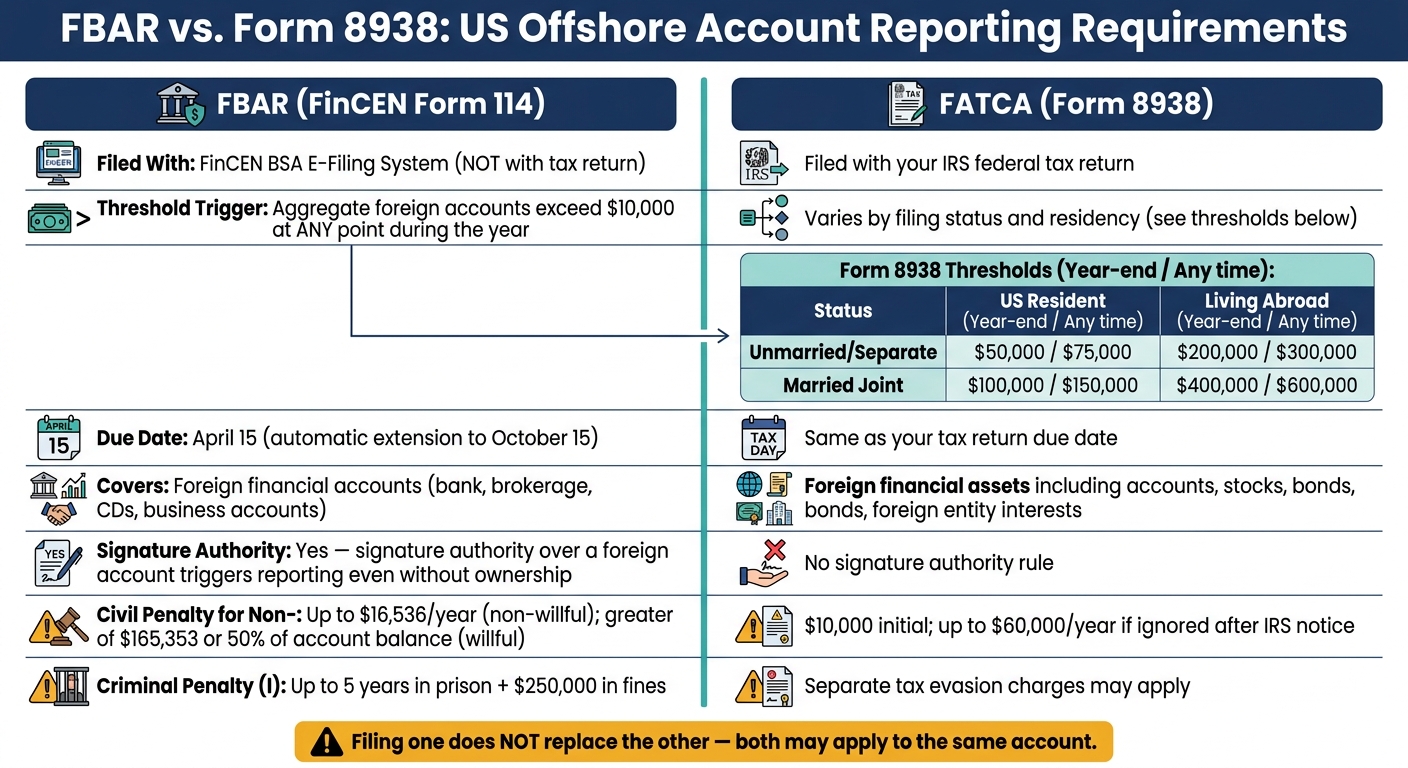
Once you own a foreign account, the next issue is reporting. This is where a lot of people slip up. And yes, you can open the account legally and still run into trouble later if you don’t file the right forms.
The U.S. uses two main reporting systems for foreign accounts: FBAR and FATCA (Form 8938). Both can apply to the same account. Filing one does not replace the other.
FBAR filing requirements
If the total value of all your foreign financial accounts goes over $10,000 at any point during the calendar year, you must file FinCEN Form 114, better known as the FBAR.
That $10,000 limit applies to the combined value of your reportable foreign accounts, not each account by itself. So if you have three foreign accounts with $4,000 in each, you still need to file.
The FBAR is due on April 15. If you miss that date, you get an automatic extension to October 15. You file it electronically through FinCEN’s BSA E-Filing System, not with your tax return.
There’s another detail people often miss: signature authority can trigger reporting too. If you can approve transactions on a foreign business account or a family member’s foreign account, that account may also need to be reported.
"Whether the account produced taxable income has no effect on whether the account is a foreign financial account for FBAR purposes." – Internal Revenue Service
FATCA and Form 8938 thresholds
Form 8938 is filed with your regular IRS tax return. It covers specified foreign financial assets, including foreign bank accounts, stocks, bonds, and interests in foreign entities.
The filing limits for Form 8938 are much higher than the FBAR limits, and they depend on where you live and your filing status.
| Taxpayer Category | Living in the U.S. (Year-end / Any time) | Living Abroad (Year-end / Any time) |
|---|---|---|
| Unmarried / Separate | $50,000 / $75,000 | $200,000 / $300,000 |
| Married Joint | $100,000 / $150,000 | $400,000 / $600,000 |
Source: IRS Summary of FATCA Reporting [7]
If you fail to file Form 8938, the IRS begins with a $10,000 penalty. If you keep ignoring the requirement after the IRS notifies you, that penalty can climb to $50,000.
Reporting foreign income on a U.S. tax return
The U.S. taxes its citizens on worldwide income. In plain English, that means interest, dividends, and capital gains from a foreign account must go on your federal tax return, even if the money never comes back to the United States.
You usually report that income yourself. Interest and dividends are typically listed on Schedule B. If you already paid tax on the same income to a foreign government, you may be able to use Form 1116 to claim the Foreign Tax Credit and reduce double taxation.
One point is worth keeping straight: the account balance itself is not taxable just because it exists. What gets taxed is the income the account earns. And that income must be reported every year, whether you move the money to the U.S. or leave it overseas.
Legal vs. illegal use cases
Comparison table: lawful uses vs. unlawful conduct
| Scenario | Legal or Illegal | Why | Key Filing Requirement |
|---|---|---|---|
| Living abroad | Legal | Managing local expenses and receiving local pay | FBAR if aggregate foreign account value exceeds $10,000; report wages on Form 1040 |
| Business revenue | Legal | Collecting foreign sales through a local account | FBAR; Form 8858 for foreign LLCs |
| Currency diversification | Legal | Holding funds in stable foreign currencies | Report interest, dividends, and capital gains; file FBAR and Form 8938 |
| Asset protection | Legal | Using jurisdictional barriers against creditors | FBAR; Form 8938; Forms 3520/3520-A for trust structures |
| Tax evasion | Illegal | Intentionally failing to report income | Criminal exposure; no lawful use |
| Nominee structures | Illegal | Using nominees or shell entities to hide beneficial ownership | Disclosure of financial interest or signature authority on FBAR |
The line between legal use and illegal conduct often comes down to one thing: disclosure.
A foreign account, by itself, is not a problem. In many cases, it makes perfect sense. You might live overseas, run a business in another country, or want part of your cash in euros or Swiss francs instead of only U.S. dollars. That’s all allowed.
The trouble starts when someone uses the account to hide income, hide who owns it, or avoid reporting rules. Same tool, very different use.
Hypothetical examples for US entrepreneurs and investors
The same account can be lawful in one setting and risky in another, based on how it is reported.
The U.S. founder in Panama. A U.S. founder operating in Panama opens a local corporate account to receive revenue from Latin American clients. This setup is allowed. The founder stays in line with the rules by filing an FBAR and reporting the business income on their U.S. tax return.
The digital nomad in Germany. A freelance designer relocates to Berlin and transfers $15,000 to a local German bank account to cover rent and living expenses. Once the account balance goes over the FBAR threshold, an FBAR is required. The designer also reports any interest earned on Schedule B of their federal return.
The investor with a Swiss private bank account. A U.S. investor holds $200,000 in a Swiss private bank for currency diversification across euros and Swiss francs. They file the FBAR and Form 8938, complete the bank’s FATCA paperwork, and report all interest, dividends, and capital gains each year. The account is fully legal because it is fully disclosed.
Even when the account is completely legal, the bank may still dig into the details before approving it. That can mean due diligence on the source of funds, business activity, tax status, and who owns the account.
Foreign bank due diligence, penalties, and key takeaway
What foreign banks typically require from US applicants
Opening a lawful foreign account doesn’t mean the process is easy. Banks outside the U.S. usually screen American applicants very closely.
In most cases, they’ll ask for:
- A notarized or certified copy of your passport
- Recent proof of address, such as a utility bill or lease agreement
- A U.S. Taxpayer Identification Number and Form W-9
- FATCA self-certification that confirms your U.S. tax status
If you refuse to sign the FATCA paperwork, the bank will usually reject the application.
Business accounts tend to bring even more scrutiny. Banks often want corporate formation documents, identification for all beneficial owners, and a source-of-funds letter backed by records like tax returns, sale documents, or inheritance paperwork. Some also ask for reference letters from your current bank, attorney, or accountant.
One point matters here: passing a bank’s due diligence process does not lower your U.S. reporting duties.
Civil penalties and criminal risk for noncompliance
The bigger problem starts when the reporting stops.
As of 2026, a non-willful FBAR violation can lead to a civil penalty of up to $16,536 per year. A willful violation can cost the greater of $165,353 or 50% of the account balance.
Failing to file Form 8938 can bring a $10,000 penalty. If the failure continues after IRS notice, extra $10,000 penalties can stack up, up to $60,000 per year.
If someone willfully hides the account, the risk goes beyond civil penalties. Criminal charges may follow, including up to five years in prison and fines of up to $250,000 for FBAR violations alone. Separate tax-evasion charges may also apply.
If you’ve missed filings in prior years, the IRS Streamlined Filing Compliance Procedures may offer a way to catch up with lower penalties.
Conclusion: legal to own, illegal to hide
Offshore bank accounts are legal for U.S. citizens when they are disclosed and used lawfully. They cross the line when they are used to hide ownership, income, or transactions.
FAQs
Do I need to report a joint foreign account?
Yes. If your total interest in all foreign financial accounts goes over $10,000 at any point during the calendar year, you must report a joint foreign account on your FBAR. And you need to report the account’s full value, not just your share.
There is one common exception for spouses. If all reportable accounts are jointly owned, and FinCEN Form 114a is completed and signed the right way, one spouse may be able to file on behalf of both. If that exception doesn’t apply, each spouse needs to file a separate FBAR.
What if my offshore account earns no income?
It does not change your reporting duties. If the total value of your foreign financial accounts goes over $10,000 at any time during the calendar year, you must file an FBAR. That rule still applies even if the account is dormant or doesn’t earn interest.
FATCA filing rules may also apply, based on the total value of your foreign financial assets, whether or not those assets produce income. So even if there’s no direct U.S. tax due, you may still need to report the account.
How do I fix missed FBAR or Form 8938 filings?
If you missed past FBAR or Form 8938 filings, don’t just file the current forms or send in a stack of late reports all at once. The IRS may treat that as a quiet disclosure.
There are established IRS paths for getting back into compliance. The right one depends on your tax duties and on whether the failure was willful.
Before you do anything, talk with a qualified tax professional or a Board-Certified Tax Law Specialist.
