
If I want offshore gold to work as a backup, I need three things: a stable country, direct title to the metal, and a vault setup I can use under stress. That’s the whole game.
Here’s the short version:
- I’d focus on Switzerland, Singapore, or Dubai
- I’d buy physical bullion, not ETFs or unallocated metal
- I’d use allocated storage at minimum
- I’d check audits, insurance, buyback terms, and delivery rules
- I’d review U.S. tax and reporting rules before funding anything
The article’s main point is simple: offshore gold is not about chasing price. It’s about keeping part of my wealth outside one banking system and one country. That only works if I can prove ownership, reach the metal, and sell or move it without confusion.
A few facts stand out:
- Canada froze 200+ bank accounts in 2022
- Swiss refineries handle about 50% to 70% of newly mined gold
- Storage fees often run about 0.12% to 1.0% per year
- Some coins, like American Gold Eagles, may not get the same tax treatment abroad as 99.5%+ bullion
- Willful FBAR penalties can reach up to 50% of the account value per violation in some cases
Quick comparison
| Option | Best use | Main upside | Main drawback |
|---|---|---|---|
| Switzerland | Deep vault market | Strong property rights and gold infrastructure | U.S. reporting review still matters |
| Singapore | Asia-based storage | English-speaking legal system and tax-free qualifying bullion | Long flight from the U.S. |
| Dubai | Lower buying premiums | Active physical gold market and no capital gains tax locally | Harder to access from the U.S. |
I’d treat offshore gold as one part of a backup plan, along with foreign cash access, legal ownership planning, and clear access steps. The rest comes down to picking the country, the custody model, and the title structure with care.
sbb-itb-39d39a6
What offshore gold means for your Plan B
Offshore physical gold is bullion stored in a private vault outside your home country. In plain English, it gives you a reserve that doesn’t depend on your local banking system.
Why keep gold outside your home country
Every country comes with its own set of risks. Currency devaluation, capital controls, banking freezes, and sudden policy changes can all hit faster than most people expect. Keeping part of your assets in a stable foreign jurisdiction lowers that dependence.
The classic case is the 1933 U.S. gold confiscation under Executive Order 6102. The government required many citizens to surrender most of their gold holdings, with limited exceptions. That’s the kind of risk offshore storage is meant to reduce.
Places like Switzerland and Singapore are often picked because of their stability and strong property rights. Private, non-bank vaults in those countries also sit outside the domestic banking system. That matters. It can help shield your gold from bail-in risk, bank holidays, and the insolvency of a financial institution.
Paper gold versus physical gold held abroad
Gold ETFs, futures contracts, and unallocated accounts can all track the price of gold. But price exposure and ownership are not the same thing.
These products don’t give you direct ownership of metal. They give you a claim tied to a fund manager, broker, or bank balance sheet.
Jurisdiction matters, but custody structure matters too. After jurisdiction, custody is the second big choice because it shapes how much control you actually have. Allocated storage gives you specific, serial-numbered bars. Unallocated storage gives you only a claim on metal.
For a Plan B, direct ownership matters more than price exposure. Once ownership is clear, the next move is picking the right jurisdiction and vault setup.
Where offshore gold fits in a wider backup plan
Offshore gold works best as one layer in a broader strategy, not as a stand-alone fix. Think of it as part of a stack:
- A foreign bank account for liquidity abroad
- A second residency for relocation planning
- Legal structures like a private U.S. LLC, an offshore company, or a trust for separation and estate planning
Each layer covers a different failure point.
A foreign bank account gives you access to cash abroad. A second residency can make a move far less chaotic if conditions at home change. An offshore company or trust can add legal separation and make estate planning simpler. The next section compares the main storage jurisdictions and what each one offers.
How to pick the right country for storing gold
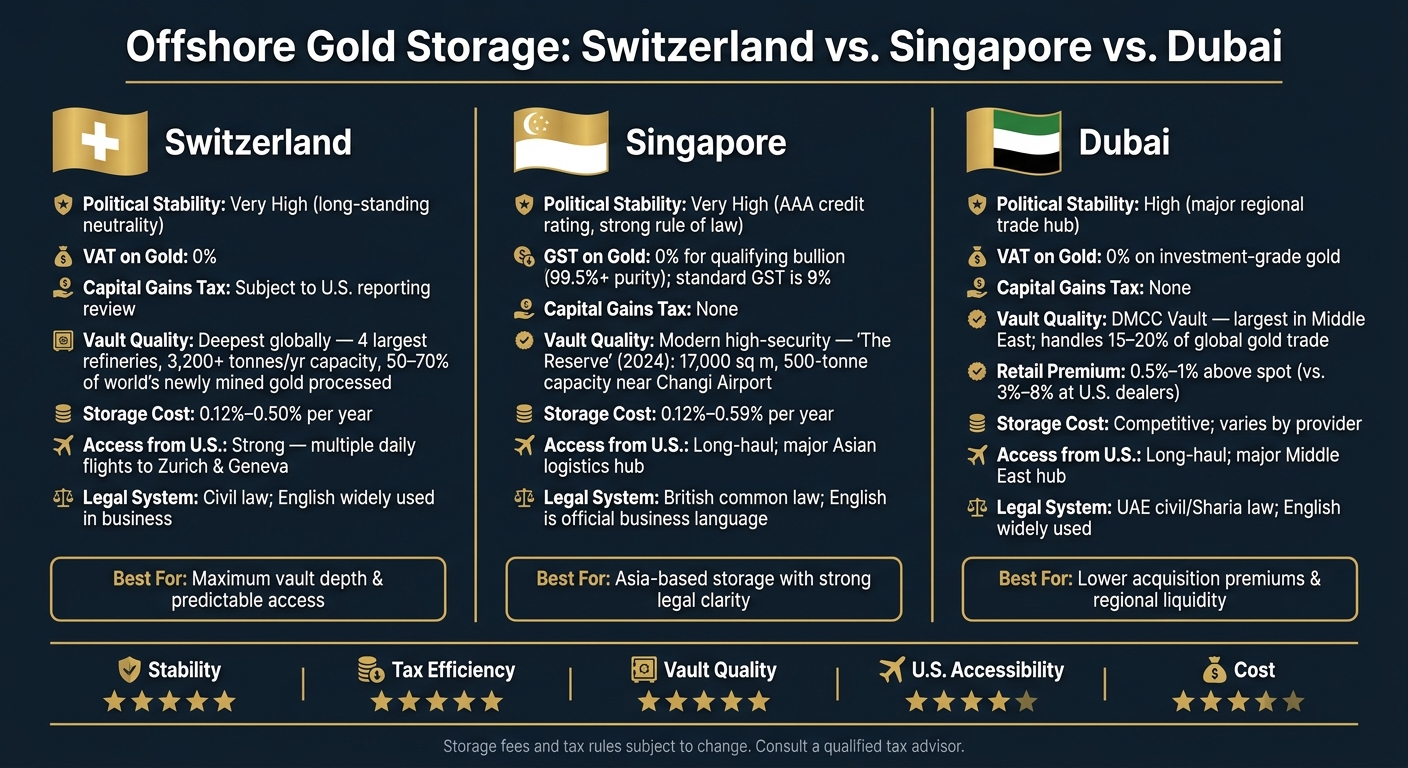
For offshore gold, the main filters are rule of law, tax treatment, vault quality, and practical access from the U.S.
For many U.S. readers, the top options come down to Switzerland, Singapore, and Dubai.
| Feature | Switzerland | Singapore | Dubai |
|---|---|---|---|
| Political Stability | Very high; long-standing neutrality | Very high; strong rule of law, AAA credit rating | High; major regional trade hub |
| Tax on Investment Gold | 0% VAT | 0% GST on qualifying bullion; no capital gains tax | 0% VAT on investment-grade gold; no capital gains tax |
| Vault Quality | Deepest vault and refining infrastructure | High-security, modern vaults | Large institutional vaulting |
| Access from the U.S. | Strong; multiple daily flights to Zurich and Geneva | Long-haul; major Asian logistics hub | Long-haul; major Middle East hub |
| Typical Storage Cost | 0.12%–0.50% per year | 0.12%–0.59% per year | Competitive; varies by provider |
| Legal/Language | Civil law; English widely used in business | British common law; English is the official business language | UAE civil/Sharia law; English widely used |
Once you’ve narrowed down the country, the next step is simple: how the gold is titled and how it’s stored.
Switzerland: the established gold storage option
Switzerland is still the default pick for many investors who want deep vault infrastructure and easy access from Europe. There’s a good reason for that. Swiss refineries process an estimated 50% to 70% of the world’s newly mined gold, and the country is home to the four largest refineries globally, with combined annual capacity of more than 3,200 tonnes.
Another big plus is custody. Private vault networks in Switzerland operate outside the banking system, so your gold can sit outside any bank balance sheet. That matters if you want direct ownership instead of another layer of financial exposure. Storage fees through providers like BullionVault start at 0.12% per year with a $48 annual minimum.
One point U.S. persons shouldn’t brush past: reporting duties still apply under the new FATCA IGA, effective Jan. 1, 2027.
Best for maximum vault depth and predictable access.
Singapore: Asia’s main bullion center
Singapore makes sense for readers who want a stable, English-speaking base in Asia. Its legal system follows British common law, and it has a long track record of business-friendly regulation. If you want a place that tends to feel orderly and easy to deal with, Singapore checks that box.
The vault setup is modern too. Silver Bullion Pte Ltd completed "The Reserve" in 2024, a 17,000-square-meter high-security facility near Changi Airport with capacity for 500 tonnes of gold. On taxes, Singapore’s GST is 9% as of 2024, but qualifying investment precious metals are fully exempt.
The detail that trips people up is purity. The main cutoff is 99.5% purity. That means 24k bullion qualifies, while 91.67% American Gold Eagles do not. In plain English: not every gold coin gets the same tax treatment, even if it’s popular with U.S. buyers.
Best for Asia-based storage with strong legal clarity.
Dubai: gold trading and storage in the Gulf
Dubai is a fit for buyers who care about lower premiums and strong market liquidity. It handles an estimated 15% to 20% of the global gold trade, which puts it among the world’s biggest physical gold markets. That scale helps explain the pricing. Retail prices at the Dubai Gold Souk can run as low as 0.5% to 1% above spot, versus 3% to 8% that’s common at U.S. dealers.
Tax treatment is also straightforward. There is no VAT on investment-grade gold and no capital gains tax.
For storage, the DMCC Vault is the largest vaulting facility in the Middle East and offers institutional-grade storage. For U.S. buyers, though, Dubai often works better as a place to vault gold than as a market you plan to visit often. The distance makes casual access a lot less practical.
Best for lower acquisition premiums and regional liquidity.
How to buy, own, and store your gold abroad
Once you’ve chosen a jurisdiction, you still have three big calls to make: what you buy, how it’s stored, and whose name is on the title. Get any of those wrong, and your “gold” can end up being little more than a paper claim.
Bars versus coins: which format to buy
Bars usually cost less. Coins are easier to sell piece by piece.
For bigger positions, 1-kilogram bars are often the sweet spot. They keep acquisition costs lower without becoming a headache to store. LBMA Good Delivery bars from refiners like Valcambi, PAMP, and Metalor can trade at spreads as low as 0.2% over spot in wholesale markets.
Coins work better when flexibility matters more than price. A 1 oz Canadian Maple Leaf or Austrian Philharmonic can be sold one at a time. That matters if you need cash in smaller chunks during a disruption, instead of unloading a full kilogram in one shot. The downside is the premium: retail coin markups can run 5% to 10% above spot for popular products.
After that, storage matters even more than price. A cheap buy doesn’t help much if the custody setup leaves you with a claim instead of metal.
Allocated, unallocated, and segregated storage: what each means
The storage model decides whether you own gold outright or just have a promise from someone else.
| Feature | Allocated | Unallocated | Segregated |
|---|---|---|---|
| Legal Title | Held by the investor | Held by the provider (investor is a creditor) | Held by the investor |
| Creditor Exposure | Low; assets off-balance sheet | High; assets on provider’s balance sheet | Lowest; physically separated |
| Delivery Rights | Specific bars by weight and purity | Claim for equivalent weight | Your exact serial-numbered bars |
| Fee Level | Moderate (0.12%–0.5%/yr) | Lowest (often zero) | Highest (0.5%–1.0%+/yr) |
| Audit Transparency | High; bar lists provided | Low; pool-based | Highest; physical verification |
Unallocated storage is the weak link. If the provider fails, you’re an unsecured creditor.
Allocated storage puts the gold off the provider’s balance sheet. Your bars are identified by serial number and held in trust. Segregated storage adds another layer: your bars are kept physically apart from other clients’ metal, so the exact bars you put in are the ones that come back out.
For a Plan B, allocated is the floor. If the position is large enough, segregated storage can be worth paying more for.
Personal ownership versus holding gold through an LLC or trust
Direct ownership is the cleanest route for smaller holdings. An LLC or trust adds legal separation and can make transfers at death much smoother.
An LLC or offshore trust can screen out weak legal claims and separate the asset from personal liability more cleanly through offshore asset protection than direct ownership. It also helps on the transfer side. Instead of moving metal across borders after death, control passes through the entity documents.
That said, privacy doesn’t erase U.S. reporting duties. A private vault may not report on its own, but U.S. persons still have FBAR and Form 8938 duties when the filing thresholds apply.
And none of this matters much if the dealer or vault can’t deliver when access counts.
Choosing providers and planning for access when it matters
How to check a bullion dealer or vault provider
Once you’ve sorted out title and storage, the next piece is the provider. That’s the part that shows whether you actually control the metal.
Start with accreditation. Dealers and refiners on the London Bullion Market Association (LBMA) Good Delivery List meet recognized bar-quality standards. Regional groups such as the Singapore Bullion Market Association (SBMA) and Dubai Multi Commodities Centre (DMCC) can also point to a legitimate operation.
Before sending any money, ask direct questions about audits and insurance. Good vault providers use independent third-party audits from firms like Bureau Veritas or major accounting firms. The best ones also give you bar photos and online serial-number matching, so you can check that your bars are there and tied to your account. On insurance, confirm that the policy includes full replacement coverage and protection for "mysterious disappearance." That’s not a small detail. Many standard policies leave out losses that can’t be tied to clear proof of theft. Common underwriters include Lloyd’s of London and Marsh & McLennan.
You should also keep your own file with invoices, authenticity certificates, and warehouse receipts that list bar serial numbers. If there’s ever a dispute over records, those papers help prove title during resale.
Here are the main questions worth asking before you commit:
| Category | Question | Why It Matters |
|---|---|---|
| Legal Structure | Does the contract keep title in my name or the entity’s name? | Bailment keeps the gold as your property, not the provider’s asset |
| Regulatory Status | Does this structure trigger FATCA reporting? | It may affect whether the provider has reporting duties to the IRS |
| Audit | Can I see a third-party audit with my bar’s serial number? | Confirms the physical existence of your specific bars |
| Insurance | Does the policy cover "mysterious disappearance"? | Standard policies often exclude losses with no clear evidence of theft |
| Counterparty | Is the vault operator a bank or a private entity? | This affects whether your metal sits on a bank balance sheet |
| Liquidity | What is the guaranteed buyback spread and timeline? | Helps you get out without steep discounts when timing matters |
| Fees | Are there fabrication or out-handling fees for physical delivery? | Hidden costs can cut into what you get back on exit |
Getting access, delivery, and liquidity when you need it
Plan for access before you need it. Most high-security international vaults need at least 48 hours’ notice for a visit or audit. Insured shipment or liquidation usually takes several business days. That’s fine in many cases, but offshore gold is not a same-day emergency fund.
If you need to move the metal, the usual paths are personal pickup at the vault, insured shipment to another location, or an in-vault transfer or sale through the provider or a dealer. For pickup, transfer, or sale, expect to show a valid passport, account credentials, and entity documents if the gold is held through an LLC or trust. Keep both physical and digital copies of these records somewhere you can reach outside your home country.
It also pays to check your setup from time to time. Log into the online portal and make sure your contact details and authorized signatories are current. If you’ve added power-of-attorney or beneficiary instructions, test those as well. If you haven’t tested access, you’re guessing.
How the gold is titled can also shape what you may need to report in the U.S.
U.S. reporting and tax rules you need to know
Not legal or tax advice: U.S. reporting rules are complex and change. Talk with a qualified U.S. tax attorney or CPA with international experience before opening any foreign account.
Tax filing depends on title and custody, not just location. Directly owned physical gold in a private foreign vault is generally not an FBAR financial account, because FBAR applies to financial accounts, not physical property. But the picture can change if your gold sits inside a custodial account where the institution controls the asset, or if it’s held through a foreign LLC or trust. In those cases, FBAR or Form 8938 (FATCA) reporting may apply.
On the customs side, gold bullion brought into the U.S. is duty-free, but it still must be declared on CBP Form 6059B no matter the amount. Legal tender gold coins taken across the border require FinCEN Form 105 if the value is more than $10,000. And no matter how the gold is titled or stored, U.S. persons owe capital gains tax on any sale.
The penalty side is no joke. Willful failure to file required FBAR reports can lead to penalties of up to 50% of the account value per violation. Even non-willful violations can still cost $10,000 per account per year.
Conclusion: Set up offshore gold you can actually rely on
Once you’ve picked a jurisdiction, dealer, and vault setup, one question matters more than anything else: will this still work in a crisis? Offshore gold only does its job if you can verify that you own it, get to it, and move it when you need to.
Use offshore gold for actual jurisdiction risk, concentration risk, or banking-system risk. That’s the simple filter. If none of those apply, you’re adding complexity without a clear upside.
Your location choice should fit how you travel and how you’d get access if things go sideways. After that, custody is the key issue. Allocated and segregated storage means specific, serial-numbered bars are held in your name and kept off the provider’s balance sheet.
Before you fund anything, have a U.S. tax attorney review who owns the asset and who holds it.
Then keep the account in working order. Update beneficiaries, confirm who has authority to act on the account, and test your access steps from time to time. Storage fees usually run 0.12% to 1.0% per year, which is manageable when weighed against the risk of keeping everything in one place.
A Plan B only counts if it works. It isn’t gold in theory. It’s gold you can prove, reach, and move.
FAQs
How much gold should I keep offshore?
How much gold to keep offshore comes down to your risk tolerance and the job you want it to do in your overall plan. For many investors, offshore gold serves as a core layer of wealth protection.
Professional vaulting often starts to make sense at around $5,000 to $10,000. And for portfolios of $500,000 or more, the case for jurisdictional diversification can be strong enough to justify the added cost and extra moving parts.
Can I take delivery of my gold quickly in an emergency?
Yes, but if your gold is stored overseas, you need to plan ahead.
Your provider may be able to package and ship your gold in a secure way. But this usually takes coordination with professional security carriers. It can also come with high handling, insurance, and shipping costs.
You may also run into customs procedures, import duties, or taxes, depending on where the gold is being sent. Check your provider’s withdrawal process, delivery policies, and contract terms before an emergency hits.
Should I own offshore gold personally or through an LLC or trust?
It comes down to what you want most: privacy, asset protection, or simpler tax reporting.
Owning gold in your own name is the most straightforward path. You have direct legal title, and there’s less setup to deal with.
Using an LLC or trust can add a layer of liability protection and can also help with estate planning. That said, the legal structure doesn’t change the need for clear ownership records.
No matter which route you choose, make allocated, segregated storage a top priority. That helps make sure you hold clear title to specific bars, not just a general claim on pooled metal.
If you’re a U.S. person, FATCA and FBAR reporting rules still apply. In plain English: putting gold in an LLC or trust doesn’t make those filing duties go away.
