
Yes – there are 18 jurisdictions in 2026 with 0% personal income tax in some form. But they do not all work the same way. Some tax nothing at the personal level. Others leave salary untaxed but still tax some local business income. And Oman already has a 5% personal income tax set to start on January 1, 2028.
If you’re comparing options, I’d focus on three things first:
- What income gets taxed: salary only, or salary plus dividends, interest, and capital gains
- How you get residency: job sponsorship, property, investor route, or citizenship-by-investment programs
- What you still pay instead: VAT, payroll tax, import duties, stamp duty, or social insurance
Here’s the full list covered in the article:
- United Arab Emirates
- Qatar
- Kuwait
- Bahrain
- Saudi Arabia
- Oman
- Brunei
- Bahamas
- Bermuda
- Cayman Islands
- British Virgin Islands
- Turks and Caicos Islands
- Anguilla
- Antigua and Barbuda
- St. Kitts and Nevis
- Monaco
- Vanuatu
- Maldives
For U.S. citizens and green card holders, there’s one big point: moving to a zero-tax country does not end U.S. tax filing. The U.S. still taxes worldwide income. The 2026 Foreign Earned Income Exclusion is $132,900, but it applies to earned income, not most investment income or pension distributions.
Quick comparison
| Type | Places |
|---|---|
| True 0% personal tax base | UAE, Kuwait, Bahrain, Brunei, Bahamas, Bermuda, Cayman Islands, BVI, Turks and Caicos, Anguilla, Antigua and Barbuda, St. Kitts and Nevis, Monaco, Vanuatu, Maldives |
| 0% on salary, but not all local business income | Qatar, Saudi Arabia |
| 0% in 2026, but changing | Oman |
Bottom line: if you want a simple short answer, the cleanest no-income-tax names in 2026 are places like the UAE, Bahamas, Cayman Islands, Bermuda, Monaco, and Vanuatu. But the best choice depends less on the headline 0% rate and more on residency access, other taxes, and your passport.
sbb-itb-39d39a6
1. United Arab Emirates
The UAE taxes personal income at 0% on salary, self-employment income, dividends, capital gains, and foreign-source income. In plain English, if your main goal is to live somewhere with no personal income tax, the UAE is one of the clearest options out there.
That said, there’s an important line to watch: business profits are still subject to a 9% federal corporate tax on net profits above AED 375,000 (about $102,000). And large multinationals with global revenue above €750 million face a 15% Domestic Minimum Top-up Tax for financial years starting on or after January 1, 2025.
Residency access
Residency is the main gateway to using the UAE’s zero-income-tax setup. To establish UAE tax residency, you generally need to spend at least 183 days per year in the country, though 90 days may be enough in some cases.
The main paths include:
- 10-year Golden Visa, which requires a property investment of at least AED 2,000,000
- 1-year Remote Work Visa
- 5-year Green Visa for freelancers who qualify through a Green Visa or free-zone license
Other taxes
The catch is simple: the UAE still collects money through spending and property-linked charges. So while income tax may be zero, daily life isn’t tax-free.
Key residual taxes include:
- 5% VAT on most goods and services
- Excise taxes from 50% on sugary beverages to 100% on tobacco and energy drinks
- 4% property transfer fee on real estate purchases in Dubai
- Housing fee of about 5% of annual rent, added to utility bills
- Mandatory private health insurance, usually $1,500 to $5,000 per person per year
Best fit
This makes the UAE a strong pick for active earners, though the non-income taxes still matter. It tends to work best for employed expats, freelancers, and business owners who care most about reducing tax on personal income.
For U.S. citizens, there’s another layer. If you hold UAE residency, you may be able to pair it with the Foreign Earned Income Exclusion to reduce U.S. federal tax on the first $132,900 of earned income in 2026. But the U.S. still taxes citizens on worldwide income, so the filing duty doesn’t disappear.
2. Qatar
Qatar taxes salaries, wages, and employment allowances at 0% under Law No. 24 of 2018.
Tax scope
The split here is pretty clear: employment income is exempt, but local self-employment and business income can still be taxed. Qatar uses a territorial system, so foreign-source income is generally outside the local tax net.
| Income Type | Tax Rate | Notes |
|---|---|---|
| Salaries & wages | 0% | Exempt under Law No. 24 of 2018 |
| Self-employment and local business income | 10% | Applies to individuals earning taxable local business income |
| Foreign-source income | 0% | Generally outside the local tax net |
| Dividends (non-resident) | 0% | No withholding tax |
| Interest, royalties & commissions (non-resident) | 5% | Final withholding tax |
Residency access
For most expats, residency in Qatar is linked to an employment contract with a local entity. There are other paths, though. Foreigners can get residency by buying property in approved areas with a minimum investment of $200,000 (QAR 728,000).
Another route is business activity. If you set up a local company or invest in Qatari enterprises, that can also open the door to residency.
Other taxes
Qatar had no VAT as of mid-2026.
Best fit
Qatar is a better match for employed expats whose income is clearly treated as salary rather than business profit. If that’s your setup, a Tax Residency Certificate can help document local tax residency.
So the appeal is clear, but it comes with limits: Qatar is mainly a strong option for wage earners, not a broad no-tax answer.
3. Kuwait
Kuwait is another Gulf jurisdiction where personal wage income is tax-free. But there’s a catch: access mostly comes through employer-sponsored residency.
Kuwait taxes salaries, self-employment income, dividends, and capital gains at 0%, unless that income comes from a taxable trade. Here’s the basic breakdown.
Tax scope
| Income Type | Tax Rate | Notes |
|---|---|---|
| Salaries & wages | 0% | No filing obligation for salary income |
| Self-employment income | 0% | Applies to individuals |
| Dividends & capital gains | 0% | Generally exempt unless part of a taxable trade or activity |
| Corporate tax (foreign-owned entities) | 15% | Applies to foreign-owned businesses, not individual earners |
Residency access
That 0% treatment only helps if you can get legal residence.
In practice, residency is mostly tied to work. Most expats need an employer-sponsored visa to live in Kuwait. That’s the main hurdle. Unlike some nearby Gulf states, Kuwait doesn’t have a commonly used Golden Visa or property-based residency route. So if you’re a retiree or remote worker with no local sponsor, getting in is tough.
Residents can apply for a Tax Residency Certificate using immigration, housing, and identity documents.
So the tax side is simple. The hard part is getting access.
Other taxes
Kuwait is unusually clean from an individual tax angle. There’s no VAT and no property tax. A Domestic Minimum Top-up Tax applies only to large multinationals, for financial years starting on or after January 1, 2025, in line with OECD Pillar Two rules.
Best fit
Kuwait makes the most sense for employed professionals who can get sponsorship and want a clean 0% personal tax setup. If you don’t have local employment, it’s not a practical relocation option.
4. Bahrain
Bahrain is a 0% personal income tax jurisdiction in 2026. That means wages, self-employment income, investment income, capital gains, and foreign-source income are all untaxed at the individual level. There’s also no personal wealth tax and no inheritance tax.
That said, the key issue isn’t the tax rate itself. It’s access. Bahrain’s zero-tax setup only starts to matter once you have residency in place.
Tax scope
| Income Type | Tax Rate | Notes |
|---|---|---|
| Salaries & wages | 0% | Personal income is not taxed |
| Self-employment income | 0% | Untaxed for individuals |
| Investment income | 0% | Untaxed for individuals |
| Capital gains | 0% | No capital gains tax for individuals |
| Foreign-sourced income | 0% | No personal tax on foreign income |
| Wealth / inheritance | 0% | No wealth or inheritance tax |
| Business profits | 0% / 46% / 15% | Most domestic companies are untaxed; oil & gas faces 46%, and large multinationals face the 15% DMTT |
For most people, the headline is simple: personal income stays untaxed. But business owners need to look a bit closer. Most domestic companies pay 0%, while oil and gas companies face 46%. Large multinational groups still deal with the 15% DMTT.
Residency access
Bahrain offers a few ways in. One of the main options is the Golden Residency Permit, which is open to investors, retirees, and highly skilled professionals.
Retirees can also qualify through property-backed self-sponsorship. The entry point starts at BHD 50,000, or about $132,000. Other investment paths call for about $270,000 in business or real estate assets.
So, on paper, Bahrain is tax-free for individuals. In practice, the main filter is whether you can meet one of those residency routes.
Other taxes
The main tax people still feel day to day is 10% VAT, which increased from 5% in 2022. Employees also pay a 1% social insurance contribution.
Best fit
Bahrain works well for retirees, skilled professionals, and business owners who want a zero-income-tax base and residency paths that are still within reach. If you’re part of a large multinational group, though, the 15% DMTT needs to be part of the math.
Next, Oman shows how fast the Gulf’s zero-tax picture is changing.
5. Saudi Arabia
Saudi Arabia taxes employment income at 0%. But that doesn’t mean it’s a no-tax-for-everything setup. Like Qatar and Kuwait, the 0% rate mostly applies to wages, not all income. Business activity, some Saudi-source payments, and non-resident cases can still fall under income tax or withholding tax rules.
Tax scope
| Income Type | Tax Rate | Notes |
|---|---|---|
| Salaries & wages | 0% | |
| Investment income | 0% | |
| Capital gains | 0% | |
| Business profits | 20% | Applies to foreign-owned entities |
| Oil & gas operations | Up to 85% |
Non-residents without a permanent establishment can also face withholding tax on some Saudi-source payments.
Residency access
For most people, residency comes through an employer sponsor. If you want another route, Saudi Arabia offers Premium Residency. This option is aimed at investors and high-net-worth applicants, and the permanent version starts at about $213,000.
Other taxes
There’s also 15% VAT in Saudi Arabia, and mandatory social insurance can trim your take-home pay.
Best fit
Saudi Arabia makes the most sense for salaried professionals who have employer sponsorship and want 0% tax on wages. If you run a business, the picture changes fast because foreign-owned entities still face a 20% corporate tax rate.
For U.S. citizens, there’s another catch. You may still owe U.S. tax. Since there’s no local income tax on wages, there may be no Foreign Tax Credit to use, although the 2026 FEIE of $132,900 still applies.
That leaves Oman as the next Gulf case, and its tax profile is changing.
6. Oman
Oman has 0% personal income tax in 2026. But that changes on Jan. 1, 2028, when a 5% personal income tax starts under Royal Decree No. 56/2025. So, for now, Oman is still a zero-tax choice. The catch is simple: that window already has an end date.
That puts Oman in a different bucket from the UAE, Bahrain, and Kuwait. In those places, there isn’t a dated personal tax change already on the books. In Oman, there is.
Tax scope
The 2028 law applies a 5% tax on income above 42,000 OMR, which is about $109,000.
| Income Type | Rate in 2026 | From Jan. 1, 2028 |
|---|---|---|
| Salaries & wages | 0% | 5% on income above 42,000 OMR |
| Self-employment income | 0% | 5% on income above 42,000 OMR |
| Rental, royalty, and interest income | 0% | 5% on income above 42,000 OMR |
| Gains from real estate or share disposals | 0% | 5% on income above 42,000 OMR |
There’s one more point that matters a lot. For tax residents, the 2028 law covers worldwide income. For non-residents, it applies only to Oman-source income.
Residency access
The usual path in is still employment-linked sponsorship.
If you’re moving as an investor, Oman offers Investor Residency with 5-year or 10-year renewable residency. That route is tied to real estate investment starting at $65,000 and going up to $130,000, based on the property’s location. Oman also opened property ownership to foreign buyers in June 2026.
For tax residency, the general rule is 183 days in Oman during a tax year.
Other taxes
Personal income tax isn’t the only thing to watch.
- VAT is 5% on most goods and services.
- Corporate income tax is generally 15% for most businesses.
- Some expat employees may also pay a 1% social insurance contribution under certain work setups.
The law also carves out a few exceptions. Certain listed Muscat Stock Exchange shares and government bond interest are exempt.
Best fit
Oman can make sense for retirees, remote workers, and business owners who want a lower-cost Gulf base. In plain English, it may work best if you want Gulf access without the price tag that often comes with bigger regional hubs.
If you expect to earn more than 42,000 OMR and want to stay for the long haul, run the numbers twice: once for the current 0% period, and again for the 2028 tax setup before making the move.
Next is Brunei, which also has no personal income tax but comes with different residency and business rules.
7. Brunei
Brunei’s personal income tax rate is 0% in 2026. That sounds simple on paper. And for individuals, it is. Corporate tax is a separate issue and applies to companies, not people.
Tax scope
The tax setup is easy to read. The harder part is getting access to live there in the first place.
| Tax Category | Rate |
|---|---|
| Personal Income Tax | 0% |
| Corporate Income Tax | 18.5% |
| VAT / Sales Tax | None |
| Capital Gains Tax | None |
Residency access
This is where Brunei gets tricky. It offers very few independent residency paths. In most cases, foreigners need employer sponsorship.
So while the tax rate looks attractive, residency is not easy to get without a company backing your move. Independent residency is rare, which makes Brunei a practical option mostly for people who already have a job offer in hand.
Other taxes
Brunei has no VAT or sales tax. It also does not impose capital gains tax. For business owners, the main number to watch is the 18.5% corporate income tax rate.
Best fit
Brunei makes the most sense for employed expats who already have a role lined up with a company operating there.
Next is the Maldives, another no-income-tax jurisdiction with different residency and tax details.
8. Bahamas
The Bahamas charges 0% personal income tax in 2026 on salary, self-employment income, investment income, capital gains, and foreign-sourced income. For anyone comparing zero-tax jurisdictions, that makes it a pretty plain, easy-to-read option.
Tax scope
| Tax Category | Rate |
|---|---|
| Personal Income Tax | 0% |
| Capital Gains Tax | 0% |
| Inheritance / Gift Tax | 0% |
| VAT | 10% |
| Import Duties | 5%–45% |
Residency access
The main residency routes include:
- Real estate investment of $750,000 or more for priority permanent residency
- An annual residence permit for about $1,000
- The BEATS program for up to one year
That part often matters more than the headline tax rate. A 0% rate sounds great, but relocation usually comes down to how easy it is to get in, stay there, and plan around the rules.
Other taxes
The Bahamas still brings in revenue through VAT, import duties, property taxes, stamp duties, and business license fees. So while personal income tax is zero, day-to-day costs and transaction taxes still matter.
For U.S. citizens, there’s another layer. They still owe U.S. tax on worldwide income, although the 2026 FEIE can exclude up to $132,900 of earned income.
Best fit
The Bahamas tends to suit retirees, remote executives, and high-net-worth residents who want 0% personal tax and clear residency routes.
Bermuda offers a similar zero-income-tax profile, but the residency rules and business-tax setup are different.
9. Bermuda
Bermuda charges 0% personal income tax in 2026. It also has no tax on foreign-sourced income, wealth, or inheritance.
Tax scope
| Tax Category | Rate | Notes |
|---|---|---|
| Personal Income Tax | 0% | No tax on salary, dividends, or interest |
| Capital Gains Tax | 0% | No tax on investment gains |
| Inheritance Tax | 0% | No estate or gift taxes |
| Payroll Tax | Varies | Levied separately from personal income tax |
| Corporate Tax | 15% | Applies only to MNEs with €750M+ annual revenue |
| VAT | 0% | Bermuda relies on customs and import duties instead |
The tax side is straightforward. Getting in is the hard part.
Residency is tough to secure. The Work from Bermuda digital nomad certificate closed to new applications in 2025. Current routes include employment sponsorship, a major local business presence, or a Permanent Resident Certificate linked to a large real estate investment. A property-based route can cost more than $2.5 million.
There’s also an important catch: Bermuda doesn’t charge personal income tax, but it does charge payroll tax separately. And while there’s no VAT, import duties on most goods range from 6% to 33%.
Bermuda tends to fit high-earning executives, insurance professionals, and high-net-worth individuals best. In plain English, that usually means sponsored workers, business owners, and people able to make a high-value property investment who can qualify through work or capital.
If you’re a U.S. citizen, the story doesn’t stop in Bermuda. You still need to file U.S. tax returns, though the 2026 FEIE can exclude up to $132,900 of earned income.
Next comes the Cayman Islands, another no-income-tax jurisdiction with different residency rules.
10. Cayman Islands
The Cayman Islands keeps its zero direct-tax system in 2026. That means no personal income tax, no corporate tax, no capital gains tax, no inheritance tax, and no gift tax. Salary, self-employment income, dividends, interest, and foreign-source income are all untaxed at the direct-tax level. The catch is pretty simple: getting access isn’t cheap.
Tax scope
| Tax Category | Rate | Notes |
|---|---|---|
| Personal Income Tax | 0% | No tax on salary, self-employment income, dividends, interest, or foreign-sourced income |
| Capital Gains Tax | 0% | No capital gains tax |
| Corporate Tax | 0% | No direct corporate tax |
| Inheritance / Gift Tax | 0% | No estate or gift taxes |
| Import Duties | 22%–27% | Applied to most imported goods and a major revenue source |
| Stamp Duty (Property) | 7.5% | 7.5% on property transfers |
Residency access
Residency mostly comes down to which route you can qualify for. Remote workers may be able to use the Global Citizen Concierge Program, which calls for at least $100,000 per year in income. Many expats arrive through employer-sponsored work permits instead.
For investors, the bar is much higher. Investor residency requires $145,000 in annual income plus $1.2 million in local real estate or business investment. Permanent residency usually starts at $2.4 million.
Other taxes
Instead of taxing income, Cayman brings in government revenue through import duties, stamp duty, and fees. So while income may be untaxed, day-to-day costs and transactions can still take a bite.
Best fit
Cayman is usually a better match for high earners, investors, and business owners who can clear the residency hurdles. For U.S. citizens, there’s an extra layer to think about: federal tax still applies no matter where you live. The 2026 FEIE can exclude up to $132,900 of earned income, but it doesn’t erase U.S. filing duties. The next section compares Cayman with the other no-income-tax jurisdictions by tax scope, access, and practical fit.
11. British Virgin Islands
Like Cayman, the BVI leans on indirect taxes and fees instead of direct personal income tax. For individuals, the rate is 0% on salary, dividends, interest, capital gains, and foreign-source income. There’s also no corporate tax, inheritance tax, gift tax, VAT, or general sales tax. The catch is pretty clear: payroll tax applies, import duties are high, and residency is not easy to get.
Tax scope
| Tax Category | Rate | Notes |
|---|---|---|
| Personal Income Tax | 0% | No tax on salary, dividends, interest, capital gains, or foreign-source income |
| Capital Gains Tax | 0% | No capital gains tax |
| Corporate Tax | 0% | No direct corporate tax |
| Inheritance / Gift Tax | 0% | No inheritance or gift tax |
| VAT / Sales Tax | 0% | No VAT or general sales tax |
| Import Duties | 22%–27% | A major revenue source on imported goods |
| Payroll Tax | Applies | Applies to both employers and employees |
Residency access
Residency usually comes through employment, running a local business, or showing proof of independent means; the BVI does not offer a formal residency-by-investment program. By Caribbean standards, residency is tough to secure.
If you want to make a residency claim stick, paper trails matter. That usually means things like a local lease or title deed, local bank accounts, and records that show you were physically present in the territory.
Other taxes
The BVI mainly funds government through import duties, stamp duties, and fees from the financial services sector rather than direct taxes. Payroll tax also applies to both employers and employees.
Best fit
The BVI tends to suit offshore business owners and high-income professionals who can deal with the residency rules and keep clean documentation. For U.S. citizens, the zero-tax setup does not erase U.S. tax obligations. They still owe U.S. tax on worldwide income, and the 2026 FEIE may help with earned income, but not passive income.
Next up is Turks and Caicos, another Caribbean zero-income-tax jurisdiction with its own residency rules.
12. Turks and Caicos Islands
The Turks and Caicos Islands (TCI) charges 0% personal income tax in 2026. That means no tax on salary, self-employment income, capital gains, dividends, interest, or foreign-source income. There’s also no corporate tax, inheritance tax, or gift tax. So the big issue usually isn’t the tax rate. It’s whether you can get the right to live there.
Tax scope
| Tax Category | Rate | Notes |
|---|---|---|
| Personal Income Tax | 0% | No tax on salary, self-employment income, dividends, interest, capital gains, or foreign-source income. |
| Capital Gains Tax | 0% | No capital gains tax. |
| Corporate Tax | 0% | No corporate income tax. |
| Inheritance / Gift Tax | 0% | No inheritance or gift tax. |
| VAT / Sales Tax | None | No VAT or general sales tax. |
| Tourism Tax | 12% | Applied to hotels and restaurants |
| Import Duties | Varies | A major source of government revenue; imported goods can be expensive. |
Residency access
Getting in usually comes down to buying property. TCI offers Permanent Residency Certificates through real estate investment. The minimum is $300,000 on Grand Turk, South Caicos, or North Caicos, and $750,000 on Providenciales.
Not ready to buy? There’s another route. A Temporary Residence Permit lasts one year and can be renewed. Applicants need to show a real connection to the islands.
Other taxes
TCI brings in revenue through import duties, stamp duties, tourism levies, and work permit fees. Residents and self-employed people also pay National Insurance contributions. It’s not income tax, but it still hits your budget.
Best fit
TCI tends to suit retirees and high-net-worth residents who want a zero-tax base and are comfortable with a property-based residency path. The next jurisdiction also has zero tax, but the entry rules are different.
13. Anguilla
Anguilla charges 0% personal income tax in 2026. That covers salary, self-employment income, dividends, interest, capital gains, and foreign-sourced income. So yes, the headline is real. But it’s not a no-cost setup. Residents still deal with GST, a temporary levy, and import-related costs.
Tax scope
| Tax Category | Rate | Notes |
|---|---|---|
| Personal Income Tax | 0% | No tax on salary, dividends, interest, capital gains, or foreign income |
| Corporate Tax | 0% | No corporate income tax |
| Capital Gains Tax | 0% | No capital gains tax |
| Inheritance Tax | 0% | No inheritance tax |
| General Services Tax (GST) | 13% | Introduced on August 1, 2025, and applied to services |
| Temporary Unemployment Levy | ~3% | About 3% of employment income |
The tradeoff is pretty simple: income tax is 0%, but GST and a small levy on earnings still show up in day-to-day life. For some people, that’s still a great deal. For others, it takes a bit of the shine off.
Residency access
The clearest path for expats and retirees is the Residency by Investment program. It calls for either a $150,000 contribution to a government fund or a $400,000 investment in approved real estate. Residency may also come through employment or an established business presence on the island.
That makes Anguilla a better match for people planning a longer move, not someone just trying to hop in for a short tax play.
Other taxes
The government brings in revenue through GST, customs duties, work permit fees, and property taxes.
Best fit
Anguilla works best for high-net-worth individuals, retirees, and remote workers who want a low-tax island base while securing offshore asset protection and a residency route tied to property.
14. Antigua and Barbuda
After Anguilla, Antigua and Barbuda is another Caribbean zero-tax option. But there’s a catch: getting access usually means coming in through an investment path.
Antigua and Barbuda has a 0% personal income tax in 2026. That 0% rate applies to salaries, dividends, interest, and capital gains. Foreign-sourced income is also not taxed locally.
Tax scope
| Tax Category | Rate | Notes |
|---|---|---|
| Personal Income Tax | 0% | Covers salaries, dividends, interest, and capital gains |
| Capital Gains Tax | 0% | No tax on capital gains |
| Inheritance/Wealth Tax | 0% | No estate or net wealth tax |
| Sales Tax (ABST) | 15% | Applied to most goods and services |
| Corporate Tax | 25% | Standard rate for local business activity |
| IBC Corporate Tax | 0% | 50-year exemption on profits from property, securities, or financial assets |
Residency access
The tax rate is easy to understand. The harder part is qualifying to live there.
For most foreign nationals, the main path is the Citizenship by Investment (CBI) program. There are three main options:
- Donation route: $230,000 minimum as a non-refundable contribution to the National Development Fund
- Real estate route: $300,000 minimum in a government-approved project
- Business investment route: $1.5 million minimum for a single investor
CBI does not replace tax residency rules. In plain English, a passport or citizenship approval alone doesn’t automatically make you a tax resident. You still need real ties to Antigua and Barbuda, such as a local bank account and a permanent home.
Other taxes
Zero personal income tax doesn’t mean zero tax across the board. The country also charges ABST, property taxes, hotel taxes, and corporate taxes on businesses with local activity.
Best fit
This setup makes the country most relevant for people who can combine zero personal tax with investment-based access.
Antigua and Barbuda tends to fit high-net-worth individuals, retirees, entrepreneurs, and international business owners who want a Caribbean base with zero personal tax. For business owners, the IBC regime is worth a close look: qualifying profits from property, securities, or financial assets can be exempt for 50 years, with a fixed annual fee instead of tax. U.S. citizens still need to file U.S. tax returns.
15. St. Kitts and Nevis
St. Kitts and Nevis is another Caribbean zero-tax option. Its big draw is the fast CBI path. In 2026, the country has a 0% personal income tax. That means no local tax on salaries, self-employment income, dividends, interest, or capital gains. Foreign-sourced income is also not taxed locally, and there are no inheritance, gift, or wealth taxes.
Tax scope
| Tax Category | Rate | Notes |
|---|---|---|
| Personal Income Tax | 0% | Applies to salaries, self-employment income, dividends, interest, and capital gains |
| Capital Gains Tax | 0% | No tax on investment gains |
| Inheritance / Estate Tax | 0% | No wealth transfer taxes |
| Corporate Income Tax | 33% | Exemptions exist for offshore businesses |
| Value Added Tax (VAT) | 17% |
Residency access
The most direct route is the CBI program. There are two main investment options:
- Donation route: $250,000 minimum to the Sustainable Island State Contribution (SISC)
- Real estate route: A minimum $325,000 investment in a government-approved project
Applications may be processed in as little as 45 to 60 days. That’s fast by citizenship-by-investment standards. But there’s an important catch: CBI can help with a long-term move, yet tax residency still depends on your actual ties and local rules. Put simply, the tax setup only helps if you can lawfully establish residence.
Other taxes
Zero personal income tax does not mean zero taxes across the board. The government still brings in revenue through VAT, import duties, and CBI program fees. And because most goods are imported, day-to-day costs can be higher than many people expect.
Best fit
This setup tends to work best for people who want simple personal taxes and a formal path to live or gain status there. It can suit high-net-worth individuals, retirees, and entrepreneurs who want zero personal tax and can meet the citizenship or residency rules.
For U.S. citizens, the story doesn’t stop there. You still have annual IRS filing duties no matter where you live. The 2026 FEIE of $132,900 can lower the U.S. tax bill on earned income. But since St. Kitts and Nevis has no income tax, the Foreign Tax Credit does not apply here.
16. Monaco
Monaco has had no personal income tax since 1869. In Europe, it’s also the most expensive place with a no-income-tax setup. In 2026, residents still pay 0% personal income tax, 0% capital gains tax, and no wealth tax. There is one big exception: French nationals are still subject to French income tax under the 1963 France-Monaco convention, so Monaco’s zero-tax system does not apply to them.
Tax scope
| Tax Category | Rate | Notes |
|---|---|---|
| Personal Income Tax | 0% | French nationals remain subject to French income tax |
| Capital Gains Tax | 0% | No personal capital gains tax |
| Wealth Tax | 0% | No wealth tax |
| VAT | 20% | |
| Corporate Tax | 25% | Applies when foreign-source revenue exceeds 25% |
| Inheritance Tax | 0% to 16% | 0% for direct heirs; up to 16% for others |
The tax rate is easy to grasp. Getting in is the hard part.
Residency access
Monaco does not offer citizenship by investment. Residency usually depends on financial proof, housing, and time spent in the country. In most cases, applicants need:
- a €500,000 bank deposit
- local housing
- at least 183 days in Monaco
- an interview with authorities
That means Monaco works as a tax-friendly base only for people who can meet the residency bar.
Other taxes
Low income tax doesn’t mean low day-to-day costs. The 20% VAT applies to most goods and services, which cuts into the tax upside in practice. On top of that, monthly living costs for one person can range from about $5,000 to over $20,000, depending on lifestyle.
Best fit
Monaco tends to suit ultra-high-net-worth individuals, professional athletes, and international financiers who want a secure European base with access to major financial centers across Europe. Put plainly, it fits people who can handle both the upfront cost and the high cost of staying there.
Next comes Vanuatu, where personal tax is also zero but access is far less demanding.
17. Vanuatu
Vanuatu is a true zero personal income tax jurisdiction in 2026. There’s no personal income tax, corporate tax, capital gains tax, or inheritance tax. Salaries, self-employment income, dividends, and foreign-sourced income are all untaxed.
That sounds simple on paper. In practice, the bigger issue is access. The tax setup is clear. The harder part is getting residency or citizenship in a way that lets you use it.
Tax scope
| Tax Category | Rate |
|---|---|
| Personal Income Tax | 0% |
| Corporate Tax | 0% |
| Capital Gains Tax | 0% |
| Inheritance / Estate Tax | 0% |
| Dividends & Interest | 0% |
| Value Added Tax (VAT) | 15% |
Residency access
The fastest path is the Citizenship by Investment (CBI) program, which usually takes 30 to 60 days to process. For a single applicant, the route involves a non-refundable government donation of about $130,000.
There are other paths too, including retiree, employee, and investor visas. One detail stands out: Vanuatu does not require a minimum number of physical presence days to keep tax-free status. That’s a big deal for people who want a base without having to spend half the year there.
Other taxes
Zero income tax doesn’t mean zero tax across the board. Vanuatu still collects money through other channels.
The main one is the 15% VAT, which applies to most goods and services. Import duties can also push up everyday costs. On top of that, a rent tax and business licensing fees may apply, depending on your setup.
One plus is that there are no foreign exchange controls, so moving funds in major currencies is fairly simple.
Best fit
Estimated monthly living costs for a single person run about $1,200 to $2,500. That puts Vanuatu in the low-cost camp for people who want a zero-tax base without a giant price tag.
It tends to fit:
- Digital nomads
- Retirees
- Investors
For U.S. citizens, there’s a catch that matters. Vanuatu’s local tax treatment does not remove U.S. filing duties. They still need to file U.S. tax returns and may use the FEIE to cut tax on earned income.
Up next is the Maldives.
18. Maldives
The Maldives charges 0% personal income tax in 2026. That means salaries, dividends, interest, and capital gains are not taxed at the individual level.
Instead, the country brings in revenue through Tourism GST, general GST, and import duties.
Tax scope in 2026 [1]
| Tax Category | Rate |
|---|---|
| Personal Income Tax | 0% |
| Corporate Tax | 15% |
| Tourism GST (T-GST) | 16% |
| General GST | 8% |
Residency access
For foreigners, residency is usually linked to employer sponsorship.
That changes the picture quite a bit. In plain English, the Maldives tends to work better for people who can land a job and get sponsored by an employer than for retirees or passive investors.
Other taxes
The 16% Tourism GST (T-GST) applies to tourism and hospitality services, while the general 8% GST applies to most other goods and services. Import duties also push up the price of imported goods.
Best fit
The Maldives is most realistic for employees in tourism, hospitality, or marine industries who can secure employer sponsorship. For most expats looking for tax and residency solutions mainly for tax planning, it isn’t a practical choice.
Next, the comparison section separates true zero-tax jurisdictions from places with important exceptions.
How these no-tax countries compare
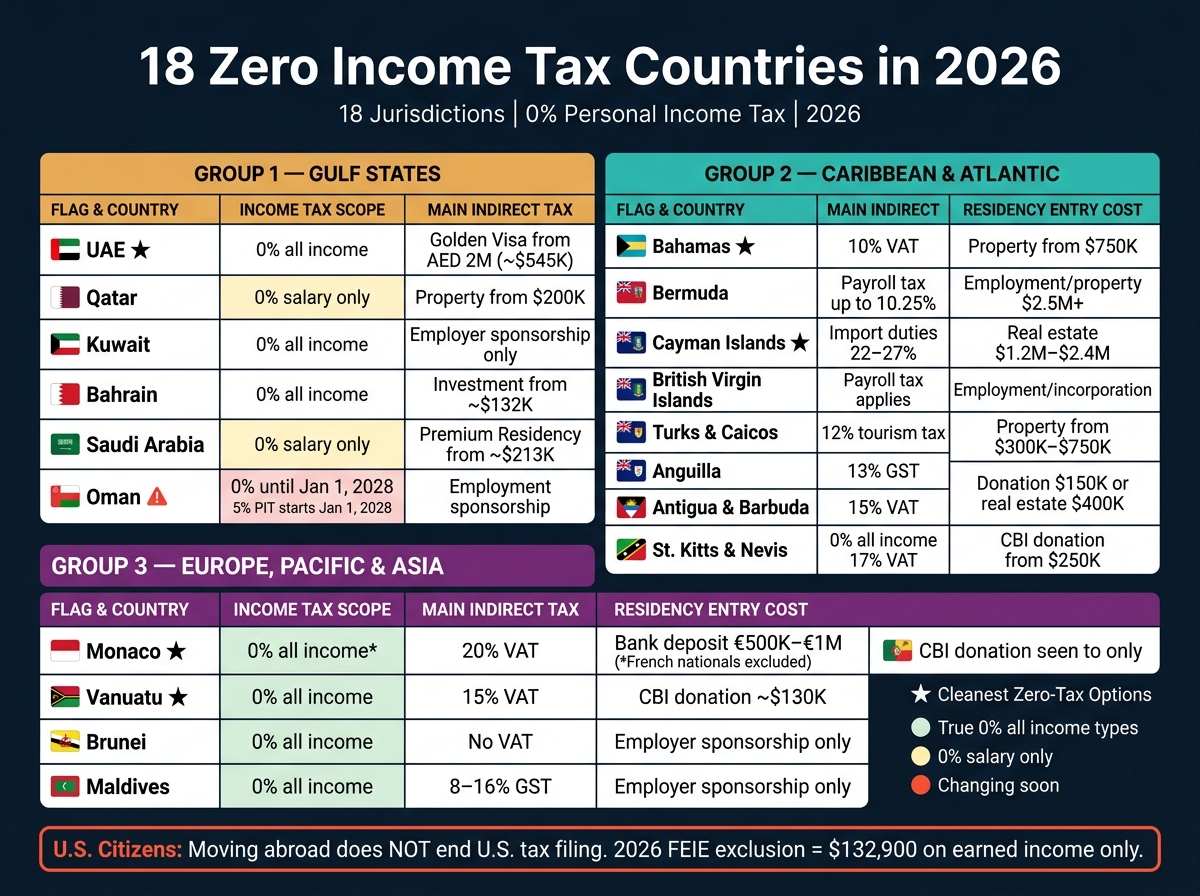
These places may all sound like “no-tax” jurisdictions, but they are not the same thing.
Some offer a true 0% personal-tax base. Others only exempt salary. And one of them – Oman – already has an end date on its zero-tax setup. So if you’re comparing options, the big things to look at are simple: what income is taxed, how hard it is to get residency, and what other taxes still show up in daily life.
| Jurisdiction | Tax on Salary/Self-Employment | Tax on Dividends/Interest/Capital Gains | Typical Residency Route | Best fit |
|---|---|---|---|---|
| UAE | 0% | 0% | Golden Visa (~AED 2 million property); Freelance Visa | Entrepreneurs, remote workers |
| Qatar | 0% (salary) | 0% for passive income; local business income taxed separately | Property (~$200,000) | High-earning employees |
| Kuwait | 0% | 0% | Employment sponsorship | Oil and gas professionals |
| Bahrain | 0% | 0% | Golden Residency / investment route | Expats, retirees |
| Saudi Arabia | 0% (salary) | 0% for passive income; local business income taxed separately | Premium Residency | Employed expats |
| Oman | 0% (until 2028) | 0% (until 2028) | Employment sponsorship | Short-to-medium term expats |
| Brunei | 0% | 0% | Employment sponsorship | Oil sector employees |
| Bahamas | 0% | 0% | Property purchase ($750,000) | North American HNWIs, retirees |
| Bermuda | 0% | 0% | Employment sponsorship or high-value property route | Finance professionals, HNWIs |
| Cayman Islands | 0% | 0% | Real estate investment ($1.2M–$2.4M) | Fund managers, investors |
| British Virgin Islands | 0% | 0% | Employment or incorporation | Offshore business owners |
| Turks and Caicos | 0% | 0% | Property purchase | Retirees, property investors |
| Anguilla | 0% | 0% | Donation or real estate | Asset protection, HNWIs |
| Antigua and Barbuda | 0% | 0% | CBI donation or real estate | Second passport seekers |
| St. Kitts and Nevis | 0% | 0% | CBI donation or real estate | Asset protection, HNWIs |
| Monaco | 0% | 0% | Bank deposit of €500,000–€1,000,000 | Ultra-HNWIs |
| Vanuatu | 0% | 0% | CBI donation (~$130,000) | Fast second passport seekers |
| Maldives | 0% | 0% | Employer sponsorship | Tourism/hospitality workers |
From here, the practical issue isn’t only who taxes income. It’s also who is easiest to enter and who is easiest to keep as a place of residence.
The cleanest group includes the UAE, Bahrain, Kuwait, Bahamas, Bermuda, Cayman Islands, BVI, Monaco, Brunei, Turks and Caicos, Anguilla, Antigua and Barbuda, St. Kitts and Nevis, and Vanuatu. These all offer a true 0% personal-tax base with no scheduled change. Qatar and Saudi Arabia are a bit different. Salary is tax-free, but they are not fully zero-tax because both tax certain local business income. Oman stands out for another reason: it is the only place here that is already moving away from zero tax, with a 5% personal income tax set for Jan. 1, 2028, on income above OMR 42,000.
The residency side also varies a lot. Kuwait and Brunei lean on employer-sponsored visas, which can make entry simple if you already have a job lined up. At the other end, some places let you buy your way in. Vanuatu starts around $130,000 through a donation-based CBI route, while Monaco sits in a very different league, asking for a €500,000 to €1,000,000 bank deposit just to get the process moving.
And then there’s the part many people skip on the first pass: zero income tax does not mean zero cost. Every place in this table still collects money through other channels – VAT, import duties, payroll taxes, tourism levies, stamp duty, or social insurance – so the headline rate only tells part of the story.
Pros and cons by jurisdiction group
Looking at these 18 jurisdictions in groups makes the trade-offs a lot easier to spot. And this grouping is based on day-to-day practical differences, not just headline tax rates.
| Group | Main Advantages | Main Drawbacks | Most Suitable Readers | Biggest Tax Caveat |
|---|---|---|---|---|
| Gulf States (UAE, Qatar, Kuwait, Bahrain, Saudi Arabia, Oman) | Strong infrastructure, major global flight hubs, high safety, and no tax on salary | Extreme summer heat, high schooling and housing costs, and a more conservative social setting | Corporate professionals and business owners | VAT and corporate taxes are now common across the region, and Oman will add a 5% personal income tax in 2028 |
| Caribbean and Atlantic (Bahamas, Bermuda, Cayman Islands, BVI, Turks and Caicos, Anguilla, Antigua and Barbuda, St. Kitts and Nevis) | Close to North America, no capital gains or inheritance tax, and well-known finance centers | High prices for imported goods, hurricane risk, and costly residency paths | Retirees, HNWIs, and North American remote workers | Import duties and stamp duties can be high, especially in the Bahamas and Cayman |
| Monaco and Pacific jurisdictions (Monaco, Vanuatu, Maldives, Brunei) | Status and strong security in Monaco, fast citizenship in Vanuatu, and a high level of privacy | Very high entry costs in Monaco, remote geography, and thinner infrastructure in some places | Ultra-HNWIs, athletes, privacy seekers, and second-passport seekers | French nationals in Monaco still pay French income tax, and Monaco’s VAT is 20% |
The big point here is simple: zero income tax is only one part of the deal.
Each jurisdiction on this list gets revenue somewhere else. That usually means VAT, import duties, work permit fees, corporate taxes, or some mix of all four. So if you only look at the income tax rate, you’re missing half the story. A place can look tax-free on paper and still be expensive once daily costs and government fees kick in.
There’s also the paperwork side. No income tax does not mean no compliance. Banks still report under CRS and FATCA, and proving tax residency usually takes more than just saying you live there. In many cases, you’ll need travel logs, a lease, utility bills, or similar records. Most jurisdictions use the 183-day rule, though the UAE can be lower in some cases.
For U.S. citizens, this gets even more tricky. The U.S. still taxes worldwide income, even if you live in a no-income-tax jurisdiction. The main tool is the FEIE, capped at $132,900 in 2026, but that does not wipe out self-employment tax or state tax residency issues. And yes, states can still come after you if you leave loose ends behind. If you don’t fully cut residency ties, places like California or New York may keep taxing you.
Conclusion
This comparison makes one thing clear: the headline rate is just the starting point.
All 18 jurisdictions on this list have 0% personal income tax. But that doesn’t mean they work the same way. The biggest gaps come down to scope, residency access, and indirect costs.
Some places offer a full 0% setup across salary, investment income, and capital gains. Others only exempt salary. And one jurisdiction – Oman – already has a 5% personal income tax set to begin on January 1, 2028. On top of that, every jurisdiction on this list still brings in revenue through other channels, such as VAT, import duties, payroll taxes, or fees.
The simplest way to make a choice is to line up tax breadth, entry cost, and residency rules with your own goals.
| Criterion | Strongest Options | Key Caveat |
|---|---|---|
| Broadest 0% treatment | Cayman Islands, Bahamas | Indirect taxes still apply |
| Easiest entry routes | UAE, Antigua and Barbuda, Vanuatu | Routes range from visas to citizenship-by-investment |
| Best fit for entrepreneurs | UAE, Qatar | Local-source business income may still be taxed |
| Best fit for retirees | Bahamas, Bahrain | Property investment thresholds apply |
| Best fit for ultra-HNWIs | Monaco, Cayman Islands, Bermuda | Financial barriers and consumption taxes can be high |
The best option is the one that matches your income source, residency path, and long-term plan. And for U.S. citizens, that math still includes worldwide filing obligations.
FAQs
How do I prove tax residency in a no-income-tax country?
You usually need to show that you actually live there, not just rent a place on paper. In many places, that means spending more than 183 days a year in the country.
You may also need to provide official paperwork, like a residency permit or a certificate of tax residency. On top of that, banks and tax authorities often ask for self-certifications that confirm your residency status for compliance.
Which no-tax countries are realistic for remote workers?
For remote workers, the most realistic no-tax destinations combine friendly tax rules with residency paths that aren’t a maze to deal with. The United Arab Emirates stands out as the top pick. It offers a remote work visa, strong infrastructure, and no personal income tax on salary.
Other solid options include Bahrain and the Bahamas. Costa Rica and Barbados can also work out as tax-free in practice for remote workers who qualify under programs that exempt foreign-sourced income.
Can I still owe U.S. taxes after moving abroad?
Yes. If you’re a U.S. citizen or permanent resident, you generally still owe federal taxes no matter where you live or where you earn your income. The United States taxes worldwide income, so you still need to file with the IRS.
Moving to a zero-tax country doesn’t automatically end that duty. The Foreign Earned Income Exclusion ($132,900 for 2026) or Foreign Tax Credits may lower what you owe, but some income can still be taxable.
