
Yes – several countries still have 0% capital gains tax in 2026, but the fine print matters. If I want the shortest answer, the clearest no-CGT places in this list are Cayman Islands, Bahamas, Bahrain, Bermuda, Anguilla, Antigua and Barbuda, St. Kitts and Nevis, Monaco, Hong Kong, Singapore, Belize, Barbados, and the UAE. But some of these are only clean if gains stay passive and do not look like business or trading income.
Here’s the plain-English version:
- Best pure 0% setups: Cayman Islands, Bahamas, Bahrain, Bermuda, Anguilla
- 0% for many personal investors, but with conditions: UAE, Monaco, Antigua and Barbuda, St. Kitts and Nevis, Belize, Barbados
- No general CGT, but trading tests matter a lot: Hong Kong, Singapore, New Zealand
- Not a full no-CGT country: Qatar, because some gains are taxed at 10% and some petroleum-related gains can hit 35%
What I’d watch first:
- Trading vs. investing: Frequent buying and selling can turn a tax-free gain into taxable income
- Real estate fees: Even with 0% CGT, property sales may still face stamp duty, transfer tax, VAT, or registration fees
- Residency rules: In many cases, tax residency still depends on around 183 days in-country
- Home-country tax: If I’m a U.S. citizen, moving to a no-CGT country does not end U.S. tax on worldwide income
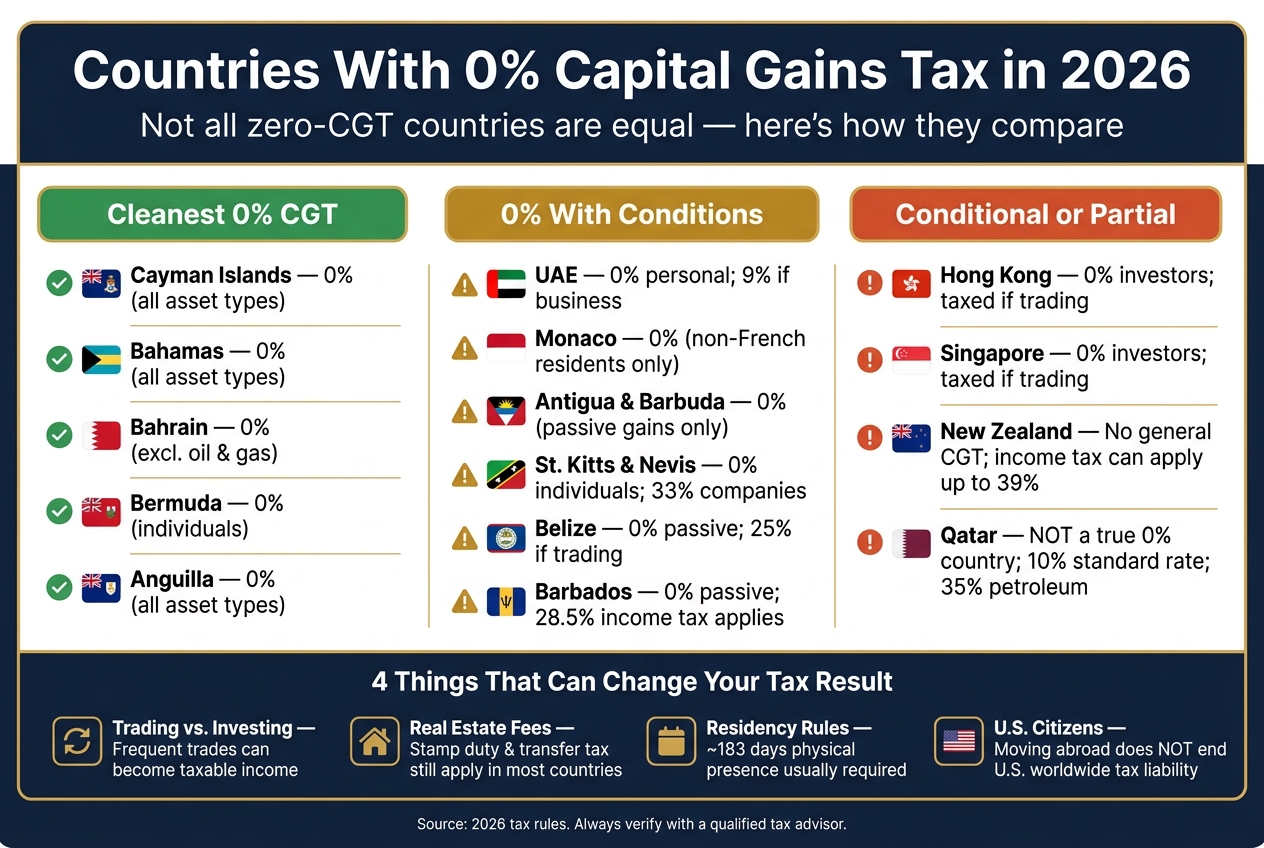
Quick comparison
| Country | Capital gains tax in 2026 | Main catch |
|---|---|---|
| Cayman Islands | 0% | Substance rules; trading review can apply |
| Bahamas | 0% | Property transfer costs; business-income risk |
| Bahrain | 0% | Oil and gas carved out |
| Barbados | 0% on passive gains | Business-income risk; local income tax still applies |
| Belize | 0% | Trading can be taxed at 25% |
| Hong Kong | 0% for investors | Frequent trading can be taxed |
| Singapore | 0% for investors | IRAS may tax gains as trading income |
| Monaco | 0% for many residents | French nationals usually still taxed by France |
| New Zealand | No general CGT | Income-tax rules often catch gains |
| Antigua and Barbuda | 0% for individuals | Passive-vs.-trading split matters |
| St. Kitts and Nevis | 0% for individuals | Companies taxed; trading reclassification risk |
| UAE | 0% for personal investments | Company and business activity can trigger 9% tax |
| Bermuda | 0% for individuals | Company tax and transfer charges still matter |
| Qatar | Partial exemption | Some gains taxed at 10% or 35% |
| Anguilla | 0% | Property transfer costs; trading review |
Bottom line: if I’m a passive investor, the cleanest answers are the Cayman Islands, Bahamas, Bahrain, Bermuda, and Anguilla. If I trade often, flip property, or run gains through a company, the “no capital gains tax” headline can change fast.
That’s the part I’d focus on before treating any country as fully tax-free.
sbb-itb-39d39a6
1. Cayman Islands
The Cayman Islands is one of the clearest true zero-CGT jurisdictions in 2026. It charges no capital gains tax for residents or non-residents. That includes gains from shares, securities, crypto, business sales, and real estate.
Real estate gains are usually outside the CGT net. Even so, stamp duty and transfer taxes can still eat into what you keep from a sale.
There’s one catch worth watching. If you trade often, local authorities may look at whether your activity counts as trading instead of investing. That review can hinge on things like:
- how often you buy and sell
- how long you hold assets
- your intent
- any improvements made
- how the deal was financed
Cayman entities also need to meet substance rules and show real activity on the ground in Cayman. And if you’re a U.S. citizen, the zero-CGT setup doesn’t wipe out your IRS bill. You still owe U.S. tax on worldwide income.
At a glance, the headline rate is simple: CGT, personal income tax, corporate income tax, dividend withholding tax, and crypto gains are all 0% for both residents and non-residents.
The Bahamas is another no-CGT option, but its property and residency rules work differently.
2. Bahamas
The Bahamas charges no standalone capital gains tax in 2026 for either individuals or corporations. That no-CGT rule applies to a broad range of assets, including shares, real estate, and other investments. In plain English: if you sell an asset at a profit, there generally isn’t a separate capital gains tax bill waiting for you.
That said, two areas need a close look: property transfers and activity that starts to look like a business.
A property sale can avoid CGT, but it may still trigger stamp duty and VAT. That’s an important distinction. The government collects much of its revenue through indirect taxes such as VAT, stamp duties, and import duties.
The other issue is business treatment. If the authorities decide you’re not passively investing but actively trading, those gains may be taxed as business income. They look at things like:
- how often you buy and sell
- how long you hold assets
- what your intent appears to be
The main danger zones are short-term trading and repeated property flips. So while the headline tax rate is 0%, the facts still matter.
| Tax Category | Rate in 2026 | Notes |
|---|---|---|
| Capital Gains Tax | 0% | No standalone CGT; business treatment can apply |
| Personal Income Tax | 0% | |
| Corporate Income Tax | 0% | |
| Value Added Tax (VAT) | 10% | Standard rate |
| Dividend Withholding Tax | 0% |
Tax residency still turns on physical presence. To qualify as a tax resident, you generally need 183 days per year in the Bahamas. And for U.S. citizens, there’s no clean escape hatch here: they still owe U.S. tax on worldwide income under U.S. law.
3. Bahrain
Bahrain is another no-CGT jurisdiction. And compared with some places, the rule is pretty straightforward.
In 2026, Bahrain does not impose capital gains tax, with one main carve-out: oil and gas. Outside that sector, the 0% rate applies broadly to gains from shares, real estate, and crypto. For most residents, expats, and foreign investors, that makes the tax treatment easy to follow.
That said, 0% capital gains tax doesn’t mean 0% transaction costs. Bahrain still collects revenue through indirect taxes. A 10% VAT applies to goods and services, and property transfers can face stamp duty. Those aren’t capital gains taxes, but they still affect the total cost of buying, selling, or moving assets.
| Tax Category | Rate in 2026 | Notes |
|---|---|---|
| Individual Capital Gains | 0% | Applies broadly outside oil and gas |
| Corporate Capital Gains | 0% | Oil and gas is taxed under separate rules |
| Personal Income Tax | 0% | No personal income tax |
| Corporate Income Tax | 0% | 0% for most sectors; oil and gas is treated separately |
| Value Added Tax (VAT) | 10% | Standard rate on goods and services |
4. Barbados
Barbados sits in the middle ground between pure zero-tax jurisdictions and places that tax far more of a resident’s income.
Here’s the key point: passive investment gains are generally taxed at 0%. But Barbados residents are still taxed on worldwide income, with a top personal income tax rate of 28.5%.
That split matters. If your activity looks passive, the tax result can be very favorable. If it starts to look like a business, the treatment can change fast.
Trade-like activity may be taxed as business income instead of capital gain. The main signals are:
- frequent transactions
- short holding periods
- a clear intent to profit from trading
Real estate is a separate wrinkle. Even where capital gains tax is 0%, property deals can still trigger stamp duty or transfer tax.
| Tax Category | Rate in 2026 |
|---|---|
| Capital Gains Tax | 0% |
| Personal Income Tax | 28.5% |
| Corporate Income Tax | 9.0% |
| Value Added Tax (VAT) | 17.5% |
| Dividend Withholding Tax | 15.0% |
So in plain English, Barbados tends to fit passive investors better than active traders.
5. Belize
Belize has no capital gains tax in 2026. That sounds simple, but there’s a catch: the tax result depends on staying in the passive investment lane. Belize taxes income earned in Belize, not passive investment gains.
The line matters. If your activity starts to look less like investing and more like trading, the profit can be taxed as business income at 25%. In plain English, that risk tends to come up when there are a lot of transactions, short holding periods, and a clear plan to make money from quick resales instead of long-term appreciation.
Real estate works the same way in one sense and differently in another. The gain itself may not be taxed, but selling property can still come with costs. Depending on the deal, you may face stamp duty, transfer taxes, or the 12.5% GST.
| Tax Category | Rate in 2026 |
|---|---|
| Capital Gains Tax | 0% |
| Personal Income Tax | 25% |
| Corporate Income Tax | 25% |
| Goods and Services Tax (GST) | 12.5% |
| Dividend Withholding Tax | 15% |
6. Hong Kong
Hong Kong’s CGT rate is 0% for private investors. In plain English, gains from stocks and cryptocurrency are usually tax-free. But the main issue isn’t the 0% headline rate. It comes down to how the activity looks in practice.
If the Inland Revenue Department sees what you’re doing as investment, the gains are generally not taxed. If it sees the same activity as trading, those gains can be treated as taxable business profit. That’s where things can shift fast. Frequent buying and selling can turn what seems like a capital gain into taxable income.
The same idea shows up in property. Real estate gains are usually outside capital gains tax, but frequent flipping can be taxed under Profits Tax. On top of that, property deals can also trigger stamp duty. Singapore uses a similar investment-versus-trading test, though its tax rules are different.
For multinational groups, offshore disposal gains may also come into play under the Foreign-Sourced Income Exemption regime. This is mostly an issue for multinational groups, not for most individual investors.
| Feature | Hong Kong Tax Treatment |
|---|---|
| Capital Gains Tax | 0% (None) |
| Real Estate Gains | Generally exempt, unless deemed a trade |
| Share/Stock Gains | Generally exempt for private investors |
| Reclassification Risk | High for frequent traders |
| Top Personal Income Tax | 16% |
| Profits Tax (Two-Tiered) | 8.25% up to HK$2 million, 16.5% above |
Keep records that show a long-term investment intent.
7. Singapore
Singapore follows the same basic rule you see in other zero-CGT places: investment gains are usually not taxed, but trading gains can be.
There’s no capital gains tax in Singapore in 2026. So if you’re a private investor, your gains are generally untaxed. But that doesn’t mean every gain is safe. If your activity starts to look like a business, IRAS may treat those profits as trading income instead.
To make that call, IRAS uses its Badges of Trade test. It looks at things like:
- how often you buy and sell
- how long you hold the asset
- your intent when you bought it
- how you financed the purchase
That last point matters more than many people think. If you use short-term loans to buy assets, IRAS may see that as a sign you were aiming for a fast profit rather than making a long-term investment.
Property gains are usually outside CGT too. But if you flip property often, those profits can be taxed as income. On top of that, property deals may trigger Seller’s Stamp Duty (SSD) and Additional Buyer’s Stamp Duty (ABSD).
Tax residency is usually based on physical presence or employment in Singapore for 183 days or more during a calendar year. For no-CGT planning, though, the bigger issue is simple: does the gain still look like capital, or does it look like trading income?
| Feature | Singapore Treatment |
|---|---|
| Capital Gains Tax | 0% |
| Listed Shares / Securities | Generally exempt |
| Real Estate Gains | Exempt unless deemed trading |
| Crypto Gains | Generally exempt |
| Reclassification Risk | High for frequent or professional traders |
| Top personal income tax | 24% |
| Seller’s Stamp Duty | Applies to residential property sold within 3 years |
If you trade often, keep records that show investment intent. Think purchase notes, holding plans, and funding details. In Singapore, the facts around why you bought an asset can matter almost as much as the gain itself.
8. Monaco
Monaco charges no personal income tax and no capital gains tax for residents who qualify in 2026. That sounds simple. It isn’t.
The big catch is scope. Monaco’s 0% capital gains setup is narrow, and it depends on who you are and how the gain is made.
French nationals residing in Monaco typically remain subject to French income and capital gains tax rules under the France-Monaco treaty. So if you hold a French passport, Monaco’s zero-tax treatment usually doesn’t help you.
For everyone else, the main issue is whether a gain stays personal or gets treated as business income. If your trading looks frequent or business-like, the gain can become taxable business income. Tax authorities may review things like transaction frequency, how deals were financed, your work history, and your intent. In plain English: if it walks and talks like a business, it may get taxed like one.
Companies face their own rule. Corporate entities can be subject to 25% corporate income tax if more than 25% of revenue comes from outside Monaco.
Real estate works in a similar way. There is no capital gains tax on property sales, but the deal costs can still bite. Individuals and transparent vehicles pay 4.75% registration duties. That rate jumps to 10% for non-transparent vehicles. On top of that, new buildings sold within five years of completion are subject to 20% VAT.
Getting residency also takes more than booking a nice apartment with a sea view. Applicants generally need substantial wealth, housing in Monaco, and proof of financial self-sufficiency. Physical presence of more than 183 days per year is also usually expected.
| Tax Category | Rate | Notes |
|---|---|---|
| Personal CGT | 0% | Non-professional income only |
| Corporate Income Tax | 25% | If more than 25% of revenue is outside Monaco |
| Registration Duty | 4.75% | Individuals or transparent vehicles |
| Registration Duty | 10% | Non-transparent vehicles |
| VAT on New Property | 20% | Buildings completed within the last 5 years |
| French nationals | Subject to French tax | Per the France-Monaco treaty |
Monaco works best for resident investors with passive gains. But once you factor in residency demands, treaty limits, and the risk of gains being reclassified, the 0% headline starts to look a lot less simple.
9. New Zealand
New Zealand doesn’t have a general capital gains tax in 2026. But that doesn’t mean gains are automatically tax-free.
Here’s the catch: New Zealand often taxes gains under its income tax rules instead of through a separate CGT system. So calling it a no-CGT country only works in some cases.
If the IRD decides you bought an asset with the aim of reselling it for profit, the gain can be treated as income and taxed at rates up to 39%. And simply holding the asset for a while doesn’t, by itself, protect you from that outcome.
Residential property gets extra attention. If you sell a residential property within 2 years of buying it, the gain can be taxed unless the property was your main home for most of the time you owned it.
NZX shares and crypto can also look simple at first glance, but the tax result depends on why you bought them. Passive gains are often tax-free. If you’re trading, or if profit on resale was the aim, those gains can be taxed as income.
Foreign shares add another layer. If the total cost of your overseas shares is more than NZD 50,000, they will usually fall under the FIF regime, which can tax a deemed 5% annual return. That’s a big reason New Zealand is less clean-cut than the zero-CGT countries that come next.
New migrants get one useful break: a 48-month transitional resident exemption on most foreign passive income, including foreign gains. That can give people time to sort out their holdings before normal New Zealand tax rules kick in.
| Asset Type | Tax Treatment in 2026 | Key Condition |
|---|---|---|
| Main home | Generally 0% | Must be main home for most of ownership period |
| Residential rental | Taxed as income if sold within 2 years | Bright-line test applies regardless of intent |
| NZX shares | Generally 0% | Taxable if dominant purpose was resale profit |
| Cryptocurrency | Taxed as income | Crypto follows the same property rules |
| Overseas shares | Deemed 5% annual return | Applies if total cost exceeds NZD 50,000 |
So yes, New Zealand fits this list, but only with an asterisk. It’s a conditional case, not a clean zero-tax setup.
10. Antigua and Barbuda
Antigua and Barbuda is a zero-CGT jurisdiction for individuals in 2026. There’s no capital gains tax, no personal income tax, no wealth tax, and no inheritance tax. On paper, that’s a very attractive setup for passive investors.
But there’s a catch: your gains need to stay passive.
Like in other zero-CGT places, the tax treatment can change based on how the gains are made. If the tax authorities decide your activity looks more like trading than passive investing, those gains can be treated as business income instead. And in that case, they may be taxed at 25%. The two big things they look at are transaction frequency and your intent when you bought the asset in the first place.
Real estate is another area where the headline can be a bit misleading. Even without a formal capital gains tax, property deals can still come with costs at the transaction level. Stamp duties or property transfer taxes may apply when you buy or sell, so “no CGT” doesn’t mean a real estate sale is tax-free from end to end.
For people thinking about a move, tax residency matters more than citizenship. A Citizenship by Investment (CBI) passport does not, by itself, make you a tax resident. Citizenship also does not automatically create tax residency. In most cases, physical presence of 183 days or more is what usually does.
That point matters even more for U.S. citizens and people from countries that tax worldwide income. Antigua and Barbuda’s zero-CGT rules apply only at the local level. Your home country may still tax your worldwide gains, which is a big deal for expats and U.S.-connected taxpayers.
| Tax Type | Rate |
|---|---|
| Personal Capital Gains Tax | 0% |
| Personal Income Tax | 0% |
| Corporate Income Tax | 25% |
| Value Added Tax (VAT) | 15% |
| Dividend Withholding Tax | 0% |
| Inheritance / Wealth Tax | 0% |
11. St. Kitts and Nevis
St. Kitts and Nevis, like a few other Caribbean no-CGT jurisdictions, tends to fit passive investors best. In 2026, there is no capital gains tax for both residents and non-resident investors.
That sounds simple at first glance, but there’s an important split in how the system works. Individuals pay 0% on capital gains, while local companies pay 33% corporate income tax. So if you’re investing as a person, the treatment is very different from investing through a company.
The main watchout is reclassification. If your activity looks more like trading than investing, the tax outcome can change. Frequent transactions or short holding periods can lead to gains being reclassified as ordinary income.
Real estate gets similar treatment on the capital gains side. Property sales are not subject to CGT, but they can still come with stamp duty or transfer charges. In plain English: no CGT doesn’t mean no tax cost at all.
Residency is a separate issue from citizenship, and that trips people up all the time. Citizenship does not create tax residency. Tax residency usually depends on 183+ days of physical presence.
| Tax Type | Rate |
|---|---|
| Personal Capital Gains Tax | 0% |
| Personal Income Tax | 0% |
| Corporate Income Tax | 33% |
| Value Added Tax (VAT) | 17% |
| Dividend Withholding Tax | 0% |
| Inheritance / Wealth Tax | 0% |
12. United Arab Emirates
The UAE does not have a separate capital gains tax on personal investments held outside a licensed business activity. For most individual investors, that means a 0% tax rate on personal holdings.
The split happens when the activity is treated as a business. In that case, gains fall under the UAE’s Federal Corporate Tax rules. The rate is 9% on taxable income above AED 375,000. There is also a participation exemption that can bring company tax on qualifying share sales down to 0%, but only if the ownership, holding-period, and tax-subject tests are met.
Real estate shows this difference pretty clearly. Individuals pay 0% on personal property sales. Companies, on the other hand, pay 9% on direct real estate gains, and the participation exemption does not apply to direct real estate holdings. On top of that, the Dubai Land Department charges a 4% transfer fee on property deals, which is usually split between the buyer and seller. If business turnover goes above AED 1,000,000, corporate tax treatment can apply.
| Seller Type | Asset | Tax Rate | Key Condition |
|---|---|---|---|
| Individual | Personal investments | 0% | Held personally; no licensed business activity |
| Company | Qualifying shares | 0% | Ownership, holding-period, and tax-subject tests met |
| Company | Non-qualifying shares | 9% | Does not meet participation exemption tests |
| Company | Real estate (direct) | 9% | No exemption available |
13. Bermuda
Bermuda is another clean no-CGT jurisdiction, but here’s the catch: the company tax side matters more than the personal tax side.
For individuals, Bermuda has no capital gains tax in 2026 and no personal income tax. Instead, the government brings in revenue through payroll taxes, import duties, stamp duties, and property taxes. That setup tends to work better for individual investors than for people running businesses through a company.
That said, property sales aren’t tax-free across the board. Stamp duties and transfer taxes still apply.
And if you trade often enough, your gains may not stay in the capital gains bucket. They can be reclassified as income. On top of that, gains held inside a company are now subject to a 15% corporate income tax that applies to certain entities.
| Tax Category | Rate | Notes |
|---|---|---|
| Personal Capital Gains Tax | 0% | Applies to shares, property, and other investments |
| Personal Income Tax | 0% | No tax on personal earnings |
| Corporate Income Tax | 15% | Applies to specific corporate entities |
| Dividend Withholding Tax | 0% | No tax on dividends paid to residents and non-residents |
Qatar takes a similar zero-CGT approach, but with its own limits on local business income.
14. Qatar
Qatar works a bit differently from the zero-CGT places above. This is not a blanket no-CGT system. Instead, Qatar applies a 10% capital gains tax, while carving out a set of exemptions for certain private and market-based gains.
For investors, that means the key issue is simple: which gains fall outside the 10% rule, and which ones don’t?
Private individuals are generally exempt when they dispose of real estate or securities, as long as those assets are not tied to a taxable business. There’s also a separate rule for resident Qatari and GCC nationals in Qatar: they are exempt on share disposals, including gains earned through entities they own. Foreign investors get their own carveout too. Gains from trading securities or investment fund units listed on the Qatar Stock Exchange are exempt. In practice, Qatar’s system tends to favor private investors, holders of listed securities, and owners of real estate that is not used in business.
The big catch is reclassification. If an asset is treated as part of a business, the gain can stop being exempt and instead be taxed as business income on the annual return. Business-related real estate is taxed at 10%, while petroleum and petrochemical assets can face tax at 35%.
| Asset Type | Tax Treatment | Key Condition |
|---|---|---|
| Real estate (individual, private) | Exempt | Must not be associated with business use |
| Real estate (business-related) | 10% | Taxed if related to taxable business activity in Qatar |
| Shares in taxable entities | 10% | Applies to shares in Qatari-resident entities |
| Listed securities and investment fund units on the Qatar Stock Exchange | Exempt | Applies regardless of nationality |
| Shares (Qatari/GCC nationals resident in Qatar) | Exempt | Applies to resident Qatari and GCC nationals |
| Tangible or intangible business assets | 10% | Taxed as business income if tied to business use |
| Petroleum/petrochemical-related assets | 35% | Applies to gains from assets related to petroleum activities or petrochemical industries |
| In-kind contribution revaluation | Exempt | Resulting shares must be held for at least five years |
15. Anguilla
Anguilla is simpler than the places above. It runs on a zero-tax setup for investment gains. As a zero-CGT, zero-income-tax jurisdiction, it charges no capital gains tax, no personal income tax, and no corporate income tax. Residents and non-residents generally pay 0% on investment gains, and stocks and most investment gains sit outside the CGT net.
That’s a key difference from territorial tax systems. In Anguilla, this 0% treatment applies no matter where the gain comes from.
There is one catch on property deals. Selling property does not trigger CGT, but stamp duty or transfer taxes can still cut into what you keep from the sale.
There’s also a line between investing and running a business. If your activity starts to look like trading, it can be treated as business income instead. Things like frequency, intent, and holding period help decide that classification.
So in practice, the main limits are property transfer costs and business reclassification.
| Tax Category | Rate |
|---|---|
| Capital Gains Tax | 0% |
| Personal Income Tax | 0% |
| Corporate Income Tax | 0% |
| Dividend Withholding Tax | 0% |
| Value Added Tax (VAT) | 13% |
Property transfers may still trigger stamp duty or transfer taxes.
How These Jurisdictions Compare in Practice
The main split is pretty simple: some places keep capital gains at 0% for individuals, while others leave gains untaxed only when they look like true investment gains. That difference shows up fast in day-to-day cases like local trading, property sales, and the risk that gains get treated as ordinary income instead.
| Jurisdiction | CGT Scope | Real Estate Caveat | Risk gains are taxed as income |
|---|---|---|---|
| UAE | 0% for individual investors | 0% for individuals; company rules differ | Moderate |
| Cayman Islands | 0% for individual investors | 0% on local property | Low |
| Bahamas | 0% for individual investors | 0% on local property | Low |
| Bermuda | 0% for individual investors | 0% on local property | Low |
| Bahrain | 0% for individual investors | 0% on local property | Low |
| Singapore | 0% under a territorial tax system | Stamp duties apply | High – strong local records required |
| Hong Kong | 0% under a territorial tax system | Stamp duties apply | High – strong local records required |
| New Zealand | No general CGT; income-tax rules can apply | Residential property sold within 2 years is taxed | Moderate |
| Qatar | Partial exemption system; not a true no-CGT jurisdiction | Local-source gains may be taxed | Moderate |
| St. Kitts and Nevis | 0% for individual investors | Stamp duty may apply | Low |
This split has a direct effect on who gets the cleanest outcome: passive investors, active traders, and business owners who relocate won’t all land in the same spot.
Singapore and Hong Kong tend to work best for genuine passive investing. But once trading becomes frequent, the risk goes up. Local authorities may look at intent, holding period, and transaction pattern to decide whether gains should be taxed as income.
From there, the pros and cons start to vary by jurisdiction.
Pros and Cons by Jurisdiction Type
The practical split is pretty simple. Some jurisdictions tax nothing at the personal level. Others exempt only foreign-source gains. And some tax passive gains only when those gains start to look like trading.
That distinction matters a lot in practice. A setup that works for a passive investor may be a poor fit for an active trader or someone planning a move around business activity.
True zero-CGT jurisdictions like the Cayman Islands, Bahamas, and Bermuda impose no personal capital gains tax on qualifying personal investments. If you want the cleanest treatment for passive holdings, that’s the most direct route. The catch is cost. The UAE Golden Visa, for example, requires a 2 million AED investment.
Territorial systems like Hong Kong and Singapore usually tax local-source gains while exempting foreign-source gains. That can work well if you hold foreign assets or run a cross-border portfolio. But gains from local property or local business activity can still fall into the tax net.
Conditional regimes like New Zealand take a different path. There is no general capital gains tax, but gains can be taxed as income if they look like trading. That’s the main risk for readers whose activity could be treated as business income. New Zealand’s bright-line test is the clearest example: residential property sold within two years is taxed.
Use the table below to match each jurisdiction’s rules to your asset mix.
| Jurisdiction | Key Advantages | Key Disadvantages | Best Fit |
|---|---|---|---|
| UAE | No personal CGT; 10-year Golden Visa available | 2 million AED minimum investment; business income taxed at 9% | Entrepreneurs, passive investors |
| Cayman Islands | True zero-CGT; no personal income tax | High cost of living | Offshore passive investors |
| Bahamas | True zero-CGT; no personal income tax | High cost of living; VAT applies | Passive investors |
| Bermuda | True zero-CGT; no personal income tax | Corporate income tax at 15%; high cost of living | Passive investors, wealth preservation |
| Singapore | Foreign-sourced gains exempt; deep financial markets | Reclassification risk for active traders | Long-term investors with offshore portfolios |
| Hong Kong | Territorial system; no CGT on foreign gains | Stamp duties on property; reclassification risk for active traders | Asia-focused investors, offshore portfolio holders |
| New Zealand | No general CGT; high quality of life | Bright-line test taxes residential property sold within two years | Long-term buy-and-hold investors |
| St. Kitts and Nevis | True zero-CGT; passport access to 149+ destinations | Minimum $250,000 CBI contribution | Second passport seekers, asset protection |
| Antigua and Barbuda | True zero-CGT; only five days of physical presence required over five years | Minimum $230,000 CBI contribution | Investors wanting minimal residency obligations |
| Qatar | Partial exemption system; only certain gains are exempt | Local-source gains may still be taxed | Expats with offshore investment portfolios |
These differences hit hardest when residency, asset type, and trading pattern point in different directions. A passive stock investor, a property buyer, and a high-frequency trader can look at the same jurisdiction and get very different tax results.
The right fit comes down to one thing: whether your gains are passive, local, or tied to a business.
Conclusion
In practice, "no CGT" only helps if your gains are still treated as investment gains.
The clearest no personal capital gains tax options in 2026 are the UAE, Cayman Islands, Bahamas, Bermuda, St. Kitts and Nevis, and Antigua and Barbuda. If you want the simplest treatment for passive investments, these are the most direct choices.
But the headline rate is just the starting point. Singapore, Hong Kong, and New Zealand are conditional cases. The exemption applies only when gains stay in the investment bucket, not when they cross into business income.
So the main issue is simple: which rule set fits your assets and residency plan? The right answer depends on asset class, residency, source of gain, and trading behavior. A passive stock investor and an active property flipper can look at the same country and end up with very different tax results.
U.S. taxpayers should treat relocation as a residency change, not a full tax exit, because U.S. tax rules can still follow you.
FAQs
How do tax authorities decide if I’m investing or trading?
In places that don’t have a formal capital gains tax, that doesn’t always mean your gains are tax-free.
Tax authorities can still treat investment profits as taxable business income if what you’re doing looks more like trading than passive investing.
This usually comes down to a case-by-case review. They look at things like:
- How often you buy and sell
- Your intent
- How long you hold assets
- Your professional background
- How you finance your trades
If your activity looks like a business instead of passive investing, your profits may be taxed as ordinary income or business income.
Do I need tax residency to benefit from a 0% capital gains tax country?
It depends on your situation and the tax rules in your home country. Just buying property or holding assets in a 0% capital gains tax country doesn’t automatically make you a tax resident there, and it doesn’t erase tax duties back home.
To get that tax treatment, you usually need to meet the other country’s residency rules and cut tax-residency ties with your home country. Professional tax planning is strongly recommended.
Can my home country still tax my gains after I move?
Yes. Moving to a country with no capital gains tax does not automatically switch off your home country’s tax rules.
Some countries tax citizens on worldwide income. Others may charge exit taxes when you leave. And in some cases, you can still be treated as a tax resident based on how much time you spend there or where your center of vital interests is.
That last point matters more than many people expect. It can include things like where your family lives, where you keep your main home, or where your financial and personal ties are strongest.
Before you relocate, check your home country’s rules and review any tax treaties that may apply.
