
Yes: several countries in 2026 have no annual property tax on real estate. The main ones in this article are the UAE, Bahrain, Oman, Qatar, Kuwait, Saudi Arabia, Monaco, Malta, Liechtenstein, Georgia, Cayman Islands, Turks and Caicos, and Vanuatu. Seychelles is only a partial match because non-residents still pay a 0.25% yearly levy.
If I were comparing these places from a U.S. buyer’s angle, I’d keep one point front and center: no annual property tax does not mean no property taxes at all. You may still pay:
- transfer tax or stamp duty at purchase
- rental income tax
- capital gains tax when you sell
- local housing or municipal fees
- foreign-buyer limits
That matters because in the U.S., a home with a 1.07% property tax rate can cost about $4,280 per year on a $400,000 property. Over 10 years, that is about $42,800. So even a country with a 4% to 7.5% purchase tax can still look cheaper to hold over time.
Here’s the short version of the article:
- Best pure no-annual-tax group: Gulf states like the UAE, Bahrain, Oman, Qatar, Kuwait, and Saudi Arabia
- Low yearly hold cost, but often high upfront cost: Cayman Islands, Turks and Caicos, Monaco, Malta
- Low-tax but with access limits or rules: Liechtenstein, Qatar, Kuwait, Malta
- Cheaper entry on paper: Georgia, with near-zero annual tax for qualifying owners
- Not fully tax-free: Seychelles and Vanuatu still have other property-linked taxes
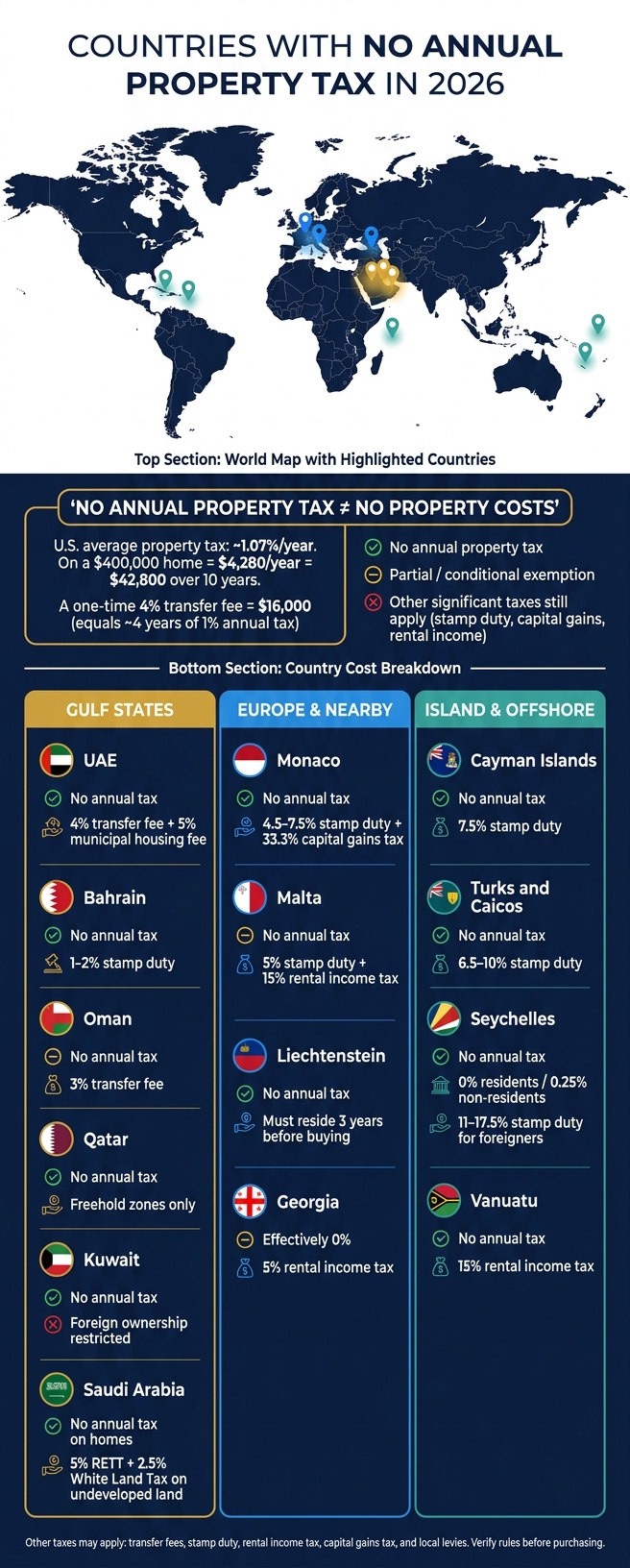
Quick Comparison
| Country | Annual property tax | Main other charges | Main catch for U.S. buyers |
|---|---|---|---|
| UAE | None | 4% transfer fee; 5% housing fee on rental value | Local fees still apply |
| Bahrain | None | 1%–2% registration/stamp duty | Buying limited to set zones |
| Oman | None | 3% transfer fee | Check foreign ownership rules |
| Qatar | None | Area-based ownership limits | Foreign buyers limited to freehold zones |
| Kuwait | None | Permit-based rules | Foreign ownership is tight |
| Saudi Arabia | None on completed homes | 5% RETT; 2.5% White Land Tax on undeveloped urban land | Land tax can apply to undeveloped plots |
| Monaco | None | 4.5%–7.5% stamp duty; 33.3% capital gains tax | Entry cost is high |
| Malta | None | 5% stamp duty; 15% rental income tax | Permit may be needed |
| Liechtenstein | None | Limited access | Must live there 3 years before purchase |
| Georgia | Effectively 0% for qualifying owners | 5% rental income tax | Income-based rule matters |
| Cayman Islands | None | 7.5% stamp duty | Upfront cost is high |
| Turks and Caicos | None | 6.5%–10% stamp duty | Tiered purchase tax |
| Seychelles | None for residents; 0.25% levy for non-residents | 11%–17.5% stamp duty for foreigners | Not a full no-tax case |
| Vanuatu | None | 15% rental income tax; stamp duty | Rental income still taxed |
My bottom line: the best question is not “Which countries have no property tax?” but “What will I pay to buy, hold, rent, and sell?” That is the part that changes the numbers most.
sbb-itb-39d39a6
What ‘no property tax’ actually means
“No property tax” means there’s no recurring yearly tax just for owning real estate. That sounds simple, but here’s the catch: a country can skip an annual property tax and still charge transfer taxes, stamp duty, city levies, service fees, or taxes when you rent out or sell the property.
Annual property tax vs. transfer taxes, stamp duty, and service fees
In the U.S., property owners usually pay a yearly tax based on assessed value. In many other countries, that annual bill just isn’t there. Instead, the costs tend to show up in a few other places:
| Charge type | When it applies | Example |
|---|---|---|
| Annual property tax | Every year, based on assessed value | U.S. county taxes |
| Transfer tax / stamp duty | Once, at purchase | Malta (5%); Cayman Islands (7.5%) |
| Municipal fee | Recurring, but service-linked | Dubai’s 5% housing fee on annual rental value |
| Rental income / capital gains tax | When renting or selling | Varies by jurisdiction |
That difference matters a lot. A place can be low-cost to hold over time even if it charges more at closing. These aren’t the same costs spread across different dates. They hit your budget in different ways.
Why this distinction matters for U.S. investors
For a U.S. buyer, this usually comes down to a trade-off between upfront cash and yearly carrying costs. On a $400,000 property, a one-time 5% stamp duty adds up to $20,000 at closing. A 1% annual property tax comes to $4,000 per year, or $40,000 over 10 years. Same property, very different math.
That’s why investors and expats shouldn’t stop at the phrase “no property tax.” The better question is: What will it cost me to buy, hold, rent, and sell this property over time?
The country list below follows that logic: no recurring annual tax, but other ownership costs may still apply.
Countries with no annual property tax in 2026
The places below do not charge a recurring yearly tax just for owning real estate. That said, “no annual property tax” does not mean “no property costs.” In many cases, the bill shows up at closing through transfer taxes, stamp duty, municipal fees, or foreign-ownership rules.
| Country | Annual Property Tax on Ownership | Other Property-Related Charges | Notes for U.S. Buyers |
|---|---|---|---|
| UAE | None | 4% transfer fee; 5% municipal housing fee on annual rental value | 4% transfer fee; 5% municipal housing fee |
| Bahrain | None | 1%–2% registration/stamp duty | Freehold ownership limited to designated zones |
| Oman | None | 3% transfer fee to the Ministry of Housing | Verify current zone and ownership rules before buying |
| Qatar | None | Foreign buyers can own only in designated freehold areas | Access depends on freehold-zone eligibility |
| Kuwait | None | Permit requirements apply | Foreign ownership is heavily restricted |
| Saudi Arabia | None | 5% RETT on sales; 2.5% White Land Tax on undeveloped urban land only | White Land Tax targets undeveloped land, not completed homes |
| Monaco | None | 4.5%–7.5% stamp duty; 33.3% capital gains tax | High entry price; residency via self-sufficiency |
| Malta | None | 5% stamp duty (2% in Gozo); 15% rental income tax | AIP permit required outside Special Designated Areas |
| Liechtenstein | None | – | Buyers must reside in the country for 3 years before purchasing |
| Georgia | Effectively 0% | 5% rental income tax; nominal registration fees | Exempt if household income is under approx. $12,500/year |
| Cayman Islands | None | 7.5% stamp duty | No income or capital gains tax; 7.5% stamp duty |
| Turks and Caicos | None | 6.5%–10% tiered stamp duty | No income or capital gains tax |
| Seychelles | No annual property tax for residents; 0.25% annual levy for non-residents | 11%–17.5% stamp duty for foreigners; 5% for residents | Non-resident owners pay a small annual levy on market value |
| Vanuatu | None | 15% rental income tax; stamp duty | No income or capital gains tax; citizenship-by-investment available |
The clearest no-annual-tax cluster is the Gulf. That’s where holding costs tend to show up up front or through service-linked fees instead of a yearly ownership tax.
Gulf states: UAE, Bahrain, Oman, Qatar, Kuwait, and Saudi Arabia
Across the GCC, the main costs usually hit at closing or through municipal-style charges. In the UAE, buyers deal with a 4% transfer fee and a 5% municipal housing fee on annual rental value. Bahrain and Oman also charge at closing, at 1%–2% and 3%, respectively.
Qatar and Kuwait follow the same broad pattern: no recurring annual property tax, but foreign-buyer access is tighter. In Qatar, ownership for foreigners is limited to designated freehold areas. In Kuwait, permit rules apply, and foreign ownership is heavily restricted.
Saudi Arabia comes with one key detail that’s easy to miss. The 2.5% White Land Tax applies only to undeveloped urban land, not completed homes. On top of that, sales are subject to a 5% Real Estate Transaction Tax.
In Europe and nearby markets, the setup looks similar at first glance. But once you get into the fine print, foreign-buyer rules and income taxes start to matter a lot more.
Europe and nearby jurisdictions: Monaco, Malta, Liechtenstein, and Georgia
Malta and Liechtenstein both have no annual property tax. But that doesn’t make them low-friction markets.
In Malta, buyers pay 5% stamp duty at closing, or 2% in Gozo, plus 15% rental income tax. Foreign buyers outside Special Designated Areas also need an Acquisition of Immovable Property permit. So the yearly holding tax may be missing, but entry rules still shape the deal.
Monaco skips a recurring annual property tax too, but the tradeoff is steep: 4.5%–7.5% stamp duty and a 33.3% capital gains tax. It’s a market where the lack of annual tax doesn’t lower the bar much for buyers.
Georgia is a bit different. It is effectively 0% for qualifying households, with the exemption applying as long as the owner’s household income stays below about $12,500 per year. Rental income is taxed at 5%, and registration fees are nominal.
Liechtenstein also charges no annual property tax, but there’s a major catch: buyers must live in the country for 3 years before they can purchase. For most U.S. investors, that rule alone puts it out of reach.
Offshore markets often remove the yearly property tax, but they can make up for it with steeper closing costs.
Island and offshore jurisdictions: Cayman Islands, Turks and Caicos, Seychelles, and Vanuatu
The Cayman Islands and Turks and Caicos both have no annual property tax, which sounds great on paper. But the upfront taxes are hard to ignore. In the Cayman Islands, stamp duty is 7.5%. In Turks and Caicos, it runs from 6.5% to 10%, depending on the property value. Neither place imposes income or capital gains tax.
Seychelles is a partial fit, not a pure one. Residents pay no annual property tax, while non-residents pay a 0.25% annual levy on market value. Stamp duty also changes based on residency: 11%–17.5% for foreigners versus 5% for residents.
Vanuatu also stands out. It has no property tax, no income tax, and no capital gains tax, though rental income is taxed at 15%. So if you’re looking at holding costs, Vanuatu keeps them light, but rental activity still creates a tax bill.
What no annual property tax means for total ownership costs
Once you know which countries don’t charge annual property tax, the next step is looking at the full cost of owning the property. No annual property tax cuts out one recurring expense. But that alone doesn’t settle the issue. What matters is whether those savings beat the purchase and exit costs over the time you plan to hold the property.
How to compare annual holding costs against one-time purchase costs
The math is pretty straightforward. A 1% annual property tax on a $400,000 property comes to $4,000 a year, or $40,000 over 10 years. A 4% transfer fee at closing on that same property comes to $16,000 once. In that case, the transfer fee equals four years of a 1% annual tax.
That’s why long-term owners often come out ahead in places with no annual property tax. Short-term buyers, on the other hand, can lose that edge if stamp duty or transfer fees are high.
The table below shows what this can look like for a hypothetical $300,000 property over 10 years in two places, assuming the property is rented out:
| Jurisdiction | Purchase Costs | Annual Tax (10 yrs) | Rental Income Tax (10 yrs) | Total 10-Year Cost |
|---|---|---|---|---|
| Georgia | ~$500 (reg. fees) | $0 | $12,000 (5% rate) | $12,500 |
| Malta | $15,000 (5% duty) | $0 | $22,500 (15% rate) | $37,500 |
In this model, Georgia is the cheapest option because entry costs are low and there’s no annual property tax.
Still, that gap doesn’t tell the whole story. Rental income tax, capital gains tax, and local fees can change the picture fast.
Other taxes that still apply: rental income, capital gains, and local fees
A low annual tax bill can still come with steep taxes somewhere else. Many of the countries discussed here tax rental income, and selling the property can trigger a big bill too. Monaco, for example, has no annual property tax, but it charges a 33.3% capital gains tax on certain sales.
In Caribbean markets like the Cayman Islands and Turks and Caicos, insurance can be a major recurring cost because of hurricane risk. Repair bills can climb too, since imported materials often cost more. Those expenses belong in any honest total-cost model, even though they won’t show up as property tax.
So even without annual property tax, you may still face:
- stamp duty
- transfer fees
- local levies
- capital gains tax
Those differences play a big role in whether a country makes sense for a long-term hold, a rental play, or a second home.
How to use these jurisdictions in a 2026 asset protection and real estate plan
After you compare purchase costs and holding costs, the next move is figuring out how to own the property.
That part matters more than many buyers expect. Once you know a country has no annual property tax, the next issue is how the asset should be held. For U.S. investors, title, reporting, and succession often matter more than the headline tax rate. A low-tax jurisdiction only makes sense when the ownership structure, reporting load, and exit plan all line up.
Put simply: how you hold title matters just as much as where you buy.
An LLC or offshore company can add a liability shield and is often used for rental property. Trusts and foundations tend to make more sense for succession and long-term control.
| Ownership Structure | Privacy | Asset Protection | Complexity | Best Fit |
|---|---|---|---|---|
| Direct Ownership | Low | Low | Low | Personal use, second homes, simple residency applications |
| LLC / Company | Moderate to High | Moderate | Moderate | Rental and investment properties, active portfolio management |
| Trust / Foundation | High | High | High | Multi-generational wealth preservation and succession planning |
Of course, the structure only works if local law allows the type of ownership you want to use. That sounds obvious, but it’s where plenty of cross-border plans start to wobble.
U.S. reporting rules still apply. FBAR and FATCA still apply, which means your offshore structure needs to be built with U.S. compliance in mind from day one, not retrofitted later.
Due diligence before buying in a no-property-tax country
Before you buy, verify:
- foreign-ownership limits
- title type
- current tax rules
- mortgage access for non-residents
Conclusion: recurring tax, total cost, and ownership structure
Some countries in 2026 do not impose a recurring annual property tax. But that doesn’t mean there is no tax at all.
Purchase taxes, exit taxes, rental income taxes, and local fees still apply in most of these jurisdictions. Model 10-year costs, then match the ownership structure to your holding period and U.S. reporting rules.
FAQs
Which no-property-tax country is cheapest long term?
It comes down to your budget and what you’re trying to do. A country with no annual property tax can still be expensive if the buy-in is high or if you need to meet residency rules.
For many mid-level investors, Georgia is often the easiest lower-cost entry point. Monaco and the Cayman Islands offer tax neutrality, but property prices are VERY high, and one-time stamp duties can add a big upfront hit. Gulf states and Pacific islands can also be tax-efficient, though leasehold rules, registration fees, and residency programs may push up long-term costs.
Do Americans still owe U.S. taxes on foreign property?
Yes. U.S. citizens are taxed on worldwide income, no matter where they live or where the property is located.
So even if a foreign country doesn’t charge an annual property tax, that doesn’t mean the IRS ignores the property. Rental income may still need to be reported on your U.S. federal tax return and may be taxed, and selling the property may trigger U.S. capital gains tax.
Because cross-border tax rules can get messy fast, it’s smart to speak with a qualified tax professional about your reporting duties and any foreign tax credits you may be able to claim.
Can foreigners buy property freely in these countries?
No. Foreign ownership rules differ a lot from one country to another.
Georgia allows foreigners to own both residential and commercial property with few barriers. The UAE and Bahrain allow foreign ownership in designated freehold areas.
Some places are much tighter. Liechtenstein is, for most foreigners, mostly closed. Malta often requires a permit for non-EU buyers. Andorra usually limits non-residents to one property unless they get special authorization.
