
Entrepreneurs are flocking to countries with no personal income tax to maximize their earnings and reduce tax burdens. These destinations offer tax-free policies, attractive residency options, and business-friendly environments. However, many have alternative taxes like VAT, high living costs, or strict residency requirements. Key highlights include:
- UAE: No income tax, 9% corporate tax for high profits, flexible residency options like the Golden Visa programs.
- Qatar: No income tax, 10% corporate tax, new 10-year entrepreneur residency program.
- Bahamas: No income tax, $1M real estate investment for permanent residency.
- Cayman Islands: No income or corporate taxes, residency through $1.2M business investment.
- Monaco: No income tax, high cost of living, requires a €500,000 bank deposit for residency.
- Vanuatu: No income tax, $130,000 for citizenship-by-investment.
- Antigua and Barbuda: No income tax, $100,000 donation for citizenship-by-investment.
These countries combine tax advantages with unique challenges like high living expenses or strict documentation requirements. U.S. citizens must still navigate worldwide taxation rules, making professional advice essential.
Quick Comparison
| Country | Personal Income Tax | Corporate Tax | Residency Requirement | Minimum Investment |
|---|---|---|---|---|
| UAE | 0% | 9% (profits > $102K) | 90-183 days, Golden Visa | $545,000 |
| Qatar | 0% | 10% | 183 days, $68,600 investment | $68,600 |
| Bahamas | 0% | 0% | $1M real estate | $1,000,000 |
| Cayman Islands | 0% | 0% | $1.2M business investment | $1,200,000 |
| Monaco | 0% | 33% (local profits) | €500,000 bank deposit | $525,000 |
| Vanuatu | 0% | 0% | $130K for citizenship | $130,000 |
| Antigua & Barbuda | 0% | 0% | $100K donation | $100,000 |
Relocating to a tax-free country can save money, but consider hidden costs like VAT, import duties, and living expenses. Always consult tax experts to ensure compliance and maximize benefits.
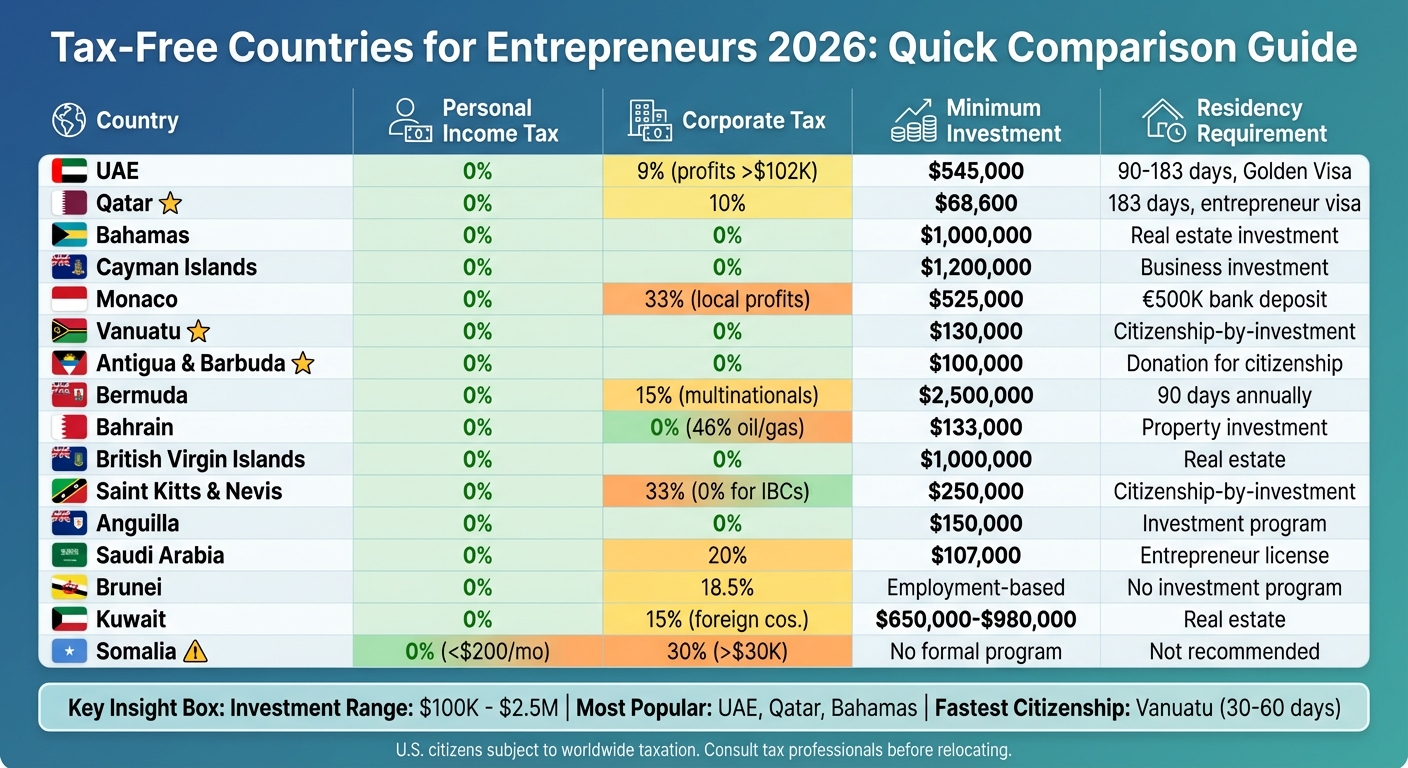
16 Tax-Free Countries Comparison: Investment Requirements and Tax Rates 2026
1. United Arab Emirates
Personal Income Tax Rate (0%)
The UAE offers a tax-free environment for individuals, with no taxes on salaries, investments, capital gains, or inheritance. However, businesses face a 9% corporate tax on annual net profits exceeding AED 375,000 (around $102,000), which means most startups and small businesses remain untaxed. Additionally, the Value Added Tax (VAT) is set at a low 5%. The country’s favorable tax policies have attracted significant wealth, including a net inflow of 9,800 millionaires in 2025, the highest globally.
Residency or Citizenship Requirements
Entrepreneurs have several residency options. The Golden Visa provides a 10-year self-sponsored residency without needing a local sponsor. Eligibility includes investing at least AED 2 million (about $545,000) in property or running an SME generating AED 1 million annually. The Standard Investor Visa offers a 2-year renewable residency through company incorporation in a Free Zone, with setup costs starting at approximately AED 25,000 (around $6,800) for solo entrepreneurs. For freelancers, the Freelance Visa costs between $5,000 and $8,000 annually through hubs like Dubai Internet City, though it doesn’t create a separate legal entity.
To qualify as a tax resident, individuals must either spend 183 days in the UAE or 90 days with ties such as property ownership or active business operations. While these residency options are attractive for securing assets and tapping into regional growth, there’s no direct citizenship path for most expatriates.
"Dubai has essentially digitized its economic infrastructure. For American entrepreneurs, the ‘Zero-Visit Residency’ model isn’t just a marketing slogan – it is a functional reality."
– Gaurav Keswani, JSB Incorporation
Business-Friendly Policies
The UAE boasts over 40 specialized free zones, allowing 100% foreign ownership across more than 2,000 commercial activities. These zones also offer full profit repatriation and exemptions on import duties. Entrepreneurs can establish a legal entity and obtain digital trade licenses remotely within 48 hours using the UAE PASS digital identity system.
A temporary Small Business Relief measure lets businesses with revenue under AED 3 million elect for zero taxable income, though this benefit ends on December 31, 2026. Even businesses with profits below AED 375,000 must register for corporate tax within 90 days of incorporation. These policies, combined with a modern expat lifestyle, make the UAE highly appealing, though living costs can be a factor to consider.
Quality of Life
Living in the UAE comes with expenses. Monthly costs for expats range from $4,900 to $8,168 (AED 18,000–30,000). Renting a one-bedroom apartment in the city center averages AED 8,600 (about $2,340) per month, while basic utilities cost around AED 780 (approximately $212). Summers are intensely hot, with temperatures often exceeding 113°F (45°C), limiting outdoor activities during peak months.
Expats are required to secure private medical insurance, as public healthcare is reserved for Emirati citizens. Additionally, opening a local bank account can take 2–4 weeks after visa approval. Despite these challenges, the UAE’s tax benefits significantly counterbalance living expenses, making it a top choice for entrepreneurs looking to optimize their tax strategies.
sbb-itb-39d39a6
2. Qatar
Personal Income Tax Rate (0%)
Qatar’s tax system is a dream for earners – there’s no personal income tax on employment income, bonuses, or allowances. This means residents get to keep every dollar they earn. On top of that, there are no taxes on foreign-source income, wealth, inheritance, or gifts. For businesses, foreign-owned entities face a flat 10% corporate tax on income sourced within Qatar, but Qatari and GCC-owned companies are generally exempt. Entrepreneurs can also tap into the Qatar Financial Centre (QFC) for tax-friendly setups. Plus, Qatar has inked over 80 Double Taxation Agreements to help individuals and companies avoid getting taxed twice on the same income.
Residency or Citizenship Requirements
In February 2026, Qatar introduced a 10-year renewable Entrepreneur Residency program, tailored for startup founders. To qualify, applicants need to invest at least QAR 250,000 (about $68,600) and own a minimum 20% stake in a registered Qatari company. The application also requires endorsement from a recognized incubator like the Qatar Science & Technology Park, Qatar Fintech Hub, or Qatar Business Incubation Center. Additionally, applicants must maintain a bank balance of QAR 36,500 (around $10,020) over the past three months and budget for upfront costs ranging between QAR 260,000–275,000.
Residency holders enjoy several perks: they can sponsor immediate family members, purchase property in designated freehold zones like The Pearl-Qatar and Lusail City, and benefit from tax residency and treaty advantages – provided they spend at least 183 days in Qatar annually.
"The launch of these Residency Visas represents a significant step in attracting global talent and enabling them to thrive in Qatar, contributing to the development of high impact ventures."
– Sheikh Ali bin Alwaleed Al Thani, CEO of Invest Qatar
While gaining residency has become more accessible, obtaining Qatari citizenship remains highly restrictive, as it is primarily tied to lineage rather than through residency or investment. However, the new residency model eliminates the need for a local sponsor or "kafeel", allowing applicants to self-sponsor.
Business-Friendly Policies
Qatar’s business environment is tailored to attract entrepreneurs. There are no foreign exchange controls, making it easy to repatriate profits and move capital freely. During major events like Web Summit Qatar 2026, the government even introduced expedited processes, enabling company formation and residency setups to be completed in just days.
In February 2026, the Qatar Investment Authority announced an additional $2 billion venture capital expansion, bringing its total innovation funding to $3 billion. This push coincided with a surge in startup activity, with over 6,000 applications submitted in 2025 alone. Entrepreneurs also benefit from the QFC’s specialized trust and foundation laws, designed to support long-term wealth planning. All these initiatives align with Qatar National Vision 2030, which aims to reduce reliance on LNG revenues and diversify the economy.
Quality of Life
Qatar’s appeal isn’t just about business. The country boasts world-class infrastructure and subsidized fuel, but living expenses can be steep due to high import costs and premium rents in Doha. Permanent residents can access public healthcare and government schools, though many prefer private insurance to meet visa renewal requirements.
Summers, however, can be brutal, with temperatures soaring up to 113°F (45°C), limiting outdoor activities during peak months. Socially, Qatar is more conservative compared to places like Dubai, which might be a consideration for some. Still, with zero personal income tax and strong support for innovation, Qatar continues to grow as a top destination for entrepreneurs in 2026.
3. Bahamas
Personal Income Tax Rate (0%)
The Bahamas stands out with its zero percent personal income tax policy. This applies to all forms of income, including salaries, bonuses, dividends, and capital gains. On top of that, there are no taxes on inheritance, estates, or gifts. The government primarily generates revenue through a 10% Value-Added Tax (VAT) and import duties, which vary from 0% to 75% depending on the goods. The Bahamian dollar is pegged to the US dollar at a 1:1 ratio, ensuring stable currency exchange. Tourism drives about 50% of the nation’s GDP, while financial services contribute roughly 20%.
Residency or Citizenship Requirements
Starting January 1, 2025, the Economic Permanent Residency program requires a minimum investment of US$1,000,000 in Bahamian real estate or zero-coupon government bonds. This investment must be maintained for at least 10 years, and applicants pay a government fee of US$15,000.
For those not ready to commit to such a large investment, the Annual Residence Permit is available for US$1,000 per year, though it doesn’t allow local employment. Alternatively, the Bahamas Extended Access Travel Stay (BEATS) program offers digital nomads the chance to live in the country for up to one year, renewable for up to three years, at a fee of around US$1,000. Property owners can opt for an Annual Home Owner’s Residence Card, which costs US$500 per year regardless of the property’s value.
Entrepreneurs managing a local business must acquire a work permit, with fees ranging from US$350 to US$10,000 annually, depending on the professional category. While the Bahamas does not have a citizenship-by-investment program, naturalization requires 10 years of legal permanent residency. Additionally, dual citizenship is generally not allowed.
Business-Friendly Policies
The Bahamas imposes no corporate income tax, but businesses are required to pay an annual license fee, which is either a flat US$100 or up to 3% of their turnover. The country operates under English common law, and its location – just 50 miles from Florida – offers excellent access to U.S. markets. However, entrepreneurs should be aware of "Bahamianization" policies, which prioritize hiring local talent and may make it more difficult to employ foreign workers.
"The Bahamas is far more than a financial hub… a safe harbor, where bespoke, top-tier financial services are not only accessible but enhanced by an exceptional quality of life."
– Niekia Horton, CEO & Executive Director, Bahamas Financial Services Board
These policies, combined with the island’s lifestyle benefits, contribute to its appeal for businesses.
Quality of Life
With its tropical climate and stunning beaches, the Bahamas offers an enviable lifestyle, though it comes at a cost. Monthly living expenses for a single person range from US$2,500 to US$4,000, driven by high import costs. Import duties and the 10% VAT further add to the expense, making it one of the pricier Caribbean destinations. Healthcare in Nassau is generally reliable, but more remote islands may lack advanced medical facilities.
For North American entrepreneurs, the English-speaking population and stable parliamentary democracy make the Bahamas an accessible option. However, U.S. citizens should remember they are subject to worldwide taxation and might benefit from the Foreign Earned Income Exclusion, which is set at US$132,900 for the 2026 tax year.
4. Cayman Islands
Personal Income Tax Rate (0%)
The Cayman Islands stands out with its 0% personal income tax policy. Beyond that, there are no corporate, capital gains, inheritance, property, or payroll taxes either. The government instead relies on indirect revenue streams like import duties, work-permit fees, and tourism-related levies. With a strong GDP and over 99,000 registered companies – including nearly 300 banks and 10,500 mutual funds – the territory has established itself as a financial hub.
Residency or Citizenship Requirements
For those aiming to establish residency, the Certificate of Direct Investment requires an investment of CI$1,000,000 (approximately US$1,200,000) in a business that generates employment and where you maintain significant management control. The application comes with a US$24,000 issuance fee and an additional US$1,200 per dependent. Residency requires spending at least 90 days annually on the islands.
Entrepreneurs looking for a more affordable option can consider Cayman Enterprise City (CEC), which offers a "Global Corporate Citizen Programme." This initiative provides fast-tracked, renewable 5-year visas without requiring significant capital investments beyond setup costs. Meanwhile, remote workers earning at least US$100,000 per year can apply for the Global Citizen Concierge Program, which allows a 24-month stay while working for overseas employers.
For those seeking long-term residency, individuals can apply for British Overseas Territories Citizenship after five years of legal residence (including one year as a Permanent Resident). Full citizenship becomes an option after 15 years.
Business-Friendly Policies
The Cayman Islands builds on its tax-free appeal with policies that make it easy to do business. Operating under British Common Law, the territory allows foreign nationals to own land without restrictions. Special Economic Zones, such as Cayman Enterprise City, eliminate bureaucratic hurdles and reduce the costs of setting up offshore operations. These zones also enable businesses to protect intellectual property and maintain full foreign ownership. The territory’s proximity to North America – just about an hour’s flight from Miami – adds to its attractiveness for businesses looking to serve U.S. markets.
Quality of Life
Life in the Cayman Islands offers modern amenities, excellent healthcare, and a low crime rate, but it comes at a higher cost. Living expenses are 30% to 50% higher than in most U.S. cities. For context, while New York City scores 130 on a cost-of-living index, the Cayman Islands ranks at 260. Everyday items reflect this difference – a gallon of milk costs around US$8, and dining out for two often ranges between US$150 and US$200.
The tropical climate is warm year-round, though residents should stay prepared for hurricane season, which runs from June to November. Healthcare services are advanced and privately operated, but health insurance is mandatory for all residents. U.S. citizens living in the Cayman Islands should also remember their obligation to file annual U.S. tax returns and report foreign bank accounts (FBAR), as they remain subject to worldwide taxation.
Next, we’ll explore how these residency options, business policies, and lifestyle factors compare across the featured countries.
5. Antigua and Barbuda
Personal Income Tax Rate (0%)
Since 2016, Antigua and Barbuda have abolished personal income tax, meaning residents pay no taxes on either local or worldwide income. The tax system follows a territorial principle, so only income earned within the islands could be subject to local levies – although no personal income tax is currently applied. Additionally, there are no taxes on capital gains, inheritance, wealth, or gifts. International Business Corporations (IBCs) also enjoy tax exemptions on profits from assets like real estate and securities for up to 50 years. Instead, the country generates revenue through a 15% sales tax and import duties. These tax benefits are complemented by tailored residency and citizenship programs.
Residency or Citizenship Requirements
Antigua and Barbuda’s Tax Residency Program allows individuals earning $100,000 or more to gain tax residency by paying a flat annual fee of $20,000 and maintaining a local residence with a minimum 30-day stay. Alternatively, the Citizenship by Investment (CBI) program offers citizenship within 3–6 months through a $100,000 donation to the National Development Fund or a $200,000 real estate investment in approved projects. CBI holders are only required to spend five days in the country during their first five years of citizenship. For remote workers, the Nomad Digital Residence (NDR) program provides a two-year visa with no minimum stay requirement, provided they earn at least $50,000 annually.
Business-Friendly Policies
Antigua and Barbuda also appeal to businesses with their favorable policies. The standard corporate income tax rate is 25%, but industries like tourism receive various incentives. Registering a business typically costs between $3,000 and $7,000. The islands are also an offshore banking hub, offering multi-currency accounts in USD and EUR, though they are subject to moderate scrutiny under the Common Reporting Standard. The country has established around 32 tax treaties, mainly within the Caribbean region.
Quality of Life
Antigua and Barbuda boast 365 beaches and a tropical maritime climate, with year-round temperatures averaging 81°F (27°C) thanks to northeast trade winds. For entrepreneurs, the islands combine financial advantages with an appealing lifestyle. Monthly living costs for a solo professional average $2,500 (excluding rent), while families typically spend $4,000 to $6,000. A basic local meal costs about $9, and a three-course dinner for two at a mid-range restaurant is approximately $90. Public healthcare is free for residents, but many expatriates prefer private clinics, where consultation fees average $70. Monthly health insurance premiums range from $240 to $375. U.S. citizens living in Antigua and Barbuda must file annual U.S. tax returns and can utilize the Foreign Tax Credit (Form 1116) or the Foreign Earned Income Exclusion (Form 2555).
6. Bermuda
Personal Income Tax Rate (0%)
Bermuda is one of the standout tax havens in 2026, offering a 0% personal income tax. This exemption covers capital gains, dividends, interest, and wealth. However, the absence of direct taxation is offset by other costs, such as employer payroll taxes ranging from 5% to 12% for higher earners. Since 2025, Bermuda has implemented a 15% corporate tax on multinational companies generating annual revenues above €750 million, while smaller businesses remain exempt. Additionally, customs duties on imports can exceed 25%.
Residency or Citizenship Requirements
For high-net-worth individuals, Bermuda’s Economic Investment Residential Certificate (EIRC) is the main route to residency. This requires a minimum investment of $2.5 million in areas like real estate, local businesses, government funds, or charities. The application includes a fee of approximately $2,625 and mandates a physical presence in Bermuda for 90 days annually during the first five years.
Entrepreneurs can explore the Global Entrepreneur Work Permit (GEWP), a one-year permit costing $1,955. This option requires an endorsement from a local business service provider. For remote workers, the Work from Bermuda Certificate offers a one-year stay for $263, provided applicants earn at least $100,000 annually or can demonstrate "substantial means". While Bermuda doesn’t offer immediate citizenship, long-term residents may later qualify for naturalization as a British Overseas Territories Citizen.
Business-Friendly Policies
Bermuda complements its tax advantages with business-friendly policies. The New Business Work Permit allows startups to expedite permits for key employees during their first year without the need for local job advertising. Setting up a business typically costs between $5,000 and $10,000. Known for its leadership in insurance, reinsurance, and fintech, Bermuda attracts entrepreneurs in financial services. However, setting up banking relationships can take 4–6 months, with local banks often requiring extensive paperwork and minimum balances of $500,000 or more.
Quality of Life
Bermuda’s appeal extends beyond its tax advantages. The island boasts a subtropical climate, excellent safety, and high-quality private healthcare (with mandatory insurance). However, living expenses are steep, with costs averaging 60% higher than in the U.S.. Its cost of living index is 260, compared to New York City’s 130. Entrepreneurs should also account for indirect costs, such as land taxes and customs duties on imported goods. While the island’s privacy and exclusivity are attractive, its isolation can feel restrictive over time.
7. Vanuatu
Vanuatu stands out as a tax-free haven with appealing residency options, quick business setup processes, and an enviable tropical lifestyle.
Personal Income Tax Rate (0%)
Vanuatu has no personal, corporate, capital gains, inheritance, or wealth taxes. However, a 12.5% VAT applies to most goods and services, and rental income exceeding US$1,800 per six months is also taxed at 12.5%. There are no restrictions on moving capital, ensuring complete freedom for fund transfers and repatriation.
Residency or Citizenship Requirements
Vanuatu offers several residency pathways:
- Self-Funded Residency: Requires proof of a stable monthly income of at least US$2,000, deposited in a local bank.
- Investor Residency: Requires a Foreign Investment Approval Certificate from the Vanuatu Investment Promotion Authority (VIPA). Investments start at approximately US$130,000 for a three-year visa, with options extending to US$860,000 for a 15-year permit.
- Permanent Residency: Provides a renewable 10-year status without mandatory investment, as long as applicants demonstrate good character and sufficient financial resources.
For those seeking citizenship, the Citizenship by Investment program under the Development Support Program (DSP) offers full citizenship within 30 to 60 days. The cost is US$130,000 for a single applicant or US$180,000 for a family of four.
"Vanuatu’s program remains the only viable citizenship option in the Asia-Pacific and one of the few left worldwide that still processes approvals in under 60 days." – Charlie Maggi, CEO of The Open World
To enjoy the full benefits of Vanuatu’s zero-tax regime, individuals generally need to spend at least 183 days per year in the country.
Business-Friendly Policies
Setting up a business in Vanuatu is straightforward, with incorporation taking just 2 to 5 days. Foreign investors can own businesses outright, and companies pay a fixed annual registration fee ranging from US$300 to US$1,000, instead of corporate tax. No audits are required, but companies must maintain proper records. For blockchain and crypto ventures, the Virtual Asset Service Provider Act adds further appeal. VAT registration is mandatory for businesses with annual turnovers exceeding 4 million vatu (around US$35,000).
Quality of Life
Vanuatu is celebrated for its relaxed lifestyle, low crime rates, and stunning natural beauty across more than 80 islands. Monthly living expenses for a single person range from US$1,200 to US$2,500, with rental prices between US$500 and US$2,000. Fiber internet is mostly available in Port Vila and Luganville. While basic healthcare is accessible, advanced medical care often requires evacuation to Australia or New Zealand, making international health insurance an important consideration.
Although foreigners cannot own land outright, they can secure long-term leasehold agreements – typically for 75 years. Vanuatu’s warm climate and vibrant community make it a standout destination for those seeking a peaceful, island lifestyle.
8. Monaco
Monaco has upheld its 0% personal income tax policy since 1869, making it a sought-after destination for wealthy entrepreneurs. Nestled on the French Riviera, this small principality combines tax benefits with a luxurious European lifestyle, albeit at a steep cost.
Personal Income Tax Rate (0%)
Monaco residents – excluding French nationals – enjoy a tax-free regime on salaries, dividends, director’s fees, and investment income. There is also no wealth tax or capital gains tax for individuals. However, inheritance tax applies, ranging from 8% to 16% for beneficiaries outside the direct family line, while spouses and direct heirs are fully exempt. The principality does impose a 20% VAT, with reduced rates of 10%, 5%, and 2.1% on certain goods and services. These policies make Monaco particularly appealing to high-net-worth individuals seeking tax efficiency.
Residency or Citizenship Requirements
The process to establish residency in Monaco typically takes 6 to 12 months. Applicants must provide proof of accommodation – either through property ownership or a minimum 1-year lease – along with a clean criminal record for the past five years, valid health insurance, and a minimum bank deposit of $525,000 (approximately €500,000). Some private banks may require deposits exceeding $1,050,000, depending on the applicant’s profile.
"The standard minimum deposit required is €500,000, though some private banks may require higher amounts depending on your profile and banking relationship." – Marc Cantavella, Manager at The Global Wealth
To benefit from Monaco’s zero-tax regime, residents must either spend at least 183 days per year in the principality or demonstrate that it is the center of their economic activities. French nationals, however, face a unique limitation due to a 1963 treaty, which generally subjects them to French income tax even if they reside in Monaco, highlighting the complexities of digital nomad taxes for those moving between jurisdictions.
Business-Friendly Policies
Monaco extends its tax advantages to businesses as well. Companies that generate at least 75% of their revenue within Monaco are exempt from corporate income tax. Startups receive additional perks, including a 0% corporate tax rate for the first two years. After that, the rate gradually increases – 6.25% in year three, 12.5% in year four, and 18.75% in year five – before reaching 25% for companies earning more than 25% of their turnover outside Monaco. Salaries and director’s fees are deductible for companies but remain tax-free for employees and directors. Monaco’s removal from the OECD and EU tax haven lists further enhances its appeal, ensuring legal stability and granting access to the Schengen Area.
Quality of Life
Monaco’s tax perks are matched by its luxurious lifestyle, reflected in its high living costs and premium real estate market. In 2024, the average resale price for real estate reached around $54,565 per square meter (approximately €51,967 per square meter). Rental prices are equally steep – small studios typically cost between $3,150 and $6,300 per month (roughly €3,000 to €6,000), while a modest two-bedroom apartment can run about $21,000 per month (approximately €20,000). Unsurprisingly, about one in three Monaco residents is a millionaire.
While Monaco offers robust public healthcare through the CCSS system, many residents opt for private international coverage for added flexibility. Conveniently located just 15.5 miles (25 km) from Nice Côte d’Azur Airport, Monaco provides easy access to major European cities.
9. Bahrain
Bahrain, a Gulf nation known as a regional hub for Islamic finance, offers a 0% income tax on salaries, investment earnings, capital gains, wealth, and inheritance. Its tax-free system is supported by strong petroleum revenues. However, there is a 10% value-added tax (VAT) – raised from 5% in 2022 – and a 10% municipality tax on properties rented to expatriates.
Residency or Citizenship Requirements
Entrepreneurs have multiple pathways to establish residency in Bahrain. The Investor Visa allows business owners to sponsor themselves by obtaining a Commercial Registration (CR), which costs approximately $456 annually, including basic health fees. For those seeking a longer-term option, the Golden Residency Visa provides a 10-year renewable permit, requiring just 90 days of physical presence per year.
Property investment is another route to residency. Purchasing freehold property in designated areas like Amwaj Islands or Durrat Al Bahrain can secure a 5-year permit with a minimum investment of BHD 50,000 (around $133,000) or a 10-year Golden Visa with an investment of BHD 200,000 (roughly $530,000). This option also requires a fixed deposit of BHD 15,000 (about $40,000) in a Bahraini bank. On the other hand, obtaining citizenship is highly challenging, typically requiring 25 years of continuous residency for non-Arabs, fluency in Arabic, and property ownership.
Business-Friendly Policies
Bahrain permits 100% foreign ownership in most industries and maintains a 0% corporate income tax for nearly all sectors, except for oil and gas companies, which are taxed at 46%. There are no foreign exchange controls, enabling free movement of capital and full profit repatriation without remittance taxes. Entrepreneurs can also benefit from free zones like the Logistics Zone, International Investment Park, and Airport Free Zone, which provide customs duty exemptions. These policies, combined with an appealing lifestyle, make Bahrain an attractive destination for global entrepreneurs.
Quality of Life
With expatriates making up nearly half of its population, Bahrain offers a diverse and inclusive environment. The country provides access to quality healthcare, though most residency permits require private health insurance. The Bahraini Dinar’s stability and the absence of exchange controls make it easier for international entrepreneurs to manage finances across borders. While residents are expected to respect local Muslim traditions, including modest dress codes and alcohol regulations, Bahrain is often seen as more relaxed and welcoming compared to other Gulf nations.
10. British Virgin Islands
The British Virgin Islands (BVI) is a tax haven with a 0% personal income tax rate and no taxes on corporate profits, capital gains, or wealth. Operating on a territorial taxation system, the BVI is a popular destination for asset protection and international business. However, there is a payroll tax for earnings over $10,000 annually – employees contribute up to 8%, while employers pay an additional 2% to 6%, depending on the size of the company.
Residency or Citizenship Requirements
Entrepreneurs can obtain residency in the BVI by making a real estate investment of at least $1,000,000. Alternatively, the Business Owner Program offers residency for those with local business ties, with setup costs ranging from $4,000 to $8,000. However, the BVI does not provide a direct citizenship-by-investment program; citizenship is granted at the government’s discretion and is not guaranteed through residency.
To qualify as a tax resident, individuals must demonstrate an economic presence and typically spend more than 183 days in the territory annually. Businesses in specific sectors like banking, holding companies, or shipping must comply with the Economic Substance Act (ESA), which includes filing annual documentation. Non-compliance can result in penalties of up to $400,000.
Business-Friendly Policies
The BVI’s tax structure is complemented by policies that simplify business operations. The territory allows 100% foreign ownership without requiring local partners and imposes no restrictions on international transactions or currency exchange. Companies are exempt from filing annual tax returns, submitting financial statements, or undergoing audits, significantly reducing administrative work. Additionally, the BVI ensures financial confidentiality by not mandating public disclosure of company shareholders or directors.
Setting up a business in the BVI costs between $5,000 and $10,000, with a straightforward incorporation process that does not require physical presence. These factors make the BVI an attractive choice for entrepreneurs looking for a low-maintenance jurisdiction to establish their ventures.
Quality of Life
While the BVI is appealing for tax efficiency, lifestyle considerations play a role in relocation decisions. The islands offer a tropical climate and high safety standards as a British Overseas Territory. However, the cost of living is steep, with a cost index of 260 compared to New York City’s 130. Non-residents pay a 12% stamp duty on real estate transactions, while individuals with "Belonger" status enjoy a reduced rate of 4%.
Healthcare options for foreign residents are limited, making private insurance a necessity. Additionally, the BVI’s limited international flight connections and infrastructure make it less suitable for large-scale family relocations. These factors position the BVI as a better option for entrepreneurs primarily seeking a base for business structuring rather than full-time residence.
11. Saint Kitts and Nevis
Saint Kitts and Nevis, known for its tax-friendly policies, has been drawing attention in 2026 as a prime relocation destination. Home to the world’s oldest Citizenship by Investment program (launched in 1984), the federation offers 0% personal income tax on both local and foreign earnings. There are also no taxes on capital gains (for assets held over 12 months), inheritance, gifts, or net wealth. However, the standard corporate tax rate is 33%, although International Business Companies (IBCs) and LLCs established in Nevis may qualify for a 100% tax exemption on foreign-sourced income. The local currency, the East Caribbean Dollar (XCD), is pegged to the US Dollar at a fixed rate of US$1 = XCD$2.70.
Residency or Citizenship Requirements
Becoming a tax resident in Saint Kitts and Nevis is relatively straightforward. Entrepreneurs can qualify by spending at least 183 non-consecutive days per year in the country or, with a local residence permit and business ties, by staying just 90 days.
The Citizenship by Investment program allows individuals to bypass physical residency altogether. It grants visa-free or visa-on-arrival access to over 149 destinations, including the UK, the EU Schengen Zone, and Singapore. Investment options include:
- A US$250,000 non-refundable contribution
- A US$325,000 real estate investment (lowered from US$400,000 in late 2024)
- A US$600,000 private home purchase
These options make it easier for entrepreneurs to benefit from the country’s favorable tax and business environment.
Business-Friendly Policies
Saint Kitts and Nevis offers a range of incentives for international businesses. IBCs can enjoy tax exemptions for 15 to 20 years, often paying only a small annual fee instead of the standard 33% corporate tax rate. Resident companies may see their taxes reduced to as low as 1%, or replaced entirely by a license fee.
The federation has also signed Double Taxation Agreements with countries like the UK, USA, Switzerland, Canada, and CARICOM nations to prevent income from being taxed twice. Non-residents face a 15% withholding tax on dividends, interest, and royalties, while VAT is set at 17% (reduced to 10% for tourism and hospitality sectors).
Quality of Life
The islands offer more than just tax perks. With over 300 days of sunshine annually, Saint Kitts and Nevis enjoys a tropical climate and generally sees lower crime rates compared to more crowded Caribbean destinations. While imported goods can be pricey due to shipping costs, locally sourced produce and seafood are more affordable. This helps keep the overall cost of living lower than in places like Western Europe or Dubai, with monthly living expenses ranging from US$1,200 to US$2,500.
Healthcare services combine public and private options, with ongoing efforts to modernize through digital upgrades and telemedicine. However, expatriates are advised to secure private health insurance. For property buyers, non-citizens must pay a 10% Alien Land Holding License fee, though this is waived for those investing through the Citizenship by Investment program.
12. Anguilla
Anguilla, a British Overseas Territory in the Caribbean, has become a magnet for entrepreneurs seeking a zero-tax haven in 2026. The island imposes 0% personal income tax on earnings such as salaries, dividends, interest, and capital gains. There are also no wealth, inheritance, or corporate taxes. However, since August 1, 2025, a 13% General Services Tax (GST) has been in place, shifting the tax focus toward consumption rather than income.
Residency or Citizenship Requirements
Entrepreneurs looking to establish residency in Anguilla have two main options. The High Value Resident (HVR) program involves a $75,000 annual lump-sum worldwide income tax payment and a minimum $400,000 real estate investment, which must be held for at least five years. To maintain tax residency, participants must spend a minimum of 45 non-consecutive days per year on the island and avoid staying more than 183 days in any other single country.
Alternatively, the Residency-by-Investment (RBI) program grants permanent residency through either a $150,000 one-time contribution to the Capital Development Fund (plus $50,000 per dependent) or a $750,000 investment in government-approved real estate. Residency is typically granted within three months, and after five years, individuals can qualify for British Overseas Territory Citizen (BOTC) status, which serves as a pathway to full British citizenship. Applicants must demonstrate "genuine links" to the island, such as holding local bank accounts or memberships.
Business-Friendly Policies
Anguilla’s business environment is designed to attract entrepreneurs and investors. The island serves as a regulated offshore jurisdiction, ideal for managing companies, trusts, estate planning, foundations, and mutual funds. Entrepreneurs can establish and operate businesses remotely through the Anguilla Commercial Registry, with no physical presence required. The combination of zero corporate tax and a confidential business environment makes it especially appealing for asset managers and remote professionals. It’s worth noting that U.S. citizens must still comply with federal reporting requirements.
Quality of Life
Anguilla offers a serene lifestyle with a population of around 15,000 people and 33 stunning white sand beaches. While the cost of living is moderate to high compared to North American and European cities, it remains lower than major financial hubs. The island’s internet infrastructure supports remote work, with fiber optic speeds of up to 50 Mbps download and 10 Mbps upload. Residents often rely on private services for both personal and professional needs.
13. Saudi Arabia
Saudi Arabia stands out with 0% personal income tax on employment earnings, no wealth or inheritance taxes, and no gift taxes. However, a 15% VAT applies, and foreign-owned businesses face a 20% corporate tax on profits.
Residency or Citizenship Requirements
Saudi Arabia’s Premium Residency program offers two routes tailored for entrepreneurs.
- Category 1: Requires an investment of SAR 400,000 (around $107,000), a 20% ownership stake in a startup, and an entrepreneur license from MISA. This option grants renewable five-year residency for an application fee of SAR 4,000 (approximately $1,066).
- Category 2: Demands SAR 15 million (about $4 million) in funding, a 10% ownership stake, and the creation of at least 20 jobs within two years. This pathway leads to permanent residency with a one-time fee of SAR 800,000 (roughly $215,000).
By mid-2025, the program had attracted over 40,000 applications, with more than 8,000 permits issued in 2024 alone. Sovereign PPG Saudi Arabia reported an 83.4% increase in program leads in 2025 compared to the previous year.
Applicants must meet specific criteria: they must be at least 21 years old, maintain a clean criminal record, and carry comprehensive health insurance. Startups using the Premium Residency benefit from an exemption from the Nitaqat labor quota system during their first three years of operation.
These residency pathways, combined with strong business incentives, make Saudi Arabia an attractive option for entrepreneurs.
Business-Friendly Policies
Saudi Arabia offers a favorable environment for business owners. The Entrepreneurial License from MISA allows for 100% foreign ownership without requiring local partners or high capital investments. Entrepreneurs can streamline their operations using integrated digital platforms like Qiwa, Absher, and Muqeem.
The government actively supports startups through initiatives such as the Saudi Venture Capital Company (SVC) and the $1.07 billion Jada Fund of Funds. Venture capital investment has seen impressive growth, with funding increasing nearly 49% annually since 2020. In the first half of 2025 alone, startups raised $1.34 billion, marking a 342% year-on-year increase. Riyadh has emerged as the third-largest startup hub in the MENA region and is recognized as the fastest-growing startup ecosystem globally.
One key requirement for businesses is that they must lease a physical office space, as virtual offices are not permitted.
Quality of Life
Saudi Arabia offers an evolving and affordable lifestyle for expatriates. Monthly living costs for a single person range from $1,500 to $3,000. Renting a one-bedroom apartment in major cities typically costs between $800 and $1,600 per month, with utilities averaging $200 to $300. In Riyadh, a five-year rent freeze implemented in September 2025 ensures stable rents for both new and existing contracts until September 2030.
Health insurance is mandatory for expatriates and their dependents, with employers required to provide at least basic coverage. While expatriates primarily rely on private healthcare providers, public healthcare services are generally reserved for citizens.
The country has a dry, hot climate, and adapting to its conservative customs and religious practices is essential. On the plus side, Saudi Arabia ranked first among G20 nations for national safety metrics in 2023.
14. Brunei
Brunei stands out as a tax-free jurisdiction with notable advantages, though its residency policies are more restrictive compared to other nations.
Brunei imposes 0% personal income tax on all forms of earnings – whether from employment, self-employment, dividends, or interest. Additionally, there are no taxes on VAT, capital gains, or dividends. However, businesses operating in Brunei are subject to an 18.5% corporate tax on profits.
Residency or Citizenship Requirements
Brunei does not have investment-based residency or citizenship programs. Instead, individuals looking to reside in the country must meet specific criteria, such as securing employment with a local company, enrolling in a local educational institution, or starting a business to obtain a visa.
Permanent residency or citizenship comes with stricter conditions. It requires over a decade of continuous residence, significant integration into local society, and royal approval. Additionally, Brunei prohibits dual citizenship, meaning naturalization demands renouncing any other nationality. These conditions make Brunei less accessible compared to places like the UAE or Bahamas, where investment options simplify relocation.
Quality of Life
Brunei is recognized for its wealth, safety, and modern amenities. Residents enjoy free healthcare and education, funded by the country’s vast oil and natural gas reserves. The nation adheres to strong Muslim traditions, and its government maintains tight control over immigration. While Brunei offers a high standard of living, its strict immigration policies and lack of investment-based residency options can make it less appealing for entrepreneurs planning to relocate.
15. Kuwait
Kuwait stands out with its 0% personal income tax, allowing entrepreneurs to keep all their earnings from salaries, wages, dividends, and interest. The absence of inheritance, gift, or wealth taxes further supports long-term wealth preservation. On top of that, there are no foreign exchange controls, giving entrepreneurs the freedom to repatriate profits without restrictions.
Residency or Citizenship Requirements
Kuwait provides several residency options tailored for foreign investors. One option is the 15-year business residency, which requires setting up a project approved by the Kuwait Direct Investment Promotion Authority (KDIPA). These projects must contribute to areas like technology transfer, economic diversification, and creating jobs for locals. Another route is the 10-year residency permit, available through real estate investments typically valued between KD 200,000 and KD 300,000 (around $650,000–$980,000). For smaller investments, standard investor visas offer renewable 1–3 year permits for those investing between KWD 100,000 and KWD 500,000 in registered businesses.
However, obtaining Kuwaiti citizenship remains highly challenging for foreigners. By September 2025, the government had revoked around 42,000 passports as part of a citizenship crackdown. Additionally, residents must earn at least KD 800 (approximately $2,600) per month to sponsor family members.
These residency options, combined with Kuwait’s business-friendly environment, make it an attractive destination for entrepreneurs.
Business-Friendly Policies
Kuwait’s Law No. 116 of 2013 allows KDIPA to license projects as 100% foreign-owned Kuwaiti companies, branches of foreign companies, or representative offices. While foreign companies are subject to a 15% corporate tax, businesses wholly owned by Kuwaiti or GCC nationals enjoy a 0% corporate tax rate. To ease international business operations, Kuwait also has a broad Double Tax Treaty network, which helps entrepreneurs avoid double taxation on their global income.
Quality of Life
Kuwait’s quality of life is another factor worth noting. Expatriates make up about two-thirds of the population. Residents benefit from subsidies on essentials like fuel, electricity, and water. However, the costs of private healthcare and international schooling can be steep. While the country offers a tax-free income environment, its hot, dry summers and relatively high cost of living are factors to consider.
16. Somalia
Important Note: While Somalia might show up on lists of no-income-tax countries, the reality is quite different. Only the first $200 of monthly income is actually tax-free. This is a far cry from the tax-free systems seen in places like the UAE or Monaco. So, while it may look appealing at first glance, the practical reality tells another story.
Personal Income Tax Rate
Somalia uses a progressive income tax system, but the 0% rate only applies to monthly earnings up to $200. Once you exceed this amount, the tax rates climb quickly: 6% for $201–$800, 12% for $801–$1,500, and 18% for anything above $1,501 per month. For higher earners, these rates are comparable to those in many developed countries.
Residency or Citizenship Requirements
Foreign entrepreneurs looking to establish themselves in Somalia must navigate the registration process through SomInvest, which involves the Somali immigration portal and the Ministry of Foreign Affairs. However, it’s worth noting that Somalia doesn’t offer formal residency or citizenship-by-investment programs for foreign nationals.
Business-Friendly Policies
SomInvest does provide some support for investors and focuses on sectors like ICT, energy, and manufacturing. For small businesses, there’s a bit of relief: corporate income tax is 0% for annual earnings under $2,400, but it rises to 9% for income between $2,400 and $3,600, and hits 30% for profits over $30,000 per year. On top of that, businesses face additional taxes like VAT, customs duties, and turnover taxes, which can make scaling up quite costly. Combined with other obstacles, these tax policies make Somalia a challenging environment for entrepreneurs to thrive.
Quality of Life
Taxes aside, Somalia’s overall living conditions pose serious challenges. The country struggles with extreme poverty, ongoing civil unrest, and high crime rates. Often labeled a "failed state", Somalia’s lack of a robust income tax system is more a reflection of its instability than a strategic move to attract entrepreneurs. With limited infrastructure and significant safety concerns, Somalia is far from an ideal choice for those seeking tax advantages.
Country Comparison Table
This table provides a quick-reference comparison of key details to help with your tax-free relocation decision. While many countries boast zero personal income tax, it’s essential to note that some impose corporate taxes or other fees. Residency requirements and investment thresholds also vary significantly, depending on the jurisdiction.
For example, Antigua and Barbuda requires a minimum investment of approximately $100,000, while Monaco demands a €500,000 bank deposit. Residency expectations range from 90 to 183 days (or more) annually to maintain tax residency. This chart condenses critical tax and residency details, complementing earlier in-depth discussions.
"Zero-tax jurisdictions aren’t a magic bullet; they’re strategic tools that, when used wisely, let you keep more of what you earn" – Project Black Ledger.
| Country | Personal Income Tax | Corporate Tax | Residency Requirement | Minimum Investment/Threshold |
|---|---|---|---|---|
| United Arab Emirates | 0% | 9% on profits over AED 375,000 | Golden Visa / Flexible | ~$270,000–$545,000 |
| Qatar | 0% | 10% (local profits only) | Employment or property investment | ~$200,000 (real estate) |
| Bahamas | 0% | 0% | Real estate investment | ~$750,000 |
| Cayman Islands | 0% | 0% | Investment-based | ~$500,000 |
| Antigua and Barbuda | 0% | 0% | Citizenship-by-Investment (CBI) | ~$100,000–$230,000 |
| Bermuda | 0% | 0% | Work permit or investment pathway | Varies (typically high) |
| Vanuatu | 0% | 0% | Citizenship-by-Investment (CBI) | ~$130,000 |
| Monaco | 0% | 33.33% (on local profits) | Bank deposit + accommodation | €500,000 deposit |
| Bahrain | 0% | 0% (46% may apply in oil/gas sector) | Employment or investment | Varies by pathway |
| British Virgin Islands | 0% | 0% | Investment-based or work permit | Varies |
| Saint Kitts and Nevis | 0% | 0% | Citizenship-by-Investment (CBI) | ~$250,000 |
| Anguilla | 0% | 0% | Investment-based | Varies |
| Saudi Arabia | 0% | 20% (for local companies) | Employment or business route | Employment-based |
| Brunei | 0% | 18.5% (on local profits) | Employment or sponsorship | Employment-based |
| Kuwait | 0% | 15% (for foreign companies) | Employment or sponsorship | Employment-based |
| Somalia | Tax-free on the first $200/month; ~18% thereafter for higher earners | N/A | SomInvest registration | No formal CBI program |
Before making a decision, verify whether your chosen destination has a U.S. Double Tax Treaty to avoid double taxation. This step ensures your income remains untaxed both abroad and at home.
Conclusion
Relocating to a zero-income-tax country can offer substantial financial advantages for entrepreneurs planning ahead for 2026. Keeping 100% of your income – including salaries, dividends, interest, and capital gains – can accelerate wealth growth over time. Many of these countries also boast excellent infrastructure, adding to their appeal.
However, as Alice Emmanuel from Savory & Partners points out:
"The lowest-tax country is rarely the smartest choice on its own. What matters is how well a country aligns with where you actually live and where your income is generated".
For U.S. citizens, the situation is more complex due to worldwide taxation, regardless of residency. Additionally, some countries impose exit taxes or require proof of economic substance – such as physical presence, local utility bills, or genuine ties – to avoid double taxation. Without proper planning, you could face unexpected tax obligations in multiple jurisdictions.
It’s also essential to consider hidden costs. While a zero-income-tax policy is attractive, it may be offset by high consumption taxes, import duties, or steep living expenses. For example, the Bahamas applies a 12% value-added tax (VAT), and Monaco is well-known for its high cost of living. These factors should be carefully evaluated to ensure your tax savings outweigh the additional expenses.
Seeking professional advice is critical. Tax and relocation experts can help you navigate double taxation agreements, meet economic substance requirements, and structure your assets effectively. They can also guide you in fulfilling physical presence rules and avoiding unintended tax residency in your home country.
Ultimately, choosing the right zero-tax destination requires aligning residency requirements and hidden costs with your personal and professional goals. Consider your income sources, business model, lifestyle preferences, and long-term objectives. With thorough research and expert guidance, you can ensure that your relocation not only minimizes taxes but also supports your broader wealth management strategy.
FAQs
How do I avoid being taxed in two countries after I move?
To sidestep double taxation after moving abroad, look into countries with territorial tax systems or those that have agreements to prevent dual taxation. These systems typically tax only the income earned within their borders, leaving foreign income untouched.
It’s crucial to establish tax residency in a jurisdiction with favorable tax rules and understand how they handle tax residency, income sourcing, and international treaties. Working with an international tax expert can help you navigate these rules, stay compliant, and make smart financial decisions.
What makes a “no income tax” country still expensive?
Countries with no income tax might sound financially appealing at first glance, but they can come with their own set of challenges. High living expenses, steep real estate prices, or hefty taxes like VAT (Value-Added Tax) and property taxes can quickly offset the savings from not paying income tax. These extra costs often balance out – or even outweigh – the financial perks of a zero income tax policy.
Which countries are easiest to get residency in for entrepreneurs?
Countries like Malta, Portugal, and Cyprus are known for having some of the easiest residency programs for entrepreneurs. These countries have created clear and structured pathways specifically aimed at investors and business professionals. Their programs not only simplify the residency process but also aim to attract international talent. For entrepreneurs, they offer a chance to establish a base while exploring ways to streamline their tax planning.
