
If you want the short answer: only a few countries are close to a clean territorial system in 2026, and most come with catches. Panama and Paraguay are among the clearest examples. Costa Rica, Hong Kong, Singapore, Malaysia, Thailand, Georgia, the Dominican Republic, and others use versions that depend on source, remittance, residency, or substance rules.
Here’s the part I’d focus on first: being in a “territorial tax country” does not mean all foreign income is tax-free. In many places, if you do the work while living there, that income can still be taxed locally. And in some places, foreign passive income is taxed when you bring it into the country, after a set number of years, or if your company fails local substance tests.
If you’re comparing options, this article covers 16 jurisdictions:
- Panama
- Costa Rica
- Paraguay
- Uruguay
- Hong Kong
- Singapore
- Malaysia
- Philippines
- Thailand
- Georgia
- United Kingdom
- Ireland
- Seychelles
- United Arab Emirates
- Bahrain
- Dominican Republic
A simple way to read the list:
- Closest to pure territorial: Panama, Paraguay
- Territorial with limits: Costa Rica, Seychelles, Dominican Republic
- Source-based or semi-territorial: Uruguay, Hong Kong, Singapore, Georgia, Malaysia
- Remittance-based: Thailand, Ireland
- Not territorial, but with 0% or short-term relief: UAE, Bahrain, UK, Philippines
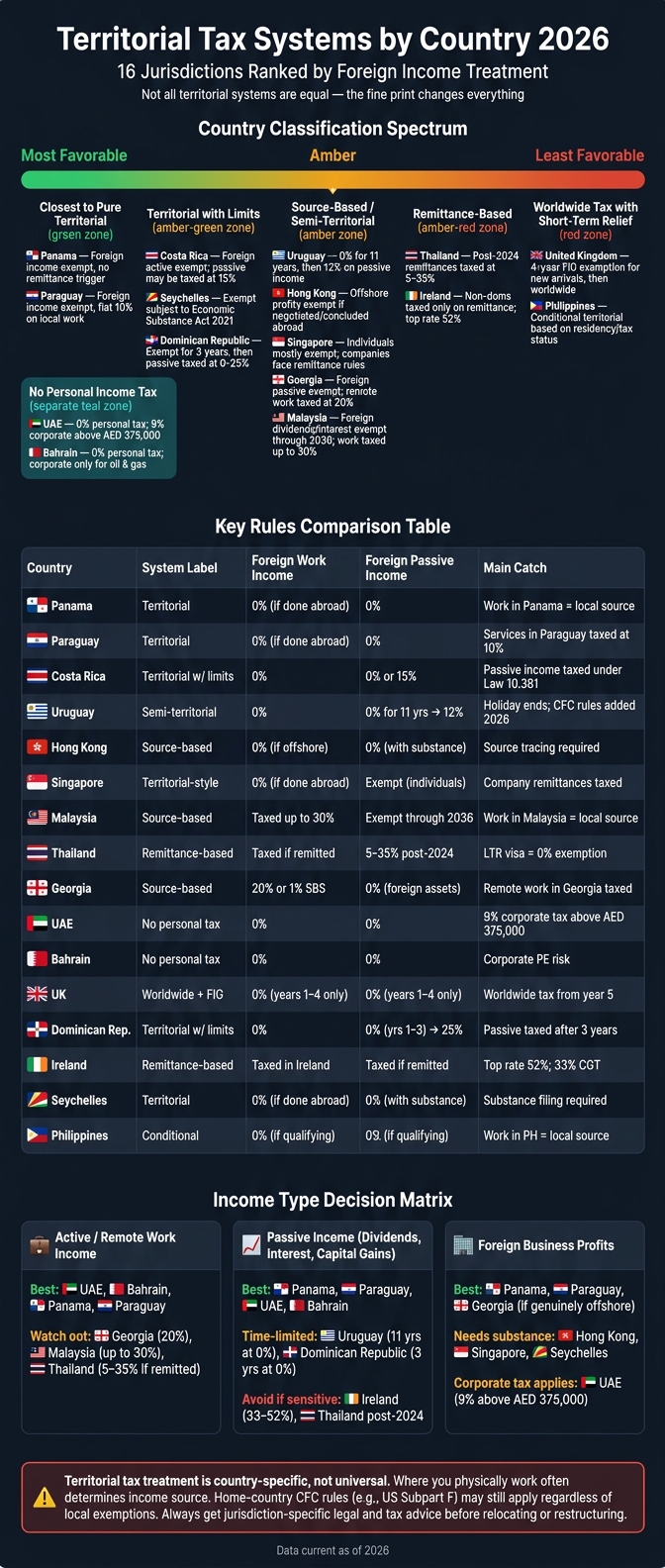
Quick Comparison
| Country | Main System in 2026 | Foreign Income Rule in Plain English | Main Catch |
|---|---|---|---|
| Panama | Territorial | Foreign-source income is generally exempt | Work done in Panama can be local-source |
| Costa Rica | Territorial with limits | Foreign active income often exempt | Some foreign passive income can be taxed at 15% |
| Paraguay | Territorial | Foreign-source income is generally exempt | Services performed in Paraguay are taxed at 10% |
| Uruguay | Semi-territorial | Foreign passive income can be 0% for 11 years | After that, many items move to 12% |
| Hong Kong | Source-based territorial | Offshore profits may be exempt | You need proof; source tracing matters |
| Singapore | Territorial-style | Individuals often get foreign income exemption | Company remittances can be taxed |
| Malaysia | Territorial/source-based | Foreign income often exempt | Work done in Malaysia can be taxed up to 30% |
| Philippines | Conditional territorial | Foreign income may be exempt for qualifying people | Work done in the Philippines may be local-source |
| Thailand | Remittance-based | Offshore foreign income may stay untaxed | Post-January 1, 2024 remittances can be taxed at 5%–35% |
| Georgia | Source-based | Foreign passive income is often exempt | Remote work done in Georgia is usually taxed at 20% |
| United Kingdom | Worldwide tax with FIG relief | New arrivals may get 4 years of foreign income relief | After that, worldwide taxation applies |
| Ireland | Remittance basis for non-doms | Non-doms are taxed on foreign income only if remitted | Irish work is taxed; remittances can be taxed hard |
| Seychelles | Territorial | Foreign-source income is generally exempt | Substance filings and local-work source rules matter |
| UAE | No personal income tax | Personal income is 0% | Company profits may face 9% corporate tax |
| Bahrain | No personal income tax | Personal income is 0% | Company tax and PE issues still matter |
| Dominican Republic | Territorial with time limits | Foreign work and business income are exempt | Foreign passive income is often taxed after 3 years |
Bottom line: if you earn salary or freelance income, the key question is usually where you physically do the work. If you live on dividends, gains, or offshore business profits, the next questions are whether remittance rules apply and whether your structure has local substance. That’s what separates a low-tax move from a tax problem.
sbb-itb-39d39a6
1. Panama
Panama taxes only local-source income. Income from outside Panama is exempt, even if you bring the money into the country. There’s no remittance trigger, which makes Panama one of the clearest territorial tax systems out there. That also makes it a useful benchmark when you compare it with the more conditional systems that come next.
For remote workers and freelancers, there’s an important catch: work done while you’re in Panama may be treated as Panamanian-source income, even if your client is based abroad. In practice, that means the place where the work happens can matter a lot. Using a foreign entity may help support foreign-source treatment. By contrast, using a Panamanian company can pull that income into the local tax net at a 25% corporate rate.
Foreign dividends, interest, capital gains from international investments, and offshore business profits are generally taxed at 0% for Panama tax residents. Foreign passive income also stays exempt unless special substance rules apply to certain multinational groups.
| Income Type | Foreign Source | Local Source |
|---|---|---|
| Employment / Remote Work | 0% | 0%–25% (progressive) |
| Business Profits | 0% | 25% (flat, corporate) |
| Dividends | 0% | 10% |
| Interest | 0% | 0%–25% |
| Capital Gains | 0% | 10% |
Foreign passive income remains exempt unless special substance rules apply to certain multinational groups.
Tax residency is generally triggered after 183 days in Panama during a calendar year, or by showing strong economic ties, such as owning property or having immediate family in the country.
Next, Costa Rica shows how territorial taxation can come with more limits.
2. Costa Rica
Costa Rica uses a territorial tax system, but it’s not as clean-cut as Panama. In plain English, foreign-source business income is often exempt, while some foreign passive income can still get taxed. That puts Costa Rica in a middle ground: a solid option for expats who earn most of their money abroad, but with more strings attached than Panama.
Under Law 10.381, foreign passive income like dividends, interest, royalties, and capital gains may be taxed at 15% for covered residents. Foreign tax credits can apply, but they’re capped at the amount of Costa Rican tax due on that same income. For entities outside multinational groups, the exemption usually stays in place without extra tests. But for entities inside multinational groups, the exemption depends on meeting economic substance rules. That includes qualified local staff, local facilities, and management control in Costa Rica.
For remote workers, the Digital Nomad Visa is the clearest path. It spells out the foreign-income exemption and requires monthly income of $3,000 for individuals or $4,000 for families. If you work remotely for foreign clients and don’t have Costa Rican customers or local operations, that income is generally exempt. For solo service providers, this is the most direct exempt route. No local company setup. No need to deal with corporate substance tests.
| Income Type | Tax Treatment | Rate |
|---|---|---|
| Foreign Active Business Income | Exempt | 0% |
| Foreign Passive Income | Conditionally taxable under Law 10.381 | 0% or 15% |
| Remote Work / Foreign Employment | Exempt (Digital Nomad Visa explicitly exempt) | 0% |
| Local Employment Income | Taxable (progressive) | Up to 25% |
| Local Capital Gains | Taxable (Costa Rican assets) | 15% |
Tax residency usually starts after 183 days in a calendar year or by holding a valid residency permit. One detail matters a lot here: if you set up a local Costa Rican company and use it to bill foreign clients, that can pull the income into Costa Rica’s tax net. So the setup matters. If you’re using a Costa Rican entity that’s part of a larger international group, keep clear records showing substance. Costa Rica also cross-checks local banking data with CRS records, which makes undeclared foreign passive income much easier for the tax authority to spot.
Next up is Paraguay, which follows a simpler territorial model with fewer carve-outs.
3. Paraguay
Paraguay sits much closer to Panama than Costa Rica on this issue. Foreign-source income is usually outside the tax net, but income tied to work you do while you’re in Paraguay is taxed. Under Law No. 6,380/2019, Paraguay follows a territorial tax system: foreign-source income is generally exempt, while income sourced to work performed in Paraguay is taxable.
It also keeps things fairly lean on the anti-avoidance side. Paraguay has no CFC rules and no broad GAAR, though it does apply transfer pricing and thin capitalization rules. It also does not levy wealth, inheritance, gift, or estate taxes.
The big catch is remote work. If you perform services while physically in Paraguay, that income is generally treated as Paraguay-source and taxed at 10%. By contrast, automated digital services like SaaS or API access can qualify for 0% digital export treatment under General Resolution 73/2020. Human consulting and custom development usually don’t make the cut. If the tax source is ever questioned, contracts and invoices that show foreign consumption can help back up your position.
For Paraguay-source income, the headline rate is simple: a flat 10% applies across corporate tax (IRE), personal income tax (IRP), and VAT. There is one lower-rate path for smaller operators. Small businesses and freelancers with annual revenue under $270,000 can elect the IRE SIMPLE regime and pay 3% of gross revenue. Personal income tax also generally does not apply below about $12,000 a year in local earnings.
| Income Type | Tax Treatment | Rate |
|---|---|---|
| Foreign Dividends / Interest | Foreign-source, exempt | 0% |
| Foreign Capital Gains | Foreign-source, exempt | 0% |
| Services Performed in Paraguay | Paraguay-source | 10% |
| Automated Digital Exports (SaaS, API) | Digital export | 0% |
Residency works a bit differently here too. Paraguay does not use a 183-day test. Instead, residency usually turns on having a residency permit, Cédula, and RUC registration with DNIT. On the standard track, applicants must make a refundable bank deposit of $5,000.
That setup changed in April 2026. Paraguay introduced an Investor Pass that lets qualifying investors skip the deposit and go straight to permanent residency. To keep that status, only one visit every three years is required. Paraguay is also not yet in CRS, though it does exchange information on request.
Uruguay next shows a more selective territorial model with tighter residency effects.
4. Uruguay
Uruguay is semi-territorial, not fully territorial. That matters because the label alone doesn’t tell the whole story. In Uruguay, relief for foreign income depends on both tax residency and the election you choose. In 2026, Budget Law 20.446 revised the system and kept the part many expats care about most: new tax residents can elect an 11-year holiday on foreign passive income.
Compared with Panama and Paraguay, Uruguay gives more relief on foreign passive income. But there’s a catch: that relief is tied much more closely to residency.
During that holiday, foreign dividends, interest, capital gains, and rental income are taxed at 0% for the year of arrival plus the next 10 calendar years. After that period ends, the same foreign passive income is taxed at 12% under the standard rules. By contrast, foreign employment income and active business profits earned abroad generally remain untaxed.
New residents also have other options. They can elect a permanent 7% rate on foreign dividends and interest, or choose a fixed annual payment of about $200,000 to $300,000.
| Income Type | During 11-Year Holiday | After Holiday |
|---|---|---|
| Foreign Dividends & Interest | 0% | 12% (or 7% if elected) |
| Foreign Capital Gains | 0% | 12% |
| Foreign Rental Income | 0% | 12% |
| Foreign Employment Income | 0% (generally territorial) | 0% (generally territorial) |
| Foreign Business Profits | 0% (generally territorial) | 0% (generally territorial) |
Getting in became stricter in 2026. The real estate investment threshold went up to about $2,000,000, and the alternative National Innovation Fund route now calls for a non-refundable $100,000 annual contribution for 11 straight years. Uruguay also scrapped the former 60-day stay route on January 1, 2026.
At the same time, Uruguay added tougher anti-avoidance rules. New look-through/CFC-style rules can attribute income from non-resident legal entities directly to Uruguayan individual shareholders who hold at least a 5% stake. In plain English, offshore holding structures are now much less useful under these rules.
Next, Hong Kong shows how territorial treatment can depend entirely on source rules.
5. Hong Kong
Hong Kong taxes only profits that come from Hong Kong. So the main question isn’t where you live. It’s where the profit was made.
Here’s the practical takeaway: if contracts are negotiated and signed outside Hong Kong, and the work also happens outside Hong Kong, those profits are often treated as offshore and may not be taxed there. That’s why source tracing matters so much in Hong Kong. It follows a territorial model for active business income, but it’s not as cut-and-dried as Panama or Paraguay once foreign passive income and MNE rules come into play.
To use the offshore claim, you can’t just state it and move on. The exemption must be claimed on the annual Profits Tax Return, and it needs support from records like contracts, emails, and shipping documents. Hong Kong companies also need audited accounts before filing.
Salaries Tax works in a similar way. It applies only to Hong Kong-sourced employment income. But there’s a catch: if you live and work remotely in Hong Kong for a foreign employer, that income can still be taxed in Hong Kong. The IRD may tax it if the work is performed in Hong Kong.
Since January 2023, Hong Kong has also taxed certain foreign passive income of MNE groups in some cases. This includes dividends, interest, IP income, and equity gains. To avoid tax, the entity generally needs to meet Hong Kong substance rules, such as having a local office, qualified staff, and local spending. That carveout is why Hong Kong is less absolute than Panama or Paraguay for some cross-border setups.
Hong Kong has no capital gains tax, no VAT/GST/sales tax, and no dividend withholding tax. Corporate tax is 8.25% on profits up to HK$2 million and 16.5% above that. For individuals, Salaries Tax applies at progressive rates from 2% to 17%, or at the standard rate of 15% on the first HK$5 million of net income and 16% after that, whichever is lower.
| Income Type | Tax Treatment | Key Condition |
|---|---|---|
| Local business profits | 8.25% / 16.5% | Always taxable |
| Offshore active business profits | 0% | Must be negotiated and concluded outside Hong Kong |
| Foreign passive income (MNE entities) | 0% | Must meet economic substance or nexus requirements |
| Capital gains | 0% | Generally exempt |
| Dividends received | 0% | Generally exempt |
| Salaries from foreign employment | Partial or 0% | Only Hong Kong-performed work is taxable |
Singapore next shows how another territorial system can still tax foreign income in specific cases.
6. Singapore
Singapore sits close to the territorial end of the spectrum, but it doesn’t give a blanket pass to all foreign income. Remittance rules matter. Substance tests matter too. So while the system is mostly territorial, foreign-sourced income can still be taxed when it’s received in Singapore. Compared with Panama or Paraguay, Singapore gives individuals more room on foreign income, but companies face tighter rules
For individuals, foreign-sourced income received in Singapore is usually exempt, except when it is received through a Singapore partnership. There’s one big line you can’t ignore: if the work is physically performed in Singapore, that income is treated as Singapore-source income, even when the employer is overseas That setup works well for many expats, but not for someone trying to treat in-country work as foreign income.
For companies, the rules are stricter. Foreign dividends, branch profits, and service income are taxable when remitted into Singapore unless Section 13 relief applies. To use that relief, the income must have been taxed abroad, and the source country must have a headline corporate tax rate of at least 15% Singapore’s corporate tax rate is a flat 17%. New startups, though, can face an effective rate of about 6.4% on the first SGD 200,000 of chargeable income
Capital gains are generally exempt. But there’s a catch. Section 10L can tax gains from foreign assets that are received in Singapore by entities that do not have enough local substance
An individual is treated as a tax resident if they are present in Singapore, or working there, for 183 days or more in a calendar year. Singapore also gives administrative concessions when employment runs across two or three back-to-back calendar years
| Income Type | Tax Treatment | Key Condition |
|---|---|---|
| Employment income performed in Singapore | Taxable at resident rates up to 24% | Tax follows where duties are performed |
| Foreign-sourced income (individuals) | Generally exempt | Unless received via a Singapore partnership |
| Foreign dividends, branch profits (companies) | Taxable on remittance unless exempt | Section 13: taxed abroad, source country headline rate ≥ 15% |
| Capital gains | Generally not taxed | Section 10L applies to entities without adequate local substance |
| Dividends from Singapore companies | 0% | One-tier tax system |
In practice, Singapore is territorial for many individuals, but it is not a blanket foreign-income exemption. The country also has no CFC rules, which means undistributed profits of foreign subsidiaries are generally not taxed Starting in 2026, MNE groups with annual revenue above €750 million fall under a 15% effective minimum tax through Pillar Two BEPS 2.0 rules
Malaysia next shows a more old-school territorial model, with a different approach to foreign-source income.
7. Malaysia
Malaysia uses a territorial tax system. On paper, that sounds simple: what matters most is where the income comes from, not just where you live. So if you’re a remote worker, Malaysia can look friendly at first glance because residents are taxed on Malaysian-source income, not worldwide income.
But this is where things get tricky.
If you do consulting, coding, design, or similar work while physically in Malaysia, LHDN may treat that income as Malaysian-source. If that happens, it can be taxed at rates up to 30%. The same problem can show up if you run a foreign company from Malaysia. Local management activity may create permanent establishment risk, which can pull part of the company’s profits into the Malaysian tax net. So while Malaysia is territorial in theory, it can feel much less so in day-to-day remote work.
There are still some clear tax breaks for foreign income.
For resident individuals, foreign dividends and foreign interest are exempt through December 31, 2036. For companies, LLPs, and trusts, the exemption for foreign-sourced dividend income and capital gains runs through December 31, 2030, but only if that income was taxed in the source country. If the money comes through a zero-tax jurisdiction, that exemption is unlikely to apply.
Capital gains follow the same source-based logic, but the rules split between listed and unlisted shares. For resident individuals, gains on listed shares are generally taxed at 0%. For companies and LLPs, unlisted share disposals have been subject to CGT since January 1, 2024, at 10% on net gains or 2% of the gross disposal price.
Tax residency usually starts at 182 days or more of physical presence in Malaysia during a calendar year. MM2H status does not by itself make you a tax resident. The 182-day rule still controls.
Here’s the practical breakdown.
| Income Type | Resident Individual | Company / LLP |
|---|---|---|
| Foreign dividends | Exempt through December 31, 2036 | Exempt through December 31, 2030 if taxed at source |
| Foreign interest | Exempt through December 31, 2036 | – |
| Foreign business profits | Generally exempt when foreign-sourced | Can be taxable if Malaysian management creates PE risk |
| Listed share gains | Generally 0% for resident individuals | – |
| Unlisted share disposals | – | 10% on net gains or 2% of gross disposal price |
| Local salary | Progressive 0%–30% | N/A |
8. Philippines
The Philippines uses a conditional territorial system. That means foreign income can be exempt, but only if the taxpayer meets certain residency or tax-status rules. For people who qualify, foreign-sourced income is generally not taxed locally. That may include foreign employment income, work for overseas clients, foreign dividends, and rental income from property abroad.
One point matters a lot here: where the work is done. It’s not just about who sends the payment. If you do the work while you’re in the Philippines, tax authorities may treat that income as Philippine-source, even if the client is based overseas. In practice, whether you qualify often turns on a specific legal residency or tax status.
If this ever gets questioned, paperwork matters. Keep records that show the income came from foreign sources, such as:
- Contracts
- Invoices
- Bank records showing foreign-source payments
Those documents can help support your position if it’s challenged.
There’s also a catch many people miss: a local exemption in the Philippines does not cancel out home-country CFC rules or citizenship-based tax rules. And because the Philippines participates in CRS, financial account data may be shared automatically with other tax authorities.
Thailand takes a stricter source-based approach.
9. Thailand
Thailand is close to the territorial end of the spectrum, but remittance-based is the better label. It isn’t fully territorial. Instead, foreign income that stays offshore is usually not taxed, while foreign income brought into Thailand can be taxed for Thai tax residents.
That includes remote work income, dividends, interest, and business profits under the post-2024 rules.
The rules got stricter on January 1, 2024. Under Departmental Instruction Por. 161/2566, foreign-sourced income earned from that date forward is taxed in the year it is remitted to Thailand, using progressive personal income tax rates of 5% to 35%. In plain English: the old play of waiting until a later tax year to bring money in no longer works.
There is one big carve-out. Foreign income earned before January 1, 2024, stays permanently exempt when remitted, as long as the source is documented. That matters most for expats with older offshore balances. The same rule applies to income earned before Thai residency began.
The Long-Term Resident (LTR) visa under Royal Decree No. 743 is the main route for remitting post-2024 foreign income without Thai tax. People in the Wealthy Global Citizen, Wealthy Pensioner, and Work-from-Thailand Professional categories are exempt from Thai tax on remitted foreign income. The visa costs THB 50,000 (about $1,400) per person and stays valid for 10 years.
There’s also a risk point many people miss. Running an offshore company from Thailand can create permanent-establishment risk and pull profits into Thai tax at 20%. Thailand uses a 180-day tax residency test, and the Revenue Department may treat wire transfers, ATM withdrawals from foreign cards, and even credit card spending in Thailand funded from offshore income as remittances.
The table below shows the practical split.
| Income Category | Standard Thai Resident | LTR Visa Holder (Decree 743) |
|---|---|---|
| Foreign income kept offshore | 0% | 0% |
| Pre-2024 foreign income (remitted) | 0% | 0% |
| Post-2024 foreign income (remitted) | 5%–35% progressive | 0% |
| Thai-source income | 5%–35% progressive | 5%–35% (17% flat for highly skilled employees) |
| Capital gains (general) | 0% (except crypto) | 0% |
10. Georgia
Georgia uses a source-based tax system, which is a big deal if part of your income comes from outside the country. In plain English: Georgian-source income is taxed at a flat 20%, while foreign dividends, interest, and capital gains tied to assets held outside Georgia are generally exempt for individuals.
For expats and founders, the main issue is pretty simple: is the income passive foreign income, or is it pay for work done in Georgia?
That distinction matters a lot. In Georgia, service income becomes Georgian-source when the work is performed in Georgia, even if your client is in another country. So if you live in Tbilisi and do remote client work from there, Georgia usually treats that income as local-source.
A lot of remote workers look at Small Business Status because the tax rate can be much lower. If you qualify, you pay:
- 1% on turnover up to GEL 500,000
- 3% on turnover above GEL 500,000
There are limits, though. Consulting, legal, and medical services do not qualify for this regime. And starting in 2026, Small Business Status holders must file monthly returns, even when they have zero income.
Georgia also uses an Estonian-style distributed profits model for companies. The standard corporate tax rate is 15%, but it applies only when profits are paid out as dividends. If profits stay inside the company, the tax is deferred. That can look simple on paper, but there’s a catch: managing a foreign company from Georgia can create permanent establishment risk.
Tax residency is the other half of the picture. The standard rule is 183 days in any 12-month period. Georgia also has an HNWI exception that can grant tax residency without the 183-day stay. To use it, a person must have assets above GEL 3,000,000 or annual income above GEL 200,000 for the previous three years, plus a Georgian link such as local property or Georgian-source income.
| Income Category | Tax Treatment | Key Condition |
|---|---|---|
| Foreign Dividends & Interest | 0% | Must be genuinely foreign-sourced |
| Foreign Capital Gains | 0% | Applies to assets located outside Georgia; 2-year holding period for real estate |
| Remote Work (performed in Georgia) | 20% standard or 1% SBS | Taxed as Georgian-source income |
| Small Business Turnover | 1% up to GEL 500,000 / 3% above | Consulting, legal, and medical services excluded |
| Corporate Retained Earnings | 0% (deferred) | Tax applies only when profits are distributed as dividends |
Georgia tends to fit best when foreign income stays genuinely foreign-source.
11. United Kingdom
The UK is not territorial in 2026. It taxes residents on worldwide income. That said, there’s a short-term carveout that matters a lot for new arrivals: a four-year FIG exemption. In a territorial-tax comparison, the UK works well as a contrast case.
On April 6, 2025, the UK permanently abolished its 200-year-old non-domiciled (non-dom) remittance-based regime. It replaced that system with the Foreign Income and Gains (FIG) regime. Under FIG, new residents who were non-UK residents for 10 straight years before arriving can claim a 100% exemption on foreign income and gains during their first four years of UK residence. And yes, that exemption still applies even if the money is remitted to the UK during that period. After the fourth year, that FIG treatment stops.
You have to claim the FIG regime each year on a self-assessment tax return. There’s a tradeoff, though. If you claim it, you give up the personal allowance (£12,570) and the capital gains tax annual exempt amount for that tax year. UK tax residency is determined under the Statutory Residence Test (SRT), which looks at time spent in the UK and ties like accommodation and family links. Days worked in the UK also count toward UK residency and can create UK-taxable employment income.
The 2025 reform also changed inheritance tax rules. The UK moved from a domicile-based IHT system to a residence-based test. As a result, worldwide assets can come within scope after 10 of the last 20 tax years.
| Feature | Details |
|---|---|
| Foreign income and gains (Years 1–4) | 100% exempt under the FIG regime, including remittances to the UK |
| Foreign income and gains (Year 5+) | Taxed on a worldwide arising basis |
| FIG eligibility | 10 consecutive years of prior non-UK residency required |
| IHT exposure | Worldwide assets can be within scope after 10 of the last 20 tax years |
Ireland follows with a more nuanced source-based approach.
12. Ireland
Ireland uses a remittance basis for non-doms, not a territorial system. That matters a lot.
If you’re tax resident in Ireland but non-domiciled, foreign income and gains are taxed only when you bring them into Ireland. Leave that money offshore, and it’s generally outside Irish tax. So Ireland can work as a useful contrast case: foreign income may avoid tax, but only for non-doms and only under tight remittance rules.
The main line here is domicile, not just residency. Domicile means your legal permanent home. If you’re Irish-domiciled and resident, you’re taxed on an arising basis. In plain English, that means your worldwide income and gains are taxable no matter where they were earned or held.
There’s no wiggle room for work done in Ireland. If you physically perform the work in Ireland, that income is fully taxable, even when the employer sits overseas. And once foreign funds are remitted, the tax bite can be steep:
- Foreign capital gains are taxed at 33%
- Foreign income can face a top marginal rate of 52%, including USC and social insurance
One practical point matters more than it may seem: keep clean capital, foreign income, and foreign gains in separate accounts. Ireland’s mixed-fund rule can treat a withdrawal as coming first from the source with the highest tax cost. That can turn a simple transfer into a tax headache fast.
| Income Type | Domiciled Resident | Non-Domiciled Resident |
|---|---|---|
| Irish-source income and work done in Ireland | Taxed | Taxed |
| Foreign employment (work done abroad) | Taxed | Taxed only if remitted |
| Foreign dividends and interest | Taxed | Taxed only if remitted |
| Foreign capital gains | Taxed | Taxed only if remitted |
Irish tax residency starts at 183 days in a calendar year, or 280 days across two consecutive years.
Next, Seychelles shows another limited offshore-friendly regime with its own source rules.
13. Seychelles
Seychelles uses a territorial tax system. That means only Seychelles-source income is taxed locally. Foreign-source business profits, including income earned through an offshore company, are generally exempt. But there’s a catch: that exemption can depend on the Economic Substance Act 2021. In plain English, the label “territorial” doesn’t tell the whole story here. What matters is where the work happens and whether the entity has real substance in Seychelles. Companies involved in relevant activities need to show genuine local substance to keep the foreign-income exemption.
If you’re working remotely while physically in Seychelles, that income is treated as Seychelles-source income. So even if your clients or employer are abroad, the income is taxed in Seychelles because the work is being done there. Personal income tax applies at progressive rates, up to 25%. Business income is also taxed based on where the work is performed.
Seychelles does not charge capital gains tax, inheritance tax, or wealth tax.
There’s also a filing rule that trips people up. Even if an entity does not carry on relevant activities, it still has to submit an annual non-applicability declaration. Miss that filing, and the fallout can include fines, automatic information exchange, and even strike-off.
Tax residency usually starts once you spend more than 183 days in a tax year in Seychelles. It can also apply if you keep a permanent home or habitual abode there. Treaty coverage is limited, so withholding tax in the source country may still apply.
| Tax Category | Rate | Notes |
|---|---|---|
| Foreign-Source Income | 0% | Subject to economic substance rules under the Economic Substance Act 2021 |
| Capital Gains / Inheritance / Wealth Tax | 0% | Not applicable |
| Personal Income Tax (Top Rate) | 25% | On Seychelles-source income above SCR 1,000,000 |
| Corporate Income Tax | 15%–25% | 15% on first SCR 1,000,000; 25% on excess |
| Withholding Tax (Non-residents) | 15% | On dividends, interest, and royalties; can be reduced by DTA where applicable |
Next, the UAE shows another territorial-style system, but with different residency and foreign-income rules.
14. United Arab Emirates
The UAE doesn’t use a classic territorial tax setup. For individuals, it’s even lighter than that: personal income is taxed at 0%. That covers salary, freelance income, remote work, dividends, interest, rent, and capital gains.
So for most founders and remote workers, the main tax question isn’t personal income. It’s where the company is run, where decisions are made, and where the income comes from.
A 9% federal corporate tax applies to mainland business profits above AED 375,000 (about $102,000). Free-zone companies may get 0% on qualifying income, but only if they meet substance and compliance rules. In plain English, that means the UAE looks closely at source, management location, and actual business presence.
That part matters more than many people expect. If key management and board decisions happen in the UAE, a foreign company can be treated as UAE-resident or seen as having a permanent establishment there. If that happens, worldwide profits may be pulled into the 9% corporate tax.
Residency also matters for treaty access. If you want a Tax Residency Certificate (TRC), which gives access to the UAE’s network of more than 140 double taxation agreements, you need to meet a physical presence test. That means either:
- 183 days in the UAE during a 12-month period, or
- 90 days with a residence visa plus a permanent home or job there
U.S. citizens have another layer to deal with. They still remain subject to U.S. worldwide taxation.
| Tax Category | Rate | Notes |
|---|---|---|
| Personal Income Tax | 0% | Applies to all income types for individuals |
| Corporate Tax (above AED 375,000) | 9% | Applies to mainland business profits |
| Free Zone Qualifying Income | 0% | Subject to substance and compliance conditions |
| Capital Gains / Dividends (Personal) | 0% | No personal-level tax |
| VAT | 5% | Standard consumption tax |
| Withholding Tax (Outbound) | 0% | No UAE withholding on dividends or interest |
Bahrain follows next with another low-tax model, but its business and residency rules work differently.
15. Bahrain
Bahrain sits at the far end of the spectrum. It isn’t fully territorial, but for individuals, the end result is much the same. Source doesn’t change the personal tax outcome. If you live there as an individual, personal tax stays at 0%, no matter where the income comes from.
That makes Bahrain a useful contrast in this comparison: no personal income tax, paired with narrower business tax rules. Tax residency usually follows work or investment permits, but that residency status doesn’t change the personal tax result.
For individuals, the picture is simple. For businesses, it’s not. Companies still deal with separate corporate tax and permanent establishment rules. Corporate tax has mostly applied only to oil and gas, yet foreign tax authorities may still question where a company is actually managed. And for large multinationals, Pillar Two top-up tax can still come into play. If you’re running a company from Bahrain, permanent establishment risk still matters because another tax authority may argue the business has a taxable presence wherever key decisions are made in practice.
| Tax Category | Rate | Notes |
|---|---|---|
| Personal Income Tax | 0% | No personal income tax on individuals, regardless of source |
| Foreign Dividends / Interest (Personal) | 0% | Not taxed at the individual level |
| Capital Gains (Personal) | 0% | No personal capital gains tax |
| Corporate Tax (Oil & Gas) | Oil and gas only | Historically limited to hydrocarbon companies |
| Corporate Tax (General) | 0% | 0% outside oil and gas |
The Dominican Republic moves back toward a more source-based model, where foreign income treatment depends on residency and the type of income.
16. Dominican Republic
The Dominican Republic uses a territorial tax system under Law 11-92. In plain English, that means foreign work income, foreign business profits, and foreign pensions are exempt, while foreign dividends, interest, rents, and capital gains on financial assets are exempt only for the first three years of residency.
Tax residency usually follows physical presence or holding a residency permit. Local-source income is taxed at progressive rates from 0% to 25%.
For general residents, that three-year window applies only to passive foreign income. Once you hit year four, foreign dividends, interest, rental income from properties abroad, and capital gains on financial assets move into the local tax base and can be taxed at progressive rates up to 25%.
There’s also a separate path under Law 171-07. This law gives a permanent exemption for qualifying pensioners, rentistas, and investors, including foreign passive income. The main thresholds are:
- Pensionados: at least $1,500 per month in foreign pension income
- Rentistas: at least $2,000 per month in stable foreign income for five years
- Investors: a minimum $200,000 investment in approved Dominican real estate or business
The Dominican Republic has no annual wealth tax, no exit tax, and no CFC rules. For business owners, the main issue is permanent establishment. If a foreign company is managed from the Dominican Republic, DGII may treat it as taxable there.
| Income Category | General Resident (Years 1–3) | General Resident (Year 4+) | Qualifying Law 171-07 Holder |
|---|---|---|---|
| Foreign Work / Remote Work | 0% (Exempt) | 0% (Exempt) | 0% (Exempt) |
| Foreign Business Profits | 0% (Exempt) | 0% (Exempt) | 0% (Exempt) |
| Foreign Pensions | 0% (Exempt) | 0% (Exempt) | 0% (Exempt) |
| Foreign Dividends / Interest | 0% (Exempt) | 0%–25% (Taxable) | 0% (Exempt) |
| Foreign Capital Gains | 0% (Exempt) | 0%–25% (Taxable) | 0% (Exempt) |
| Foreign Rental Income | 0% (Exempt) | 0%–25% (Taxable) | 0% (Exempt) |
This puts the Dominican Republic in the middle of the pack. You get broad relief for foreign work and business profits, but passive income gets a three-year grace period unless you qualify under Law 171-07. That split matters a lot if you live on dividends, portfolio gains, or rent from property abroad.
How These Countries Compare for Expats, Investors, and International Entrepreneurs
Now that the country-by-country list is done, the next step is simpler: match the tax regime to the way you make money.
That matters because these systems don’t all work the same way. The countries covered here fall into a few clear groups. You have territorial or territorial-style systems like Panama and Paraguay, conditional territorial systems like Costa Rica, source-based systems like Georgia, remittance-based systems like Thailand and Malaysia, hybrid foreign-income exemption systems like Singapore and Hong Kong, and no personal income tax jurisdictions like the UAE and Bahrain.
The best fit comes down to your income type. Active income, passive income, and company profits can each be treated very differently.
For expats and remote workers, the big dividing line is source. Some countries tax work based on where the work is performed. Others may treat that same income as foreign-source. If you earn active income, life is usually easier in no-personal-tax jurisdictions or in clean territorial systems. It gets tougher where work location determines source.
Passive income follows a different pattern. It tends to be safest where foreign dividends and capital gains stay outside the tax base. It gets less protected where remittance rules apply or where substance tests come into play. In plain English, what you actually do and where you do it often matters more than the label attached to the income.
Holding-company owners usually face the toughest scrutiny. The tax upside often depends on showing real local substance. And foreign-source income may stay exempt at the individual level only if the structure actually supports that result.
| Taxpayer Profile | Best Fit | Why |
|---|---|---|
| Digital Nomad | Costa Rica, Paraguay, UAE | Explicit foreign-income exemption |
| Expat Employee | UAE, Bahrain, Malaysia | No or low personal tax |
| Portfolio Investor | Paraguay, UAE, Uruguay | Foreign passive income relief |
| Holding-Company Owner | Singapore, Hong Kong, UAE | Can support real substance |
| Founder with Foreign Business Profits | Panama, Paraguay, Georgia | Foreign-source profits stay exempt |
There’s one more thing that can change the whole picture: your home country’s tax rules. Local tax perks don’t always win. US citizens, for example, still face Controlled Foreign Corporation rules under Subpart F no matter where they live, so territorial treatment in Panama or Georgia does not automatically shield offshore profits from US federal tax.
That’s why picking the right country is only part of the job. Residency, entity structure, and income sourcing all have to line up.
The next section breaks these trade-offs down by regime type.
Pros and Cons by Regime Type
The main issue isn’t whether a country calls itself territorial. It’s how that country handles foreign income in day-to-day tax treatment. And that can look very different from one place to the next.
Some systems offer a near-full exemption. Others use remittance rules. Others give you relief for a set number of years and then switch gears. For expats, investors, and founders, that difference matters a lot more than the label on the brochure.
One point trips people up all the time: in practice, source often depends on where the work is physically done.
Remittance-based systems, like Malaysia and Thailand, can let you defer tax by leaving money offshore. That sounds simple enough. But Thailand tightened its remittance rule in 2024, so remitted foreign income is now taxable no matter when it was earned. In plain English, the old deferral play is getting weaker.
Hybrid and time-limited systems work in a different way. They give you a set period of relief, which can be useful if you’re planning a move with a clear timeline. Uruguay gives new residents a 10-year holiday on foreign passive income. After that, dividends and interest are taxed at 12%. The Dominican Republic gives a 3-year exemption on foreign financial income. That can be a good fit for medium-term planning, but there’s a catch: the clock is always ticking.
The table below pulls the main trade-offs into one place.
| Regime Type | Main Advantages | Main Drawbacks | Best For | Main Watchouts |
|---|---|---|---|---|
| Mostly territorial (Panama, Paraguay; Seychelles with substance rules) | Foreign income is exempt regardless of remittance; foreign business profits and gains are generally 0% tax | Source disputes for remote work; new substance requirements for passive income | Solo entrepreneurs, remote freelancers, retirees | Labor performed on local soil may be deemed local-source |
| Remittance-basis (Malaysia, Thailand) | Tax-free if kept offshore; flexibility for large offshore portfolios | Taxed the moment funds enter the country; rules tightened a lot in 2024–2025 | High-net-worth investors who rarely need local liquidity | Thailand’s 2024 rule change |
| Hybrid source-based systems (Hong Kong, Singapore) | Access to top-tier banking and global markets | High compliance burden; strict substance tests for passive income | Large operational businesses and regional holding structures | Adequacy tests for passive income; paper companies no longer qualify |
| Tax Holiday (Uruguay, Dominican Republic) | Predictable 0% window for a set period; high livability | The exemption ends on a fixed date | Families and investors with a 5- to 10-year relocation horizon | Transition to worldwide or partial taxation after the holiday |
| Zero-tax (UAE, Bahrain) | Maximum simplicity; for individuals, source usually does not change the result | Not truly territorial; UAE corporate tax of 9% still applies to business owners | Expat employees, passive investors, founders with clean structures | Corporate-level tax obligations can offset personal tax savings |
A simple way to think about it: some regimes help if you keep money abroad, some help for a limited number of years, and some help only if your facts line up cleanly on source and substance. That’s why regime fit tends to matter more than marketing language.
Conclusion
Territorial systems look very different in 2026. The label itself matters less than the fine print. What matters is how each country handles foreign-source income, remittance, and local work.
That’s where the decision gets real. Foreign work income, passive income, and business profits are not taxed the same way in every jurisdiction. So the main job is to match the tax regime to the kind of income you have.
Before you relocate or change your structure, check whether remittance rules apply, what substance rules you’ll need to meet, and whether your home country’s CFC rules could still pull offshore income into tax. Territorial tax treatment is country-specific, not universal.
Use the table as a shortlist. Then get jurisdiction-specific legal and tax advice before moving, investing, or restructuring.
FAQs
How is income source determined?
In a territorial tax system, the source of income comes down to where the money-making activity happens. Tax authorities usually care less about where the client pays from or where the company is registered. What matters more is where the work is physically done or where the asset sits.
So if you’re in a country while doing the work, that income may be treated as locally sourced, even if every client is overseas. On the flip side, income is usually foreign-sourced when the work, business activity, or assets are entirely outside that country.
Can remote work still be taxed locally?
Yes. Even in a territorial tax system, remote work can still be taxed locally because tax authorities often treat income as sourced where the work happens.
So if you’re physically in a country while providing services, that income may be taxable there. Local tax duties can also come from where you run your company, whether you use local entities, and your residency status.
Which countries are closest to true territorial tax?
Panama, Paraguay, and Costa Rica are often viewed as the closest things to a true territorial tax system in the Americas. The main reason is simple: foreign-sourced income is usually exempt under the core tax rules, not through short-term incentives or remittance-style deferrals.
Of the three, Panama and Paraguay are often seen as the clearest examples.
Hong Kong gets mentioned a lot too. But the details still matter. Sourcing rules can affect how income is treated, and economic substance reviews may come into play, especially for multinationals and remote workers.
