
Territorial taxation can cut your local tax bill to $0 on foreign-source income – but only if your income is sourced outside the country and you still handle U.S. tax rules the right way.
If I had to sum up the whole topic in a few lines, I’d put it like this:
- A territorial tax system usually taxes only local-source income
- A worldwide tax system taxes income from everywhere
- For many Americans abroad, the biggest issue is not where the client lives, but where the work is done
- A move to a territorial-tax country does not end U.S. tax filing or U.S. tax on worldwide income
- Savings can be large: for example, $180,000 of foreign-source service income in a 40% tax system could mean $72,000 in local tax, versus $0 if that income is excluded under territorial rules
Here’s the short version: territorial taxation helps when your income is foreign-source under local law, your tax residency is set up the right way, and your entity, banking, and records match the facts. If any of those pieces are off, the tax break can disappear.
A few points matter most:
- Service income: often sourced where you physically do the work
- Dividends: often sourced based on where the paying company is based
- Rent: usually taxed where the property is located
- Royalties: often sourced where the IP is used
- Capital gains and interest: treatment changes by country
The main takeaway: territorial taxation can lower taxes, but it is not a shortcut. For U.S. citizens and green card holders, it works only alongside tools like the Foreign Earned Income Exclusion, foreign tax credits, and U.S. reporting rules such as FBAR when foreign account totals go over $10,000 at any point in the year.
Quick comparison
| Topic | Territorial system | Worldwide system | U.S. citizens / green card holders |
|---|---|---|---|
| What gets taxed | Usually local-source income | Global income | Global income |
| Foreign salary/service income | Often exempt if foreign-sourced | Taxed | Taxed, though FEIE/credits may help |
| Foreign dividends | Often exempt | Taxed | Taxed, though credits may help |
| Main risk | Misreading source rules | Double tax | Double tax plus extra reporting |
| What matters most | Source, residency, substance | Residency | U.S. status, source, credits, filings |
If I were looking at this for tax planning, I’d start with one question: Is my income foreign-source under that country’s rules? That answer usually decides whether territorial taxation saves money – or just adds paperwork.
sbb-itb-39d39a6
Worldwide vs. territorial taxation: the basic difference
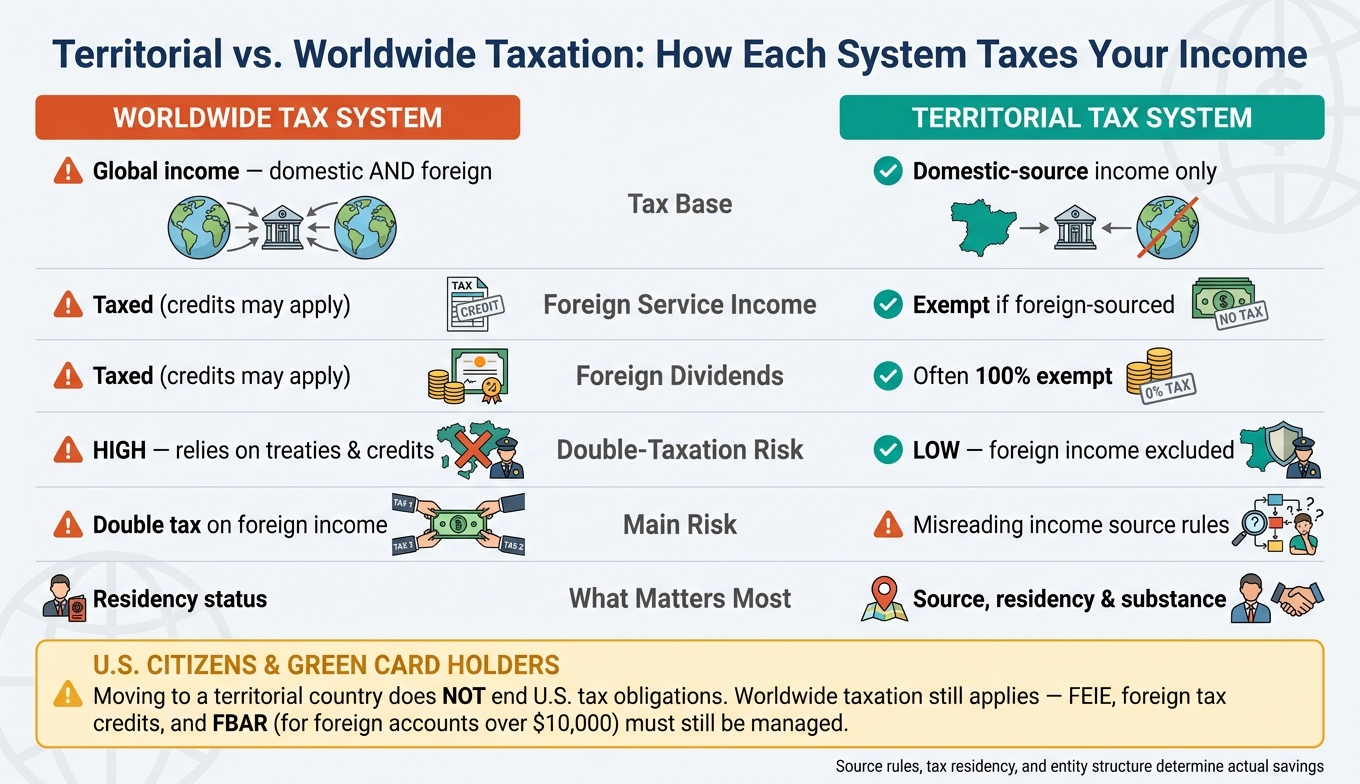
The main issue is simple: does tax follow where you live or where the income comes from?
Under a worldwide tax system, tax follows residency. That means foreign income still goes on your tax return. Tax credits and treaties can help soften the double-tax hit, but they don’t remove the paperwork.
A territorial tax system works in a different way. Foreign-source income stays outside the local tax base. If you earn money across borders, that can mean your foreign income isn’t taxed locally at all. That’s a big deal when your work, clients, or business income comes from more than one country.
Here’s where people get tripped up: income sourcing. Some countries tax work based on where the work is physically done. Others look at client location or the way the business is set up. So even if your client is overseas, the tax edge can vanish if the income is treated as locally sourced.
In practice, the split comes down to three things: sourcing, how foreign income is treated, and what you still have to report.
| Feature | Worldwide Tax System | Territorial Tax System |
|---|---|---|
| Tax base | Global income, domestic and foreign | Domestic-source income only |
| Foreign-source income | Taxed, often with credits for foreign taxes paid | Generally exempt |
| Double-taxation risk | High; relies on treaties and credits to mitigate | Low; foreign income is excluded from the domestic base |
The next step is figuring out whether your income actually counts as foreign-source.
How territorial taxation can lower your tax bill
The main upside is straightforward: foreign-source income may not be taxed locally at all. How much you save comes down to one thing: whether that income is classified as foreign-source in the first place.
Savings examples for service businesses and freelancers
The biggest tax cuts often show up with active business income. Say a freelance software consultant bills $180,000 per year to clients only in Europe and Asia. In a worldwide tax system with a 40% effective rate, that means $72,000 goes to taxes each year. In a territorial system, if that same income is treated as foreign-source, the local tax bill on those earnings can drop to $0.
A remote agency owner who works only with non-U.S. clients can run into the same kind of outcome when they become tax-resident in a territorial country. But this is where things get tricky. Source rules matter a lot. If the work is physically done inside the territorial country, some places treat that income as locally sourced instead of foreign-source, and the tax break disappears.
That’s why checking how a country defines the source of service income before moving is a big deal. Two countries can both call themselves territorial and still treat the exact same work in very different ways.
Savings examples for investors and holding structures
For investors, the picture is less clean because the tax result often changes based on the type of income. Foreign dividends usually get the best treatment under territorial systems. Countries such as Singapore, Malaysia, and Panama often exempt foreign dividends from local tax altogether.
Other income types are less predictable:
- Capital gains: depend on the jurisdiction
- Foreign interest income: may still be taxable
- Royalties: often taxed or handled under special rules
- Foreign business profits: often exempt, but the result still depends on the country and how the income is sourced
| Income Type | Worldwide System | Territorial System |
|---|---|---|
| Foreign service income | Taxed | Exempt if foreign-sourced |
| Foreign business profits | Taxed, with possible credits | Generally exempt |
| Foreign dividends | Taxed | Often 100% exempt |
| Capital gains (foreign assets) | Taxed | Varies |
| Foreign interest income | Taxed | Varies; may be taxable |
| Royalties from abroad | Taxed | Often taxable or subject to special rules |
Those tax savings hinge on sourcing rules, tax residency, and income type. That’s where the limits start to show.
What qualifies, what does not, and what limits the benefit
Territorial taxation cuts taxes only when income is actually foreign-source and the taxpayer meets the local rules. That’s the part people often miss.
Not every payment from abroad gets exempt treatment. A foreign client, foreign bank account, or foreign company name doesn’t settle it. What matters is sourcing, tax residency, and rules meant to stop people from gaming the system. The first question is simple: is the income foreign-source at all?
How different income types are sourced
Source usually turns on where the money-making activity happens, not who pays you. So if a developer lives and works in Panama and sends invoices to a client in Germany, Panama may still treat that income as taxable because the work happened there.
Here’s how common income types are usually sourced under territorial systems:
| Income Type | Typical Source Rule | Territorial Treatment |
|---|---|---|
| Active Business / Service | Where the work is physically performed | Taxed if done locally; exempt if done abroad |
| Dividends | Location of the paying company | Usually exempt if from a foreign corporation |
| Interest | Location of the debtor or debt instrument | Usually exempt if foreign-sourced |
| Rental Income | Physical location of the property | Taxed where the property sits |
| Capital Gains | Where the asset is located or transaction executed | Often exempt for foreign assets |
| Royalties | Where the intellectual property is used | Generally exempt if foreign-sourced |
Rental income is usually taxed where the property sits, and royalties are usually taxed where the IP is used.
And here’s the catch: even if income is foreign-source, the exemption can still fail if you don’t meet local residency and substance rules.
Residency, substance, and compliance rules
Becoming a tax resident in a territorial country is not as easy as staying under 183 days somewhere else. Tax authorities now look at the full picture. That can include your family ties, where your home is, where your business is managed, and even where your banking happens through center-of-vital-interests tests.
Many territorial countries also want real local substance, not just a mailing address or a paper company. If that substance isn’t there, passive income like dividends or royalties may not get exempt treatment.
CFC rules can also pull undistributed foreign profits into the tax net, even when the company is based in a low-tax jurisdiction. Panama, Singapore, the UAE, and Paraguay each apply their own sourcing and substance standards, so the details matter.
For Americans, there’s another layer on top of all of this: US worldwide taxation.
The US limitation for citizens and green card holders
Moving to a territorial jurisdiction does not end US tax duties if you are a US citizen or green card holder. The United States taxes its citizens on worldwide income no matter where they live or where the income is earned.
US citizens abroad may cut their US tax bill with the Foreign Earned Income Exclusion (FEIE), which excludes part of foreign earned income from US tax, or with foreign tax credits (FTC), which offset US tax with income taxes paid to another country. FBAR filing still applies when foreign accounts go over $10,000 in total at any point during the year.
So the setup has to work on two fronts at once: local territorial tax rules and US reporting rules.
Using territorial taxation in a legal international plan
Territorial tax can save money, but only when a few moving parts line up: residency, entity structure, and banking all need to match how the income is actually earned and sourced. That’s why the structure comes after you figure out where the income comes from for tax purposes.
Choosing the right structure before choosing the jurisdiction
Start with the facts first. Look at citizenship, tax residency, where the work is done, where the clients are, and whether the main goal is lower tax, asset protection, or relocation.
Each structure shifts tax exposure, control, and reporting in its own way.
| Structure | Tax Exposure | Control | Compliance Burden |
|---|---|---|---|
| Operating Company | High local exposure; foreign income may be exempt under territorial rules | Requires local substance: staff, office, local management | High; payroll, local filings, source documentation |
| Holding Company | Variable; foreign dividends and gains may be exempt depending on local rules and anti-deferral rules | Centralizes global assets; must be managed where resident | Moderate; ownership records, controlled foreign corporation reporting for U.S. persons |
| Trust / Foundation | May reduce personal tax exposure; separates legal ownership from beneficial use; tax treatment varies by jurisdiction | High control through protector or trustee roles | High; U.S. persons file Form 3520 and FBAR |
A business owner who physically performs work in a high-tax country needs a very different setup from a passive investor using a foreign holding company. That distinction matters. If you choose the wrong structure before moving, you can run into exit taxes, local tax presence, or controlled foreign corporation issues that eat up the expected tax savings.
Conclusion: territorial taxation saves money only when the facts support it
When the structure matches the facts, territorial taxation can cut tax on true foreign-source income. If the income is genuinely foreign-source and residency is set up the right way, the savings are there. If the facts don’t support the plan, the structure falls apart and the compliance costs still show up.
For U.S. citizens and green card holders, the plan also has to deal with U.S. worldwide taxation alongside local territorial rules. That includes FEIE, foreign tax credits, and controlled foreign corporation planning. In this area, documentation matters just as much as structure.
FAQs
How do I know if my income is foreign-source?
It depends on your country’s tax rules and on how the income was earned. In many cases, tax agencies look first at where the work or activity physically takes place, not where the client sits or where the company is registered.
Here’s the basic idea: service income is often sourced where you actually do the work. Other types of income may be sourced based on the payer, the location of the property, or where the asset is used.
So if you work for a client based outside the U.S., that alone doesn’t mean the income is foreign-source. That’s a common mix-up. Keep clean records and check the rules that apply to your setup.
Can territorial taxation help if I work remotely in one country for clients in another?
Yes. Territorial taxation can work in a remote worker’s favor, but the key detail is how your country of residence defines the source of income. In many territorial tax systems, income treated as foreign-sourced may not be taxed locally.
That said, having a foreign client by itself doesn’t automatically mean your income is exempt. Some countries focus on where the work is physically performed. Others look at whether you operate through a local business entity. In those cases, the income may be treated as locally sourced and taxed that way.
Do U.S. citizens still owe U.S. tax in a territorial-tax country?
Yes. U.S. citizens generally still owe U.S. tax on their worldwide income, no matter where they live or whether the country they live in uses a territorial tax system.
That means moving to a territorial-tax country might cut down – or even remove – local tax on income from outside that country. But it does not erase your U.S. filing duties or U.S. tax bill.
In some cases, the Foreign Earned Income Exclusion or Foreign Tax Credits can help reduce what you owe to the IRS.
