
Yes, it can – but mostly through delay risk, not an automatic loss of access. If you travel to Europe on a visa-free CBI passport, you will likely still qualify for ETIAS when it starts in Q4 2026. But your file may face more checks than a standard U.S. or U.K. case, and manual review can take up to 30 days.
Here’s the short version:
- ETIAS is not a visa. It is pre-trip travel approval for visa-exempt visitors.
- Most approvals should come in minutes. The EU expects 95%+ of cases to clear fast.
- CBI passport holders may face more review. This is more likely if the issuing country is under EU pressure.
- Vanuatu shows the risk is real. Its Schengen visa-free access was removed in November 2024.
- If Europe matters to your work, family, or property setup, a CBI passport alone may not be enough.
- EU residence permits are in a different class. If you hold one, you do not need ETIAS.
The main issue is not whether ETIAS blocks all CBI travelers. It’s whether your second passport still gives you the kind of predictable access you thought you were buying.
Quick comparison
| Traveler type | ETIAS need | Review risk | Europe access outlook |
|---|---|---|---|
| U.S./U.K./Canada passport holder | Yes | Low | Stable |
| Caribbean CBI passport holder | Yes | Medium to high | More uncertainty |
| EU residence permit holder | No | N/A | More certainty |
| Vanuatu passport holder | No ETIAS; visa needed | High | Visa-free access lost |
If I were relying on a second passport for Schengen travel in 2026, I’d do three things now: check whether that passport is still visa-free by reviewing the simplest citizenship programs in the world, apply early when ETIAS opens, and avoid non-refundable bookings until approval is in hand.
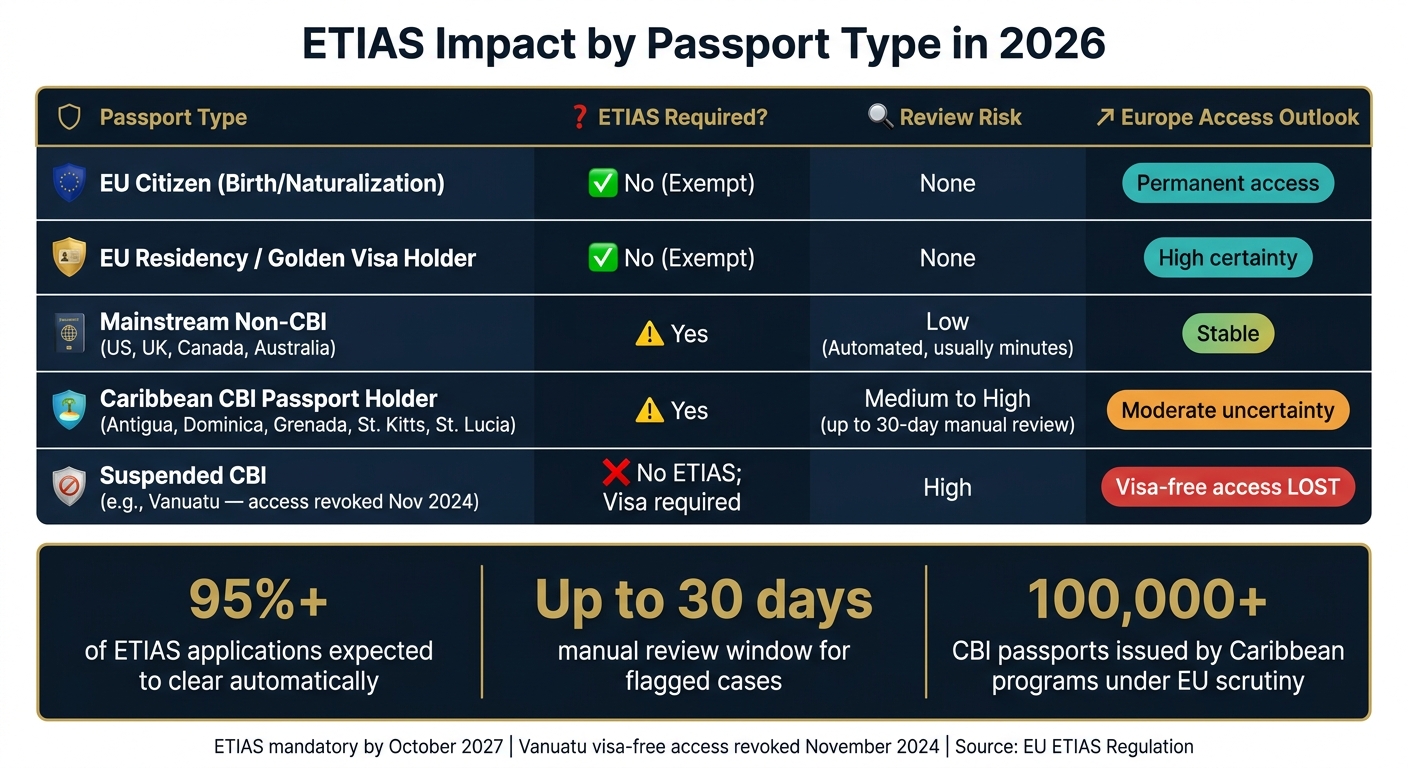
How ETIAS works and what it checks
Once ETIAS goes live, visa-free travelers will need to get approval before they board a flight, ferry, or other carrier bound for the Schengen Area. It covers short stays of up to 90 days within any 180-day period for tourism, business, or transit.
If approved, ETIAS stays valid for three years, or until the passport expires, whichever comes first. It’s tied electronically to the exact passport used in the application. So if you renew or replace that passport, you’ll need to apply for a new ETIAS.
Who needs ETIAS and who does not
ETIAS applies to citizens of about 60 visa-free countries, including the U.S., U.K., Canada, Australia, and many Caribbean nations. That also includes Caribbean CBI passport holders from Antigua and Barbuda, Dominica, Grenada, Saint Kitts and Nevis, and Saint Lucia.
The key detail is simple: ETIAS is linked to the passport you travel with. Use a different passport, and you need a new authorization. For some CBI holders, that passport-based screening may lead to more scrutiny than it does for other travelers.
What data ETIAS reviews before travel
The application asks for identity details, biometric passport data, contact information, your first point of entry, and answers to background questions. Those questions cover criminal history, prior travel to conflict zones, and public-health risk factors.
ETIAS then checks that information against EU security databases, Interpol, border management systems, and watchlists tied to security and public health.
Most applications are expected to move through the system without much delay. But if a case is flagged for manual review, the process can take up to 30 days. That’s where the next part of the story starts: not whether ETIAS exists, but which passports are more likely to draw a closer look.
sbb-itb-39d39a6
Where ETIAS can hurt CBI passport holders
ETIAS does not end visa-free travel. But it does add one more step before departure. For CBI passport holders, that can mean sharing more data before a trip and facing a higher chance of delay. So the issue isn’t ETIAS by itself. The issue is which passports are more likely to get a second look.
Why some CBI passports may face more scrutiny than others
The EU’s main concern with CBI programs is simple: citizenship through investment may be seen as missing a real tie to the country. The EU refers to this as the "genuine links" issue. Because of that, the five main Eastern Caribbean CBI programs – Antigua and Barbuda, Dominica, Grenada, Saint Kitts and Nevis, and Saint Lucia – are all under direct EU engagement. Taken together, those programs have issued more than 100,000 passports.
In June 2025, the EU finalized rules that connect a country’s CBI program to the possible suspension of visa-free travel. The clearest example is Vanuatu. Its visa-free access was revoked in November 2024 after the EU found that its program had issued 13,489 citizenships with weak vetting.
Some factors can make an ETIAS file more likely to get pulled for manual review, including:
- Multiple citizenships
- Recent passport changes
- Complex residence histories
- Travel to conflict zones
That doesn’t mean a CBI passport holder will be denied. It does mean the file may take longer than a plain-vanilla case. And that’s why a passport-by-passport risk check matters here.
Delays, refusals, and extra screening at the border
| Feature | Typical U.S./UK Passport Holder | CBI Passport Holder from a Country Under Closer EU Review |
|---|---|---|
| Processing Speed | Usually minutes | Minutes to 30 days if flagged |
| Manual Review Risk | Very low | Moderate to high |
| Border Friction | Minimal | Possible extra questioning on travel purpose and proof of funds, lodging, or return travel |
| Program Risk | Stable | Higher if the issuing country faces EU scrutiny |
Even with an approved ETIAS, border officers can still ask for proof of funds, accommodation, or return travel. That’s not the same as a denial. Still, it adds friction, and that friction can mean more time, more questions, and more uncertainty on every trip.
Why this matters more for mobility planning than for tourism
If someone takes one vacation to Europe each year, a delay can usually be handled by applying earlier. For entrepreneurs, investors, and globally mobile families, it’s a different story. They may need smooth access to Europe for meetings, property matters, or family logistics. In that context, a delayed ETIAS isn’t just annoying. It’s a business continuity risk.
Next, assess each passport by access, scrutiny risk, and how much you rely on Europe.
How to assess your ETIAS exposure before relying on a second passport
Map each passport by access, scrutiny risk, and how much you depend on Europe
The main test isn’t whether a passport looks fine on paper. It’s whether it lets you move in and out of Europe without drama when you actually need to travel.
Start by listing every passport your family holds, plus any you expect to get. Then run each one through three basic questions:
- Does it currently allow visa-free access to the Schengen Area?
- How likely is it to face ETIAS manual review?
- How much does your day-to-day life depend on smooth access to Europe?
That last point matters more than many people think. If Europe is central to your family or business, a second passport may help, but it may not solve the whole problem. A holiday can usually survive a delay. Regular business trips, a child’s schooling, or hands-on oversight of property and assets often can’t.
EU residency permits sit in a different category. Holders are exempt from ETIAS and get a much higher level of certainty. If Europe is part of your routine, that exemption should be part of your planning.
A simple risk-tier model for CBI and non-CBI passports
Use the tiers below to sort passports that only need ETIAS from those that avoid it altogether.
| Passport Category | ETIAS Scrutiny | Access Stability | Planning Value |
|---|---|---|---|
| EU Citizenship (Birth/Naturalization) | Exempt | Permanent | Relocation, work, and residence rights |
| EU Residency (Golden Visa) | Exempt | High | Frequent travel and physical oversight of assets |
| Mainstream Non-CBI (US, UK, Canada) | Low (Automated) | High | Reliable for tourism and short business trips |
| Caribbean CBI Passports | Medium to High (Manual Review Risk) | Moderate to high risk | Diversification only; not a full Europe solution |
| Suspended CBI (e.g., Vanuatu) | Visa required | Low | No longer supports visa-free travel |
Personal factors that can trigger closer review
Your passport category is only one piece of the puzzle. ETIAS also looks at you, and some parts of your profile can increase the odds of manual review even if your passport is ETIAS-eligible.
The clearest triggers are:
- Multiple citizenships
- Recent passport changes
- Complex residence histories
- Prior Schengen overstays
- Prior visa or entry refusals
- Criminal records
- Travel to conflict zones within the past 10 years
It’s smart to audit your travel history before you apply. Prior visa refusals, overstays, criminal records, or conflict-zone travel can move a case into the full 30-day review window.
Use the same passport for your ETIAS application, airline check-in, and border entry. If those documents don’t line up, you risk identity mismatches in the Entry/Exit System (EES). The EES reached full operation on April 10, 2026.
If you have any personal red flags, treat them as a timing issue as much as a rules issue. In plain English: give yourself more lead time before travel.
Conclusion: What investors should do in 2026
What current and future passport holders should take away
For most eligible travelers, ETIAS should still clear fast. But there’s a big shift here: visa-free travel is turning into pre-cleared travel. ETIAS is set to launch in Q4 2026 and become mandatory by October 2027.
That’s why passport choice matters for more than convenience. A second passport should be judged by how long its access is likely to hold up, not just by whether it offers visa-free entry today. Visa-free access can change fast.
If Europe plays a big role in your business, family life, or asset setup, the steps for 2026 are pretty simple:
- Apply early when the ETIAS portal opens
- Keep your passport valid and up to date
- Hold off on non-refundable bookings until approval is confirmed
For investors, that also means looking at passport planning and offshore asset protection at the same time.
How Global Wealth Protection fits into the planning process
ETIAS is a travel filter, but passport risk is only one piece of a much bigger offshore setup. Global Wealth Protection helps line up passport planning with offshore companies, trusts, and relocation plans, so a travel delay doesn’t throw the rest of your structure off track.
FAQs
Can ETIAS deny a CBI passport holder?
Yes. ETIAS can deny a CBI passport holder.
ETIAS isn’t a visa, but it is a required pre-travel authorization. Before approval, it checks applicants against security databases and watchlists.
In some cases, an application may also go through manual review, which can lead to refusal.
If your ETIAS is denied, you can’t travel to the Schengen Area. And even if you have a valid ETIAS, border authorities can still deny entry.
Which CBI passports face the most ETIAS risk?
Caribbean CBI passports may face the most ETIAS risk, especially those from Antigua and Barbuda, Dominica, Grenada, Saint Kitts and Nevis, and Saint Lucia.
These passports are still visa-free. But ETIAS adds mandatory pre-travel screening, which changes the process in a meaningful way.
The risk is highest for applicants with complex travel histories, dual nationality tied to high-risk countries, or past immigration issues. ETIAS may also give the EU more room for stricter case-by-case review of CBI programs it sees as security concerns.
Is an EU residence permit safer than a CBI passport?
Yes. An EU residence permit is generally the safer route for Schengen access than a citizenship-by-investment (CBI) passport.
Here’s the key difference: ETIAS will apply to Caribbean CBI passport holders. That adds a pre-travel screening step and, with it, the chance of a denial before the trip even starts.
By contrast, EU residence permit holders are exempt from ETIAS. That includes people with residency through programs like the Portugal Golden Visa or Greece Golden Visa. So they avoid that extra screening risk when traveling within the Schengen area.
