
Malta’s fast-track citizenship-by-investment route is over. If I were choosing today, I’d sort the options by one simple question: Do I want a passport fast, Schengen residency, or a route tied to recoverable capital?
Here’s the short answer:
- For direct citizenship in months: look at Antigua and Barbuda, St. Kitts and Nevis, Grenada, St. Lucia, or Dominica
- For U.S. E-2 access: look closely at Grenada or Turkey
- For Schengen residency: compare Malta MPRP, Greece, and Portugal
- For lower entry cost: Dominica starts at $200,000
- For families: Antigua and Barbuda starts at $230,000 for up to 4 people
- For recoverable capital: Turkey uses a $400,000 real estate purchase
- For a long-term EU plan: Portugal and Greece are residency-first options, not fast passport routes
What matters most is not just price. I’d weigh timeline, travel access, tax exposure, U.S. reporting rules, family fit, and rule changes before making a move.
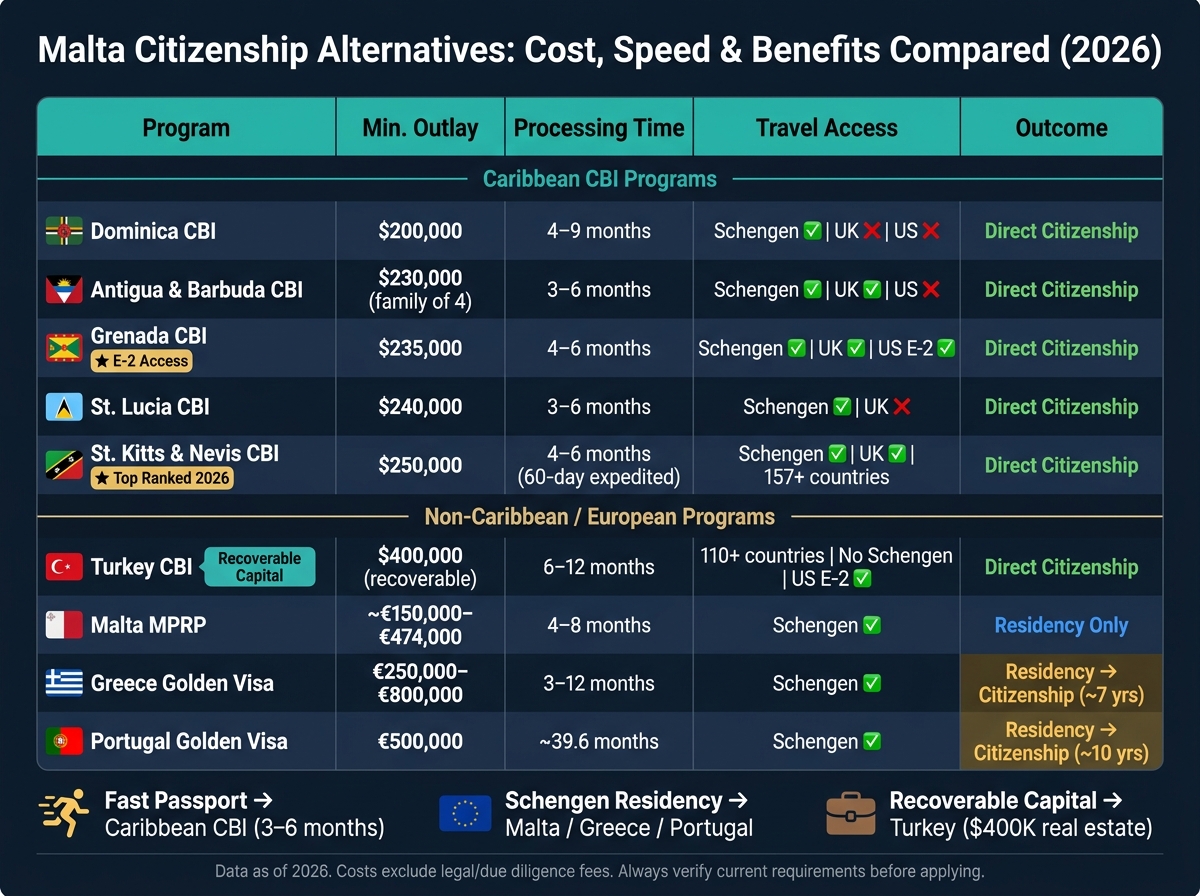
Quick comparison
| Option | Starting point | Main draw | Main limit |
|---|---|---|---|
| Dominica | $200,000 | Lowest Caribbean entry point | UK and U.S. travel limits |
| Antigua and Barbuda | $230,000 | Good fit for families | U.S. visa issues in 2026 |
| Grenada | $235,000 | E-2 path + China access | E-2 use may take time |
| St. Lucia | $240,000 | Bond route available | No UK visa-free access |
| St. Kitts and Nevis | $250,000 | Strong travel access | Highest Caribbean entry cost |
| Turkey | $400,000 | Real estate you can later sell | No Schengen visa-free access |
| Malta MPRP | About €150,000 on rental route | Schengen residency | No direct citizenship path |
| Greece Golden Visa | €250,000 to €800,000 | EU residency with low stay rules | Citizenship needs real residence |
| Portugal Golden Visa | €500,000 | Low stay rule, long-term EU route | Long wait times and longer citizenship path |
If I had to sum it up in one line: Caribbean programs are about passport speed, while Greece, Portugal, and Malta are about European access over time.
sbb-itb-39d39a6
1. Global Wealth Protection planning support
The question has shifted. It’s no longer just about how to buy citizenship. It’s about how to line up mobility, tax fit, and long-term stability in a way that still works years from now.
For many people, the most practical setup is simple: pair a fast Caribbean passport with a European residency track for longer-term EU access. That gives you one path for speed and another for future optionality. But the comparison should start with tax, because mobility doesn’t help much if the structure is inefficient or unstable.
Tax and long-term security
A second passport does not change U.S. tax obligations. The IRS taxes U.S. citizens on worldwide income no matter where they hold citizenship or residency. That means every option needs to be tested against U.S. tax rules, including CFC, GILTI, and PFIC exposure. Caribbean CBI states usually do not tax foreign income, while EU residency can trigger tax residency after 183 days.
Rules also move fast, and that matters. Portugal doubled its citizenship timeline for most non-EU applicants on May 3, 2026. That kind of regulatory volatility is a core planning risk, not a side note.
The programs most likely to stay in place over time are usually the ones with strong due diligence, clear rules, and steady political backing. They are not always the cheapest. They are not always the fastest either. That’s why it makes sense to put more weight on strong due diligence, transparent rules, and durable political support.
So each option below should be judged on more than speed alone. Stability and tax impact matter just as much.
2. Antigua and Barbuda citizenship by investment
Antigua and Barbuda is one of the clearest Malta replacements for families that want fast, direct citizenship. It stands out in the areas that tend to matter most: cost, speed, and family coverage.
Minimum outlay
The $230,000 National Development Fund donation covers a family of up to four, while the $260,000 University of the West Indies Fund works for families of six or more and includes one tuition-free scholarship.
For a single applicant, the total cost usually lands around $278,000 to $283,000, including government fees, due diligence, and legal fees. Due diligence fees start at about $7,500 per adult.
Processing speed
Standard processing usually takes 3 to 6 months. There’s also an expedited option that can cut that to about 45 business days.
That makes Antigua one of the fastest direct-citizenship options in the Caribbean. There is a catch, though. Applicants 16 and older now go through biometrics and interviews, so source-of-funds files need to be clean and easy to verify.
Mobility is strong, but tax treatment and vetting standards often decide whether this program makes the final cut.
Mobility and U.S. considerations
The Antigua passport gives visa-free or visa-on-arrival access to more than 150 countries, including the EU Schengen Area and the UK.
One weak spot is the United States. As of early 2026, the U.S. suspended new nonimmigrant visa issuance for Antigua and Barbuda nationals because of concerns about CBI vetting standards. If U.S. travel sits high on your list, that’s hard to ignore.
By contrast, Grenada, which appears later in this article, also gives access to the U.S. E-2 Investor Visa treaty.
Tax and long-term security
Antigua and Barbuda does not tax worldwide income, capital gains, or inheritance for non-residents, and personal income tax is 0%. For many people, that’s a big plus.
That said, U.S. citizens still owe full federal tax and reporting under FBAR and FATCA. A second passport doesn’t change that.
On long-term security, Antigua and Barbuda recorded a 1.7% rejection rate in 2024, the lowest among Caribbean CBI programs. It also ranked second in the 2026 Global Citizenship Programs Index, with a 94.40 compliance score.
Next comes a program with a different tradeoff: stronger U.S. access, but higher due diligence expectations.
3. St. Kitts and Nevis citizenship by investment
St. Kitts and Nevis runs the world’s oldest citizenship-by-investment program, launched in 1984, and it still sets the pace in the Caribbean for travel access and speed. In plain English: this is the premium Caribbean route. You pay more, but you get broader travel access and a fast-track option when time is tight.
Minimum outlay
The minimum contribution is $250,000 through the Sustainable Island State Contribution (SISC), and that covers either one applicant or a family of four. Due diligence fees are $10,000 for the main applicant and $7,500 per dependent age 16 or older. For a family of four, total costs usually land around $300,000 to $330,000.
For a single applicant, that’s the highest starting price among the five Caribbean CBI programs. The upside is clear, though: St. Kitts and Nevis offers the broadest travel access in the region and the only guaranteed accelerated processing track in the Caribbean.
Processing speed
Standard processing takes about 4 to 6 months. If speed matters, the Accelerated Application Process (AAP) gives a decision in 60 days for an extra $25,000. No other Caribbean program offers a guaranteed accelerated track.
There’s also more scrutiny here than some people expect. Applicants 16 and older must complete biometrics and interviews, which means the quality of the file matters a lot.
Mobility and EU access
The St. Kitts passport gives visa-free or visa-on-arrival access to 157+ countries, including the full Schengen Area, the UK, Singapore, and Hong Kong. That’s the broadest travel footprint of any Caribbean CBI passport.
St. Kitts and Nevis remains the Caribbean benchmark for travel access, speed, and program maturity.
Tax and long-term security
St. Kitts imposes no personal income tax, no capital gains tax, no inheritance tax, and no wealth tax. That tax setup also applies to non-resident citizens.
On long-term stability, St. Kitts ranked 1st overall in the 2026 Global Citizenship Programs Index with a composite score of 93.08. The program also sits under the oversight of the Eastern Caribbean Citizenship by Investment Regulatory Authority (ECCIRA), launched in June 2026 to standardize due diligence across the region. In practice, ECCIRA adds a formal regional layer of due diligence and oversight.
If access to U.S. investor routes matters more than sheer travel volume, Grenada is the next comparison to look at.
4. Grenada citizenship by investment
Grenada is often the more tactical Caribbean pick for people who care about U.S. business access. If St. Kitts gives you the broadest Caribbean passport, Grenada stands out for two reasons: U.S. E-2 treaty access and visa-free access to China. For many investors, that combo is the whole draw.
The minimum donation is $235,000 through the National Transformation Fund (NTF) for a single applicant or a family of up to four members.
Minimum outlay
The donation is only the starting point. Once you add government and processing fees, total costs usually climb by another $25,000 to $60,000.
Grenada also has a real estate option. The entry point is $270,000 for tourism projects or $350,000 under the standard route, and the holding period is five years.
Processing speed
Standard processing usually takes 4 to 6 months from application to passport approval. It isn’t a light-touch process, either. Applicants must go through mandatory interviews and strict source-of-funds checks.
Mobility and EU access
Grenada gives access to more than 140 countries, including the Schengen Area and the UK. It also includes visa-free China access and the U.S. E-2 treaty.
That matters because no other Caribbean CBI program offers both. If that’s on your checklist, Grenada sits in a lane of its own.
There is one catch: E-2 access does not happen right away. Applicants usually need about three years of Grenadian domicile first.
Tax and long-term security
From an asset protection angle, Grenada’s main appeal is simple: zero tax for non-residents plus strong travel access. Non-residents pay no tax on worldwide income, capital gains, inheritance, or wealth. Tax residency depends on where you live, not on the passport itself.
If you’re a U.S. person, that does not change your reporting duties. FBAR and FATCA rules still apply no matter which passport you hold.
Grenada is also part of ECCIRA, which supports due diligence and regional standardization.
If you want a similar Caribbean path but don’t need Grenada’s E-2 edge, St. Lucia is the next place to look.
5. St. Lucia citizenship by investment

St. Lucia is a good pick for investors who want a flexible Caribbean option without Grenada’s E-2 angle or St. Kitts’ higher price tag. The two big draws here are simple: a government bond route and mid-range costs.
Minimum outlay
The minimum donation through the National Economic Fund is $240,000 for a single applicant, with extra fees for family applications. That puts St. Lucia above Antigua and Grenada, but still below St. Kitts.
Its $300,000 government bond route stands out because it’s the only one of its kind in the Caribbean, and the principal is returned after five years.
Processing speed
Processing is usually targeted at 3 to 6 months, and some approvals come through in under 90 days. There’s also no physical residency requirement, which keeps the process fairly straightforward.
Mobility and EU access
The passport gives access to about 144 countries, including the Schengen Area. But there’s a catch: UK visa-free access ended on March 5, 2026. So if UK travel matters to you, St. Lucia no longer fits that need.
Tax and long-term security
St. Lucia does not tax non-residents on worldwide income, capital gains, or inheritance, and it now falls under ECCIRA oversight. That tax setup can work well for offshore planning, but it does not change U.S. reporting rules.
Next: Dominica, the lowest-entry Caribbean option.
6. Dominica citizenship by investment
Dominica has run its citizenship-by-investment program since 1993, which makes it one of the Caribbean’s longest-standing options. It also has the lowest starting price in the region.
The Economic Diversification Fund (EDF) donation starts at $200,000 for a single applicant. For one person, the total all-in cost is usually about $227,200 to $250,150. For families, though, Dominica is not always the cheapest pick. Antigua can cost less because its $230,000 starting point covers a family of four.
Dominica also offers a $200,000 real estate route, which matches the donation minimum, with a three-year holding period. On paper, that price looks hard to beat. In practice, the tradeoff is pretty clear: lower cost, but often slower processing and tighter screening than the headline number might suggest.
Processing speed
A more realistic timeline today is 4 to 9 months, based on how simple or complex the file is. ECCIRA now requires mandatory interviews for applicants age 16 and older, along with biometric data collection.
Dominica rejected 6.5% of applications in 2024, which is higher than some nearby programs. That matters. A lower price means less if the passport no longer lines up with the travel access you want.
Mobility and EU access
The Dominica passport gives visa-free or visa-on-arrival access to 145+ countries, including the EU Schengen Area. That’s still a strong travel footprint.
But there have been setbacks. The U.K. ended visa-free access in 2023, and the U.S. suspended B-1/B-2, F, M, and J nonimmigrant visas for Dominica nationals in early 2026. So while the passport still opens many doors, some big ones have narrowed.
Tax and long-term security
Dominica generally does not tax the worldwide income, wealth, or inheritance of citizens who do not live on the island. It also does not require physical residence at this time. That said, a proposed 30-day minimum stay within the first five years would limit that perk if adopted.
For non-residents, that tax setup can look attractive. But it does not fix U.S. reporting duties under FBAR and FATCA.
If you want a non-Caribbean route, Turkey is the next comparison.
7. Turkey citizenship by investment
Turkey gives you a direct path to citizenship through a recoverable $400,000 real estate purchase. This is not a donation route, and it isn’t a residency-first setup. You buy a real asset, hold it, and use that investment to qualify for a passport. It tends to appeal to people who want an asset they can later sell, access to E-2 eligibility, and a backup passport outside the EU. If your main goal is Europe, the next section shifts to residency-based routes instead.
Minimum outlay
The most common route is a real estate purchase, with a minimum investment of $400,000. Other routes, such as a bank deposit, government bonds, or an investment fund, each require $500,000 and come with a 3-year holding period.
For a single applicant, the all-in cost usually lands around $420,000 to $437,000, once you add transfer tax and legal fees. Adding a spouse and children under 18 does not increase the investment amount. It only adds extra government and legal fees, which are often about $2,000 to $5,000.
Because the capital can be recovered after three years, the main money you don’t get back is tied to fees and transfer taxes. In practice, that puts the sunk cost at roughly $20,000 to $50,000.
Processing speed
Processing usually takes 6 to 12 months. The main applicant and spouse must go to Turkey for biometrics, since proxy filing is not allowed. Background checks are strict as well.
Mobility and EU access
Turkey gives access to 110+ countries through visa-free or visa-on-arrival entry, but it does not include Schengen access. So the passport can help with travel, yet it is less useful if your main target is free movement across Europe.
The big draw here is E-2 treaty eligibility. Turkish citizenship can make you eligible for the U.S. E-2 Treaty Investor Visa, which can support long-term U.S. residence through a qualifying business investment.
Tax and long-term security
As of June 4, 2026, Turkey’s Law 7582 introduced a 20-year tax holiday on all foreign-source income for qualifying new residents who move to Turkey, including dividends, capital gains, crypto, and royalties. For those who qualify, inheritance and gift tax also falls to a flat 1%, down from a prior progressive scale that had reached 30%.
There’s an important catch: this tax break applies only if you actually relocate. To use the regime, you need to spend 183+ days per year in Turkey and must not have had a domicile there during the previous 3 calendar years. Citizenship by itself does not unlock the tax break. Residency does. And if you’re a U.S. person, U.S. tax reporting still applies.
If you need Schengen access, or you want a residency-first route into Europe, the next section compares Greece, Portugal, and Malta’s residence program.
8. European residency pathways: Greece Golden Visa, Portugal residency, and Malta Permanent Residence Programme
If Europe is still the goal after Malta’s citizenship route shuts, residency is now the practical stand-in. For buyers focused on Europe, the main options are Greece, Portugal, and Malta’s Permanent Residence Programme. These make the most sense when your goal is European residence, not fast-track citizenship.
Minimum outlay
The entry cost varies a lot.
Greece uses tiered pricing. The minimum investment starts at €250,000 for restoration or commercial-to-residential conversion projects, moves to €400,000 for standard properties, and goes up to €800,000 for prime areas such as Athens, Mykonos, and Santorini.
Portugal no longer allows real estate under this route. The minimum is now €500,000 into a qualifying Portuguese investment fund.
Malta’s MPRP comes in lower on the rental route, with a total cost of about €150,000, or about €474,000 on the purchase route.
Price is one piece of the puzzle. In these three programs, speed and the long-term route to citizenship also carry a lot of weight.
Processing speed
Malta is the fastest option, with processing usually taking about 4 to 8 months.
Greece often lands in the 3 to 12 month range, depending on the property type and how clean the paperwork is.
Portugal is far slower. As of Q2 2026, AIMA’s backlog was more than 55,000 applications, and average timelines were about 39.6 months.
That gap is hard to ignore. One route moves in months; another can stretch well past three years.
Mobility and EU access
All three programs give you full Schengen access. That means visa-free travel across the 29-country Schengen Area for up to 90 days in any 180-day period.
The stay rules are also light:
- Greece: no minimum stay to keep the permit valid
- Portugal: 7 days per year
- Malta MPRP: no minimum stay
So if your plan is to keep a base in Europe without living there full time, each option can work.
Tax and long-term security
This is where the programs start to pull in different directions.
Portugal’s IFICI regime offers a 20% flat tax on qualifying income for eligible new residents.
Greece offers a 7% flat tax for foreign pensioners under its Article 5A regime, with tax residency triggered at 183+ days per year.
Malta uses a remittance basis for non-domiciled residents. Under the Global Residence Programme, remitted income is taxed at a 15% flat rate, with a minimum annual tax of €15,000. This structure is increasingly relevant as global tax reporting standards tighten for international residents.
The practical tradeoff is pretty simple: Greece works for a lower entry point, Portugal stays in the conversation because of its citizenship path and low stay rule, and Malta MPRP stands out for faster residency processing.
Here’s the short comparison.
| Feature | Greece Golden Visa | Portugal Golden Visa | Malta MPRP |
|---|---|---|---|
| Visa/Residence Type | 5-year renewable | 2-year renewable | Lifelong permanent |
| Minimum Investment | €250,000–€800,000 | €500,000 (fund) | ~€150,000–€474,000 |
| Stay Requirement | None | 7 days/year | None |
| Time to Citizenship | 7 years (actual residence) | 5 years (minimal stay) | 5 years (actual residence; not automatic) |
| Processing Speed | 3–12 months | ~39.6 months | 4–8 months |
| Language Requirement | B1 Greek | A2 Portuguese | English (official) |
Side-by-Side Comparison: What Matters Most
This shortlist turns the program-by-program reviews into a simple decision matrix: passport now, EU residency later, or capital you may get back.
Caribbean CBI = direct citizenship, but no EU residence rights.
That distinction matters more than the lowest sticker price. A low entry point can look great at first glance, but the better pick depends on what you want most: fast citizenship, Schengen travel, a path tied to living in Europe, or access to a U.S. E-2 option.
| Program | Min. Outlay | Processing Speed | Mobility | Citizenship Outcome |
|---|---|---|---|---|
| Dominica CBI | $200,000 | 4–9 months | Schengen access | Direct citizenship |
| Antigua & Barbuda CBI | $230,000 | 3–6 months | Schengen access | Direct citizenship |
| Grenada CBI | $235,000 | 4–6 months | Schengen access + U.S. E-2 eligibility | Direct citizenship |
| St. Lucia CBI | $240,000 | 3–6 months | Schengen access | Direct citizenship |
| St. Kitts & Nevis CBI | $250,000 | 4–6 months | Schengen access | Direct citizenship |
| Turkey CBI | $400,000 | 6–12 months | No Schengen access | Direct citizenship |
| Malta MPRP | ~€150,000–€474,000 | 4–8 months | Schengen residency | Residency only; no direct citizenship route |
| Greece Golden Visa | €250,000–€800,000 | 3–12 months | Schengen residency | About 7 years of genuine residence |
| Portugal Golden Visa | €500,000 | About 39.6 months | Schengen residency | 10 years for most non-EU nationals |
A quick way to read the table:
- If you want a second passport fast, the Caribbean options sit at the front of the pack.
- If you want Schengen residency, Malta, Greece, and Portugal are playing a different game.
- If U.S. E-2 treaty access matters, Grenada CBI stands out.
- If your main aim is future EU citizenship, the residency routes may fit better, but they come with time-on-the-ground rules or long waiting periods.
That’s the trade-off in plain English: CBI programs are about speed and passports, while European residency programs are about access and patience.
Pros and Cons of Each Option
Use this quick snapshot to line up each route with your main goal: speed, U.S. access, EU residency, or keeping as much capital intact as possible.
Caribbean CBI programs give direct citizenship but no EU residency rights. Keep that in mind as you look at the Caribbean options below.
| Option | Main Pros | Main Cons | Best For |
|---|---|---|---|
| Dominica CBI | Lowest-cost Caribbean route ($200,000); fast passport in 4–9 months | Nonrefundable contribution | Budget-conscious investors who want a passport quickly |
| Antigua & Barbuda CBI | Family-friendly pricing ($230,000 for a family of four); 3–6 months | Nonrefundable contribution | Families wanting fast second passports |
| Grenada CBI | U.S. E-2 treaty access; path to the U.S. market | Nonrefundable contribution | Non-U.S. founders who want a path to the U.S. market |
| St. Lucia CBI | Fast-track Caribbean citizenship with no residency requirement | Nonrefundable contribution | Investors who want a straightforward second passport |
| St. Kitts & Nevis CBI | Oldest, most established program; 157+ visa-free or visa-on-arrival destinations | Highest Caribbean cost ($250,000); nonrefundable contribution | Investors who value program stability and track record |
| Turkey CBI | Recoverable asset path with a 3-year hold | No Schengen visa-free access | Investors who want capital back and a U.S. E-2 option |
| Greece Golden Visa | EU residency with Schengen access; entry can start at €250,000 for restoration projects | Requires real residence for citizenship eligibility; 7-year path | Investors willing to actually relocate to Europe |
| Portugal Golden Visa | Low stay requirement; may support E-2 planning for eligible nationals | 10-year citizenship path; 24–36 month backlog | Long-term planners comfortable with a decade-long timeline |
| Malta MPRP | Broader family inclusion; Schengen residency | Residency only, no direct citizenship route | Those who want EU residency without committing to one country |
Once you get past the headline differences, the deal often comes down to three things: documents, tax exposure, and policy shifts.
Source-of-funds paperwork is often where cases slow down. If your money trail is messy, the process can drag. Keep records for every dollar invested, from bank statements to sale documents and tax filings.
Tax treatment matters too, especially for U.S. citizens. A second passport does not remove U.S. worldwide taxation, FBAR reporting, or Form 8938 filing duties.
And rules can move fast. Minimum investment amounts, processing times, and eligibility standards can change with little warning, so check the current rules before you commit capital.
Use the table to narrow the field, then confirm the live requirements before you apply.
Conclusion
Malta’s investor citizenship route is over. Direct EU citizenship-by-investment through Malta ended after the ECJ found the program incompatible with EU law.
So the next step isn’t about chasing the lowest sticker price. It’s about picking the option that fits what you need most: speed, family coverage, U.S. access, or a base in Europe.
| Your Goal | Best Fit | Why |
|---|---|---|
| Fastest second passport | St. Kitts and Nevis | 4–6 months standard; 60-day expedited track |
| Family-friendly Caribbean citizenship | Antigua and Barbuda | $230,000 covers a family of four |
| U.S. business access | Turkey | Recoverable $400,000 real estate investment; E-2 treaty access |
| Schengen residency now, citizenship later | Portugal | 7 days per year minimum stay; 10-year naturalization for most applicants |
| EU residency without a long-term commitment | Greece or Malta MPRP | Schengen residency now; citizenship later or not directly |
A fast Caribbean passport makes sense if time is the main factor. Turkey stands out if you want a path tied to recoverable capital and E-2 access. And if your focus is Schengen presence now with the option of citizenship later, Portugal, Greece, or Malta MPRP may be the better lane.
Start with your goal, then work back to the program. That means looking at your tax profile, travel needs, family setup, and timeline before you make a call.
FAQs
Which option is best for U.S. E-2 access?
Grenada is the strongest citizenship-by-investment route for access to the U.S. E-2 visa. Turkey can also make applicants eligible, but Grenada is the only Caribbean citizenship-by-investment country with an active treaty with the United States.
Here’s why that matters: if your application is approved, you can apply for an E-2 investor visa and live and work in the U.S. through a business investment, as long as you keep citizenship in that treaty country.
Can I get EU citizenship through residency later?
Yes, but not directly through investment. In the EU, the usual path is to get residency first through an investment program, then apply for citizenship later through naturalization.
This is a long-term process, not a shortcut. You need to keep your residency valid and meet rules around physical presence, language, and integration. In most cases, you become eligible after five to ten years of legal residence.
Will a second passport change my U.S. taxes?
No. A second passport, by itself, does not change your U.S. tax obligations.
The United States taxes based on citizenship. So if you’re a U.S. citizen, you’re generally taxed on your worldwide income no matter where you live or what other passports you hold.
That said, a second passport can help with future planning. For example, it may matter if you later consider renunciation. But it does not create an immediate tax exit on its own.
For advice tied to your situation, talk with a qualified tax professional.
