
If I’m a U.S. citizen, I can visit the UAE for up to 90 days in any 180-day period without a visa – but I still need residency if I want to live there long term. That usually means choosing between a Golden Visa, work visa, Green Visa, retirement visa, property visa, or a 1-year remote work visa.
Here’s the short version:
- Golden Visa: best if I meet a high salary or investment rule and want 10-year self-sponsored residency
- Standard work visa: best if I already have a UAE job offer
- Green Visa: best if I’m a freelancer, self-employed, or a skilled worker who wants residency not tied to one employer
- Retirement visa: for people 55+ who meet income, savings, or property rules
- Property visa: for buyers who want residency through real estate, including Dubai’s 2-year option
- Remote work visa: for Americans who keep a U.S. job and want to live in the UAE for 1 year
A few rules matter more than most people think:
- The Golden Visa usually has no 180-day absence limit
- Standard residence visas often end if I stay outside the UAE for more than 180 days
- For a salary-based Golden Visa, only basic salary counts
- An Emirates ID is needed for daily life like banking, renting, school enrollment, and utilities
- The UAE dirham is pegged at AED 3.6725 = $1.00, which makes cost math simple
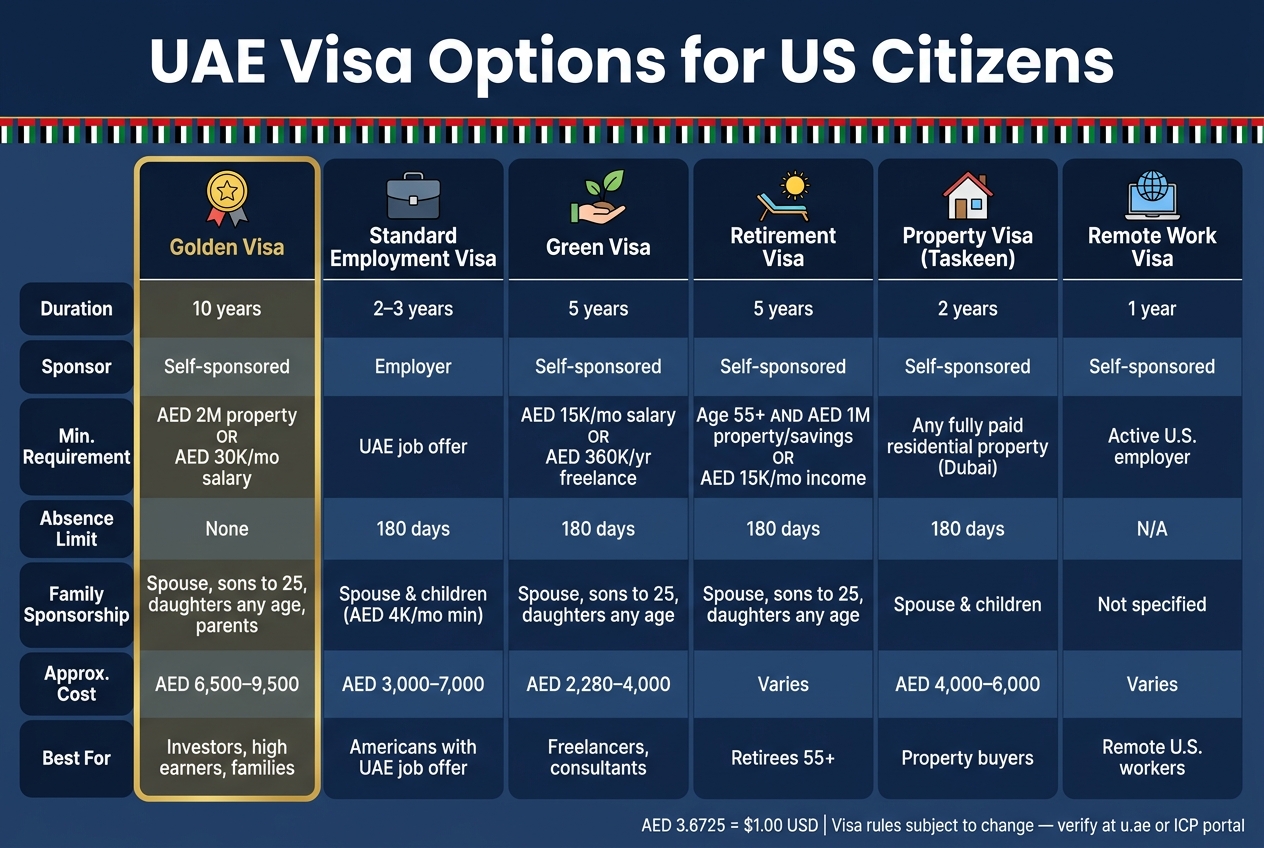
Quick comparison
| Visa type | Length | Sponsor | Good fit for |
|---|---|---|---|
| Golden Visa | 10 years | Self-sponsored | Investors, high earners, some talent-based applicants |
| Standard employment visa | 2 to 3 years | Employer | People moving for a UAE job |
| Green Visa | 5 years | Self-sponsored | Freelancers and skilled workers |
| Retirement visa | 5 years | Self-sponsored | Adults age 55+ |
| Property visa | 2 years | Self-sponsored | Buyers of qualifying UAE property |
| Remote work visa | 1 year | Self-sponsored | People keeping a U.S. employer |
My takeaway: if I want the most freedom, I’d look at the Golden Visa first. If I’m moving for a job, the standard employment visa is usually the starting point. And if I want to live in the UAE without tying my status to one company, the Green Visa is often the middle option.
Below, I break down which path fits which type of American move.
sbb-itb-39d39a6
1. UAE Golden Visa
The Golden Visa is the UAE’s most flexible long-term residence option for qualified U.S. citizens. It’s self-sponsored, which means you don’t need a UAE employer or local sponsor. And if your job changes, the visa stays valid. For Americans weighing different visa paths, this is the main point of comparison for long-term flexibility.
Eligibility routes
Americans can qualify through property, salary, investment, business, or exceptional-talent routes. The right path depends on your line of work, available capital, and why you’re moving.
| Route | Minimum Requirement | Duration |
|---|---|---|
| Real Estate | AED 2 million in property value | 10 years (renewable) |
| Skilled Professional | AED 30,000/month basic salary + bachelor’s degree | 10 years (renewable) |
| Investment Fund | AED 2 million deposit in an accredited fund | 10 years (renewable) |
| Entrepreneur | AED 500,000 in an approved startup or project | 5 years (renewable) |
| Exceptional Talent | Nomination by a UAE authority | 10 years (renewable) |
For U.S. professionals in finance, tech, or AI, the salary route is often the lowest-cost option because it doesn’t require an investment. On the property side, mortgaged or off-plan units can qualify if the total valuation hits AED 2 million. You can also combine multiple properties to meet the threshold.
Validity and renewal
Renewal depends on whether you still meet the original rules. That could mean keeping your salary level, holding the qualifying property, or maintaining your investment. Property investors are generally expected to keep the qualifying asset for at least two years after the visa is issued.
If you’re buying property for this visa, it helps to leave yourself some room. A valuation about 10% to 15% above the AED 2 million minimum can protect you if the market dips before renewal.
Absence flexibility and grace periods
This is where the Golden Visa stands out. Unlike a standard UAE residency visa, it doesn’t come with a six-month absence limit. So if you need to spend long stretches outside the UAE, your residency status can still remain in place.
If the visa expires, renewal windows can run up to 180 days. That’s much longer than the 30- to 60-day grace periods that are common with standard visas.
Family benefits
This kind of flexibility makes the Golden Visa a strong fit for families and people planning a long stay. Holders can sponsor:
- A spouse
- Sons up to age 25
- Unmarried daughters of any age
- Parents
One thing to note: the Golden Visa is a residence visa only. If you want to work in the UAE, you still need a separate MOHRE work permit.
Government fees usually land between AED 6,500 and AED 9,500, including medical tests and the Emirates ID. Processing often takes 2 to 8 weeks.
2. Standard employment residence visa
If you want UAE residency through a job, not through money or property, this is the main path. For Americans moving to the UAE for work, this is the usual employer-sponsored option. Unlike the Golden Visa, this visa is linked to one employer.
Eligibility triggers
You usually become eligible once you have a signed offer from a UAE-registered employer, whether that’s on the mainland or in a free zone. Americans often land roles in finance, tech, consulting, hospitality, aviation, healthcare, and energy.
The employer handles the work permit filing. You handle the medical test and Emirates ID process.
Sponsor model
Your employer acts as your sponsor, which means your residency depends on that job. If you resign or lose the role, the employer cancels the visa. In most cases, you then get 30 days to find a new sponsor or leave the country.
The good news: changing jobs usually does not lead to an automatic labor ban.
One point that’s worth saying plainly: do not hand over your passport to your employer. Passport confiscation is illegal in the UAE.
Validity and renewal
Mainland visas usually last 2 years. Many free zone visas last 3 years. If you stay outside the UAE for more than 180 days, the visa is usually canceled.
Family sponsorship
If you earn at least AED 4,000 per month, or AED 3,000 plus accommodation, you can sponsor your spouse and children.
| Feature | Details |
|---|---|
| Sponsor | UAE-registered employer |
| Duration | 2 years (mainland) / 3 years (certain free zones) |
| Grace period after job loss | 30 days |
| Max absence from UAE | 180 days |
| Family sponsorship salary | AED 4,000/month, or AED 3,000 plus accommodation |
| Visa costs | Usually paid by the employer; total processing costs are often AED 3,000–7,000 |
Start your paperwork early. FBI background checks and attestation for U.S.-issued documents can take 4 to 8 weeks.
If you’d rather have residency that isn’t tied to one employer, the Green Visa is the next option to look at.
3. UAE Green Visa
The Green Visa sits between the standard employment visa and the Golden Visa. It gives you self-sponsored residency without tying your status to one employer.
That’s the big draw. With a standard employment visa, your residency is linked to your job. Change jobs, and your visa status can shift too. With the Green Visa, that link is looser. For Americans who want more room to move but don’t meet the bar for a Golden Visa, this is a solid middle-ground option.
Eligibility triggers
US citizens can qualify through three main routes:
- Skilled employee: You need a valid UAE employment contract, a MOHRE occupational level of 1–3, a bachelor’s degree or equivalent, and a salary of at least AED 15,000 per month.
- Freelancer or self-employed: You need a MOHRE freelance or self-employment permit, a bachelor’s degree or relevant diploma, and proof of at least AED 360,000 in annual income for the previous two years.
- Investor or partner: You need proof of an approved investment or partnership in a UAE project. In some cases, the amount needed is AED 1,000,000.
In plain English, this visa tends to work best for salaried professionals, established freelancers, and business partners who want residency without employer sponsorship.
There’s one catch for freelancers: the two-year income history matters. So if you’ve just landed in the UAE and are starting from scratch, you usually can’t apply right away.
Sponsor model
Because the visa is self-sponsored, you stay in control of your residency if you switch jobs or take time off work.
Validity and renewal
The Green Visa is valid for 5 years and can be renewed for another 5-year term as long as you still meet the rules.
Family and residency benefits
The family side is one of the strongest parts of this visa. Green Visa holders can sponsor a spouse and children, including sons up to age 25 and unmarried daughters with no age limit. If you earn at least AED 20,000 per month, you can also sponsor your parents.
There’s also a grace period of up to 180 days after cancellation or expiry. That gives people a bit of breathing room, which can make a big difference when plans change.
Application costs usually fall between AED 2,280 and AED 4,000, not including medical exam and Emirates ID fees.
| Feature | Details |
|---|---|
| Sponsorship | Self-sponsored |
| Duration | 5 years, renewable |
| Min. salary (skilled employee) | AED 15,000/month |
| Min. income (freelancer) | AED 360,000/year for 2 prior years |
| Min. investment (investor) | AED 1,000,000 in some cases |
| Grace period after expiry | Up to 180 days |
| Sons’ sponsorship age | Up to 25 |
| Application costs | AED 2,280–AED 4,000 |
For Americans age 55 and older, the next route is the retirement visa.
4. UAE retirement visa
For Americans age 55 and up, the retirement visa is the main way to get UAE residency without relying on a job.
Eligibility triggers
You can qualify if you’re 55+ or if you have 15 years of service inside or outside the UAE. On top of that, you must meet one of these money-based thresholds:
- Own property in the UAE worth at least AED 1,000,000
- Hold AED 1,000,000 in savings in a 3-year fixed deposit
- Have a monthly income of AED 15,000 in Dubai or AED 20,000 in Abu Dhabi
Validity and renewal
The visa is valid for 5 years and can be renewed as long as you still meet the rules. The 180-day absence rule also applies, so you can’t stay outside the UAE for too long without affecting your residency.
Family and residency benefits
Visa holders can sponsor a spouse and children. That includes sons up to age 25 and unmarried daughters of any age.
| Feature | Details |
|---|---|
| Age requirement | 55+ or 15 years of service |
| Min. property value | AED 1,000,000 |
| Min. savings | AED 1,000,000 in a 3-year fixed deposit |
| Min. monthly income | AED 15,000 (Dubai) / AED 20,000 (Abu Dhabi) |
| Sponsorship | Self-sponsored |
| Duration | 5 years, renewable |
| Sons’ sponsorship age | Up to 25 |
| Time abroad | 180-day absence rule applies |
Next is the property/investor residence visa for buyers and business investors.
5. Property/investor residence visa
For Americans buying property in the UAE, the choice usually comes down to two paths: the 2-year Taskeen visa or the 10-year Golden Visa. Both are self-sponsored, which means you don’t need a UAE employer or a local sponsor.
If you’re going the property route, the main tradeoff is simple: speed vs. flexibility.
Eligibility triggers
For the Golden Visa, the property must reach a Dubai Land Department (DLD) valuation of at least AED 2,000,000 (about $545,000). Mortgaged or off-plan properties can still qualify, as long as the total DLD valuation meets that mark.
For the Taskeen visa, Dubai removed the AED 750,000 minimum property value rule in May 2026. That change means a sole owner can now qualify for a 2-year visa with any fully paid residential property.
That said, the two visas don’t treat property type the same way. The Taskeen visa requires a completed property with a title deed, while the Golden Visa can also cover off-plan properties.
Validity and renewal
The table below shows the main differences in day-to-day terms.
| Feature | Taskeen Visa | Golden Visa (Property) |
|---|---|---|
| Validity | 2 years, renewable | 10 years, renewable indefinitely |
| Min. investment | No minimum for sole owners in Dubai | AED 2,000,000 |
| Mortgage allowed | No, fully paid property only | Yes, if the total DLD value meets the threshold |
| Absence limit | Must enter every 6 months | No limit |
| Property type | Completed residential only | Completed or off-plan |
Renewing either visa usually involves a standard medical fitness test and updated Emirates ID biometrics.
The biggest practical split is the 180-day absence rule. If you stay outside the UAE for more than 180 straight days, the Taskeen visa can lapse on its own. The Golden Visa doesn’t have that rule. For someone who plans to travel a lot or live between countries, that’s a big deal.
Family and residency benefits
Golden Visa holders can sponsor a broader family group than Taskeen holders. The Taskeen visa usually covers a spouse and children.
All property-based visas come with a UAE Emirates ID. For the Golden Visa, government fees usually run from AED 4,000 to AED 6,000 for the main applicant. Family sponsorship often adds about AED 3,500 to AED 5,500 per dependent.
These gaps set up the pros-and-cons tradeoff in the next section.
Pros and cons of each UAE visa route for Americans
Each visa route comes with its own tradeoffs. Some are easier to get into, but easier to lose. Others take more money or a higher salary up front, but give you more control once you’re in.
The table below breaks down the day-to-day pros and cons that matter most.
| Visa Route | Main Advantages | Main Drawbacks | Best Fit | Biggest Risk Factor |
|---|---|---|---|---|
| Golden Visa (10-year) | Self-sponsored; no 6-month absence limit; broader family sponsorship | High entry threshold | Investors, senior executives, and families planning long-term stays | Cash tied up in property or investments; you must still meet the original requirements at renewal |
| Standard Employment Visa (2–3 year) | Employer usually covers fees and paperwork; fastest path if you have a job offer | Residency is tied to the job contract and can end quickly if employment ends; usually a 30-day grace period | Americans with a confirmed UAE job offer | Job loss can quickly end residency |
| Green Visa (5-year) | Self-sponsored; no employer dependency; 180-day grace period after visa expiry or cancellation | Requires qualifying salary or freelance income | Freelancers, consultants, and mid-career skilled professionals | Maintaining the income threshold for renewal |
| Retirement Visa (5-year) | Lower financial threshold than the Golden Visa; designed for non-workers | Restricted to ages 55+; 180-day absence rule still applies | Americans 55+ planning to retire in the UAE | Health insurance costs can rise with age |
| Property/Investor Residence Visa (2-year) | No minimum property value for sole owners in Dubai | Short renewal cycle; requires a completed property with title deed; 6-month absence rule applies | Entry-level buyers and those testing the market | Property sale can end the visa |
The pattern is pretty clear: lower entry costs often mean less room to breathe. Employment and property visas can be cheaper to start, but they’re also more fragile. Lose the job, sell the property, or miss a rule, and your residency can disappear fast.
Golden and Green visas ask more from you at the start. But in return, they give Americans more independence and a bit more breathing room. That’s a big deal if you don’t want your visa status hanging on one employer or one asset.
The next section maps these tradeoffs to common American situations: a job move, self-employment, retirement, or buying property.
Which UAE visa fits your situation?
The right visa comes down to three things: how you earn, how much you earn or invest, and how often you plan to travel. The table below turns those tradeoffs into common use cases for Americans.
| Your Profile | Best-Fit Visa | Best For | Use Instead If… |
|---|---|---|---|
| Keeping your U.S. job, working remotely | Remote Work Visa (Virtual Working Programme, 1-year) | Americans who want to live in the UAE while keeping a U.S. job | Freelance Permit if you need to work with UAE-based clients |
| Moving for a UAE salaried role | Standard Employment Visa (2–3 year) | Best for a confirmed UAE job offer | Golden Visa if your basic salary reaches AED 30,000/month |
| Freelancing or consulting independently | Green Visa (5-year) | Self-sponsored and not tied to one employer | Standard Employment Visa if you later take a full-time UAE job |
| Buying property below AED 2 million | Property Investor Visa (2-year) | Sole owners in Dubai with no minimum property value requirement | Retirement Visa if you’re 55+ and qualify through property, savings, or income |
| Investing AED 2 million or more | Golden Visa (10-year) | Best if you already meet the AED 2 million threshold and want long-term, self-sponsored residency | Property Investor Visa if your purchase is below AED 2 million |
| Retiring at age 55 or older | Retirement Visa (5-year) | Built for non-working seniors who want a 5-year residence option | Golden Visa if your property value reaches AED 2 million |
| Traveling frequently between the U.S. and UAE | Golden Visa (10-year) | Best for frequent travel because it has no 180-day absence limit | – |
One rule matters more than many people expect: for salary-based Golden Visas, only basic salary counts toward the threshold. Housing, transport, and other allowances don’t help you hit it. That’s why the Green Visa is often a better fit for salaried professionals.
Before you apply, check the latest thresholds, renewal rules, and eligible property categories on u.ae, the ICP portal, or GDRFA Dubai.
FAQs
Which UAE visa offers the most flexibility?
The UAE Golden Visa gives you the most freedom. It’s a self-sponsored, renewable 10-year residence permit, so it doesn’t rely on an employer, business partner, or any other sponsor.
Compared with standard residency visas, it gives you far more room to move. You can work for any employer, freelance, or run your own business. You’re also not tied to the usual six-month rule for time spent outside the country. On top of that, it allows broad family sponsorship.
Can I switch visa types after moving to the UAE?
Yes. A lot of residents first come in on a short-term visa or an employer-sponsored visa, then move to another option, like the Golden Visa or Green Visa, once they qualify.
In most cases, that means canceling your current residence permit and applying for a new one. There can be a few extra admin steps and added fees, but this is a common path.
What documents do U.S. citizens usually need to apply?
U.S. citizens usually need a valid passport and digital passport photos. If you’ve been to the UAE before, you may also need an existing UAE visa or entry stamp.
The rest depends on the visa route you’re taking. In many cases, you’ll need proof that you qualify, such as:
- An employment contract
- A salary certificate
- Company license documents
- Investment proof
- Attested marriage or birth certificates
- An attested bachelor’s degree
- Six months of bank statements
- In-country biometric and medical screening
The exact paperwork can feel like a moving target, so it helps to match your documents to the visa type before you apply.
