
Most U.S. travelers do not need a visa for Turkey in 2026. If I’m traveling for tourism or short business, I can enter visa-free for up to 90 days in any 180-day period with a U.S. passport valid for at least 6 months.
Here’s the short version:
- Visa needed? No, for tourism and short business visits
- Stay limit: 90 days within 180 days
- Passport rule: At least 6 months valid on arrival
- Border checks may include: return/onward ticket, hotel details, and proof of funds
- Visa required before travel: for work, study, research, official, or diplomatic travel
- Staying over 90 days? I need a residence permit before the first 90 days end
- e-Visa for U.S. tourists? No
A lot of people get one part wrong: leaving Turkey does not reset the 90-day count. Border officers look back at the last 180 days, and if my total time in Turkey hits 90 days or more, I can’t use visa-free entry.
If my trip is longer or for a different purpose, the right path is simple: consular visa before travel for work, study, or research, and residence permit for stays past 90 days.
| Situation | What I need |
|---|---|
| Tourism or short business, 90 days or less | No visa |
| Work, study, research, official, or diplomatic trip | Consular visa before arrival |
| Stay longer than 90 days | Residence permit |
That’s the full answer up front. The rest of the article explains the stay rule, border checks, fees, timing, and common mistakes to avoid.
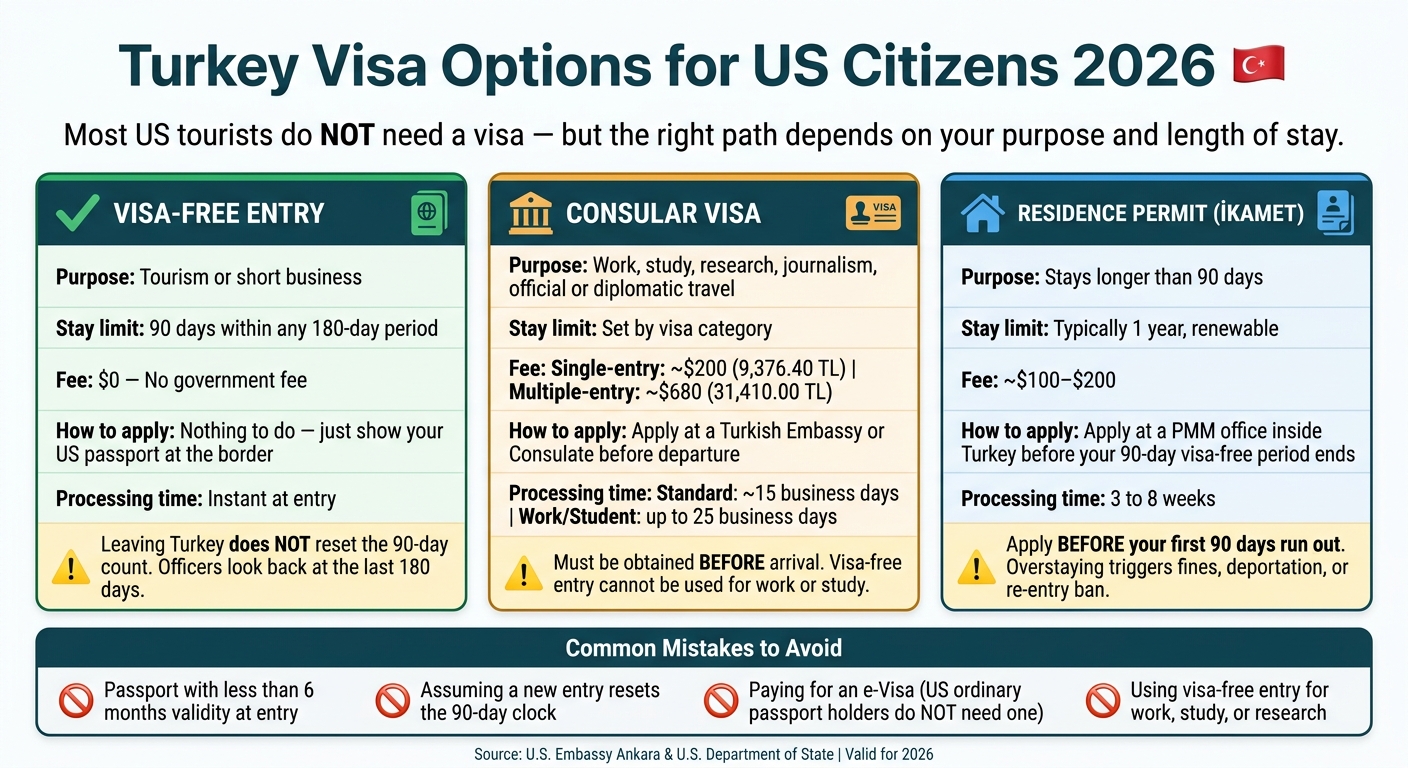
Visa-free entry for US citizens: the 90/180-day rule and basic entry checks
For visa-free trips, the big limit is 90 days in any 180-day period. The U.S. Embassy in Ankara says ordinary U.S. passport holders can enter Turkey visa-free for up to 90 days within that 180-day window. That means visa-free entry, not a visa. And that distinction matters.
How the 90 days within 180 days rule works
Turkey looks at every day you spent in the country during the previous 180 days. If that total reaches 90 days or more, you can’t enter visa-free.
Here’s the part that trips people up: leaving Turkey and coming back does not reset anything. The clock keeps rolling. Your oldest days only drop off once they move outside the 180-day look-back period. So before you book, add up all your Turkey days from the prior 180 days. If your plan goes past the limit, you’ll need a visa or a residence route instead.
Passport validity and arrival documents
Your passport needs to be valid for at least six months beyond entry and have one blank page. If it’s close to expiring or nearly full, renew it before the trip. It’s a lot easier to deal with that at home than at the airport.
If you still meet the visa-free rules, border officers may ask for a few basic items when you arrive, including:
- An onward ticket
- A hotel booking
- Proof of funds
A common benchmark is $50 to $100 per day in cash or available credit.
One more thing: make sure the officer stamps your passport on both arrival and departure. A missing exit stamp can lead to fines or even trouble re-entering later.
What visa-free entry does not allow
Visa-free access is for tourism and short business meetings only. It does not cover work, study, or academic or scientific research. If that’s the purpose of your trip, you must get a visa from a Turkish embassy or consulate before you arrive.
Using visa-free entry for work, study, or research can lead to fines, removal, or problems with future entry. If your plans go beyond tourism or short business travel, the next section covers the right visa route.
sbb-itb-39d39a6
When a Turkish visa or residence authorization is required
If visa-free entry doesn’t fit your trip, you’ll need the right visa or residence path instead. The right option comes down to why you’re going and how long you’ll stay.
Travel purposes that require a visa or prior approval
According to the U.S. Department of State:
"If you are planning to work, study, or conduct academic or scientific research, you must receive a visa from a Turkish embassy or consulate before arrival."
That same rule applies to official or diplomatic travel, which also needs a consular visa before arrival.
If you expect to stay more than 90 days, visa-free entry is no longer enough. In that case, you need to apply for a residence permit (ikamet) with PMM in Turkey before your 90 days run out.
Visa-free travel vs. consular visa vs. residence permit
U.S. citizens do not need a Turkish e-Visa for tourism. Here’s the simple breakdown:
| Entry Type | Purpose | Stay Limit | How to Apply |
|---|---|---|---|
| Visa-Free | Tourism or business | 90 days in any 180-day period | No application; present your U.S. passport at the border |
| Consular Visa | Work, study, research, official or diplomatic travel | Set by visa category | Turkish Embassy or Consulate before arrival |
| Residence Permit | Stays over 90 days | Typically 1 year, renewable | PMM office in Turkey after arrival |
Overstays and compliance risks
Overstaying can trigger fines, deportation, and even a re-entry ban.
This matters even more if you travel to Turkey more than once in a year. The 90-day limit works on a rolling 180-day basis. In plain English, it doesn’t start over just because you leave and come back.
A lot of travelers trip up here. They assume a new entry means a clean slate, but that’s not how the rule works. Keeping track of your days before each trip can help you avoid an accidental overstay and pick the right entry route before travel.
How to apply when visa-free entry does not cover your trip
When visa-free entry doesn’t fit your plans, the next move is simple: pick the right application route from the start. That matters more than people think. If you choose the wrong path, you can lose time, pay extra fees, and end up redoing the whole file.
Step 1: Confirm the correct visa category
Start by matching your trip purpose to the right route. Use a consular visa for work, study, or research. Use a residence permit for stays longer than 90 days.
If your trip includes employment or formal enrollment in a Turkish school or university, visa-free entry is not enough. You need a consular visa.
Once you’ve pinned down the right route, pull together the documents tied to that specific application.
Step 2: Prepare documents and complete the application
For consular visa cases, begin with the official online pre-application. It’s a lot easier if you collect your paperwork before you start. In most cases, you’ll need:
- A valid U.S. passport with at least 6 months of validity from your planned arrival date and one blank page
- A 2×2.4 inch (50×60 mm) passport photo with a white background and a neutral expression
- A confirmed return or onward flight ticket and accommodation details
- Purpose-specific documents, such as an acceptance letter, work letter, or other proof tied to your visa category
Stick to official .gov.tr websites only. Third-party sites can tack on extra fees and create data risk.
Step 3: Attend the appointment, pay fees, and wait for approval
After your file is complete, submit it, go to the appointment, pay any required fees, and wait for a decision. For consular visa applications and residence permits, fingerprints and other biometrics are often taken at that appointment.
Processing times vary by case:
- Standard consular visas: about 15 business days
- Work and student visas: up to 25 business days
- Residence permits: usually 3 to 8 weeks
Before you submit, check every passport number, travel date, and name spelling. A tiny typo can turn into a headache, since fixes after issuance often mean paying a new fee.
Book nonrefundable travel only after approval.
Fees, processing times, common mistakes, and final takeaway
What US travelers can expect to pay and how long it may take
Once you know which route fits your trip, the next thing to sort out is cost and timing.
For paid routes, fees and processing times change by visa type. Trips beyond that limit require a consular visa or residence permit.
| Application Type | Estimated Fee | Processing Time |
|---|---|---|
| Visa-free entry (tourism/business ≤ 90 days) | $0 | No government fee; processed at entry |
| Single-entry consular visa | 9,376.40 TL (~$200) | 2 to 8 weeks |
| Multiple-entry consular visa | 31,410.00 TL (~$680) | 2 to 8 weeks |
| Short-term residence permit | About $100 to $200 | 2 to 4 weeks |
If you need a consular visa, give yourself time. Start at least 2 to 3 months before departure. If you plan to stay more than 90 days, apply for a residence permit before your first 90-day period runs out.
Mistakes that commonly disrupt Turkey travel plans
A few common errors trip people up, and most of them are easy to avoid.
Traveling with a passport that has less than 6 months of validity can cause trouble at boarding or on arrival. Turkey requires at least 6 months of passport validity when you enter.
Not having proof of funds or an onward ticket can also slow things down or stop entry. It helps to carry proof of both, plus your accommodation details.
Visa-free entry does not cover work, study, journalism, or research. For those trips, you need the right visa or other approval before you leave.
And one more thing: do not pay for an e-Visa that U.S. ordinary passport holders do not need.
Conclusion: the correct application path for 2026
For U.S. citizens traveling to Turkey in 2026, the right path comes down to why you’re going and how long you’ll stay. Tourism and short business visits of up to 90 days within any rolling 180-day period do not need a visa and have no government fee. Work, study, journalism, or research requires a consular visa before departure. Stays longer than 90 days require a residence permit filed before the first visa-free period ends.
FAQs
How do I count my Turkey days correctly?
Use the 90 days within 180 days rule. You can stay in Turkey for a total of 90 days within any rolling 180-day period, whether that’s one long trip or several shorter visits.
Here’s the simple way to check it: count back 180 days from your entry or exit date. Then add up every day you were in Turkey during that window. If the total is 90 days or less, you’re within the limit.
That’s the key point: it’s a rolling 180-day window, not a fixed six-month block. So yes, your dates matter. A lot. Track every entry and exit date carefully.
What happens if I accidentally overstay in Turkey?
If you stay in Turkey past the time you’re allowed, you may need to pay administrative fines when you leave.
How long you overstay matters. Turkish authorities can also place a travel ban on you for 3 months to 5 years.
In more serious cases, overstaying can lead to deportation.
To avoid trouble, keep your status valid and apply for a residence permit if you need to stay longer than the 90-day visa-free limit.
Can I switch from visa-free entry to a residence permit in Turkey?
Yes. If you plan to stay in Turkey for more than 90 days within a 180-day period, you can enter visa-free and then apply for a residence permit before your first 90 days run out.
For tourism, U.S. citizens can apply for a short-term residence permit for up to six months through the DGMM online e-residency system.
