
The Cayman Islands is one of the world’s leading offshore banking hubs, managing nearly $2 trillion in assets and hosting some of the largest global banks. It offers a tax-neutral environment with no income, corporate, capital gains, or inheritance taxes, making it an attractive choice for entrepreneurs and investors. Key features include:
- Banking Options: Personal, corporate, and private banking accounts are available, with minimum deposits ranging from $100 for residents to $1,000,000+ for private banking.
- Tax Benefits: No direct taxation and guarantees against future tax changes for up to 50 years.
- Privacy: Strong confidentiality laws balanced with compliance to international standards like FATCA and CRS.
- Regulatory Strength: Governed by English Common Law, with oversight from the Cayman Islands Monetary Authority (CIMA) ensuring high compliance standards.
- Banking Services: Multi-currency accounts, wealth management, and investment services tailored for global needs.
Opening an account requires thorough documentation, including proof of identity, source of funds, and a legitimate connection to the Cayman Islands. The process can take 5–20 business days, with initial deposits varying by account type. High compliance costs mean annual fees range from $500 to $5,000. For businesses and high-net-worth individuals, the Cayman Islands offers a secure and globally connected financial ecosystem.
Benefits of Banking in the Cayman Islands
Tax Advantages and Wealth Management
The Cayman Islands offers a tax-neutral environment, with government-backed guarantees protecting entities from potential future tax changes. For example, exempted companies enjoy 20-year guarantees, while exempted limited partnerships, LLCs, and unit trusts benefit from guarantees lasting up to 50 years. This lack of direct taxation is paired with the absence of exchange controls, allowing for smooth asset transfers. Additionally, specialized structures such as Private Trust Companies (PTCs) and Segregated Portfolio Companies (SPCs) provide tailored solutions for managing family wealth and separating assets and liabilities across portfolios.
The Cayman Islands Stock Exchange, with a market capitalization exceeding US$850 billion, underscores the jurisdiction’s importance as a hub for institutional capital. These tax and structural benefits are further enhanced by strong privacy protections, as discussed below.
Privacy and Confidentiality
The Confidential Relationships (Preservation) Law, first enacted in 1976 and updated in 2009, criminalizes the unauthorized disclosure of confidential information. This law safeguards financial privacy, as highlighted by the US Treasury Department:
"The Cayman Islands remains committed to strict bank secrecy, outside of a limited suspicious transaction reporting and international cooperation regime."
While the Cayman Islands ensures privacy, it also complies with international standards like the Common Reporting Standard (CRS) and FATCA, facilitating automatic exchange of account information with tax authorities in account holders’ home countries. Furthermore, while company constitutional documents must be registered, they are not open to public inspection, preserving corporate confidentiality. This balance between privacy and transparency is supported by the jurisdiction’s rigorous regulatory framework.
Stability and Regulatory Strength
As a British Overseas Territory, the Cayman Islands operates under English Common Law, with the Privy Council in London serving as the final court of appeal. The UK’s oversight of external affairs, defense, and internal security contributes to the territory’s Aa3 sovereign risk rating, reflecting sound economic policies and a stable financial sector.
The Cayman Islands Monetary Authority (CIMA) enforces stringent regulatory standards, surpassing international norms. For instance, while the Basel Committee recommends a minimum risk asset ratio of 8%, CIMA mandates a higher 10% for locally incorporated banks. These banks must also maintain a minimum net worth of KYD 400,000 (approximately US$488,000).
The Cayman Islands is listed on the OECD "white list" and adheres to frameworks like FATCA, CRS, and robust Anti-Money Laundering regulations. The Beneficial Ownership Transparency Act, 2023, effective as of July 31, 2024, requires entities to maintain or report beneficial ownership details, further strengthening its regulatory landscape. This legal and regulatory environment, combined with creditor-friendly legislation protecting secured parties during insolvency, offers a highly secure setting for international investors.
sbb-itb-39d39a6
Types of Bank Accounts and Minimum Deposit Requirements
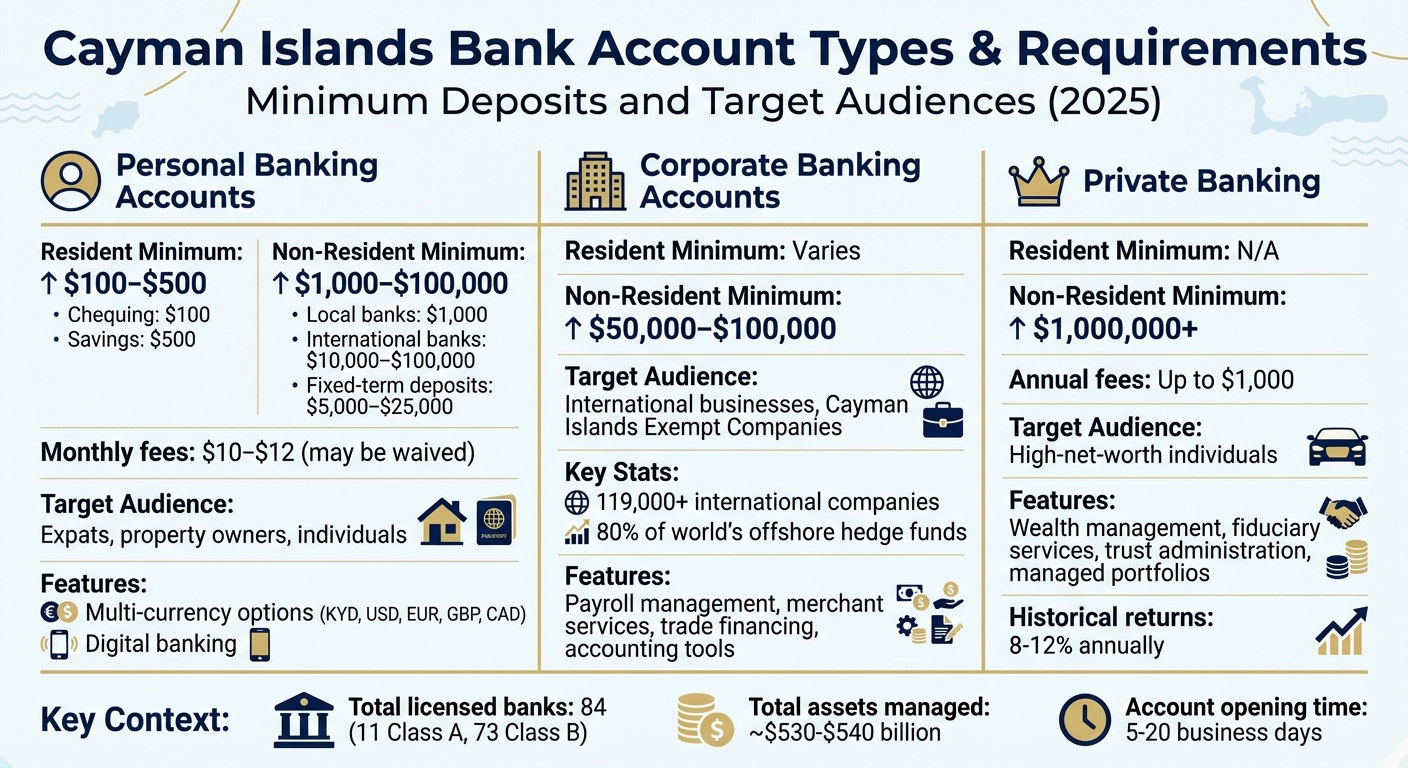
The banking sector in the Cayman Islands offers a range of account types, each with its own deposit requirements. As of August 2025, the jurisdiction hosts 84 licensed banks, including 11 Class A banks (serving both residents and non-residents) and 73 Class B banks (focused on offshore business). Together, these institutions manage total assets valued at approximately $530–$540 billion. Below is an overview of the requirements for personal, corporate, and private banking accounts.
Personal Banking Accounts
Personal banking accounts cater to both residents and non-residents, though the conditions for each group differ. Residents can open basic chequing accounts with deposits starting at $100 or savings accounts requiring at least $500 at local banks. These accounts often include features like multi-currency options (e.g., KYD, USD, EUR, GBP, CAD), fixed deposits, and access to digital banking services.
For non-residents, the entry deposit is higher, typically beginning at $1,000 for local banks and ranging from $10,000 to $100,000 at international institutions. Fixed-term deposits require between $5,000 and $25,000. Monthly maintenance fees average around $10–$12 but may be waived if the account maintains a high daily balance. Non-residents are often required to demonstrate a legitimate connection to the islands, such as property ownership or a Cayman-registered business, to ensure their application is accepted.
Corporate Banking Accounts
Corporate accounts are tailored to support international business activities, including those of Cayman Islands Exempt Companies and foreign corporations. These accounts provide services like payroll management, merchant services, trade financing, and specialized accounting tools. The minimum average balance for corporate accounts typically falls between $50,000 and $100,000, depending on the bank’s risk evaluation. The Cayman Islands is a hub for over 119,000 international companies and hosts 80% of the world’s offshore hedge funds, reflecting its strong corporate banking framework.
Private Banking for High-Net-Worth Individuals
Private banking services are designed for high-net-worth individuals who require advanced financial solutions, including wealth management, fiduciary services, and offshore asset protection strategies. These accounts generally demand a minimum deposit of $1,000,000, though banks may offer flexibility for long-standing clients. Services include asset management, trust administration, and access to managed investment portfolios, which have historically yielded annual returns of 8% to 12%. Premium accounts often come with annual fees of up to $1,000.
| Account Type | Resident Minimum | Non-Resident Minimum | Target Audience |
|---|---|---|---|
| Personal Chequing/Savings | $100–$500 | $1,000–$100,000 | Expats, property owners |
| Corporate | Varies | $50,000–$100,000 | International businesses |
| Private Banking | N/A | $1,000,000+ | High-net-worth individuals |
How to Open a Cayman Islands Bank Account
Opening a bank account in the Cayman Islands involves careful preparation and adherence to strict requirements. Once all necessary documents are submitted, the process typically takes 5 to 20 working days to complete.
Researching and Choosing the Right Bank
The first step is deciding between Class A banks, which serve both residents and non-residents, and Class B banks, which primarily cater to offshore and non-resident clients.
When choosing a bank, focus on your specific needs. For corporate accounts tied to international businesses, look for banks with strong trade financing and merchant services. For personal wealth management, prioritize institutions offering fiduciary services and tailored investment strategies. Be sure to check each bank’s minimum deposit requirements, as these vary by account type.
Non-residents must prove a legitimate connection to the Cayman Islands. This often means providing evidence of property ownership, business operations, or a Cayman-registered entity. A clear rationale for opening the account can improve your chances of approval.
Gathering Required Documentation
The documentation process is detailed and must be followed closely. For personal accounts, you’ll need:
- A certified copy of your passport
- Proof of address, such as a utility bill or lease agreement dated within the last three months
- A curriculum vitae
- An original bank reference letter from your current bank, covering at least three years of history
For corporate accounts, additional documents include:
- Certificate of Incorporation
- Memorandum and Articles of Association
- Register of Directors and Shareholders
- Certificate of Good Standing (if the company is over one year old)
You’ll also need identification for all directors and beneficial owners, along with a detailed business plan outlining your operations and expected banking activity. All documents must be certified or notarized, and some banks may require an apostille stamp for international documents. If you’re a US citizen, you’ll also need to provide a W-9 form and comply with FATCA reporting. Additionally, banks will request proof of your source of funds, such as sales contracts, inheritance records, or audited financial statements.
Submitting the Application and Funding the Account
Once your documents are ready, you can submit your application and fund the account. Many banks offer remote application options through email or video interviews, though some may still require an in-person visit or original certified documents sent via courier. By 2026, most banks are expected to provide fully digital account opening services.
After submission, your application will undergo customer due diligence (CDD) and Anti-Money Laundering (AML) checks, overseen by the Cayman Islands Monetary Authority (CIMA). Politically Exposed Persons (PEPs) are subject to enhanced due diligence (EDD). Under CRS 2.0, effective January 1, 2026, banks have stricter due diligence protocols and automatically share financial information with global tax authorities.
Upon approval, you’ll receive instructions for funding your account. Initial deposits typically range from $50,000 to $100,000 for standard accounts, though some offshore banks may require $250,000 or more. Professional setup fees usually fall between $500 and $1,000. To streamline the process, consider working with a local agent who can assist with incorporation and prepare a "bank-ready" KYC and beneficial ownership package.
Banking Services and Costs
Available Banking Services
Cayman Islands banks offer a wide range of services designed to cater to global financial needs. For individuals and businesses, current accounts facilitate international transfers and payroll management, while savings and fixed-term deposit accounts are ideal for growing capital. Many banks also provide multi-currency accounts, supporting currencies like USD, CAD, KYD, EUR, and GBP. These accounts are especially useful for managing international portfolios and reducing the risks tied to currency fluctuations.
The Cayman Islands is also a leading destination for investment services. Banks provide brokerage access for stocks, bonds, and mutual funds, along with specialized opportunities in hedge funds and private equity. Fiduciary and trust services are available to safeguard assets, particularly for high-net-worth clients.
Corporate clients can take advantage of services tailored to their needs, such as batch payments, wire transfers, merchant services, and access to dedicated relationship managers. Impressively, the local banking sector manages over US$1.7 trillion in assets, accounting for about 6% of the global total. Furthermore, 40 of the world’s top 50 banks are licensed in the jurisdiction. The Cayman Islands Dollar (KYD) is pegged to the U.S. Dollar at a fixed rate of 1 KYD = 1.20 USD. While these services offer extensive benefits, understanding the associated costs is essential for effective financial planning.
Fee Structures and Maintenance Costs
While the Cayman Islands offers a robust banking infrastructure, it’s important to be aware that banking costs here are generally higher than in many other regions. This is largely due to the stringent international compliance requirements, including AML (Anti-Money Laundering) and KYC (Know Your Customer) standards. Instead of basing fees solely on account types, banks often determine costs based on the compliance profile of the client.
Initial deposits can range from US$2,500 for basic accounts to over US$1,000,000 for private banking. Setup fees typically fall between US$300 and US$2,500, while annual maintenance fees range from US$500 to US$5,000 . Debit and credit card fees vary, costing anywhere from US$10 to US$100 per month or year.
Other common fees include charges for incoming and outgoing wire transfers, foreign exchange transactions, and checkbooks. Falling below the required minimum balance can result in hefty monthly penalties or even account closure. To avoid any surprises, it’s a good idea to request the bank’s detailed tariff schedule. This will help you understand costs related to FX spreads, wire transfers, and card maintenance.
Regulatory Framework and Legal Considerations
Beyond the banking advantages already discussed, which are detailed in our offshore banking report, the Cayman Islands’ regulatory framework plays a key role in establishing its reputation as a trusted offshore banking destination. At the heart of this system is the Cayman Islands Monetary Authority (CIMA), which oversees licensing, supervision, and compliance for all banking operations in the jurisdiction. As of December 31, 2025, the Cayman Islands hosted 77 licensed banks, including 11 Category A banks and 66 Category B banks. The regulatory framework is anchored by the Banks and Trust Companies Act (BTC Act) and the Monetary Authority Act, which govern all banking activities.
CIMA employs a dual approach to supervision: off-site analysis of financial statements and on-site inspections. This ensures banks maintain robust internal controls and adhere to compliance standards. Additionally, CIMA conducts "fit and proper" evaluations for directors and senior officers, assessing their honesty, integrity, competence, and financial soundness. Any management changes must receive prior written approval from CIMA. Banks are also required to maintain a minimum risk-adjusted capital adequacy ratio of 10%, with stricter thresholds of 12% for subsidiaries and 15% for independently supervised banks. For new unrestricted banking licenses, the minimum paid-up capital is set at CI$400,000 (about US$500,000). These measures ensure a solid foundation for the legal standards outlined below.
The Cayman Islands has transitioned from a secrecy-based banking model to one emphasizing transparency and institutional integrity. As noted by OCBF Consulting:
"Cayman offshore banking is best understood as institutional offshore banking, not secrecy banking".
The jurisdiction aligns with global transparency initiatives, adhering to frameworks like the Common Reporting Standard (CRS), FATCA, and stringent Anti-Money Laundering (AML) regulations. Under CRS and FATCA, banks are required to report account information to the tax authorities in the account holder’s country of residence.
Key legislative updates, such as the 2025 revisions to the Proceeds of Crime Act (POCA) and Anti-Money Laundering Regulations, form the backbone of compliance efforts. The Financial Reporting Authority (FRA) reviews Suspicious Activity Reports to combat financial misconduct. Additionally, the Beneficial Ownership Transparency Act (BOTA), fully implemented in 2025, mandates entities to maintain accurate registers of beneficial ownership. Vetted authorities can access this information under "legitimate interest" provisions to combat financial crime. These legal frameworks are further reinforced by rigorous auditing and penalty systems.
Banks must have their accounts audited annually by a CIMA-approved auditor and submit these reports within three months of the financial year-end. Regulatory breaches can result in substantial fines, reaching up to CI$1 million for entities and CI$100,000 for individuals. Looking ahead, the Cayman Islands is preparing for the 5th Round Caribbean Financial Action Task Force (CFATF) Mutual Evaluation in 2027, underscoring its commitment to meeting international compliance standards.
Conclusion
The Cayman Islands provides entrepreneurs and investors with a highly developed financial environment that blends tax neutrality, world-class banking, and strong asset protection. With no corporate, income, capital gains, or inheritance taxes, it offers a unique opportunity to reinvest profits and scale businesses globally. The banking sector’s scale is impressive, managing approximately $530–$540 billion in total assets across 84 licensed banks as of mid-2025, showcasing its strength in wealth management.
To access these benefits, banks enforce strict KYC and AML standards, requiring a clear connection to the islands. This connection could come from property ownership, local business activities, or corporate incorporation. Minimum deposit requirements depend on the type of account you open. Additionally, specialized legal structures like Exempted Companies, LLCs, Trusts, and Segregated Portfolio Companies offer robust asset protection while adhering to global compliance standards. The absence of exchange controls ensures unrestricted fund transfers, and multi-currency accounts simplify international trade.
To maximize these advantages, establish a local presence, prepare thorough source-of-wealth documentation, and collaborate with licensed corporate service providers to navigate the approval process, which typically takes 2–6 weeks. The Cayman Islands’ reputation is further solidified by hosting over 75% of the world’s offshore investment funds and 40 of the top 50 global banks, cementing its role as a gateway to international capital markets.
Whether you’re focused on safeguarding assets, optimizing taxes, or growing your global reach, the Cayman Islands offers the stability, infrastructure, and expertise needed for effective long-term wealth management.
FAQs
Can I open a Cayman bank account without living there?
Yes, opening a bank account in the Cayman Islands is possible even if you don’t live there. However, most banks will require you to visit in person as part of their due diligence process and to establish a connection to the jurisdiction. You’ll need to provide the required documentation and comply with their regulations during the application process.
What counts as a “legitimate connection” to the Cayman Islands?
A “legitimate connection” to the Cayman Islands generally refers to having a real economic or personal relationship with the territory. This could include living there, operating a business, or maintaining a significant physical or professional presence. Simply owning an account or entity without any meaningful ties typically doesn’t meet the criteria for such a connection.
Will my Cayman account be reported to the IRS under FATCA or CRS?
Your Cayman Islands bank account must comply with international tax reporting regulations. If the account involves U.S. persons or is linked to the U.S., it will be reported to the IRS under FATCA (Foreign Account Tax Compliance Act). Additionally, it will be reported to the Cayman Tax Information Authority under CRS (Common Reporting Standard) to meet global tax compliance requirements.
