
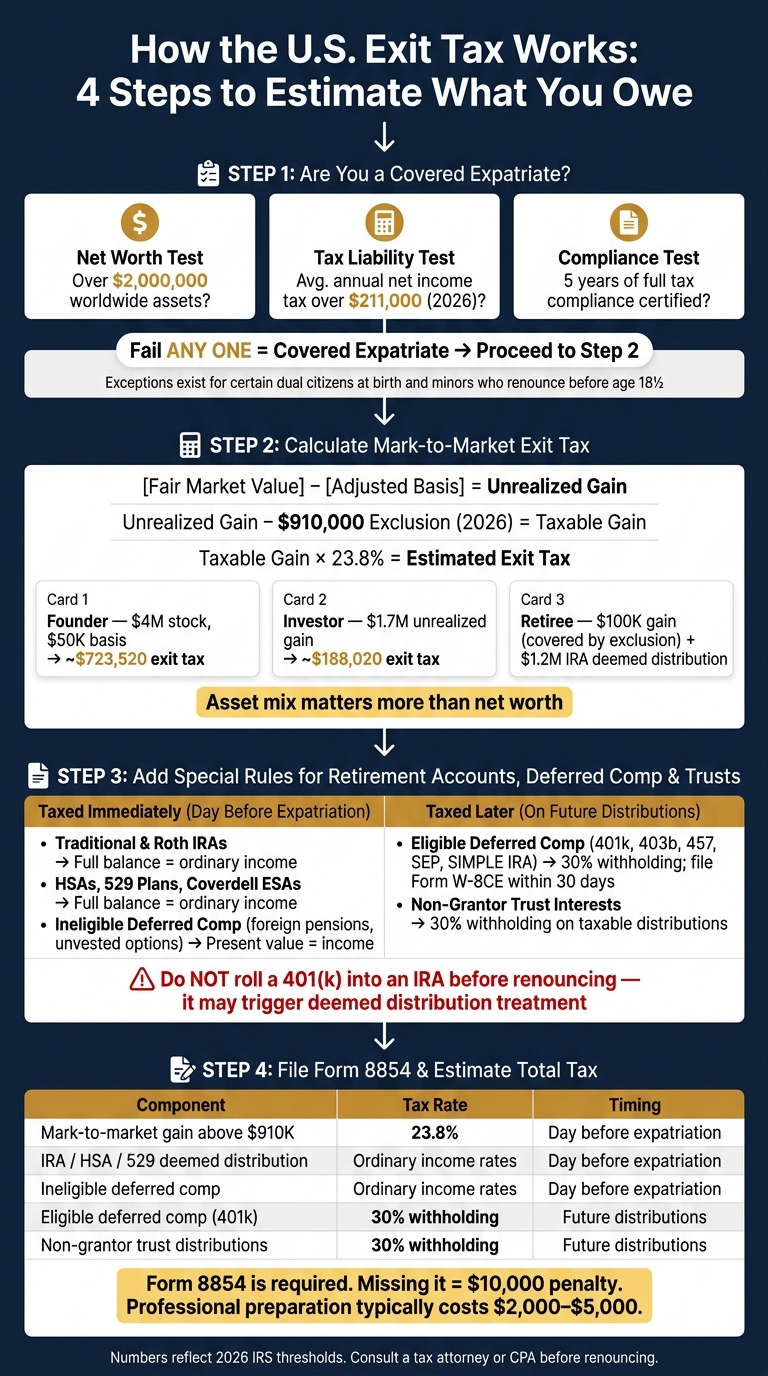
There is no single U.S. exit tax amount. If I renounce U.S. citizenship in 2026, I may owe $0 or a large tax bill, and the result usually depends on three tests first: $2,000,000 net worth, $211,000 average annual net income tax liability, and 5 years of full tax compliance.
Here’s the short version:
- If I fail any one of those tests, I’m usually a covered expatriate
- Then the IRS may treat many assets as if I sold them the day before expatriation
- In 2026, the first $910,000 of net gain is excluded from the mark-to-market tax
- IRAs, HSAs, 529 plans, foreign pensions, deferred comp, and some trusts can follow different rules
- Form 8854 matters a lot, and missing it can trigger a $10,000 penalty
What matters most is not just net worth. It’s asset mix, cost basis, and whether I can certify 5 full years of tax compliance.
A few fast examples from the article make that clear:
- A founder with $4,000,000 of low-basis stock could face about $723,520 of mark-to-market tax on that holding alone
- An investor with $1,700,000 of total unrealized gain could owe about $188,020 after the $910,000 exclusion
- A retiree with a big IRA may owe more from the IRA’s deemed distribution than from a taxable brokerage account
If I had to boil the article down to one point, it would be this: before renouncing, I need to test covered expatriate status first, then separate assets into the right tax buckets, then estimate the tax on each bucket.
Step 1: Find out if you are a covered expatriate
First, figure out whether you’re a covered expatriate. That status decides whether the exit tax applies. And here’s the key point: you only need to meet one of the three tests below.
The 3 covered expatriate tests: net worth, tax liability, and compliance
If you meet any one of these tests, you become a covered expatriate.
| Test | Threshold | Data Needed | Common Mistake |
|---|---|---|---|
| Net Worth Test | $2,000,000 worldwide | Worldwide asset and debt list | Underestimating the value of private businesses or crypto |
| Tax Liability Test | $211,000 average annual net income tax liability for 2026 | Your net U.S. income tax liability for the prior five tax years | Confusing "taxable income" with "net tax liability" |
| Compliance Test | 100% compliance | Five years of Forms 1040, FBARs, and information returns | Assuming low net worth waives the need to certify compliance |
The $2,000,000 net worth threshold is not adjusted for inflation.
So if you trip even one of these tests, move to Step 2 and work out the mark-to-market tax.
Exceptions for certain dual citizens and short-term residents
There are two narrow exceptions that can keep you from covered expatriate status, even if you go over the net worth or tax liability limits.
The dual-citizen exception applies if all of the following are true:
- You were both a U.S. citizen and a foreign citizen at birth
- You still hold citizenship in that other country and are a tax resident there on your expatriation date
- You lived in the U.S. for no more than 10 of the last 15 tax years
The minor exception applies if you renounce before age 18½ and were a U.S. resident for no more than 10 years total.
For green card holders, the rule is a little different. You become a long-term resident if you held that status for at least part of 8 of the last 15 tax years. That’s the line that decides whether the mark-to-market exit tax rules can apply. If you end long-term resident status before hitting that 8-year mark, those long-term resident exit-tax rules do not apply. Even one day in a tax year counts as a full year.
One more thing: neither exception gets rid of the five-year compliance rule. You still have to certify full tax compliance on Form 8854.
Documents needed to test covered expatriate status
To test your status, pull together five years of U.S. tax filings, including Form 1040, FBARs, and Form 8938.
You’ll also need a current worldwide list of assets and debts. That means everything you own, anywhere in the world, such as U.S. brokerage accounts, real estate, foreign bank accounts, cryptocurrency, and privately held business interests. On the debt side, include items like mortgages and personal loans.
For privately held assets, get professional appraisals to pin down fair market value as of the day before expatriation. Those numbers decide whether Step 2 applies – and how much taxable gain may be on the table.
If you are a covered expatriate, Step 2 calculates the mark-to-market tax on your assets.
sbb-itb-39d39a6
Step 2: Calculate the mark-to-market exit tax on your assets
For a covered expatriate, the IRS treats most worldwide assets as if you sold them at fair market value on the day before expatriation. Then you back out any allowed exclusion and calculate the tax on what remains.
How the mark-to-market rule works
For each asset, your taxable gain or loss equals fair market value minus adjusted basis. After that, net the gains and losses across all assets. Under the exit tax, long-term capital gains are taxed at up to 23.8%, which includes the 3.8% NIIT.
How the exclusion amount reduces your taxable gain
For 2026, the exclusion is $910,000. So if your total net gain is $1,500,000, only $590,000 is taxable. Put simply, only net gain above the $910,000 exclusion is taxable in 2026.
One practical move before expatriating is to sell underperforming assets at a loss first. Those realized losses reduce your net gain before the exclusion applies, which can cut your final tax bill.
Valuing stock, businesses, and real estate for exit tax purposes
Use fair market value as of the day before expatriation in the mark-to-market calculation. Here’s how that usually works by asset type:
| Asset Type | Valuation Method | Common Problem |
|---|---|---|
| Publicly Traded Stocks | Closing price on the day before expatriation | Forgetting to adjust basis for reinvested dividends or wash sales |
| Closely Held Business | Professional business appraisal, such as a discounted cash flow analysis | IRS challenges to valuation; high cost of formal appraisal |
| Real Estate (U.S. & Foreign) | Professional appraisal by a qualified appraiser | Difficulty obtaining reliable appraisals for foreign property |
| Partnership Interests | FMV of the interest, often requiring specialized valuation | Look-through rules for underlying assets add complexity; possible ordinary income on certain items |
| Cryptocurrency | Market price on the day before expatriation | Tracking original cost basis across multiple wallets and exchanges |
| Collectibles/Antiques | Specialist appraisal | Subjective valuations; need for specialist appraisers |
For publicly traded securities, valuation is pretty direct. For closely held businesses and real estate, it usually makes sense to get a formal appraisal and use a value you can defend. For cryptocurrency, keep clear records of the market price on the deemed sale date and your original cost basis across every wallet and exchange you’ve used.
For long-term residents, basis may start on the date U.S. residency began. If you became a U.S. resident after acquiring certain assets, your adjusted basis may be stepped up to the FMV on the date you first became a U.S. resident, instead of your original purchase price. That can reduce taxable gain.
Deferred compensation, retirement accounts, and trusts follow separate expatriation rules.
Step 3: Add the tax rules for retirement accounts, deferred compensation, and trusts
Step 2 covers assets taxed under mark-to-market. Step 3 deals with the items taxed under separate expatriation rules.
Three categories sit outside the mark-to-market regime: specified tax-deferred accounts, deferred compensation plans, and interests in non-grantor trusts. The big shift here is timing. Some items are taxed right away as ordinary income. Others stay tax-deferred and are taxed later when money is paid out.
Deferred compensation: eligible vs. ineligible plans
Deferred compensation falls into two groups.
Eligible deferred compensation includes 401(k)s, 403(b)s, 457 plans, SEPs, and SIMPLE IRAs, but only if the payor is a U.S. person and you file Form W-8CE within 30 days after expatriation. If those rules are met, future distributions face a flat 30% withholding tax when paid.
Ineligible deferred compensation includes foreign pension plans, vested but unexercised stock options, and any plan that would otherwise be eligible if Form W-8CE is not filed on time. In that case, the IRS treats the present value of accrued benefits as ordinary income on the day before expatriation.
One planning trap is easy to miss: don’t roll a 401(k) into an IRA right before renouncing. That move can shift the asset out of the deferred-compensation rules and into a specified tax-deferred account. And that usually means deemed distribution treatment instead.
IRAs, HSAs, MSAs, and 529 plans: the deemed distribution rule
Traditional and Roth IRAs, Health Savings Accounts, Archer MSAs, 529 plans, and Coverdell Education Savings Accounts are treated as if you withdrew the full balance on the day before expatriation. The full balance is taxed as ordinary income, and the IRS generally waives the 10% early withdrawal penalty for this deemed distribution.
Roth IRAs have an extra wrinkle. Contributions and earnings can be treated differently, and post-expatriation basis is reset to the amount used in the exit-tax calculation.
Trust interests and non-grantor trusts
Interests in non-grantor trusts also fall outside the mark-to-market regime. The taxable portion of future distributions is generally subject to a flat 30% withholding tax, and the trust must recognize gain if it distributes appreciated property. To keep that deferred treatment, waive treaty reductions on Form 8854.
Here’s the simple way to think about it: some assets are treated as if you cashed them out the day before expatriation, while others stay deferred and trigger tax later.
| Asset Category | Rule at Expatriation | Tax Trigger | Required Form or Withholding Rule |
|---|---|---|---|
| Specified Tax-Deferred Accounts (Traditional and Roth IRAs, HSAs, Archer MSAs, 529 plans, Coverdell Education Savings Accounts) | Deemed distribution | Day before expatriation | Entire balance taxed as ordinary income; no 10% early withdrawal penalty; reported on Form 8854 |
| Eligible Deferred Compensation (401(k), 403(b), 457, SEP, SIMPLE IRA) | Tax-deferred | Future distributions | 30% withholding; Form W-8CE within 30 days |
| Ineligible Deferred Compensation (foreign pension, vested but unexercised stock options) | Deemed lump-sum distribution | Day before expatriation | Taxed on present value as ordinary income; no exclusion applies; reported on Form 8854 |
| Non-Grantor Trust Interests | Tax-deferred | Future distributions | 30% withholding on taxable portion; waive treaty rights on Form 8854 |
Step 4: Build your exit tax estimate and plan next steps
Now that you know how each asset type is treated, the next move is to pull everything into one federal estimate.
A simple worksheet for estimating your total federal exit tax
Use the rules above to turn your assets into one federal number. Start by confirming whether you’re a covered expatriate. Then total each tax bucket that applies.
If you are covered, list every worldwide asset with its fair market value (FMV) and adjusted cost basis. Next, apply the mark-to-market rule. Subtract basis from FMV to find your total unrealized gain. Then subtract the $910,000 exclusion for 2026. What’s left is taxable, usually at 23.8%.
Then add the items taxed under separate rules: deemed-distribution accounts, ineligible deferred compensation, and trust distributions.
| Component | Amount | Tax Rate | Estimated Tax |
|---|---|---|---|
| Mark-to-market gain above $910,000 exclusion | Your figure | 23.8% (long-term capital gains + NIIT) | Calculated |
| IRA / HSA / 529 deemed distribution | Full balance | Ordinary income rates | Calculated |
| Ineligible deferred compensation (present value) | Your figure | Ordinary income rates | Calculated |
| Eligible deferred comp (401(k) with W-8CE filed) | Future distributions | 30% withholding on future distributions | Deferred |
| Non-grantor trust distributions | Taxable distributions | 30% withholding on taxable portion | Deferred |
| Total estimated federal exit tax | Sum of above |
Exit tax examples for 3 different asset profiles
The cases below show something people often miss: the same net worth can lead to very different exit tax results.
Case 1: The founder with low-basis company stock. A U.S. citizen owns shares in a software company worth $4,000,000 with an adjusted basis of $50,000. That creates a total unrealized gain of $3,950,000. After the $910,000 exclusion, $3,040,000 is taxable. At 23.8%, the estimated exit tax on that position alone is about $723,520. If that person also has a $200,000 traditional IRA, that adds ordinary income tax on top. And there’s a practical issue here too: private company shares need a professional appraisal to set FMV before renouncing.
Case 2: The investor with appreciated brokerage assets and real estate. A U.S. investor owns a $1,500,000 brokerage portfolio with a basis of $600,000 and a rental property worth $1,200,000 with a basis of $400,000. The combined unrealized gain is $1,700,000. After the $910,000 exclusion, $790,000 is taxable. At 23.8%, that leads to an estimated exit tax of about $188,020. If some positions are underwater, tax-loss harvesting before expatriation may trim that taxable gain.
Case 3: The retiree with large IRA balances. A retiree holds a $300,000 brokerage account with a basis of $200,000 and a $1,200,000 traditional IRA. The $100,000 mark-to-market gain is fully covered by the $910,000 exclusion, so there’s no mark-to-market tax. But the full IRA balance is treated as ordinary income through a deemed distribution at expatriation. That means a small brokerage gain plus a large IRA can lead to a higher exit tax than a much bigger appreciated portfolio.
These examples make the main point pretty clear: asset mix matters more than headline net worth.
Conclusion: key numbers, forms, and steps to take before renouncing
Three numbers shape the result: $2,000,000, $211,000, and $910,000. The exclusion cuts down your mark-to-market gain, but it does not apply to IRAs, HSAs, 529 plans, or ineligible deferred compensation. Trust interests follow separate withholding rules. Form 8854 is the required filing used to certify compliance, and if you don’t file it, you may face a $10,000 penalty.
If your case includes private company stock, foreign pensions, trust interests, or assets spread across more than one country, paying for a professional review can save you from costly mistakes. Tax attorneys and CPAs often charge between $2,000 and $5,000 to prepare Form 8854 and your final dual-status return.
FAQs
How do I know if I’m a covered expatriate?
You’re a covered expatriate if you give up U.S. citizenship or end long-term permanent residency and meet any one of these tests:
- Your net worth is $2,000,000 or more on your expatriation date.
- Your average annual net U.S. income tax liability for the previous 5 years is more than $211,000.
- You don’t certify 5 years of U.S. federal tax compliance on Form 8854.
Some dual citizens and minors can qualify for exceptions.
Which assets are excluded from the mark-to-market rules?
Most assets are treated as though you sold them for fair market value on the day before expatriation.
But a few asset types don’t follow those mark-to-market rules. They get their own expatriation tax treatment instead.
That group includes specified tax-deferred accounts, eligible and ineligible deferred compensation items, and beneficial interests in non-grantor trusts.
Rather than using a deemed sale, these items are taxed through deemed distributions or present value calculations at expatriation.
What documents do I need to estimate my exit tax?
To estimate your potential exit tax, pull together records that show your net worth, tax liability, and filing status. That usually includes:
- Your last five years of U.S. federal tax returns
- A list of your worldwide assets, with current fair market value and original cost basis
- FBAR and FATCA records, including Form 8938
If you own more complicated assets, you may also need appraisals to pin down their value. In the end, these details are reported on Form 8854.
