
If you want the short answer, the highest headline tax rates tend to cluster in Northern and Western Europe, plus Japan. In this list, Finland tops personal income tax at 57.65%, Denmark reaches 55.9% on personal income tax and up to 60.5% in total marginal tax for high earners, and Japan hits 55.95%. But salary tax is only part of the story.
If I were sizing up a move, an investment, or a business setup, I would look at the full tax stack: income tax, payroll charges, VAT, capital gains tax, and any wealth or exit tax. That is where places like Belgium, France, Germany, Norway, Spain, and Portugal can get expensive fast, even when the top income tax rate alone does not look like the highest in the world.
Here’s the article in one quick list:
- Highest personal income tax in this group: Finland, Japan, Denmark
- Heavy payroll tax countries: France, Belgium, Germany
- High VAT countries: Finland, Denmark, Norway, Iceland, Portugal
- Wealth-tax or wealth-like pressure: Norway, Spain, Netherlands
- Inbound tax deals for newcomers: Denmark, Finland, France, Netherlands, Spain, Portugal, Norway
- Main planning point for U.S. citizens abroad: U.S. tax filing still matters, even after moving
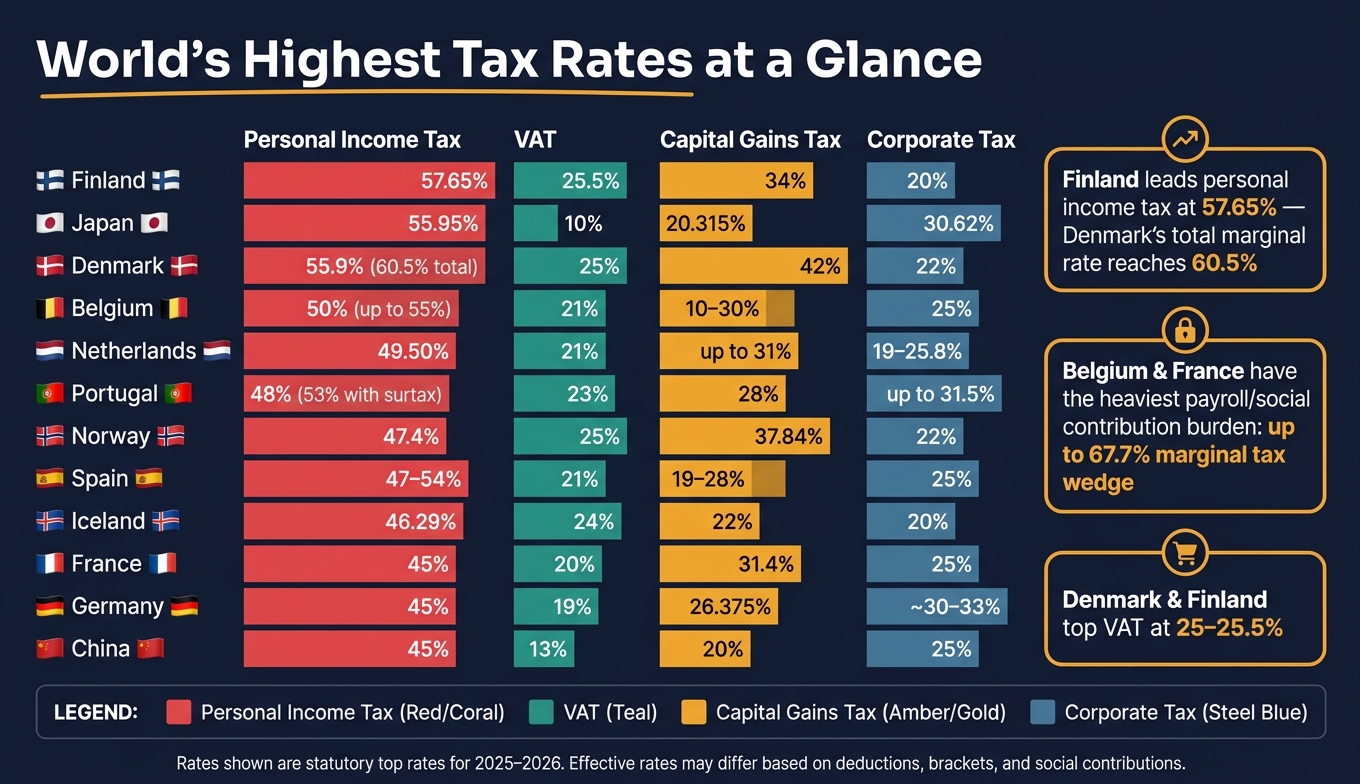
Quick Comparison
| Country | Top Personal Tax | Corporate Tax | VAT / Sales Tax | Capital Gains / Investment Tax | Extra Pressure Point |
|---|---|---|---|---|---|
| Finland | 57.65% | 20% | 25.5% | 34% | Local taxes and payroll charges |
| Japan | 55.95% | ~30.62% | 10% | 20.315% listed shares; crypto up to 55% | High inheritance tax |
| Denmark | 55.9% | 22% | 25% | 42% | Total marginal rate up to 60.5% |
| Belgium | 50% | 25% | 21% | 10% on some gains; 30% withholding | Heavy labor-cost wedge |
| Netherlands | 49.50% | 19% / 25.8% | 21% | Box 2 up to 31%; Box 3 deemed-return tax | Wealth-style Box 3 system |
| Portugal | 48% base, 53% with surtax | Up to 31.5% | 23% | 28% securities | High combined salary burden |
| Norway | 47.4% | 22% | 25% | 37.84% on shares | Annual net wealth tax |
| Iceland | 46.29% | 20% | 24% | 22% | High labor tax vs. lower capital tax |
| France | 45% | 25% | 20% | 31.4% PFU in 2026 | Very high employer charges |
| Germany | 45% | 15% plus trade tax | 19% | 26.375% | Heavy social insurance costs |
| China | 45% | 25% | 13% | 20% | Worldwide income risk after residency trigger |
| Spain | 47% to 54% by region | 25% | 21% | 19% to 28% | Regional tax gaps and fortune tax |
Bottom line: the “highest-tax country” depends on which tax you mean. If I only looked at personal income tax, I would focus on Finland, Japan, and Denmark. If I cared about total labor cost, I would watch Belgium, France, and Germany. If I cared about wealth exposure, I would look hard at Norway, Spain, and the Netherlands.
That gives you the answer fast. The rest of the article explains how each country gets there, and why the headline rate often tells only half the story.
1. Denmark
Denmark sits near the top of the global tax table. The main reason is plain enough: a 55.9% top income tax rate and a 25% VAT. But that headline figure doesn’t come from one tax alone. It’s the result of several taxes stacked on top of each other.
Here’s how it works. Denmark applies an 8% Labor Market Tax to gross income, then adds progressive national taxes and an average municipal tax of 25.049%. Put together, the total top marginal rate can reach 60.5%. And the top bracket starts at only 1.3 times average income, so this isn’t a system where only a tiny slice of ultra-high earners gets pulled into the top band. A lot of people hit near-top rates.
Investors don’t get much breathing room either. Dividends and capital gains face a top rate of 42%, which puts Denmark near the top of the OECD on investment tax as well.
| Tax Category | Rate |
|---|---|
| Top Statutory Personal Income Tax | 55.9% |
| Total Top Marginal Rate for High Earners | up to 60.5% |
| Labor Market Tax (AM-bidrag) | 8% |
| Corporate Income Tax | 22% |
| Standard VAT | 25% |
| Top Capital Gains and Dividend Tax | 42% |
One contrast stands out right away: corporate tax is 22%, far below the top personal rate. For expatriates and investors, there is one main planning carve-out. Denmark’s special expatriate scheme offers a flat 27% tax rate, or 32.84% including the Labor Market Tax, for up to 84 months if the income threshold is met. That’s a much lighter deal than the standard system, but it’s a narrow exception. For everyone else, Denmark sets the tone for the high-tax countries that come next.
2. Finland
Like Denmark, Finland stacks national and local taxes. But Finland goes a step further. It has the highest top personal income tax rate in this comparison: 57.65%.
That top rate comes from several layers working together: a progressive national tax, municipal taxes, mandatory social security contributions, and church tax for members of the state church. So the headline number isn’t just one tax. It’s the total effect of multiple charges landing on the same paycheck.
Municipal tax ranges from about 7% to 23%, and church tax can push the total higher for members. The top national income tax bracket starts at €85,800 per year, which means many middle-to-upper-income professionals can end up close to the top marginal rate.
There’s also a clear split between how Finland taxes labor and how it taxes investment income. Salary faces much heavier tax than capital gains. High earners can pay up to 57.65% on salary, while capital gains are taxed at 34%. Finland’s corporate tax rate is 20%, and it’s scheduled to fall to 18% in 2027. That gap can make it more attractive to keep profits inside a company instead of pulling them out as salary.
| Tax Category | Rate | Notes |
|---|---|---|
| Top Personal Income Tax | 57.65% | Highest in this comparison |
| Corporate Tax | 20% | Scheduled to drop to 18% in 2027 |
| Standard VAT | 25.5% | Second highest in the OECD after Hungary |
| Capital Gains Tax | 34% | Separate from earned income |
| Municipal Tax | Up to 23.5% | Varies by municipality |
| Employee Social Security Contributions | 8.4% – 9.9% | Varies by contribution type |
Finland also offers a 32% flat tax for qualifying foreign key employees for up to seven years. That period was extended from four years in 2024. For people who qualify, that’s a major cut from the standard system, though it only applies to workers who meet set income and role rules. For mobile earners, the next issue is how closely wages, capital, and company income are taxed.
3. France
France taxes earned income in layers, much like Denmark and Finland. But here, payroll charges do a lot of the heavy lifting. The top personal income tax rate is 45% on income above €177,106. Even so, the bigger hit often comes from payroll taxes and social contributions.
Employer social contributions can run from 40% to 50% of gross salary. Employees also pay about 22% in their own contributions, plus a 9.7% CSG/CRDS charge on employment income. Put that together, and France ends up with a tax wedge of about 44.6%, which puts it among the highest in Europe.
Investment income gets its own treatment. Dividends and capital gains are taxed at 31.4% in 2026 under the PFU. High earners may also face a 3% to 4% surtax, and a 2025 minimum-tax rule requires at least a 20% effective rate.
| Tax Category | Rate | Notes |
|---|---|---|
| Top Personal Income Tax | 45% | Applies above €177,106 |
| High-Income Surtax | 3% to 4% | Income above €250,000 / €500,000 |
| Corporate Income Tax | 25% | – |
| Standard VAT | 20% | – |
| Flat Tax on Investment Income (PFU) | 31.4% from 2026 | 12.8% income tax + 18.6% social levies |
| Employee Social Contributions | ~22% | Health, pension, and unemployment |
| Employer Social Contributions | 40% to 50% | Major driver of labor cost |
There is one break worth noting for new arrivals. Under the Impatriate Regime, qualifying newcomers can exclude 30% of pay and 50% of certain foreign income for up to eight years.
Germany has a similar pattern of high labor taxes and social charges, though the setup works a bit differently.
4. Belgium
Belgium looks a lot like France and Germany in one key way: work is taxed heavily. In some cases, it’s taxed even more.
The top personal income tax rate is 50%, and it starts on income above €51,070. On top of that, local communal taxes add 0% to 9% of the federal tax amount. That can push the top effective rate to 55% for some earners.
The bigger hit, though, comes from payroll taxes and social charges.
For a single worker earning the average wage, the combined tax and social contribution rate comes to 53.05% of total labor cost. That climbs to 59.14% at 167% of the average wage, and the marginal tax wedge reaches 67.7% for high earners. Put simply, once pay goes up, a big share of each extra euro goes to tax and social contributions.
Here’s how the main rates break down:
| Tax Category | Rate | Notes |
|---|---|---|
| Top Personal Income Tax | 50% | Income above €51,070 |
| Municipal Tax Surcharge | 0% to 9% | Applied on top of federal income tax |
| Employee Social Contributions | 13.07% | Paid on gross salary |
| Employer Social Contributions | ~27.04% | Paid on top of gross salary |
| Corporate Income Tax | 25% | Standard rate |
| Standard VAT | 21% | – |
| Capital Gains (Financial Assets) | 10% | Gains above €10,000, effective Jan. 1, 2026 |
| Withholding Tax (Dividends/Interest) | 30% | – |
Employer social security contributions are about 27.04% of gross salary, while employees pay 13.07% on their side. That’s the heart of Belgium’s tax model: labor carries a very heavy load.
Investment income gets lighter treatment. Starting Jan. 1, 2026, individual capital gains on financial assets such as stocks and crypto are taxed at a flat 10% on gains above €10,000. Corporate profits are taxed at 25%, and the standard VAT rate is 21%.
5. Germany
Like Belgium and France, Germany puts a heavy tax load on labor. But it leans more on social insurance than on surtaxes.
The top personal income tax rate is 45%, and it starts at income above €277,825. Income from about €69,879 to €277,825 falls into the 42% bracket, while the tax-free allowance is €12,348.
Then there are the mandatory social insurance payments. Employees pay about 20.3% of gross salary across pension, health, unemployment, and long-term care insurance, and employers put in a similar amount. That helps explain why Germany’s labor-cost wedge is 47.8% for a single worker earning the average wage, the second-highest in the OECD after Belgium. On $100,000 of gross income, the estimated total tax and contribution burden comes to about 45.2%, leaving roughly $62,200 in take-home pay.
Here’s a simple view of Germany’s main tax rates:
| Tax Category | Rate | Notes |
|---|---|---|
| Top Personal Income Tax | 45% | Income above €277,825 |
| Standard Income Tax (High Earners) | 42% | Income about €69,879 to €277,825 |
| Employee Social Contributions | ~20.3% | Pension, health, unemployment, long-term care |
| Capital Gains Tax | 26.375% | Includes 5.5% solidarity surcharge |
| Corporate Income Tax | 15% | Trade tax lifts the total burden to roughly 30% to 33% |
| Standard VAT | 19% | – |
For investors and business owners, the next piece is company profits and capital gains. Germany’s corporate setup starts with a 15% corporate income tax, then adds municipal trade tax. Because that local trade tax changes by location, the total burden usually lands around 30% to 33%.
Capital gains rules matter too. Real estate held for more than 10 years is exempt, which can make a big difference for long-term property investors. And if a resident leaves Germany while holding a shareholding above 1%, an exit tax can apply.
6. Japan
Japan stands out in Asia as a high-tax country, and that shows up across income, investing, and estates.
It has the highest top personal income tax rate in Asia in this comparison: 55.95%. That total comes from three parts:
- 45% national income tax
- 10% local inhabitant tax
- 2.1% reconstruction surtax on the national tax
That surtax was added to help pay for earthquake recovery, and it’s set to stay through 2037.
There’s also a timing wrinkle that catches many people off guard. Inhabitant tax is based on the prior year’s income, so new arrivals often owe nothing in year one. On the flip side, people who leave Japan can still get a final tax bill after they’ve already moved away.
| Tax Category | Rate | Notes |
|---|---|---|
| Top Personal Income Tax | 55.95% | 45% national + 10% local + 2.1% surtax |
| Combined Corporate Tax Burden | ~30.62% | National + local + enterprise tax |
| Consumption Tax (VAT) | 10% | 8% reduced rate for groceries and certain newspapers |
| Capital Gains (Listed Stocks) | 20.315% | 15.315% national + 5% local |
| Capital Gains (Crypto) | Up to 55% | Taxed as ordinary income at progressive rates |
| Inheritance Tax | Up to 55% | One of the highest in the world |
Income tax is only part of the picture. Social insurance adds a big extra cost. Employees pay about 14.75% of gross salary into health insurance, welfare pension, and employment insurance. Employers add about 15.1%, which pushes the total payroll burden to roughly 30%.
For people who move around a lot, the headline rate doesn’t tell the whole story. Residency timing can matter just as much. Expats may use NPR status, which can exempt unrepatriated foreign-source income for the first five years. After that, Japan taxes worldwide income.
Investors also get one small break through NISA. It exempts up to ¥1,200,000 in annual gains from the 20.315% capital gains tax.
7. Netherlands
The Netherlands has a top personal income tax rate of 49.50% on Box 1 income above €78,426 in 2026. But this isn’t just a high-salary tax system. The Dutch setup also adds a separate tax on wealth through Box 3, which changes the math for people with savings, portfolios, or other assets.
The system runs on three boxes. Box 1 covers employment income and home ownership. Box 2 applies to people who own 5% or more of a company, with tax set at 24.5% on the first €68,843 and 31% above that. Box 3 taxes wealth based on a deemed return rather than what you actually earned. For 2026, that assumed return is 6.00% for investments and other assets and 1.28% for bank balances, with the first €59,357 per person exempt. In practice, Box 3 often works like an annual wealth tax of about 1.5% to 2% of asset value. So the Dutch system doesn’t stop at wages. It can hit earned income, shareholder income, and assets in separate layers.
That setup has been under pressure in court. The Dutch Supreme Court ruled that the earlier version of Box 3 violated property rights, and the government responded with a rebuttal scheme that lets taxpayers ask for relief based on actual returns. A shift toward taxing actual returns is still in progress.
| Tax Category | 2026 Rate |
|---|---|
| Top Personal Income Tax (Box 1) | 49.50% (income above €78,426) |
| Corporate Tax (Tier 1) | 19.0% (up to €200,000) |
| Corporate Tax (Tier 2) | 25.8% (above €200,000) |
| Standard VAT | 21.0% |
| Box 3 Deemed Return Tax Rate | 36.0% on notional return |
| Employee social contributions (first bracket) | 27.65% |
This mix tends to matter most for investors, founders, and expats. If you can choose whether to hold assets personally or inside a company, the structure can make a big difference.
For mobile workers, the main offset is the 30% ruling. It allows employers to pay 30% of a qualifying employee’s salary tax-free for up to five years. There’s a timing catch: applications must be filed within four months of the start date to keep retroactive treatment. In 2026, the exempt salary base is capped at €262,000, and the rate falls to 27% on January 1, 2027.
sbb-itb-39d39a6
8. Norway
Norway sits in the same high-tax Nordic camp as Denmark and Finland, but with one extra layer: an annual wealth tax. The top marginal tax rate on employment income is 47.4%, made up of 22% ordinary income tax, a bracket tax of up to 17.7%, and 7.7% employee social security.
The bracket tax ramps up step by step. It starts at 1.7% on income from NOK 217,400 to NOK 306,050. From there, it moves through four more brackets and reaches the top rate of 17.7% on income above NOK 1,410,750.
| Tax Category | Rate |
|---|---|
| Top Marginal Personal Income Tax | 47.4% |
| Corporate Income Tax (Standard) | 22% |
| Petroleum Sector Corporate Tax | 78% |
| Capital Gains on Shares (Effective) | 37.84% |
| Standard VAT | 25% |
| Net Wealth Tax | 1.0% (>NOK 1.9M) to 1.1% (>NOK 21.5M) |
| Employee Social Security | 7.7% |
Norway also charges an annual net wealth tax on worldwide assets. The rate is 1.0% above NOK 1.9 million and rises to 1.1% above NOK 21.5 million. There’s one big detail here: a primary residence counts at only 25% of market value for wealth tax purposes, which cuts the taxable amount for homeowners.
This setup hits investors and business owners more than it hits plain salary earners. On top of that, investors deal with a 22% corporate tax rate and an effective 37.84% tax on dividends and gains from shares.
There is one short-term break for some newcomers. New foreign workers can choose a flat 25% PAYE rate for their first two years in Norway. At the same time, Norway applies an exit tax on unrealized capital gains, so people who move abroad may still owe Norwegian tax on gains that existed before they left.
9. Spain
Spain’s top income tax rate doesn’t just depend on how much you earn. It also depends on where you live. The national top rate is 24.5%, and regional taxes push the combined top marginal rate to 47% across the country and as high as 54% in Catalonia. On a €300,000 salary, living in Madrid can cost more than €30,000 less than living in Catalonia. That’s a big gap, and it shows how much local tax rules can shape the final bill.
| Tax Category | Rate | Notes |
|---|---|---|
| Top Personal Income Tax (IRPF) | 47% (up to 54% with regional rates) | Applies to income above €300,000 |
| Corporate Income Tax | 25% standard | – |
| Standard VAT (IVA) | 21% | Reduced rates of 10% and 4% apply to essentials |
| Savings Income Tax | 19% to 28% | Applies to dividends, interest, and capital gains |
| Social Security (Employee) | ~6.47% | Mandatory contribution |
| Social Security (Employer) | ~29.9% | Varies slightly by industry |
| Solidarity Tax on Large Fortunes | 1.7% to 3.5% | Applies to net assets above €3 million |
Spain also taxes savings income on a sliding scale. Dividends, interest, and capital gains fall into brackets from 19% to 28%, with the top band kicking in above €300,000. That matters for founders weighing salary against dividends. It also matters for investors, since Spain stays in the higher-tax camp for both work income and investment income.
A major planning option is the Beckham Law, also called the Special Regime for Displaced Workers. If you qualify as a new resident, you can pay a flat 24% tax rate on Spanish-source employment income up to €600,000 for six years. On a €300,000 salary, that flat rate can save about €68,000 per year compared with the standard progressive system. The catch is timing: you need to apply within six months of starting work, or you drop into the standard regime.
Spain also applies a Solidarity Tax on Large Fortunes to net assets above €3 million, with rates from 1.7% to 3.5%. The tax was set up to counter regional wealth-tax exemptions. Put it all together, and Spain becomes a place where regional income tax, investment tax, and wealth tax all pull weight. For anyone thinking about a move, residency location isn’t a small detail. It can shape the whole tax picture.
10. Portugal
Portugal follows much the same tax pattern as Spain and France: high income tax rates, extra surtaxes, and heavy payroll costs. The top personal income tax rate is 48%, which applies to income above €86,634 in 2026.
Then the extra layers kick in. A solidarity surcharge adds 2.5% on income between €80,000 and €250,000 and 5% on income above €250,000. That pushes the top marginal income tax rate to 53%. Add the employee social contribution of 11%, and the total marginal burden reaches 58.2%. That puts Portugal near the top of the OECD range.
In plain English, the pressure falls hardest on high earners. The base income tax is already steep, and the surtaxes plus payroll charges make it much heavier.
| Tax Category | Rate | Notes |
|---|---|---|
| Top Personal Income Tax | 53% | Includes 5% solidarity surcharge |
| Corporate Income Tax | 31.5% | 21% standard + 1.5% municipal + 9% state surcharge |
| Standard VAT | 23% | Reduced rates of 13% and 6% apply to specific goods |
| Capital Gains (Securities) | 28% | Flat rate on stocks and bonds |
| Social Security (Employee) | 11% | No general cap on contributions |
| Social Security (Employer) | 23.75% | Combined burden of 34.75% |
For investors, the rules split depending on the asset. Capital gains on securities are taxed at a flat 28%. Real estate works in a different way: 50% of the gain gets added to regular income and taxed under the progressive rate system. There is one standout exception. Crypto held for more than 365 days is exempt from capital gains tax.
On the business side, the standard corporate tax rate is 21%. A state surcharge of up to 9% applies to profits above €35 million, and a municipal surcharge of up to 1.5% can apply as well. That brings the top effective corporate rate to 31.5%. Companies in Madeira or the Azores pay about 13.3% in 2026.
Portugal has also changed its inbound tax incentives. The NHR regime is closed to new entrants. In its place, the IFICI regime offers a 20% flat rate on employment income for 10 years for qualifying newcomers in tech, science, and academia who were not Portuguese tax residents during the previous five years.
China follows with a different mix of headline rates, but business and payroll taxes still matter for cross-border planning.
11. Iceland
Iceland’s top combined personal income tax rate is 46.29% in 2026. It applies to monthly income above ISK 1,398,450. That top rate blends the national income tax with a municipal tax that is usually withheld at 14.94%, although the final municipal rate can fall between 12.44% and 14.94% based on where you live.
The system works in tiers. Income up to ISK 498,122 per month is taxed at 31.49%. Income up to ISK 1,398,450 is taxed at 37.99%. Income above that level is taxed at 46.29%. Non-resident directors and committee members pay 20% plus the 14.94% municipal tax.
For mobile workers, the split is pretty clear: Iceland taxes labor much more heavily than capital.
On the employer side, payroll tax is 6.35% on all wages. Employees also get a monthly tax credit of ISK 72,492, which reduces their income tax bill.
That puts Iceland in a different light depending on how you make money. If most of your income comes from salary, the tax hit is much heavier than if you live on invested funds.
| Tax Category | Rate | Notes |
|---|---|---|
| Top Personal Income Tax | 46.29% | National tax plus municipal tax; income over ISK 1,398,450/month |
| Corporate Income Tax | 20% | Competitive within the Nordic region |
| Standard VAT | 24% | Reduced rate of 11% for specific goods and services |
| Capital Gains Tax | 22% | Flat rate on capital income |
| Employer Payroll Tax | 6.35% | Applied to all employee wages |
For investors, the picture is lighter. Capital gains, dividends, and interest are taxed at 22%. There’s also a small tax-free allowance of ISK 300,000 per person for interest and dividends from listed companies. Rental income gets some relief as well: 25% of rental income from up to two homes is exempt, and the rest is taxed at 22%.
Iceland does not impose a broad annual wealth tax. China follows with a different mix of income, consumption, and business taxes.
12. China
China closes out the list with a tax mix that leans hard on labor income while keeping VAT on the lower side. The top personal income tax rate is 45%, and it applies to annual taxable income above RMB 960,000. That puts China near the top of this comparison for personal tax rates. The rate covers comprehensive income, which includes wages, salaries, labor remuneration, author’s remuneration, and royalties.
The system is progressive. It starts at 3% for the lowest bracket and moves through seven brackets before hitting the 45% top rate. For expats, the big trigger is residency. Residents may be taxed on worldwide income after spending 183 days in China during a tax year.
| Tax Category | Rate | Notes |
|---|---|---|
| Top Personal Income Tax | 45% | Comprehensive income over RMB 960,000/year |
| Corporate Income Tax | 25% | Standard rate; 15% for high-tech enterprises |
| Standard VAT | 13% | Most goods; 9% for transport and utilities, 6% for services and intangibles |
| Individual Capital Gains | 20% | Flat rate on asset transfers |
| Withholding Tax on Dividends | 10% | Often reduced to 5% via tax treaties |
There’s a separate progressive scale for sole proprietors and partnerships, with a top rate of 35% on income above RMB 500,000. Investors usually face a flat 20% tax on capital gains, dividends, and rental income.
For foreign nationals, the fine print matters just as much as the top rate. One rule stands out: the six-year rule. If someone leaves China for more than 30 straight days during that six-year period, the clock on worldwide income taxation can reset. Tax treaties can also cut dividend withholding to 5% in some cases.
So the picture here is pretty clear. China’s VAT is not especially high. The heavier hit comes from income tax instead. That’s what makes China a good example of how a headline number can point you in the wrong direction at first glance: the main pressure comes from labor, not consumption. That leads straight into the next issue: which type of tax is actually the highest around the world?
Which Tax Category Has the Highest Rates Globally
The country-by-country rankings above show where tax pressure is heaviest. The next step is to separate which kind of tax is doing most of the work. That matters because countries don’t hit every tax base the same way. Some lean hardest on wages. Others put more weight on spending, business income, or investment returns.
Here’s the snapshot:
| Tax Type | Highest-Rate Countries | Top Rate | Why It Matters |
|---|---|---|---|
| Personal Income Tax | Finland, Japan, Denmark | 55% – 60% | Directly reduces take-home pay for high earners and mobile professionals |
| Corporate Tax | France, Germany, Portugal | 30% – 40% | Shapes where multinationals book profits and invest |
| VAT / Sales Tax | Hungary, Finland, Denmark | 25% – 27% | Raises the cost of living for every resident, regardless of income |
| Capital Gains Tax | Denmark, Finland, Netherlands | 33% – 42% | Reduces after-tax returns on stocks, real estate, and business exits |
| Social Contributions | France, Belgium, Germany | 40% – 60%+ (combined) | The biggest hidden driver of the gap between gross pay and net pay |
Chad leads on top personal income tax, Hungary leads on VAT, and France stands out on social contributions.
There’s one catch here: a 45% top rate is not the same thing as a 45% effective rate. Tax systems use progressive brackets, personal allowances, and deductions, which means the share people actually pay is often lower than the headline figure. That gap matters a lot in cross-country comparisons, because the table above shows statutory peaks, not what most workers end up paying.
Social contributions are often the hardest part to spot. They don’t get the same attention as income tax rates, but they can make a huge difference in what work costs. In France and Germany, employee contributions add around 20% to 22% on top of income tax, while employer contributions reach 40% to 50% of gross salary. In plain English, that means the full cost of hiring someone can be far higher than their paycheck suggests.
That’s why looking at income tax alone can give a warped picture. If you’re deciding where to live, work, hire, or hold assets, the mix matters more than any single headline rate.
Pros, Cons, and Planning Takeaways for High-Tax Countries
High-tax countries come with a clear tradeoff. You give up more of each paycheck, but in return you often get public services, social support, and a steadier day-to-day system. Once you see which countries sit at the top of the tax scale, the next step is figuring out what those rates mean on the ground.
The table below gives a quick side-by-side view of the main planning tradeoffs.
| Country | Main Tax Advantage | Main Tax Drawback | Key Planning Concern |
|---|---|---|---|
| Denmark | Comprehensive "cradle-to-grave" welfare | High labor tax and high consumption tax | High daily cost of living |
| Finland | World-class education system | Wage income rises fast | Progressive bracket creep |
| France | Extensive public healthcare | Payroll taxes are heavy | Wealth and exit taxes |
| Belgium | Robust pension and safety net | Labor is heavily taxed | High employer social costs |
| Germany | Efficient infrastructure and stability | Employee costs are high | Mandatory health insurance costs |
| Japan | Competitive tech and manufacturing sector | Labor and local layers push rates up | Complex municipal tax layers |
| Netherlands | 30% tax-free allowance for expats | High top wage and wealth exposure | Ruling duration limits |
| Norway | Strong social safety net | Investment returns are heavily taxed | Wealth tax on global assets |
| Spain | Beckham Law flat rate of 24% | Standard rates are high without special status | 6-year maximum duration |
| Portugal | IFICI regime at 20% for R&D roles | Top earners face steep combined rates | NHR closed to new retirees |
| Iceland | Strong social safety net | Labor is taxed heavily | High import duties and cost of living |
| China | Large domestic market access | Higher earners face steep labor tax | Complex global income reporting |
For mobile taxpayers, the big patterns show up across all 12 countries. The same pressure points keep coming back:
- High wage tax
- Heavy payroll and social charges
- High VAT
- Wealth or exit tax risk
- Special inbound regimes for people who qualify
Those special regimes can change the outcome in a major way. Spain’s Beckham Law, the Netherlands’ 30% ruling, and Portugal’s IFICI regime can all cut tax for qualifying arrivals. In plain English, when you move and how your residency is set up can matter just as much as the top rate on paper.
That’s why the headline rate only tells part of the story. For mobile taxpayers, the harder question is which structures, residency rules, and asset-holding choices change the actual burden. Those are the tradeoffs the conclusion ties together.
Conclusion
The countries at the top of this list don’t just tax income at a high rate. They usually stack income tax, VAT, and social contributions on top of each other. That means the real burden comes from the whole tax stack, not just one eye-catching headline rate.
You can see the same pattern across the list. Nordic and Western European systems often rank highest because they combine progressive income taxes with VAT and mandatory social contributions.
For U.S.-based readers, that gap matters when you’re planning. The federal top rate is 37%, and the United States does not have a national VAT.
If you’re thinking about moving, investing abroad, or setting up assets across borders, run the numbers first. Look at income tax, social contributions, VAT, capital gains, and any wealth or exit tax exposure. Headline rates matter, but the full tax stack matters more.
FAQs
How do effective tax rates differ from headline rates?
The headline tax rate is the top rate tied to the highest tax bracket. It applies only to the part of your income that goes above a set cutoff. In a progressive tax system, that doesn’t mean all of your income gets taxed at that top rate.
The effective tax rate is the share of your total income that you actually pay in tax after tax brackets, deductions, and exemptions are factored in. That’s why it’s usually lower than the headline rate.
Which taxes matter most for expats and entrepreneurs?
For expats and entrepreneurs, tax exposure goes well beyond the top income tax rate. Social security contributions matter too, along with taxes on dividends and capital gains, and whether a country taxes territorial income or worldwide income.
If you run a business, there are a few extra pressure points to watch. Exit taxes can come into play when you leave a country, and wealth taxes can add another layer of cost.
Expats, on the other hand, may get a break through special tax regimes. Countries such as Denmark, Finland, and Spain offer programs that can change how much tax you pay.
Can special expat tax regimes significantly lower the burden?
Yes. Special expat tax regimes can cut your tax bill in high-tax countries. They usually do this with flat tax rates or partial exemptions for a set period, often five to seven years.
A few well-known examples include Denmark’s 32.84% Researcher Tax Scheme, Finland’s 25% Key Employee regime, the Netherlands’ 30% rule, and Spain’s Beckham Law.
