
Yes – your money can be frozen or your account can be shut down even if you were never charged with a crime. In many cases, it starts with an automated review, a cross-border wire, a foreign address, or ownership records that do not match.
Here’s the short version:
- Banks and brokerages screen accounts and payments all the time
- A flag can lead to a hold, a rejected wire, a frozen balance, or a closed account
- U.S. dollar payments are exposed because many pass through U.S. banks
- Expats, founders, investors, and offshore account users often face more review
- Your best defense is simple: spread liquidity, keep records clean, and have documents ready
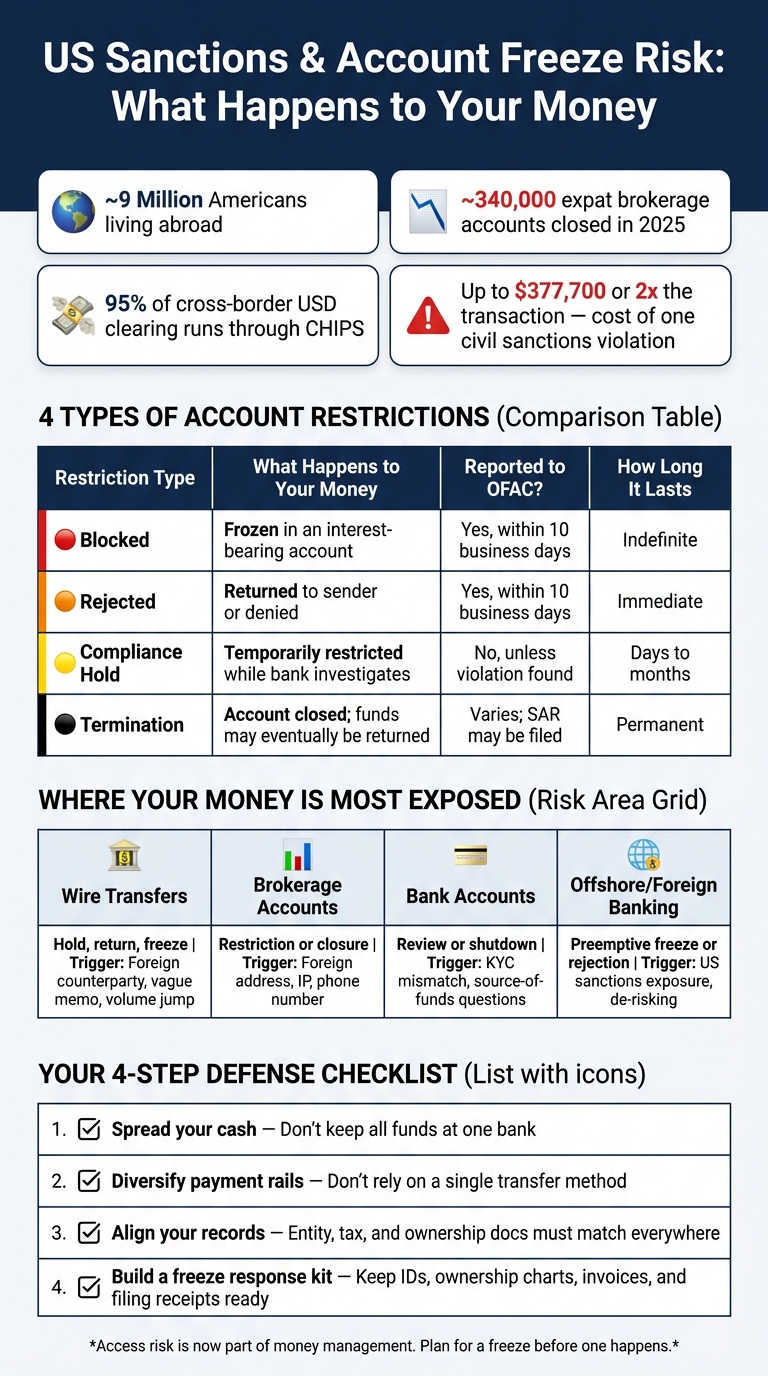
A few numbers show the scale:
- About 9 million Americans live abroad
- Around 340,000 expat brokerage accounts were closed in 2025
- CHIPS handles about 95% of cross-border U.S. dollar clearing
- One civil sanctions violation can cost up to $377,700 or 2x the transaction amount
What I take from this is simple: the main threat is not just sanctions law itself. It is the mix of automated screening, bank risk controls, and heavy penalties that push firms to freeze first and sort it out later.
If I wanted to cut this risk, I would focus on 4 things:
- Do not keep all cash with one bank
- Do not rely on one payment rail
- Make sure entity, tax, and ownership records match everywhere
- Keep a ready file with IDs, ownership charts, invoices, and filing receipts
Quick comparison
| Risk area | What can happen | Common trigger | What helps |
|---|---|---|---|
| Wire transfers | Hold, return, freeze | Foreign counterparty, vague memo, volume jump | Clear payment details, backup rails |
| Brokerage accounts | Restriction or closure | Foreign address, IP, phone number | Backup broker, transfer plan |
| Bank accounts | Review or shutdown | KYC mismatch, source-of-funds questions | Clean records, matched ownership files |
| Offshore/foreign banking | Preemptive freeze or rejection | U.S. sanctions exposure, de-risking | Split funds across banks and countries or structure offshore trusts |
The bottom line: access risk is now part of money management. If you move funds across borders, live overseas, or use offshore structures, you need to plan for a freeze before one happens.
sbb-itb-39d39a6
How US sanctions and compliance rules freeze your money
Frozen funds usually come from automated sanctions and compliance screening, not a criminal charge. US financial institutions screen customers and transactions against the Specially Designated Nationals (SDN) List. If the system finds a match, it can trigger an immediate freeze on property within US jurisdiction. And this doesn’t stop at US banks. Foreign banks that touch US dollars can get pulled into the same process through correspondent banking.
That’s why it helps to know what the bank is actually doing with your money. Is it blocked, held, rejected, or tied to a closed account? Those are not the same thing, and the next steps can look very different.
OFAC blocking rules and what a frozen account actually means
Not every restriction leads to the same result. Some freeze funds for an unknown period. Others send the payment back. Some are just temporary while the bank checks what happened.
A blocked transaction means a sanctioned person has an interest in the property. The funds are frozen and cannot be touched without OFAC authorization. A rejected transaction breaks sanctions rules but does not count as blocked property, so the payment is denied or returned instead of frozen. A compliance hold is a temporary lockout caused by automated checks, like unusual volume or a country mismatch, while the bank reviews the activity. Account termination is different again. That means the bank ends the relationship for good.
| Restriction Type | What Happens to Your Money | Reported to OFAC? | How Long It Lasts |
|---|---|---|---|
| Blocked | Frozen in an interest-bearing account | Yes, within 10 business days | Indefinite |
| Rejected | Returned to sender or denied | Yes, within 10 business days | Immediate |
| Compliance Hold | Temporarily restricted while the bank investigates | No, unless a violation is found | Days to months |
| Termination | Account closed; funds may eventually be returned | Varies; a SAR may be filed | Permanent |
Once a transaction gets flagged, the next hurdle often isn’t the rule itself. It’s the bank’s fear of penalties.
One rule that surprises a lot of people is OFAC’s 50 Percent Rule. If one or more blocked persons own 50% or more of an entity, that entity is also treated as blocked, even if its name does not appear on the SDN List. So a business account can get frozen because of a partner’s sanctions exposure, even when you are not the direct target.
Why banks, brokerages, and payment platforms over-comply
The penalties for getting this wrong are steep, so most institutions don’t wait around for perfect clarity. Under the International Emergency Economic Powers Act (IEEPA), a single civil violation can cost up to $377,700 or twice the transaction amount, whichever is greater, as of January 2025. Willful violations can bring criminal fines of up to $1,000,000 and up to 20 years in federal prison.
That pressure shapes bank behavior in a big way. Many institutions use de-risking, which means they stop serving whole groups of customers just to cut sanctions exposure. That can include foreign passport holders, high-transaction-volume accounts, or clients tied to certain countries.
Then there’s secondary sanctions. These push foreign institutions too by putting their US access at risk. The pressure point is simple: no bank wants to be cut off from the US financial system. And when that risk is hanging over a transaction, even a fuzzy or incomplete match can be enough for a foreign institution to reject it.
For expats and entrepreneurs, this can hit hard. A blocked wire, a locked brokerage account, or suspended access on a payment platform can cut you off from operating cash or even basic living expenses.
In practice, that’s usually how these rules first show up: blocked wires, locked brokerage accounts, or suspended payment access.
Where your money is most exposed
The biggest weak spots usually show up in three places: wires, brokerage access, and foreign counterparties.
Wire transfers and cross-border payments can be held for weeks
Most international U.S. dollar wires still pass through U.S. correspondent banks and clearing rails like Fedwire or CHIPS. CHIPS by itself handles about 95% of all cross-border USD clearing. That single U.S. touchpoint can be enough to slow down or stop a transfer.
If an intermediary bank’s screening system flags a wire, the money can sit there while the bank reviews it. And the trigger doesn’t have to be a sanctions hit. A vague payment note, a recipient in a high-risk jurisdiction, or a sudden jump in transaction volume can all put a transfer on hold.
For a business, that kind of delay isn’t just annoying. It can hit payroll, vendor payments, and day-to-day cash flow. And once that review starts, the same compliance logic can carry over into brokerage and payment access.
Brokerage accounts, cards, and payment platforms can lose access fast
U.S. brokerages are closing more accounts for Americans living abroad because cross-border compliance costs time and money. In 2025, about 340,000 expat brokerage accounts were closed due to foreign residency.
A lot of this happens through automated reviews. Systems can flag:
- Foreign IP addresses
- Foreign phone numbers used for two-factor authentication
- Foreign residential addresses
Once an account gets flagged, it may be restricted or shut down.
For online businesses, the risk stacks up fast. If one payment platform freezes your account, that can trigger reviews across the rest of your payment setup. If all your revenue runs through one rail and that rail stops working, you can lose access to operating cash with no short-term backup. That same weak point shows up offshore too, where foreign banks often act before U.S. authorities do.
Secondary sanctions and foreign-bank de-risking expand the risk
You don’t even need a U.S. account to feel the impact. Non-U.S. banks in places like Turkey, the UAE, and China may freeze accounts or reject payments before the U.S. takes action, just to protect their own access to the U.S. financial system.
A Shanghai-based engineer added to a U.S. sanctions list in March 2025 saw WeChat Pay cut off and multiple Chinese commercial banks freeze his personal and corporate accounts within 24 hours.
That’s the core issue. Local institutions can move very fast when they spot possible U.S. sanctions exposure.
How to lower freeze risk with lawful international structuring
One flagged wire or one de-risking call can choke off your cash flow fast. The fix is simple in theory, but it takes work: don’t let one bank, one country, or one payment rail control all of your liquidity.
You want separation. If one piece gets stuck, the rest of the system should still work.
Spread your money across jurisdictions, banks, and payment rails
Keep operating cash and reserves at separate institutions, and place them in different jurisdictions when it makes sense. Add at least one backup payment rail that does not rely on U.S. clearing.
That way, if your main operating account gets flagged, your reserves are still within reach. And if one rail goes down, you’re not dead in the water because all outgoing payments don’t stop at once.
| Feature | Single-Bank Setup | Multi-Bank International Setup |
|---|---|---|
| Freeze Risk | High; one flag can block all liquidity | Low; assets are isolated across rails |
| Access | Vulnerable to de-risking | Stronger; backup rails available |
| Fees | Lower administrative overhead | Higher (multiple fees, reporting costs) |
There’s no sugarcoating the tradeoff. Multi-bank structuring costs more. It also brings extra compliance work. But the other option is a single point of failure that can lock up everything you have.
That same logic applies to your entity records too. When the paperwork lines up, freeze risk drops.
Use compliant offshore entities, trusts, and clean documentation
Offshore entities, trusts, and foundations can work well, but only if the corporate records, BOI filings, and bank KYC files match exactly. Clear ownership charts make reviews smoother and help cut down on false sanctions flags.
A lawfully formed offshore entity is just a tool. It can separate assets, manage jurisdiction risk, and help keep access open if one part of the structure comes under pressure. But it only stands up when there’s real business activity behind it and the documents are clean.
| Feature | Weak Documentation | Strong Documentation |
|---|---|---|
| Account Stability | Frequent algorithmic flags | High; verified records |
| Review Time | Weeks to months for unfreezing | 3 to 7 business days for resolution |
| Compliance Risk | High; potential regulatory suspicion finding | Low; demonstrates good-faith effort |
| UBO Clarity | Opaque; triggers ownership tracing suspicion | Clear; verified by BOI receipts |
One step you can take today is building a freeze response kit. Put it in a secure folder and include:
- good-standing certificates
- BOI receipts
- ownership charts
- invoices
If a bank flags your account, having that file ready can shrink review time from months to days.
Once ownership records and documents are aligned, the next move is cutting your dependence on U.S.-clearing rails.
Cut reliance on the US financial system without breaking US rules
Keep part of your liquid reserves outside U.S.-clearing institutions. Holding some reserves in non-dollar cash or assets, or with institutions that run on non-U.S. rails, lowers the share of your financial life sitting inside one failure point.
That does not mean walking away from U.S. reporting rules. FBAR filings, FATCA compliance, and full tax transparency are non-negotiable. The structure has to rest on documented business logic, not on hiding ownership.
As of March 2025, OFAC extended its recordkeeping rule to 10 years. So the documents you create now need to hold up for a full decade. Every account, every entity, and every transfer should leave a paper trail that shows why it exists and what it does.
If a freeze still happens, speed matters. Even a well-built structure can face a hold, which is why the next step is an immediate, documented response.
What to do if your funds are frozen
If prevention fails, sort out the freeze by type first. Don’t move too fast. The fix depends on what kind of freeze you have.
An OFAC block freezes funds until OFAC approves a release. A compliance review is a short-term hold. An account closure usually gives you a brief window to move your money.
Once you know which one you’re dealing with, ask the bank for written details right away. Then send the full document package. Don’t send a long narrative. The bank needs to confirm ownership and source of funds fast.
- Case or block reference number
- Transaction date, amount, and counterparties
- SWIFT or wire reference number
- Beneficial ownership chart
- Government-issued IDs
- One-page legal summary explaining why the funds should be released
If the freeze is a false positive, you can ask for an administrative release under 31 C.F.R. § 501.806. Send clear identifiers such as your date of birth, passport number, and address history to show that you are not the listed party. If the block is tied to a real OFAC designation, you need to apply for a specific OFAC license through the OFAC online portal. That process can take several months.
| Issue Type | Status of Funds | Resolution Path | Typical Timeline |
|---|---|---|---|
| OFAC Block | Frozen in segregated account | Specific OFAC License or Delisting | Months to Years |
| Compliance Review | Temporary hold | Provide KYC and ownership docs | 5 to 15 Business Days |
| Account Closure | Accessible for limited time | ACATS transfer to new institution | 30 to 90 Day Notice |
Brokerage freezes call for a different playbook because positions can usually be transferred instead of sold. Use ACATS (Automated Customer Account Transfer Service) to keep your market exposure in place and avoid a forced liquidation. In plain English: don’t sell the holdings for cash unless you have no other option.
After access is restored, focus on lowering the odds of another freeze. Spread lawful activity across jurisdictions, institutions, and payment rails, and keep your records clean and consistent. If one part of the system goes sideways, that setup gives you a much better shot at keeping the rest of your money within reach.
FAQs
Can my bank freeze my money without charging me with a crime?
Yes. A bank can freeze your money without charging you with a crime.
In the United States, banks and other financial institutions must freeze accounts when they suspect illicit activity, compliance issues, or ties to a sanctioned party.
Sometimes this happens because a system flags a pattern that looks off. That can include:
- logins from foreign IP addresses
- mismatched personal data
- transactions tied to high-risk jurisdictions
And if a bank files a Suspicious Activity Report, it can’t warn you about it.
Why do U.S. dollar transfers face higher freeze risk?
U.S. dollar transfers carry a higher risk of being frozen because most cross-border dollar payments move through the U.S. financial clearing system. That gives U.S. banks and regulators a direct point of control over the transaction.
If a transfer involves a sanctioned party or sets off compliance alerts, U.S. banks may have to block it. And it doesn’t stop there. Foreign banks may also freeze or reject dollar payments to protect their own access to the U.S. financial system.
What documents should I keep ready if my account is flagged?
If your account is flagged or frozen, ask for the exact reason in writing. That request should include the transaction dates, amounts, and reference numbers tied to the hold. You need specifics, not vague language.
Then put together a clear evidence package for your bank or OFAC. The goal is simple: show who you are, what the payments were for, who owns the business, and why you are not the person or entity on a sanctions list.
Include:
- Identity: government-issued ID and company formation documents
- Transactions: invoices, contracts, wire/SWIFT instructions, payment confirmations
- Ownership: beneficial ownership chart (UBO)
- Non-match proof: evidence you are not the sanctions target
- Compliance: intended use of funds and end-use assurances
A tight, well-organized file can save time and cut down on back-and-forth with the bank or regulators.
