
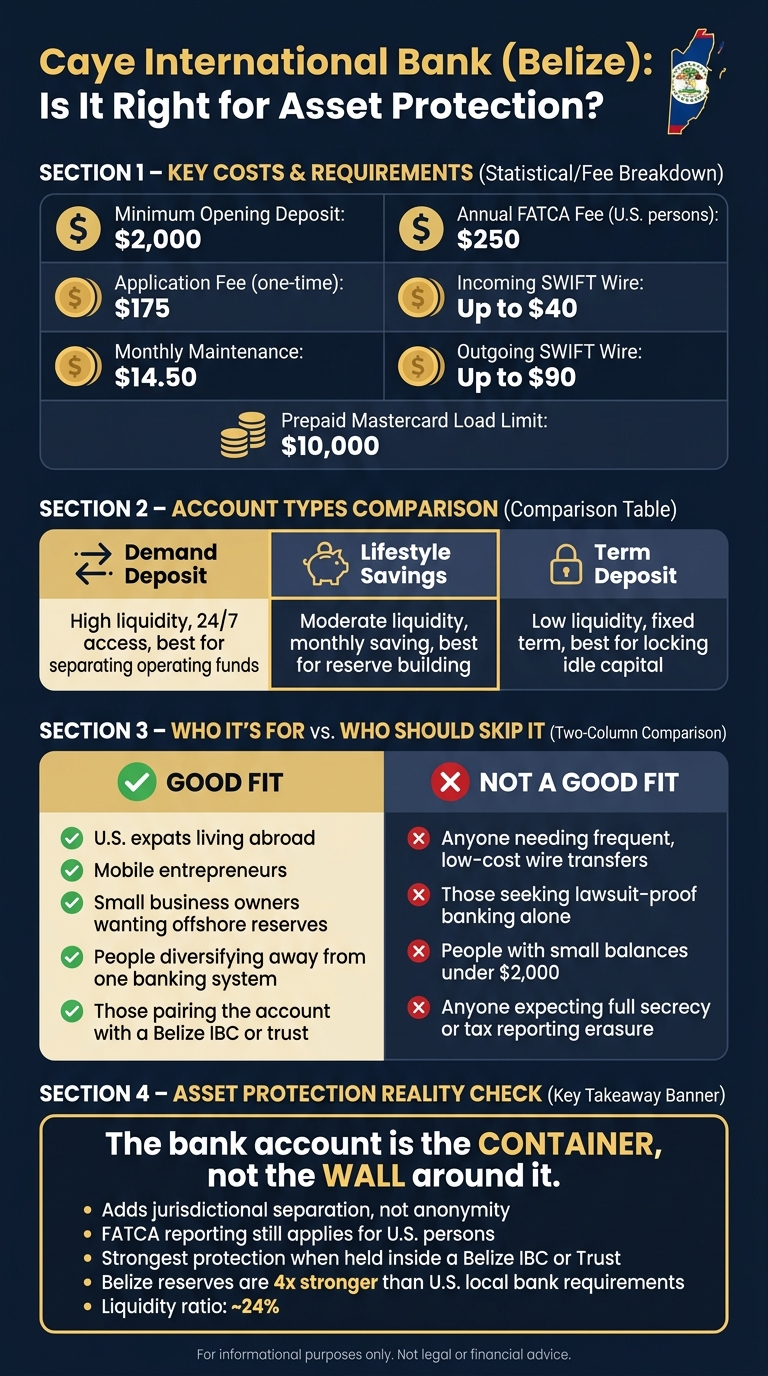
Short answer: yes, but only as one part of the setup. If I’m looking at Caye International Bank for asset protection, I’d treat it as a place to keep offshore cash reserves, not as a stand-alone shield. The main trade-off is clear: Belize can add legal distance from a U.S. claim, but I still have to deal with FATCA reporting, a $2,000 minimum deposit, a $175 application fee, $14.50 monthly maintenance, and a $250 annual FATCA fee for U.S. persons.
Here’s the plain-English takeaway:
- What it does well: keeps cash in a second jurisdiction, offers accounts in 5 currencies, and supports offshore banking for U.S. persons
- What it does not do: give me secrecy, erase tax reporting, or stop claims on its own
- Who it fits: expats, mobile business owners, and people holding reserve cash abroad
- Who should skip it: anyone needing cheap, frequent wires or lawsuit-proof banking
- Best use: pairing the account with a Belize IBC or trust, instead of holding it only in my own name
If I want simple day-to-day banking, this may feel expensive and document-heavy. If I want cross-border cash separation and I’m fine with the paperwork, it can make sense.
| Factor | My take |
|---|---|
| Asset protection value | Moderate on its own; stronger with a Belize entity or trust |
| Privacy | Limited; private from third parties in some cases, but not from lawful reporting |
| U.S. compliance | Full FATCA reporting applies |
| Cost | High for small balances or frequent transfers |
| Best account use | Offshore reserve funds, not daily spending |
So if I’m asking, “Is Caye International Bank right for asset protection?” my answer is simple: it can help, but the bank account is the container, not the wall around it.
Caye International Bank: a quick overview
Caye International Bank is based on Ambergris Caye, Belize. CIB has held an unrestricted Class A international banking license since September 2003. It serves nonresident individuals and corporations.
This is an offshore bank built for lawful offshore use, not for anonymity. The main draw is pretty practical: offshore diversification, multi-currency banking, and access to a regulated foreign bank. Of course, those points only go so far if Belize’s legal and compliance system also lines up with your protection goals.
The bank offers accounts in USD, EUR, GBP, CAD, and CHF. That setup gives clients room to spread funds across major currencies instead of keeping everything tied to one. Belize also has no exchange controls, which means clients can deposit or withdraw funds at any time without restriction.
Account types and how they fit common protection goals
CIB offers three account types: Demand Deposit for active cash management, Lifestyle Savings for gradual reserve building, and Term Deposit for funds you can lock away.
Why does that matter? Because asset protection isn’t just about where money sits. It’s also about how easily you can move it. Some people need daily access. Others want a structure that makes funds harder to reach on impulse or under pressure.
| Account Type | Access & Liquidity | Likely Use | Asset Protection Usefulness |
|---|---|---|---|
| Demand Deposit | High; unlimited transfers and 24/7 online access | Active cash management | High for separating operating funds from personal balances |
| Lifestyle (Savings) | Moderate; intended for regular monthly saving | Reserve building | Strong for long-term cash accumulation outside your home jurisdiction |
| Term Deposit | Low; funds are locked for a fixed term | Locked capital | Very high for keeping idle capital locked away |
For stronger legal separation, Belize structures such as IBCs and trusts can add another layer between assets and personal claims. A CIB account held in your own name still gives you jurisdictional diversification. But the protection angle is usually stronger when the account sits inside an IBC or trust.
Liquidity, reserves, and day-to-day access
CIB reports a liquidity ratio of about 24%, and Belize requires stronger reserves than U.S. local banks.
"Essential bank reserve requirements in Belize are at least four times the reserve requirements of those in the United States for their local banks." – Luigi Wewege, President, Caye International Bank
On the day-to-day side, the bank offers 24/7 secure online banking, international wire transfers, and a prepaid Mastercard that can be funded with up to $10,000 at a time. That gives clients a way to keep offshore reserves liquid while still having direct access when needed.
The next step is looking at Belize itself and whether the jurisdiction adds to these advantages or puts limits on them.
sbb-itb-39d39a6
Why Belize matters for asset protection
Belize matters because the jurisdiction shapes how much protection CIB’s features can give you. Asset protection doesn’t rest on the bank alone. It also rests on the legal system standing behind it.
Privacy, jurisdictional diversification, and legal separation
The main asset-protection edge of banking in Belize is jurisdictional separation. Assets held there are not directly reachable by a U.S. judgment alone. In plain English, a creditor usually can’t just wave a U.S. court order and grab those assets. They generally must pursue enforcement in Belize, which adds cost and delay.
Under Belize law, qualified international trusts get immediate statutory protection, and local courts cannot annul them based on foreign law. That setup helps split legal ownership from personal exposure.
Belize also protects banking confidentiality under local law, with criminal penalties for unauthorized disclosure. That privacy matters in disputes with private third parties. It does not cancel lawful government reporting.
Privacy can help against private claims, but it does not replace tax reporting.
AML, KYC, FATCA, and reporting obligations for U.S. persons
For U.S. persons, reporting still applies. Caye International Bank is FATCA-compliant, so U.S. account holders should expect account information to be reported to the IRS.
Before an account is opened, CIB conducts customer due diligence. That includes:
- notarized identification
- a bank reference letter
- source-of-funds documentation
That screening is part of the deal when you use a regulated offshore bank. U.S. persons should also plan for an annual FATCA compliance fee of $250.
Belize adds legal separation across borders, not anonymity.
The next issue is whether that separation is worth the onboarding friction and the recurring fees.
Costs, onboarding, and account limitations
Minimums, fees, and transfer costs
That extra layer of jurisdictional protection isn’t cheap. It also comes with a paperwork-heavy setup process. In plain English: this account is a better fit for parked cash than for money you plan to move around all the time.
The minimum opening deposit is $2,000. On top of that, there’s a one-time application fee of $175, a $14.50 monthly maintenance fee, and a $250 annual FATCA compliance fee for U.S. persons. Incoming SWIFT wires can cost up to $40, while outgoing wires can run as high as $90.
| Fee Type | Amount |
|---|---|
| Minimum initial deposit | $2,000 |
| Application fee | $175 |
| Monthly maintenance | $14.50 |
| Annual FATCA fee (U.S. persons) | $250 |
| Incoming SWIFT wire | Up to $40 |
| Outgoing SWIFT wire | Up to $90 |
That fee structure works better for reserve funds. For day-to-day operating cash, it can get expensive fast.
Who can open an account and where onboarding gets harder
Caye International Bank accepts individuals, corporations, U.S. persons, expats, and international business owners. You can start the application from abroad through email and video calls, which sounds simple enough at first. The harder part comes later: final approval usually means sending notarized or apostilled original documents by courier to Belize.
Once the bank has a complete file, onboarding usually takes 2 to 3 weeks.
The document list is long. Personal applicants should expect to provide:
- A notarized passport copy
- A second photo ID
- Recent proof of address
- A bank reference letter
- Proof of income or source of funds
- A form explaining the account’s purpose
Corporate applicants need formation records, including the certificate of incorporation, articles of association, a certificate of good standing, and registers of shareholders and directors. All documents must be in English. If an original document is in another language, the applicant has to pay for a certified translation.
Some applicants may hit a wall. Higher-risk profiles, including people tied to crypto activity, adult content, or unregulated online gambling, may be rejected.
"The modern offshore sector has evolved beyond these outdated stereotypes. Transparency, compliance, and alignment with international standards… have reshaped the industry." – Luigi Wewege, President, Caye International Bank
As for spending access, the prepaid card is better viewed as a controlled-access feature than as your main payment tool. Its load limit is capped at $10,000.
Final verdict: who should and should not use Caye International Bank
Strong-fit and weak-fit profiles
Given the fees, compliance workload, and access limits above, the main issue is pretty simple: is the jurisdictional upside worth the trade-off?
Caye International Bank makes the most sense as a place to hold cash reserves and spread jurisdictional risk. It is not built for high-frequency banking. The better-fit users are U.S. expats, mobile entrepreneurs, and small business owners who want offshore reserve storage and compliance-based separation. It can also work well for people who want diversification away from a single banking system.
For business owners, the appeal is straightforward. An offshore structure can add a lawful layer between personal wealth and domestic liability.
At the same time, those same features can make the account a poor match in other cases. If you need low-cost, frequent international transfers, the fees and compliance steps may feel cumbersome. If you are working with a small balance, the $2,000 minimum opening deposit can make the account less practical. And if your goal is legal immunity from lawsuits or judgments, a personal bank account by itself will not do that.
Key points to consider before opening an offshore bank account
The bottom line is simple: CIB works only when it is part of a broader protection plan. CIB is a buffer, not the shield itself. The stronger legal protection comes from the structure that holds the funds.
Before opening an account, look at the fit across five factors:
- Jurisdiction strength
- Compliance burden
- Liquidity needs
- Fee tolerance
- Whether the account fits into a broader protection plan
If those factors line up, Caye International Bank can be a solid option for holding offshore reserves. If they do not, the account may create more friction than it solves.
FAQs
Can a Belize bank account protect assets by itself?
No. A Belize bank account by itself does not provide true asset protection.
It can help with geographic and jurisdictional diversification, which is useful. But that’s only part of the picture.
For asset protection to work, you usually need a formal legal structure, such as an IBC or a trust. Why? Because a bank account on its own doesn’t create the legal separation needed to put a barrier between you and the assets.
On its own, a Belize bank account may offer:
- privacy
- stability
- access to another jurisdiction
What it usually does not offer is protection from:
- lawsuits
- creditor claims
- domestic judgments
That legal shield generally comes from the structure holding the assets, not from the bank account itself.
Should I open the account personally or through a Belize entity?
It comes down to what you want most: control, liability protection, or a more formal setup.
A personal account gives you the most direct control. That’s often the better fit for people who want to manage their own assets without an extra layer in the middle.
A Belize entity, such as an IBC or trust, can offer stronger asset protection. Accounts held through an entity are usually a better match for long-term wealth shielding and estate planning, while personal accounts are simpler if your main goal is diversification.
What U.S. tax forms may I need to file?
For U.S. taxpayers, the Foreign Account Tax Compliance Act may require Form 8938 to report foreign financial assets.
You file this form with your annual tax return. It shows the highest value of your foreign accounts and any income those accounts produce.
The filing thresholds and exceptions can get complicated fast. It’s a good idea to check with a tax professional to confirm whether you need to file and whether any exemptions apply.
