
Yes, some Americans can pay 0% tax on certain crypto gains in Puerto Rico – but only on gains that happen after the move. If I become a bona fide Puerto Rico resident, get an Act 60 decree, and keep up with the rules, some post-move capital gains may be taxed at 0% in Puerto Rico and excluded from U.S. federal income tax.
Here’s the short version:
- Pre-move crypto gains do not become tax-free just because I relocate.
- Post-move capital gains may qualify for 0% under Act 60.
- Staking, mining, airdrops, and lending income are usually taxed as ordinary income, not at 0%.
- I must pass all 3 IRS residency tests: presence, tax home, and closer connection.
- To lock in the old 0% rate, the Act 60 application generally must be filed by December 31, 2026.
- Missing records, weak residency proof, or treating trading like passive investing can bring IRS trouble.
A big point many people miss: Act 60 is not a blanket “no crypto tax” rule. It is a narrow tax setup based on residency, timing, and income type.
| Issue | What I need to know |
|---|---|
| Capital gains on crypto bought after moving | May qualify for 0% |
| Gain built before moving | Still tied to U.S. federal tax |
| Staking / mining / airdrops | Usually ordinary income |
| Application deadline | 12/31/2026 for the old 0% decree terms |
| Main compliance items | Residency proof, Form 8898, Puerto Rico filings, clean records |
If I’m thinking about moving for crypto tax savings, the main question is simple: Did the gain happen before or after I became a Puerto Rico resident? That one detail can change the tax result by a lot.
Act 60 basics: what the 0% crypto tax benefit actually means
Act 60 is Puerto Rico’s tax incentives code, and Chapter 2 covers Resident Individual Investors. If you become a bona fide Puerto Rico resident and get an Act 60 decree, you can receive a 100% tax exemption on qualifying capital gains, dividends, and interest, including gains from digital assets, as long as the residency and sourcing rules are met. The decree also generally locks in the incentive terms for the stated period.
That’s the part many people miss. The issue isn’t simply that the asset is crypto. The issue is whether the gain fits Act 60’s residency and sourcing rules.
Which types of crypto income may qualify
The headline 0% rate applies to capital gains from assets acquired after you became a bona fide resident of Puerto Rico. That sounds simple, but crypto income doesn’t all fall into the same bucket.
Staking rewards, mining income, lending interest, and airdrops are generally treated as ordinary income, not capital gains. So they do not get the same 0% treatment. Active trading can also be treated as business income instead of passive gains. If that activity is set up under Chapter 3, also called Export Services, it may face a 4% corporate tax rate. But that is different from the 0% Resident Individual Investor rate under Chapter 2.
| Crypto Income Type | Act 60 Chapter 2 (Individual Investor) |
|---|---|
| Post-move capital gains | 0% |
| Pre-move gains | Not eligible for the 0% Act 60 treatment |
| Staking / mining / airdrops | Generally taxed as ordinary income |
| Active / professional trading | Not eligible; may qualify for 4% under Chapter 3 |
Why residency status matters more than holding period
On the U.S. mainland, crypto tax treatment leans hard on holding period. Short-term gains are taxed as ordinary income, while long-term gains get lower rates. Under Act 60, the bigger issue is when you became a bona fide resident and when you acquired the asset.
That timing can change the tax result in a big way, which is why the residency test matters so much in the next part of the article.
sbb-itb-39d39a6
How to qualify: bona fide Puerto Rico residency and Act 60 requirements
Qualifying for Act 60 comes down to bona fide Puerto Rico residency. That’s the line that matters. These rules decide whether your crypto gains after you move can be treated as Puerto Rico-sourced.
The 3 IRS residency tests: presence, tax home, and closer connection
The IRS uses three tests to decide whether you’re a bona fide resident. You need to meet all three for each year you want the tax break.
| IRS Test | Core Requirement | Key Supporting Records |
|---|---|---|
| Physical Presence | Spend at least 183 days in Puerto Rico during the tax year | Travel logs, flight itineraries |
| Tax Home | Main work location must be in Puerto Rico; no tax home elsewhere | Office lease, business license, employment contracts |
| Closer Connection | More ties to Puerto Rico than to the mainland U.S. | Puerto Rico driver’s license, voter registration, local bank accounts |
This isn’t a pick-two-out-of-three setup. If one test falls apart, the whole plan can fall apart with it. That’s why records matter so much. Travel logs help show where you were. Work documents help show where your main business life sits. Day-to-day ties, like local banking and a Puerto Rico driver’s license, help show where your life is actually based.
Pass all three tests, and your post-move gains may qualify for Act 60 treatment.
How to get and keep your Act 60 decree
Residency gets you in the door, but the Act 60 decree is what puts the tax deal in writing. You apply through Puerto Rico’s Single Business Portal with the Department of Economic Development and Commerce (DDEC).
There’s an extra gate here: in general, you must not have been a Puerto Rico resident during the 10-year lookback period. Approval usually takes 6 to 12 months, so waiting until the last minute is a bad bet.
Once approved, the decree works like a binding contract with the Puerto Rican government and usually lasts 15 years, with a possible 15-year extension.
To keep it, you also need to stay on top of the annual rules. Those include:
- Buying a primary residence in Puerto Rico within two years of getting the decree
- Making an annual $10,000 donation to two Puerto Rico nonprofits
That mix of residency tests, timing rules, and yearly duties is what turns Act 60 from a nice idea into something that can actually hold up on paper.
Pre-move vs. post-move crypto gains: where the tax savings actually apply
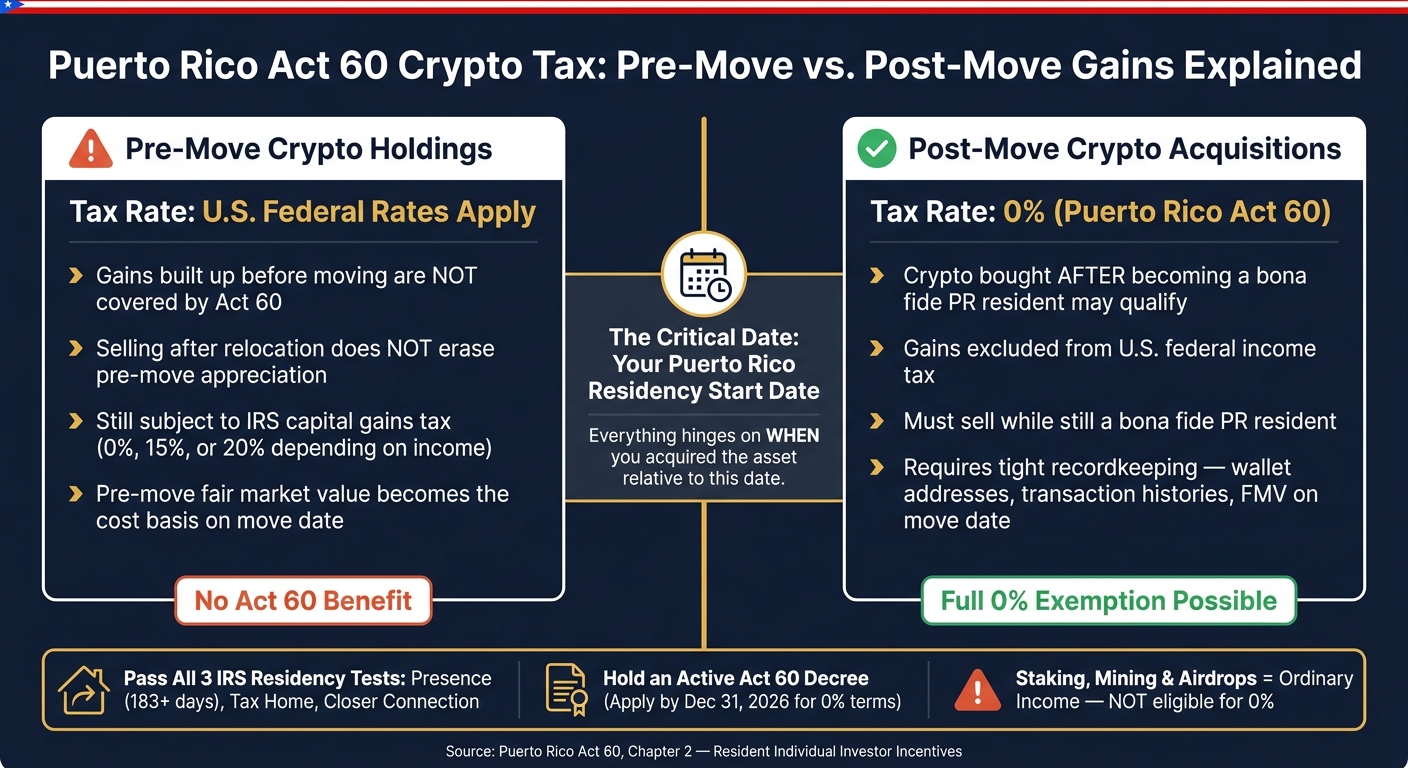
Two dates matter here: when you became a Puerto Rico resident and when you got the crypto.
That split is what decides whether Act 60 can help. Simply moving to Puerto Rico doesn’t make every gain tax-free. The tax result depends on where you were living when the gain built up and whether the asset was bought before or after your move.
Pre-move holdings: why existing gains are not automatically tax-free
If your crypto went up in value while you were living on the U.S. mainland, that built-in gain still falls under U.S. federal income tax. In plain English: pre-move appreciation does not get the 0% Act 60 rate.
So even if you sell after relocating, the part of the gain that piled up before your move doesn’t just disappear for tax purposes.
Post-move acquisitions: how qualifying crypto gains can reach 0%
Crypto you buy after becoming a bona fide Puerto Rico resident may get very different treatment. If you later sell it while you still meet bona fide residency rules, those gains can qualify for Puerto Rico’s 0% rate and be left out of U.S. federal tax.
That sounds simple, but the recordkeeping has to be tight. You need to track the fair market value of each asset on the date your Puerto Rico residency starts, because that number becomes your basis for later gain calculations.
Timing can also trip people up. If a sale was already being worked out before the move, the IRS may say the gain was earned before you arrived in Puerto Rico. If that happens, the tax break can be denied.
Table: pre-move vs. post-move crypto tax treatment at a glance
| Asset Type | Timing of Sale | Tax Jurisdiction | Main Planning Takeaway |
|---|---|---|---|
| Before move | Any point after relocating | U.S. federal (IRS) | Pre-move appreciation is not covered by the 0% Act 60 benefit |
| After move | While a bona fide resident | Puerto Rico at 0% | Gains accrued after the move date can be fully exempt from Puerto Rico tax and excluded from U.S. federal tax |
Next, the records and filings determine whether the IRS respects that split.
Compliance, limits, and next steps
Annual filings, crypto records, and common audit risks
Once gain timing is clear, the next step is simple: can your filings and records back up the exemption? If they can’t, the tax break can fall apart fast.
Act 60 decree holders need to stay current with Puerto Rico compliance filings, keep filing U.S. returns when required, and submit IRS Form 8898 when they begin or end bona fide Puerto Rico residency. Starting in 2026, the new compliance portal will also require certified CPA letters and a detailed breakdown of income sources.
Crypto records are under more scrutiny now too. Puerto Rico’s Department of Economic Development and Commerce and the IRS ask for wallet addresses, transaction histories, and asset holdings to check whether gains were earned after residency began. In practice, a separate wallet for pre-move and post-move assets can save a lot of headaches.
Audit risk goes up when residency is more on paper than in real life, records are spotty, or active trading is treated like passive investing. The most common trouble areas include:
- Paper-only residency
- Weak closer-connection evidence
- Treating active trading as passive gains
Missing annual reporting or donation deadlines can also put the decree at risk.
Who benefits most: holders, traders, and business owners
The compliance load isn’t the same for everyone. It’s usually easiest for long-term holders and tougher for active traders.
Long-term holders who build new positions after moving tend to have the cleanest case. If you buy crypto after becoming a bona fide Puerto Rico resident and later sell while still a resident, those gains can qualify for the 0% rate, assuming your records and annual filings are in order.
Active traders have a messier path. Frequent trading can start to look like business activity, which means the 0% individual investor rate may not apply unless you use a separate Act 60 export services entity. That setup has its own rules, including a 4% corporate rate and a requirement to hire at least one local employee if revenue goes above $3 million.
Business owners may be able to combine 0% post-move investment gains with 4% export-services income, but only if the structures stay separate and the paperwork is clean.
Conclusion: what to know before moving to Puerto Rico for crypto tax savings
Act 60 can mean 0% tax on qualifying post-move gains, but ONLY if you meet the bona fide residency rules and handle compliance the right way. If you do this carelessly, you’re not setting up tax savings. You’re setting up an expensive audit risk.
FAQs
Can I avoid tax on crypto I bought before moving?
No. You generally can’t avoid U.S. tax on crypto gains that built up before you became a bona fide Puerto Rico resident.
Here’s the plain-English version: Act 60 usually applies only to gains that both accrue and are realized after your residency starts. So if your crypto went up in value while you were living on the U.S. mainland, that part of the gain usually stays subject to U.S. federal tax.
There is one wrinkle. In some situations, certain pre-move gains may fall under a graduated toll tax instead of standard treatment. But that doesn’t mean those gains simply disappear for tax purposes.
Does staking income qualify for Puerto Rico’s 0% rate?
It’s unclear.
Act 60 offers a 0% tax rate on qualifying capital gains, dividends, and interest sourced within Puerto Rico. But staking income is a lot tougher to pin down, because its tax treatment depends on how that income gets classified.
There’s another wrinkle here. Proposed U.S. federal legislation would treat income from mining, staking, and similar digital asset activities as not sourced within Puerto Rico. If that happens, that income could fall under standard U.S. federal tax instead.
What proof do I need for bona fide Puerto Rico residency?
You need to pass the IRS’s three residency tests and keep records that show your physical, economic, and personal ties to Puerto Rico.
In plain English, that usually means keeping:
- A travel log showing at least 183 days in Puerto Rico
- Proof that your main business and personal ties are in Puerto Rico
- Local records, such as a Puerto Rican driver’s license and voter registration
- A primary residence bought within two years of your decree
- Form 8898
This isn’t the kind of thing you want to handle casually. If the IRS asks questions later, your paperwork needs to show that Puerto Rico is your main home on paper and in day-to-day life.
