
If I wanted the short answer, it’s this: renouncing U.S. citizenship in 2026 means going in person to a U.S. embassy or consulate abroad, paying $450 if the appointment is on or after April 13, 2026, taking the oath, and then finishing the IRS side, which can include Form 8854, a dual-status tax return, and, for some people, an exit tax.
Here’s the part many people miss: the consular step is only half of the job. I’d make sure I have another nationality first, confirm I can certify 5 years of U.S. tax compliance, and check whether I might be a covered expatriate under the $2,000,000 net worth test, the $211,000 average annual tax-liability test for 2026, or the compliance test. Even with the lower fee, tax prep can still run $2,000 to $15,000+, and travel can add $500 to $5,000+.
If I were reviewing this fast, I’d focus on these points:
- You cannot renounce in the U.S.
- You must appear in person before a consular officer
- The fee is $450 on or after April 13, 2026
- You should already have another citizenship to avoid statelessness
- Your citizenship ends on the oath date, even if the CLN arrives months later
- A covered expatriate may owe exit tax
- Form 8854 is required if you must report expatriation to the IRS
- State tax ties may continue unless you cut them off
A short side-by-side view helps:
| Topic | What to know |
|---|---|
| Where to renounce | U.S. embassy or consulate abroad |
| 2026 government fee | $450 on or after 04/13/2026 |
| Main appointments | Often 2 |
| CLN timing | Often 4 to 6 months |
| Covered expatriate triggers | $2,000,000 net worth, $211,000 average tax liability, or no 5-year compliance certification |
| Exit tax exclusion | $910,000 of unrealized gain in 2026 |
| Gift/bequest rule for covered expatriates | 40% tax on U.S. recipients above $19,000 |
| FBAR risk | Willful penalties can be the greater of $100,000 or 50% of the account balance |
So if I were planning this, I would treat it as a legal act first and a tax project second – and I would not assume the lower fee means the full process is cheap or simple.
Step-by-step: how to renounce at a U.S. embassy or consulate
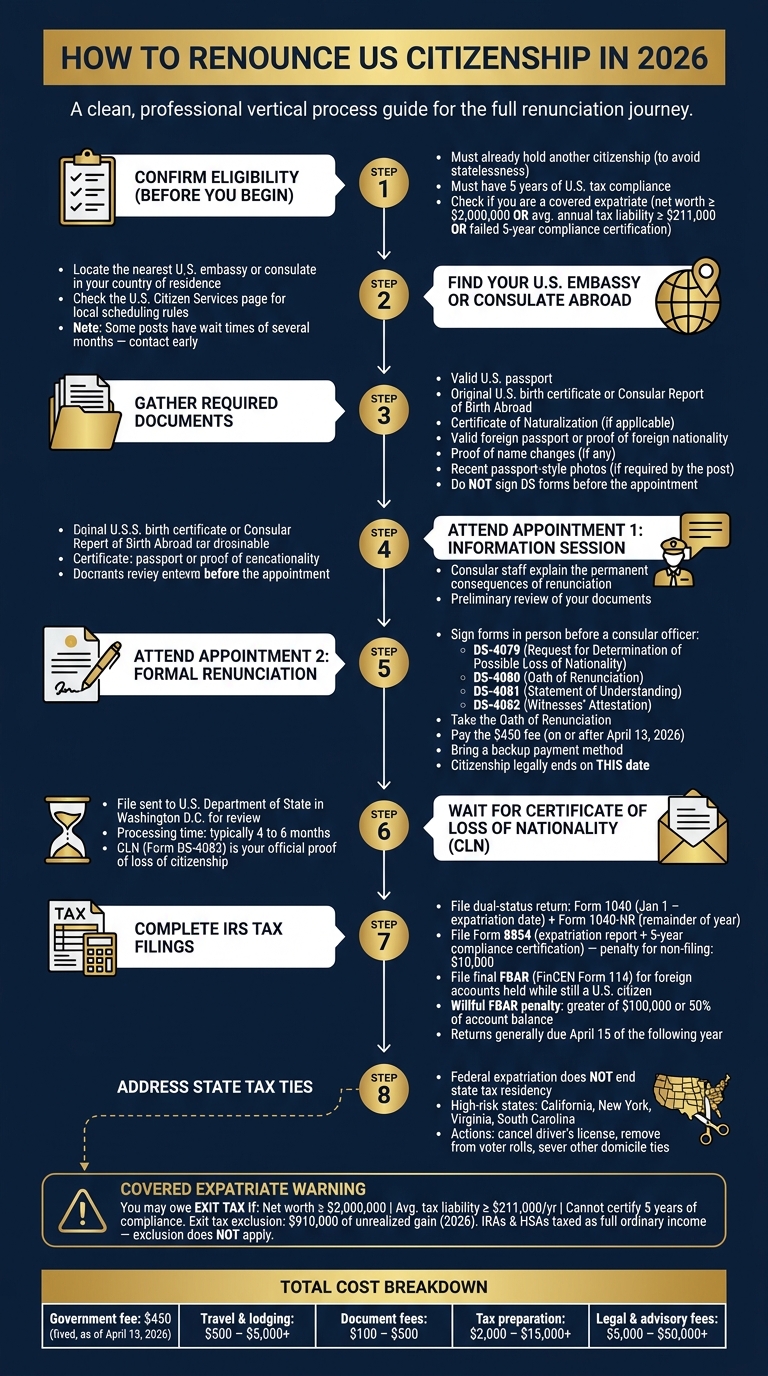
Once you’ve confirmed that you’re eligible, the process is pretty simple on paper: contact the right consular post, show up in person, complete the appointments, and then wait for your CLN. Start with the local post’s instructions first. After that, pull your documents together before you ask for an appointment.
Documents to gather and how to contact the right consular post
Begin by finding the U.S. embassy or consulate in your country of residence. Then check that post’s U.S. Citizen Services page. This part matters because scheduling rules differ by location, and some posts want scanned documents by email before they’ll even book you.
Some busy posts have wait times that stretch for several months, so it’s smart to reach out early.
Before you contact the post, gather:
- Valid U.S. passport
- Original U.S. birth certificate or Consular Report of Birth Abroad
- Certificate of Naturalization, if applicable
- Valid foreign passport or other proof of foreign nationality
- Proof of any name changes, such as marriage or divorce certificates
- Recent passport-style photos, if the post asks for them
Do not sign the DS forms before the appointment. You must sign them in the physical presence of a consular officer.
Forms, interviews, oath, and fee payment
This process usually has two separate appointments. The first is often an information session where the consular staff explain the permanent effects of renunciation. The second is the formal appointment where the renunciation happens.
During that second appointment, you’ll sign the required forms in front of the officer, take the Oath of Renunciation, and pay the $450 fee. It’s also wise to bring a backup payment method in case your card doesn’t go through. A small backup can save a big headache.
At the appointment, the officer will ask you to sign these forms in person:
| Form | Purpose |
|---|---|
| DS-4079 | Request for Determination of Possible Loss of U.S. Nationality |
| DS-4080 | Oath/Affirmation of Renunciation of Nationality of the United States |
| DS-4081 | Statement of Understanding Concerning the Consequences and Ramifications of Renunciation |
| DS-4082 | Witnesses’ Attestation Renunciation/Relinquishment of Citizenship |
One practical point: avoid saying that tax avoidance is your main reason for renouncing. Consular officers may record your stated reasons, and directly pointing to taxes can create issues under the Reed Amendment.
Certificate of Loss of Nationality and expected timeline
After the ceremony, the consular post sends your full file to the Department of State in Washington, D.C., for final review. If it’s approved, Form DS-4083, the Certificate of Loss of Nationality (CLN), is issued. That’s the official proof that you’re no longer a U.S. citizen.
Legally, the loss of citizenship takes effect on the day you take the oath at the consulate, even if the CLN shows up later. In most cases, processing takes 4 to 6 months, depending on the post and the State Department’s workload. Once the CLN is issued, the next step is dealing with the fee and any tax filings you still need to finish.
sbb-itb-39d39a6
What renouncing US citizenship costs in 2026
Renouncing U.S. citizenship is not just a government filing fee. In most cases, people also pay for travel, paperwork, and, often, the tax work needed to wrap up their U.S. filings.
The State Department fee in 2026
As of April 13, 2026, the official fee to renounce U.S. citizenship and receive your Certificate of Loss of Nationality is $450. That’s a big drop from $2,350. The fee is also non-refundable and non-waivable, even if the renunciation application is denied.
That lower price helps. But for most people, it won’t be the main expense. Travel and tax compliance usually cost more. And if you qualify as a covered expatriate, exit tax exposure can far exceed the consular fee.
Travel, document, and professional costs beyond the consular fee
Travel alone often runs $500 to $5,000+. Once you add hotels and local transportation, the total can climb fast.
Document prep is usually a smaller line item, but it still adds up. Certified copies of birth certificates and translations of foreign-language records typically cost $100 to $500.
Tax work is where the numbers can swing the most. Preparing your final Form 1040, any required Form 1040-NR dual-status return, FBARs, and Form 8854 can cost $2,000 to $15,000+, depending on how complex your filings are.
If your finances include foreign companies, trusts, or retirement accounts, fees can jump again. In those cases, lawyer and advisory costs can run $5,000 to $50,000+.
Cost comparison tables: fixed vs. variable and pre- vs. post-April 13, 2026 fees
The table below breaks out the fixed cost from the moving parts:
| Cost Category | Typical Range | Who Charges It | When Incurred |
|---|---|---|---|
| Consular fee (fixed) | $450 | U.S. State Department | At the oath ceremony appointment |
| Travel and lodging (variable) | $500 – $5,000+ | Airlines, hotels | During the interview process |
| Tax preparation (variable) | $2,000 – $15,000+ | CPA or tax advisor | Year of renunciation and the five prior tax years |
| Lawyer and advisory fees (variable) | $5,000 – $50,000+ | Specialized law firm | Pre-renunciation planning |
| Document fees (variable) | $100 – $500 | Government agencies, translators | Before the first interview |
| Future U.S. travel authorization (variable) | Varies | U.S. government | If you plan to travel to the U.S. after renouncing |
And here’s how the government fee changed in 2026:
| Period | Official Renunciation Fee |
|---|---|
| Before April 13, 2026 | $2,350 |
| On or after April 13, 2026 | $450 |
The lower fee cuts the front-end government cost. But for many people, the bigger number comes later in the form of tax filings, planning costs, or a possible tax bill.
Exit tax, covered expatriate status, and final IRS filings

The bigger issue is usually the IRS side: covered expatriate status, exit tax, and final filings. Once the CLN process is in motion, the key question is simple: will the IRS treat you as a covered expatriate?
How covered expatriate status is determined
The IRS uses three tests to decide this:
- Net worth of $2,000,000 or more
- Average annual net income tax above $211,000 in 2026
- Failure to certify five years of full tax compliance on Form 8854
Fail any one of those tests, and you’re a covered expatriate.
That third test catches people off guard. You might be under the net worth and tax-liability limits, but if you can’t certify five full years of compliance, the IRS can still treat you as covered. The IRS Streamlined Filing Compliance Procedures may help fix past noncompliance before expatriation.
If you do end up covered, the next issue is how Section 877A applies to your assets.
How the exit tax applies to assets, retirement accounts, and trusts
A covered expatriate is generally treated as if they sold their worldwide assets the day before expatriation under IRC Section 877A. That means the IRS looks at unrealized gain as though it were sold, even if nothing was actually sold.
In 2026, the first $910,000 of unrealized gain is excluded. Any gain above that is taxed at capital gains rates.
Retirement accounts work differently, and this is where things can get painful. Traditional IRAs, Roth IRAs, and HSAs are taxed as a deemed distribution at ordinary income rates. The $910,000 exclusion does not apply to those accounts.
One move to avoid: do not roll a 401(k) into an IRA right before renouncing. That can trigger immediate tax.
For eligible deferred compensation, you need to file Form W-8CE within 30 days of expatriation if you want to defer tax. If you don’t, the amount is generally taxed on your final return.
There can also be fallout for family members in the U.S. Section 2801 imposes a 40% tax on the recipient of gifts or bequests from a covered expatriate for amounts above the annual exclusion, which is $19,000 in 2026.
Final Form 1040, Form 8854, FBAR, and covered vs. non-covered expatriate comparison
After you size up any exit tax, the last big job is filing the right IRS forms on time.
In the year you renounce, you file as a dual-status taxpayer: a Form 1040 for January 1 through your expatriation date and a Form 1040-NR for the rest of the year . These returns are generally due by April 15 of the following year.
You must also file a final Form 1040, Form 8854, and any required FBAR . Form 8854 tells the IRS that you expatriated, shows a balance sheet of your worldwide assets, and includes your five-year tax compliance certification . If you have to file it and don’t, the penalty can be $10,000.
A final FBAR (FinCEN Form 114) is required for foreign accounts held during the part of the year when you were still a U.S. citizen. Willful FBAR penalties can reach the greater of $100,000 or 50% of the account balance.
| Feature | Covered Expatriate | Non-Covered Expatriate |
|---|---|---|
| Exit tax on unrealized gains | Taxed on gains above $910,000 | No exit tax |
| IRA and HSA treatment | Full balance taxed as ordinary income | No immediate taxation |
| 401(k) and pension treatment | 30% withholding if Form W-8CE is filed within 30 days | Standard nonresident withholding |
| Gifts and bequests to U.S. heirs | 40% tax on the recipient above $19,000 | Standard U.S. gift and estate tax rules apply |
| Form 8854 required | Yes | Yes |
| Five-year compliance certification | Required | Required |
One more thing: giving up federal citizenship does not automatically end state tax residency. States such as California, New York, Virginia, and South Carolina may require separate steps to cut ties, like canceling a driver’s license and removing yourself from voter rolls. Miss that step, and you may still face state tax exposure even after the CLN is issued.
Federal expatriation ends citizenship. It does not end every U.S. tax obligation. Next, review how life after renunciation affects U.S.-source income, benefits, and estate planning.
Life after renunciation: taxes, benefits, and next steps
How former U.S. citizens are taxed on U.S.-source income
After expatriation, the big tax issue is how the U.S. treats your income and benefits. For IRS purposes, you’re generally treated as a nonresident alien. That means U.S.-source passive income is usually hit with 30% withholding, unless a tax treaty cuts that rate.
If the withholding already covers what you owe, you usually don’t need to file Form 1040-NR. You file it only when withholding does not fully satisfy the U.S. tax. To claim treaty rates, give Form W-8BEN to U.S. payors so they can apply the lower withholding.
Social Security, estate exposure, and post-expatriation planning
Taxes are only part of the picture. Federal benefits can change too.
Renouncing U.S. citizenship does not wipe out Social Security benefits you’ve already earned. If you’ve worked long enough to qualify, you can still receive those payments while living abroad. That said, the payments may face nonresident alien withholding, often 25.5% or 30%, based on the social security agreement or treaty that applies. You should notify the Social Security Administration directly so the right withholding is set up.
Medicare is different. Eligibility ends for good after renunciation, and other federal benefits may stop as well.
There is also an estate and gift tax angle that catches people off guard. If you’re a covered expatriate, gifts and bequests you leave to U.S. persons can trigger a 40% tax, and the recipient pays it.
Conclusion: key legal, financial, and tax points to review before renouncing
Renunciation is more than paperwork at a consulate. It’s a legal, tax, and wealth-planning move that can affect you for years. Before you finish the process, make sure you have these points nailed down:
- Five years of tax compliance are confirmed, your covered expatriate status is clear, and your final filings are correct, including Form 8854 and the dual-status return.
- Room in your budget for professional help with the final dual-status return and Form 8854.
- State tax ties are cut off cleanly, especially in states like California, New York, Virginia, and South Carolina, including driver’s licenses and voter registrations.
FAQs
Can I renounce without another citizenship?
No. You can’t renounce your U.S. citizenship unless you already have, or are set to get, another nationality.
The U.S. government does not support statelessness. During the formal process, you must show proof of another citizenship at your consular interview, such as a foreign passport or a naturalization certificate.
What makes you a covered expatriate?
You’re a covered expatriate if you meet any one of these three IRS tests:
- Net worth test: Your worldwide net worth is $2,000,000 or more on the date of expatriation.
- Tax liability test: Your average annual net U.S. income tax liability for the previous five years is more than $211,000 for 2026.
- Compliance test: You can’t certify on Form 8854 that you met all U.S. tax and reporting obligations for the previous five years.
This is an either-or rule, not an all-three rule. If even one of these applies, the IRS treats you as a covered expatriate.
Do I still owe state taxes after renouncing?
Renouncing U.S. citizenship does not automatically end your state tax duties. State tax rules are separate from the federal expatriation process.
That’s the part many people miss.
Your last state of residence may still treat you as a resident for tax purposes unless you clearly cut ties. And that can mean more tax bills, more forms, and more back-and-forth than you expected.
So while federal status changes matter, state residency and domicile rules still have their own say. If you want to avoid ongoing state tax liability and reporting requirements, you may need to take formal steps based on your state’s rules.
Talk with a tax professional about your specific state before you make any moves.
