
If I renounce U.S. citizenship or give up a green card, I become a covered expatriate if I fail any 1 of 3 IRS tests. That usually means: net worth of $2,000,000 or more, average U.S. income tax liability above $211,000 for the last 5 years, or failure to certify 5 full years of tax compliance on Form 8854.
Here’s the short version:
- 1 failed test = covered expatriate
- Covered status can trigger the exit tax under IRC §877A
- The IRS may treat my assets as sold the day before expatriation
- For 2026, the gain exclusion is $910,000
- Some dual citizens at birth and some minors can skip 2 tests, but they still must file Form 8854
- A green card holder usually must meet the 8-of-15-year long-term resident rule before these rules apply
If I want to avoid covered status, I usually focus on 3 things before expatriation:
- Keep net worth under $2,000,000
- Keep the 5-year average tax liability under $211,000
- Fix all tax, FBAR, and foreign reporting gaps before filing Form 8854
That’s the whole issue in plain English: covered expatriate status is mostly a numbers-and-filing problem. If I check those numbers early, I have a better shot at avoiding the exit tax.
Quick comparison:
| Item | What I need to check | 2026 amount/rule |
|---|---|---|
| Net worth test | Worldwide assets minus debts | $2,000,000 |
| Tax liability test | 5-year average U.S. income tax liability | $211,000 |
| Compliance test | 5 full years of clean filing history | Required |
| Exit tax gain exclusion | Gain excluded if I am covered | $910,000 |
| Green card holder rule | Long-term resident test | 8 of last 15 tax years |
Below, I break down who counts as an expatriate, how each test works, who may qualify for a narrow carveout, and what steps I would take before the expatriation date.
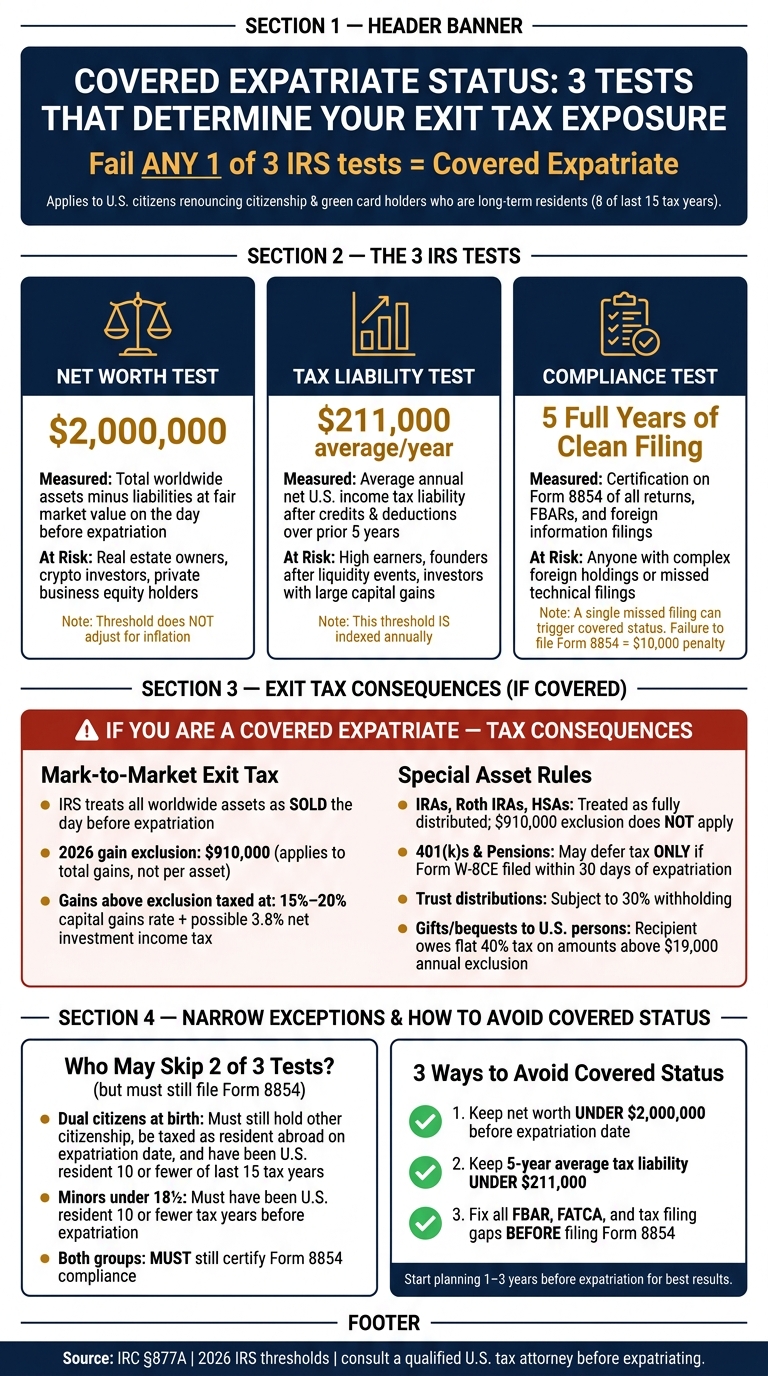
The 3 IRS tests that determine covered expatriate status
The IRS uses three tests. If you fail any one of them, you’re a covered expatriate.
Here’s the simple way to think about it: before you expatriate, you need to check your net worth, your average U.S. tax liability, and your filing history.
| Test Name | 2026 Threshold | What Is Measured | Typical At-Risk Profiles |
|---|---|---|---|
| Net Worth Test | $2,000,000 or more | Total worldwide assets minus liabilities at fair market value | Owners of appreciated real estate, private business interests, crypto investors |
| Tax Liability Test | $211,000 average annual net U.S. income tax liability | Average U.S. income tax liability after credits and deductions over the prior 5 years | High earners, founders after a liquidity event, investors with large capital gains |
| Compliance Test | 5 years of full compliance | Certification on Form 8854 of all returns, FBARs, and informational forms | Individuals with complex foreign holdings who missed technical reporting requirements |
Net worth test: worldwide assets at or above $2,000,000
The net worth test is pretty direct: add up the fair market value of all your worldwide assets, subtract your liabilities, and compare the result to $2,000,000 on the day before your expatriation date.
This catches more people than you’d think because the IRS casts a wide net. Assets can include:
- U.S. and foreign real estate
- Brokerage accounts
- Business interests
- Crypto
- Retirement accounts
- Personal property
- Certain trust interests
The key detail is that the $2,000,000 threshold does not adjust. So as markets move up and property values climb, more people drift over the line. A single person with $2,100,000 in worldwide net worth fails this test even if their income history is modest and their filings are spotless.
Average income tax liability test: five-year average above the indexed limit
This test stands on its own. It doesn’t matter whether your net worth is under $2,000,000. The IRS looks at your average annual net U.S. income tax liability for the prior five years, after credits and deductions.
For 2026, the threshold is $211,000. Unlike the net worth test, this number is indexed, so it can change from year to year. That means timing matters. The right figure depends on the year you expatriate.
The people most often at risk here are high-income executives, founders after a liquidity event, and investors sitting on large capital gains. Foreign tax credits may push the number down, but not always enough to get under the line.
Tax compliance certification test: Form 8854 and five full years of compliance
This is the test many people underestimate.
To pass, you must certify under penalty of perjury on Form 8854 that you’ve fully complied with all U.S. federal tax obligations for the five years before expatriation. That includes required income tax returns, FBARs, and foreign information filings.
A single missed filing can sink you here, even if it’s technical and even if your net worth and tax liability would otherwise keep you out of covered expatriate status.
Failing to file Form 8854 can trigger a $10,000 penalty and, in some cases, can itself trigger covered expatriate status. Put plainly, this test is mostly about process. Get your filings cleaned up before you expatriate, not after.
Next: the exceptions that can keep some people from becoming covered expatriates.
sbb-itb-39d39a6
Exceptions, edge cases, and common profiles
These carveouts are narrow. In most cases, people still rise or fall based on the three IRS tests.
Dual citizens, certain minors, and long-term resident edge cases
The IRS gives two narrow exceptions, but neither one removes the filing duty.
Dual citizens at birth do not have to meet the net worth test or the average income tax liability test if all of the following are true: they were dual citizens at birth, they still hold citizenship in the other country and are taxed there as a resident on the expatriation date, and they were U.S. residents for 10 or fewer tax years out of the last 15.
Minors who expatriate before age 18½ also do not have to meet those same two tests if they were U.S. residents for 10 or fewer tax years before expatriation.
But there’s a catch. These exceptions apply only to the net worth and average tax liability tests. Both groups must still certify on Form 8854, under penalty of perjury, that they fully complied with U.S. tax duties for the five years before expatriation.
Green card holders run into a different edge case. A person can still be treated as a long-term resident even after moving abroad. For green card holders, that status applies if they held a green card for any part of 8 of the last 15 tax years, even if they later live outside the United States. And claiming treaty residence in another country can also trigger expatriation, even if the person never formally gives up the green card.
The examples below show how that plays out in practice.
Profiles that do and do not become covered expatriates
The easiest way to make sense of the rule is to look at common fact patterns.
| Profile | Covered Expatriate? | Why |
|---|---|---|
| Founder with $5 million in business equity and real estate | Yes | Fails the net worth test |
| Consultant with $1.5 million net worth and $250,000 average tax liability over 5 years | Yes | Fails the average income tax liability test |
| Digital entrepreneur with $500,000 net worth, low tax liability, and 3 unfiled FBARs | Yes | Fails the compliance test |
| Compliant expatriate with $1.2 million net worth, $50,000 average tax liability, and five years of clean filings | No | Passes all three tests |
| Green card holder who surrenders status in year 7 | No | Has not reached long-term resident status |
One practical issue shows up a lot with illiquid private-company equity. A covered expatriate is treated as if they sold assets at fair market value on the day before expatriation. On paper, that can create gain. In cash terms, though, the money may not be there yet.
Tax consequences and how to avoid covered expatriate status
If you meet any of the three tests, the next step is simple to name but not always simple to handle: what will this cost in tax, and what can you still do about it?
Main tax consequences: exit tax, retirement account rules, and trust exposure
Covered expatriates can face a mark-to-market exit tax. The IRS treats this as if you sold your worldwide assets at fair market value on the day before expatriation. For 2026, the first $910,000 of unrealized gain is excluded. Any gain above that amount is taxed at the usual capital gains rate, often 15% or 20% at the federal level, plus a possible 3.8% net investment income tax.
Retirement accounts work under a different set of rules, and this is where people often get blindsided. Traditional IRAs, Roth IRAs, and HSAs are treated as fully distributed before expatriation. The $910,000 exclusion does not apply to those accounts. Eligible deferred compensation, which includes many 401(k)s and pensions, may avoid immediate tax only if Form W-8CE is filed within 30 days. Miss that window, and the full balance may become taxable.
Trusts add another layer. Distributions from non-grantor trusts that are tied to the covered expatriate can face 30% withholding. And if a covered expatriate makes a gift or bequest to a U.S. person, the U.S. recipient may owe a flat 40% tax on amounts above the $19,000 2026 annual exclusion.
How to avoid covered expatriate status before expatriation
Once the tax hit is on the table, the work shifts to timing, valuation, and cleanup. In most cases, it makes sense to start planning 1 to 3 years before expatriation.
| Objective | Typical Actions | Key Constraints | Documents Needed |
|---|---|---|---|
| Reduce net worth | Gift assets to a spouse or heirs, pay down liabilities, and get appraisals for closely held interests | 2026 gift limits are $195,000 for a non-citizen spouse and $19,000 per recipient for others; assets gifted in the final year may still be counted | Gift tax returns (Form 709), appraisals, asset inventory |
| Lower average tax liability | Defer bonuses, avoid large capital gains, and time the exit so high-tax years fall off the lookback period | 2026 threshold is $211,000 | Five years of tax returns and transcripts |
| Pass the compliance test | Use IRS Streamlined Filing Compliance Procedures to fix FBAR or FATCA gaps before filing Form 8854 | You must certify five years of full compliance under penalty of perjury | Form 8854, FinCEN 114 (FBAR), Form 8938 |
| Minimize exit tax if covered | Tax-loss harvesting and allocating the exclusion to the highest-gain assets | The 2026 exclusion is $910,000 and applies to total gains, not per asset | Fair market value valuations for worldwide property |
| Protect retirement assets | File Form W-8CE for eligible 401(k)s and pensions; avoid rolling a 401(k) into an IRA before expatriation | Form W-8CE must be filed within 30 days of expatriation; IRAs do not get the exclusion shield | Form W-8CE, plan administrator records |
For lawful permanent residents, timing can make all the difference. If you give up your green card before you have held it for part of 8 of the last 15 tax years, you avoid becoming a long-term resident. That means the exit tax rules do not apply at all.
Documents and professional support to prepare before expatriation
After the planning comes the proof. You need clean records, support for asset values, and a filing history that holds up if the IRS takes a close look. This matters even more with illiquid assets. If a real estate holding or private business interest is undervalued, that can turn into a messy dispute fast.
Before filing Form 8854, gather:
- Five years of tax returns and IRS transcripts
- A complete worldwide asset list with fair market values as of the day before expatriation
- Professional appraisals for real estate and closely held business interests
- Gift tax returns (Form 709) for prior gifts
- FBAR filings (FinCEN 114)
- Form 8938
- 401(k) or pension statements if Form W-8CE applies
You will usually need more than one adviser here. A U.S. tax attorney can handle legal strategy, a CPA can manage the filings, and an appraiser can support hard-to-price assets. If your new country has its own tax traps, bring in local counsel there too.
Conclusion: A practical checklist before renouncing citizenship or ending long-term residency
Before you lock in a departure date, run through these five checks. They’ll tell you if you may fall into the expatriation tax rules.
| Checkpoint | What to Verify | 2026 Threshold |
|---|---|---|
| Confirm you are an expatriate | U.S. citizen, or green card holder for at least part of 8 of the last 15 tax years | 8-year LTR rule |
| Net worth test | Total worldwide assets minus debts on the day before expatriation | $2,000,000 |
| Average income tax liability test | Average annual net income tax liability for the five years before expatriation | $211,000 |
| Compliance test | Five full years of clean tax and reporting compliance | Five years of full compliance |
| Estimate exit tax | Total unrealized gains across worldwide assets, minus the $910,000 exclusion | $910,000 exclusion |
A couple of items need their own timing check. IRAs and HSAs are treated as distributed on the day before expatriation. Eligible 401(k)s and pensions can defer tax, but only if Form W-8CE is filed within 30 days.
If you fail even one of these tests, don’t treat expatriation like simple paperwork. Treat it like a tax-planning event. Starting 2–3 years early gives you room to lower assets, control income timing, and fix filing issues before the expatriation date.
FAQs
How is my expatriation date determined?
Your expatriation date is the day you officially give up U.S. citizenship or end long-term resident status, such as by voluntarily giving up a green card.
That date matters because the IRS treats your worldwide assets as if they were sold at fair market value on the day before. So it becomes the main reference point for figuring out your net worth and whether you may owe exit tax.
Do foreign assets and retirement accounts count toward the $2,000,000 test?
Yes. The $2,000,000 net worth test looks at the fair market value of all your assets worldwide. That includes foreign assets and retirement accounts.
So the calculation can include:
- Real estate
- Bank and brokerage accounts
- Business interests
- Personal property
- IRAs
- 401(k)s
Your total net worth equals your worldwide assets minus your worldwide liabilities.
Can I still avoid covered expatriate status if I have missing FBARs or tax forms?
Yes, often – if you fix the issue before you officially expatriate.
To meet the compliance test, you must certify on Form 8854, under penalty of perjury, that you complied with all U.S. tax obligations for the five years before expatriation, including required FBARs.
If you are not compliant now, IRS amnesty programs such as the Streamlined Filing Compliance Procedures may help you correct past omissions.
