
Yes – the U.S. renunciation fee is now $450, down from $2,350 as of April 13, 2026. But if I were looking at renunciation in 2026, I would not focus on the embassy fee alone. The bigger costs can still come from tax filing, Form 8854, exit-tax rules, and covered expatriate status.
Here’s the short version:
- New fee: $450
- Old fee: $2,350
- Rule date: March 13, 2026
- Effective date: April 13, 2026
- Retroactive? No
- Another citizenship required? Yes
- Form 8854 required? Yes, for all renunciants
- 2026 net worth test: $2,000,000
- 2026 tax liability test: $211,000 average annual U.S. income tax
- 2026 exit-tax gain exclusion: $910,000
- Gift/bequest tax for covered expatriates: 40% in some cases
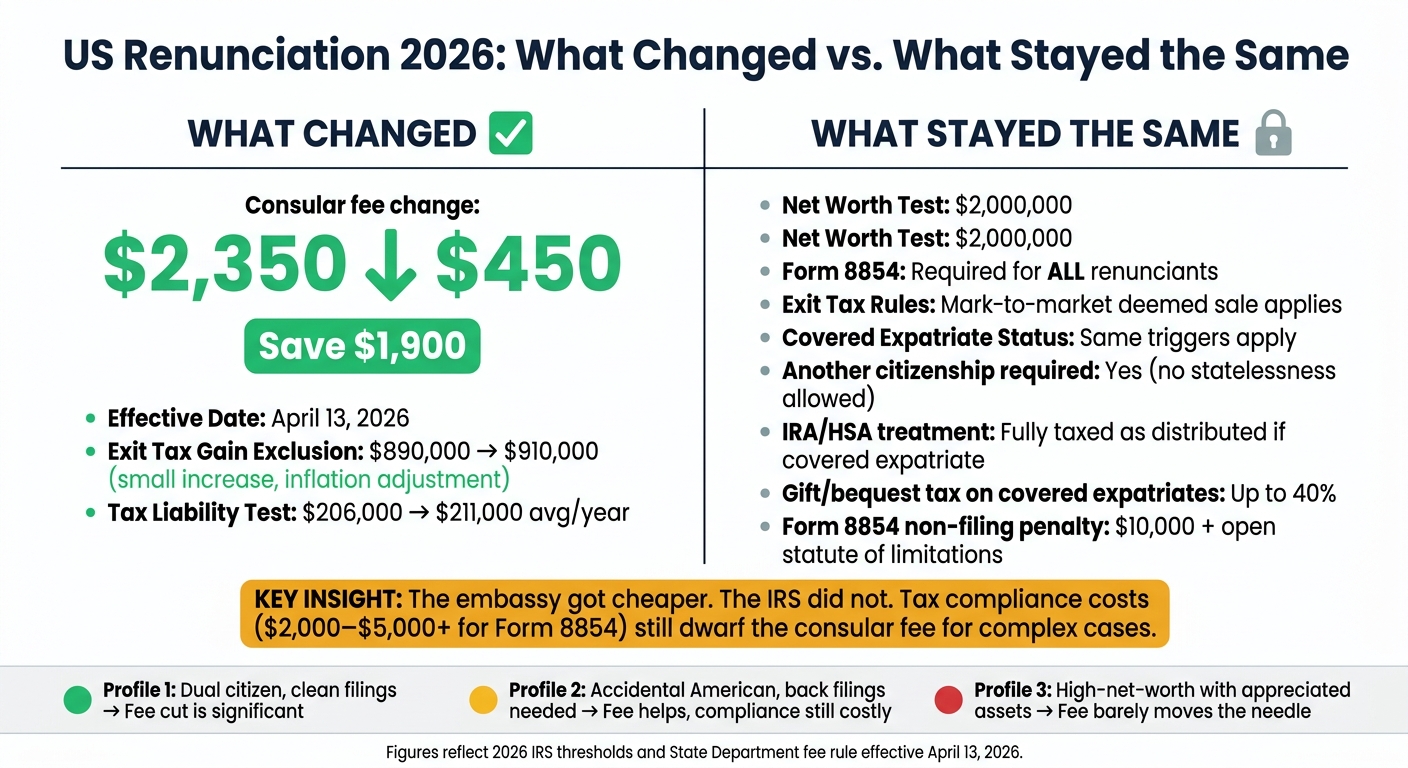
What changed was only the consular fee for the Certificate of Loss of Nationality, or CLN. What did not change: the tax rules tied to expatriation. So while the fee cut can save you $1,900 up front, the total bill may still run far higher if your filings are not in order or your assets trigger covered expatriate rules.
If I had to sum it up in one line, it would be this: the process got cheaper at the embassy, not with the IRS.
What changed in 2026 and why the State Department lowered the fee
On March 13, 2026, the State Department cut the CLN processing fee from $2,350 to $450. The new rule took effect on April 13, 2026. This shift came after years of legal pressure and advocacy from groups such as the Association of Accidental Americans (AAA). The State Department said the lower fee would reduce deterrence for U.S. nationals abroad who faced reported tax-related barriers.
That drop is steep. But there’s a catch: the consular fee went down, while the tax and compliance side did not. So the lower price helps, but it doesn’t change the bigger cost picture for many people.
The old fee, the new fee, and when it took effect
What makes this change matter is that it rolls back the 2014 increase. It does not create a new process. After the 2026 rule, the fee returned to its original 2010 level of $450.
| Period | Fee |
|---|---|
| 2015–April 12, 2026 | $2,350 |
| April 13, 2026 onward | $450 |
The $450 fee applies only to CLN processing that takes place on or after April 13, 2026. It is not retroactive. If your CLN processing happened before that date, you do not qualify for the lower rate or a refund.
What the rule changed and what it left alone
This was a consular fee change, not a tax law change. Put simply, the 2026 rule changed one thing: the administrative cost of processing a CLN at a U.S. embassy or consulate.
Everything else stayed the same. IRC Section 877A, the exit tax rules, the covered expatriate tests, the $2 million net worth threshold, the $211,000 average annual net income tax liability threshold for 2026, and the need to file Form 8854 all remain in place.
For simple cases, the lower fee can trim the bill. For more involved cases, tax compliance may still cost more than the embassy fee.
Next comes the key issue: who can use the new fee, and whether timing affects eligibility.
sbb-itb-39d39a6
Who pays the $450 fee and what the 2026 procedural limits look like
The $450 fee covers CLN processing at a U.S. embassy or consulate, whether you’re doing a formal renunciation or documenting a prior loss of nationality. So the next part is pretty straightforward: who gets the new rate?
Which applicants the lower fee applies to
The lower fee applies to dual nationals, accidental Americans, and long-term U.S. expatriates alike. Whether you qualify for the fee is separate from your tax situation.
There is one gate that applies across the board: the State Department will not process a renunciation if it would leave you stateless. You must already hold another nationality.
Timing, appointments, and non-retroactive treatment
The $450 rate applies only to CLN processing on or after April 13, 2026. That date matters.
In practice, timing can still get messy. Some posts have long backlogs. The process may require two in-person visits: one for the interview and document review, and another for the oath. After the oath, final CLN issuance can still take months because the case goes to the State Department for final review.
The federal fee is now uniform, but the rest isn’t. Local logistics, travel costs, and post-specific document requirements still vary by location.
The fee is lower, but the total cost still depends on tax filing and expatriation status.
The real cost of renouncing in 2026: the fee, tax compliance, and covered expatriate risk
Now that the fee and timing are clear, the next step is the part that catches many people off guard: the $450 fee is only a small slice of the total cost. What you end up paying still depends far more on tax filing and possible exit-tax exposure than on the embassy appointment itself.
Costs beyond the embassy fee
Travel, lodging, local transport, and notarization can easily add a few hundred dollars or more. But in many cases, the embassy visit isn’t the expensive part. Tax work is.
Form 8854, the IRS expatriation form, is required for all renunciants. Preparing that form often costs $2,000 to $5,000, and cross-border accountants often bill $300 to $500 per hour. If you own real estate, a business, or crypto, you may also need valuations to back up fair market value.
Why Form 8854 and covered expatriate status matter more than the fee for many readers
For a lot of people, Form 8854 is the main issue, not the consular charge. The form certifies five years of tax compliance. If you miss the filing or fail the compliance test, you can become a covered expatriate. That’s where a straightforward renunciation can turn into a much more expensive process.
Covered expatriates are treated as though they sold their worldwide assets on the day before renouncing. For 2026, the first $910,000 in unrealized gains is excluded, and anything above that amount is taxed. So yes, someone can face exit tax without actually selling anything.
Retirement accounts add another trap. If you’re a covered expatriate, IRAs and HSAs are treated as fully distributed on the final return and taxed as ordinary income, with no exclusion for that income. Covered expatriates must also file Form W-8CE within 30 days to defer tax on certain retirement accounts.
There’s more. Covered expatriate status can also lead to a 40% tax on large gifts or bequests made to U.S. persons above the $19,000 annual exclusion in 2026. And if Form 8854 isn’t filed, the IRS can impose a $10,000 penalty and keep the statute of limitations open for that year with no end date.
Side-by-side comparison: $2,350 era vs. $450 era
Here’s what changed, and what didn’t.
| Feature | $2,350 Era (Pre-04/13/2026) | $450 Era (Post-04/13/2026) |
|---|---|---|
| Consular Fee | $2,350 | $450 |
| Exit Tax Exclusion | $890,000 | $910,000 |
| Tax Liability Test Threshold | $206,000 avg./year | $211,000 avg./year |
| Net Worth Test | $2,000,000 | $2,000,000 (unchanged) |
| Form 8854 Requirement | Mandatory for all | Mandatory for all (unchanged) |
| Exit Tax Rules | Mark-to-market deemed sale | Mark-to-market deemed sale (unchanged) |
| Primary Cost Driver | Consular fee + tax compliance | Tax compliance + exit tax exposure |
| Who Benefits Most | N/A | Accidental Americans, low-complexity cases |
These figures reflect the State Department fee change and the 2026 expatriation thresholds [1][3].
The drop from $2,350 to $450 helps most in simple cases. If your tax situation is light, that cut is a big deal. But if you have high net worth, large unrealized gains, retirement accounts, or hard-to-value assets, the fee is still the easy part. The next section looks at how the lower fee plays out for different types of Americans abroad.
What the lower fee means for different Americans abroad
How the change plays out across low-complexity and high-complexity cases
The $450 fee cut hits hardest in simple cases. In those situations, the embassy fee can make up a big share of the total bill. But once a case gets more complex, that same $450 starts to look pretty small.
Profile 1: Dual citizen with clean filings. For a dual citizen with modest assets and clean filings, most of the cost comes from the fee, travel, and Form 8854.
Profile 2: Accidental American with limited U.S. ties. For an accidental American with limited U.S. ties, the lower fee removes a big hurdle. But back filings and compliance work still make up most of the cost.
That’s why the same fee cut can feel like a big deal for one person and barely move the needle for another.
Profile 3: High-net-worth founder with appreciated equity. For a high-net-worth founder with appreciated equity, the fee drop barely changes the total cost. The main risk is exit tax, not the embassy fee.
Why pre-expatriation planning still matters in 2026
The lower fee doesn’t change the covered expatriate tests, retirement-account rules, or the need to plan before renouncing.
Conclusion: the $450 fee is real savings, but not the full financial picture
The pattern is pretty clear. The $450 fee can mean real savings in simple cases, especially when the rest of the file is clean. But for many Americans abroad, tax compliance work and exit-tax exposure still shape the total cost far more than the embassy fee.
FAQs
Does the $450 fee include the entire renunciation process?
No. The $450 fee only covers the administrative processing of your Certificate of Loss of Nationality.
You may still face other costs, including:
- Travel for required in-person embassy or consulate interviews
- Getting fully compliant with U.S. taxes for the previous five years
- For some people, a potentially large U.S. exit tax on unrealized capital gains
So while the filing fee is fixed, the total price can end up much higher depending on your tax status and travel needs.
How do I know if I’m a covered expatriate?
You’re a covered expatriate if you meet any one of these IRS tests under 26 U.S.C. 877A:
- Your worldwide net worth is $2 million or more when you expatriate.
- Your average annual U.S. income tax liability for the past five years is above the inflation-adjusted IRS threshold.
- You can’t certify that you fully complied with all U.S. tax and reporting duties for the past five years.
That last point trips people up more often than they expect. You don’t have to be wealthy to fall into covered expatriate status. If you can’t make that five-year compliance certification, the IRS may still treat you as one.
What tax filings should I complete before renouncing?
Before you renounce U.S. citizenship, you need to be fully tax compliant for the five years leading up to expatriation. That means filing all required U.S. tax returns, FBARs, and any required information forms for foreign businesses or trusts.
In the year you renounce, you must file Form 8854. This form is used to certify your compliance and determine whether you’re a covered expatriate. If you don’t certify compliance, you’re automatically treated as a covered expatriate.
