
Dubai is still 0% for personal income tax in 2026 – but that does not mean your total tax bill is $0. If you earn a salary, you usually pay no UAE income tax. But if you run a business, buy property, import goods, or file U.S. taxes, the picture changes fast.
Here’s the short version:
- Salary in Dubai: 0% UAE personal income tax
- Corporate tax: 9% on taxable profit above AED 375,000 (about $102,000)
- Freelancers: corporate tax can apply once business revenue passes AED 1,000,000
- VAT: 5% on most goods and services
- Customs duty: usually 5% on imported goods
- Excise tax: 50% to 100% on certain products
- Property costs: transfer fees, registration fees, service charges, and municipality fees still apply
- U.S. citizens and green card holders: still report worldwide income to the IRS, even while living in Dubai
Put another way: when people say Dubai is “tax-free,” they usually mean no tax on personal salary, dividends, and capital gains at the UAE individual level. That part is true. But business profits, consumption, imports, and property transactions can still trigger taxes or fees.
If I were reducing this article to one takeaway, it would be this: your Dubai tax cost depends less on where you live and more on how your income is earned, which structure holds it, and whether you cross the key thresholds.
| Area | What you may pay in 2026 | Main trigger |
|---|---|---|
| Personal salary | 0% | Employment income |
| Business profits | 9% above AED 375,000 profit | Taxable business activity |
| Freelancer income | CT may apply | Revenue above AED 1,000,000 |
| VAT | 5% | Taxable supplies above AED 375,000 |
| Imports | 5% customs duty | Goods entering mainland UAE |
| Excise goods | 50%–100% | Tobacco, energy drinks, sugary products |
| Property purchase | 4% transfer fee plus other fees | Buying real estate |
| U.S. tax filing | IRS reporting still applies | U.S. citizenship or green card |
So before I look at Dubai as “tax-free,” I’d split the question into four parts: employee income, business income, spending, and cross-border filing. That gives a much more accurate view of what you may pay in 2026.
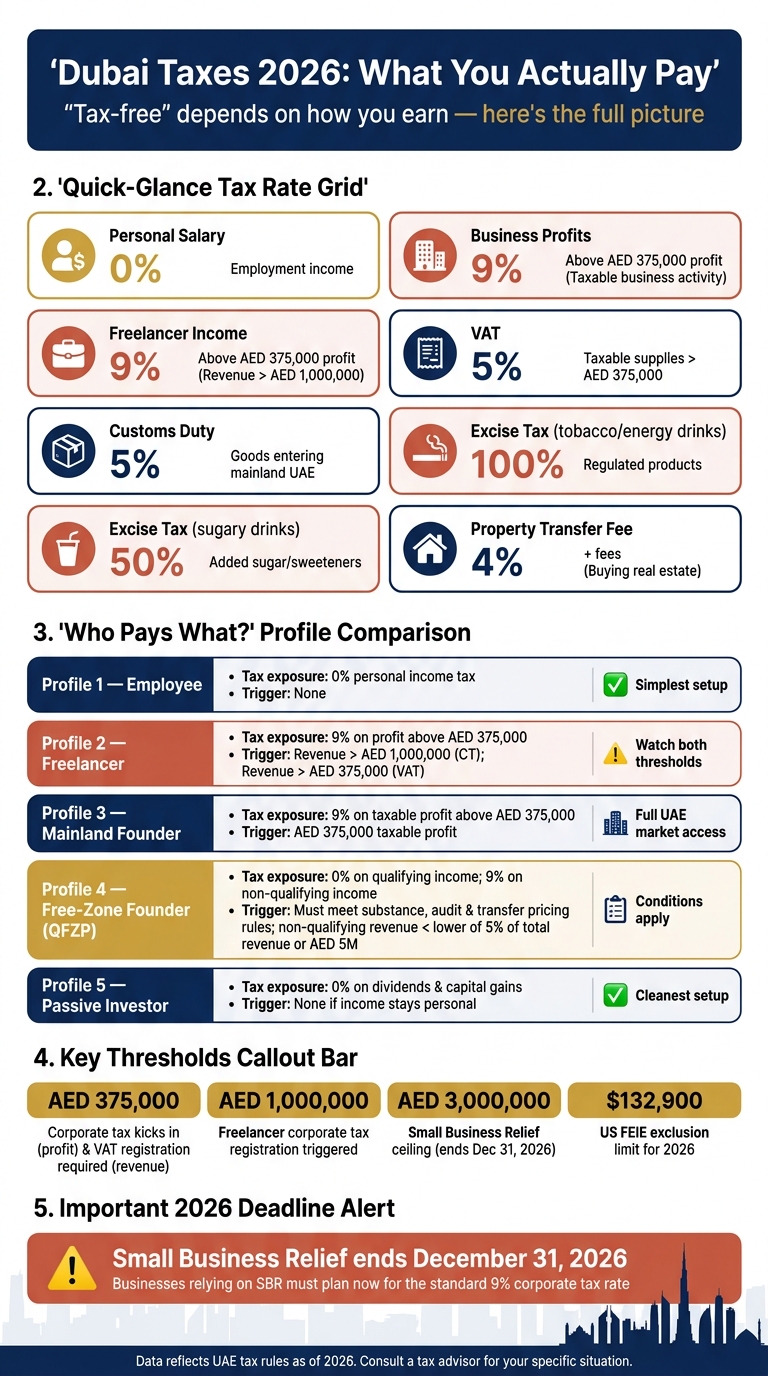
What individuals actually pay: 0% income tax, but not zero overall
Salary, dividends, and capital gains at the individual level
For most people in Dubai, private income still sits at 0%. Salaries, dividends, interest, and capital gains are generally tax-free when you hold them personally. Private residential rent is also generally outside corporate tax.
That said, the line moves once the income comes from an active business instead of a private investment portfolio.
When freelance or side income becomes a business
This is where things start to matter. Once business revenue goes above AED 1,000,000 in a year, UAE Corporate Tax rules can apply. That may mean registration and corporate tax on profits above AED 375,000.
The people most likely to hit this threshold are freelancers, consultants, and creators. A regular employment salary does not count toward the AED 1,000,000 threshold, but client fees and service income do.
There is some breathing room for smaller setups. Under Small Business Relief, eligible resident businesses with revenue under AED 3,000,000 can elect to treat taxable income as zero. Right now, that relief is scheduled to end on December 31, 2026.
Here’s the simple version:
| Income Type | Can it trigger corporate tax? | Condition |
|---|---|---|
| Salary / Employment | No | Always 0% |
| Personal Dividends / Interest | No | Held personally |
| Private Residential Rent | No | Held personally |
| Freelance / Business Income | Yes | Only if revenue > AED 1,000,000 |
| Property trading as a business | Yes | If conducted as a business activity |
For U.S. citizens and green card holders, that business label can add a whole extra layer of filing work.
Why U.S. taxpayers still need tax planning
Living in Dubai does not wipe out U.S. tax rules. U.S. citizens and green card holders are taxed on worldwide income no matter where they live. So if you earn a salary in Dubai, it still has to be reported to the IRS.
The main relief tool is the Foreign Earned Income Exclusion (FEIE). In 2026, it excludes up to $132,900 of foreign earned income. But there’s a catch: income above that amount can still be taxed by the U.S., and dividends, capital gains, and interest are not covered by the FEIE.
There’s also the reporting side, which catches plenty of people off guard. U.S. taxpayers must file an FBAR if UAE bank accounts go above $10,000 at any point during the year. Form 8938 under FATCA may also apply if foreign asset thresholds are met.
Corporate tax in Dubai in 2026: when 0% becomes 9%
Once you earn income through a business, the tax issue in the UAE shifts. It’s no longer about personal income. It becomes a question of taxable profit.
The core rules: AED 375,000 threshold and the 9% rate
For most businesses, the setup is simple: 0% on the first AED 375,000 of taxable profit and 9% on profit above that.
That distinction matters because corporate tax is based on profit, not revenue. Say a business brings in AED 2,000,000 in revenue and has AED 1,600,000 in allowable expenses. Its taxable profit is AED 400,000. In that case, only AED 25,000 is taxed at 9%.
Most taxable businesses also need to register through EmaraTax and get a TRN, even if they end up owing no tax at all. Miss the registration step, and the penalty is AED 10,000. Miss a filing, even for a nil return, and the cost is AED 500 per month.
Freelancers, LLCs, and free-zone companies: a side-by-side look
The business setup you choose can change how income is taxed, even if the headline rate seems the same. What matters isn’t just the license. It’s also whether the income is mainland, qualifying free-zone, or non-qualifying income.
| Profile | When registration starts | Tax on first AED 375,000 | Tax above AED 375,000 | Notes |
|---|---|---|---|---|
| Freelancer / sole proprietor | When turnover exceeds AED 1M in a calendar year | 0% | 9% on profit above AED 375,000 | SBR available if gross revenue stays below AED 3M |
| Onshore LLC | Upon licensing | 0% | 9% on profit above AED 375,000 | SBR available if gross revenue stays below AED 3M |
| Qualifying Free Zone Person (QFZP) | Upon licensing | 0% on all qualifying income | Non-qualifying income taxed at 9% | Must meet substance, audit, and transfer pricing requirements |
| Free Zone (Non-QFZP) | Upon licensing | 0% | 9% on profit above AED 375,000 | Standard 9% regime applies |
A free-zone company can look tax-light on paper. But if it starts earning meaningful mainland income, it may lose QFZP status and move into the standard 9% regime.
Small business relief and free-zone planning in 2026
Resident businesses with gross revenue under AED 3,000,000 may elect Small Business Relief. For freelancers and early-stage companies weighing different setups, this can lower corporate tax exposure before revenue grows.
There’s a catch, though: SBR is not automatic. You have to elect it when filing your corporate tax return through EmaraTax, and you can’t apply it later for a past period. The relief is available for tax periods ending on or before December 31, 2026.
"Small Business Relief remains available for qualifying resident taxpayers with annual revenue up to AED 3 million for tax periods ending on or before December 31, 2026." – YouResidency
For free-zone businesses aiming for QFZP status, the 0% rate on qualifying income comes with strings attached. You need audited financial statements, enough substance in the free zone, and compliance with transfer pricing rules. On top of that, businesses with revenue above AED 50,000,000 must also maintain audited financial statements.
So the 0% rate isn’t just a box you tick once. It’s a status you have to qualify for and keep each year.
Corporate tax is only one layer; the next section covers VAT, customs, excise, and property-related costs.
sbb-itb-39d39a6
Indirect taxes and transaction costs: VAT, customs, excise, and property fees
Corporate tax gets most of the spotlight. But in Dubai, a lot of the costs businesses and residents feel day to day come from indirect taxes instead. They show up on receipts, import paperwork, and property transfer documents.
VAT at 5% and when registration is required
The UAE applies 5% VAT to most goods and services. For imported goods, VAT is charged on the value of the goods plus any customs and excise duties.
A business must register for VAT when its taxable supplies and imports go above AED 375,000. If taxable supplies fall between AED 187,500 and AED 375,000, voluntary registration is allowed.
Some supplies are zero-rated, while others are exempt.
If your business relies heavily on imports, customs duty and excise can hit harder than VAT.
Customs duties and excise on imported or regulated goods
Bringing goods into Dubai adds cost before the product even gets near a store shelf. The standard customs duty is 5% of CIF value – that is, cost, insurance, and freight. Some items, such as medicines and basic food staples, are exempt and taxed at 0%.
Excise tax applies to certain goods and can go as high as 100%. Tobacco products and energy drinks are taxed at 100%, while sugary drinks and products with added sugar or sweeteners are taxed at 50%.
| Tax Type | 2026 Rate | Applies To | Who Bears the Cost |
|---|---|---|---|
| VAT | 5% | Most goods and services | Consumers (collected by businesses) |
| Customs Duty | 5% | Imported goods (CIF value) | Importers (often passed to consumers) |
| Excise Tax | 50% | Sugary drinks; products with added sugar/sweeteners | Importers, manufacturers, or distributors |
| Excise Tax | 100% | Tobacco products, energy drinks | Importers, manufacturers, or distributors |
Goods imported straight into a free zone generally face 0% import duty until they move into the mainland.
For residents, another big layer of cost comes from property deals and occupancy-related fees.
Property transfer fees, registration costs, and service charges
Dubai does not charge an annual property tax, but buying and holding property still comes with one-time fees and yearly costs.
The biggest upfront charge is the 4% transfer fee based on the sale price. It is usually split between the buyer and seller. Buyers also pay a registration fee of AED 2,000 for properties under AED 500,000, or AED 4,000 for properties above that amount, plus a AED 250 title deed fee.
If there is a mortgage, there is also a 0.25% registration fee on the loan amount, plus AED 290 in admin fees.
After purchase, annual service charges apply. These usually range from AED 55 to AED 220 per square meter per year, depending on the development. Tenants also pay a municipality fee: 5% of annual rent for residential leases and 10% for commercial leases. In many cases, this is collected through utility bills.
For owners, the main property-related costs are transfer fees, registration fees, service charges, and municipality charges.
How to keep your Dubai tax burden predictable
Your Dubai tax bill usually comes down to four things: how your income is classified, which entity holds the activity, whether your turnover passes key thresholds, and whether property or imports are part of the setup. If the structure doesn’t match the income, tax costs can climb fast.
Which structure fits employees, freelancers, founders, and investors
The same rules can hit very differently based on how you earn money and where that income sits.
| Profile | Main Tax Exposure | Trigger | What matters |
|---|---|---|---|
| Employee | 0% personal income tax | None for the individual | Most predictable setup; no corporate tax registration required for the individual |
| Freelancer | Corporate tax if annual revenue exceeds AED 1 million; 9% on taxable profit above AED 375,000 | AED 1 million annual revenue; VAT registration at AED 375,000 | Watch both the corporate tax and VAT thresholds |
| Mainland Founder | 9% on taxable profit above AED 375,000 | AED 375,000 taxable profit | Best for direct access to UAE consumers and government entities; higher setup costs |
| Free-Zone Founder | 0% on qualifying income; 9% on non-qualifying income | QFZP conditions and revenue cap | Requires audited financial statements and adequate substance; non-qualifying revenue must stay below the lower of 5% of total revenue or AED 5 million |
| Passive Investor | 0% on dividends and capital gains | None if income stays personal | Passive investors usually stay outside corporate tax unless the activity becomes a business |
For employees, this is about as simple as it gets. Personal income tax stays at 0%, and there’s no corporate tax registration for the individual.
Freelancers need to watch the edges more closely. Once annual revenue goes above AED 1 million, corporate tax can apply. And if revenue hits AED 375,000, VAT registration becomes part of the picture too. That’s where people get tripped up: one threshold affects corporate tax, another affects VAT.
For founders, the split between mainland and free zone matters a lot. A mainland business pays 9% on taxable profit above AED 375,000. A free-zone company can still get 0% on qualifying income, but non-qualifying income is taxed at 9%. To keep that free-zone tax treatment, the company must meet QFZP rules, keep proper substance, and produce audited financial statements. On top of that, non-qualifying revenue has to stay below the lower of 5% of total revenue or AED 5 million.
Passive investors usually have the cleanest setup. Dividends and capital gains stay at 0% if the income remains personal. But if the activity starts to look like a business, the tax treatment can change.
Small Business Relief ends on December 31, 2026. If your setup depends on that relief today, you need to plan now for the move to the standard 9% rate.
Where professional planning adds the most value
Most tax mistakes don’t happen because the rules are hidden. They happen when the setup no longer matches the income.
That often shows up around the margins:
- turnover crossing AED 1 million
- a free-zone company losing QFZP status
- a U.S. filer missing foreign reporting
This is where cross-border planning starts to matter more. If you have UAE filing duties and home-country reporting at the same time, the overlap can get messy fast.
Key takeaways for 2026
Dubai personal income tax is still 0%. That part of the “tax-free” pitch is correct. But that’s only one part of the story.
Depending on what you do and how you’re set up, you may also face 9% corporate tax, 5% VAT, 5% customs duty, excise taxes on certain goods, and property-related fees.
A salaried employee and a free-zone founder can end up with very different tax exposure. The smart move is to sort out the structure before you relocate or start routing income through a company, not after.
FAQs
Does Dubai tax remote work income?
It comes down to how your work is set up.
If you’re a salaried employee working under an employment contract, your wages, bonuses, and allowances are exempt from personal income tax.
If you work on your own as a freelancer, consultant, or sole establishment, your income falls under UAE Corporate Tax. In that case, you need to register and pay 9% tax on profits above AED 375,000 if your annual business turnover is more than AED 1,000,000.
There are a couple of common carve-outs. Personal investment income and private real estate rental income are generally excluded.
When does a freelancer owe corporate tax?
A freelancer in the UAE owes corporate tax once total yearly turnover from business activities goes above AED 1,000,000 in a Gregorian calendar year.
Once that happens, they need to:
- register with the Federal Tax Authority
- keep financial records
- file an annual corporate tax return
Here’s how the tax rate works: the first AED 375,000 of taxable profit is taxed at 0%. Any net profit above that amount is taxed at 9%.
If turnover stays below AED 1,000,000, the freelancer will generally not need to register, file, or pay corporate tax.
What taxes still apply if income tax is 0%?
Even with 0% personal income tax, you can still run into other taxes and fees in Dubai.
Here are the main ones:
- 5% VAT on most goods and services
- 9% corporate tax on net profits above AED 375,000 for businesses and licensed freelancers with annual turnover above AED 1 million
- 4% DLD transfer fee on real estate transactions
If you own property, you may also need to pay municipality fees and service charges. And if you’re a foreign national, your home country may still require tax reporting.
So while Dubai can be very tax-friendly, 0% personal income tax doesn’t mean zero tax across the board.
