
If you want the short answer: an Anguilla trust is an offshore trust used for asset protection and estate planning, and in 2026 it often costs $10,000 to $30,000+ to set up and $3,000 to $10,000+ per year to keep. If you’re U.S.-connected, add about $3,000 to $5,500 per year for IRS trust filings in many cases.
Here’s the plain-English version:
- What it is: You transfer assets to a trustee, who holds them for your beneficiaries under Anguilla law.
- Why people use it: asset protection, family succession, privacy, and long-term family wealth planning.
- Who it fits: often people with $1,000,000+ in assets and more than basic lawsuit risk.
- What changes the cost: the assets inside the trust, the number of entities, distribution activity, and U.S. tax reporting.
- Main catch: this is not a low-maintenance setup. It adds filings, trustee fees, and admin work.
Put another way: an Anguilla trust can help when you have a clear protection or succession problem to solve. If you don’t, the fees and paperwork can outweigh the upside.
I’d frame the article this way: it explains how the trust works, when it may make sense, where it may not, and what the all-in 2026 cost can look like for U.S.-connected readers.
What an Anguilla trust is and how it works
An Anguilla trust runs on its trust deed. That document lays out the rules for control, distributions, and who gets to make which decisions. In practice, it’s the playbook for how the structure operates day to day. Anguilla trusts are governed mainly by the International Trust Act, while ASTrA adds a framework for trusts that hold shares in Anguilla companies.
The key parties: settlor, trustee, protector, and beneficiaries
Most Anguilla trust structures involve four main parties, and each one has a separate job.
The settlor is the person or entity that puts assets into the trust. In Anguilla, a settlor can keep certain reserved powers and can also leave a non-binding letter of wishes that gives the trustee guidance on succession and distributions.
The trustee holds legal title to the trust assets and manages them for the beneficiaries. In Anguilla, trustees must be qualified individuals or licensed trust companies, and they act under fiduciary duties.
The protector isn’t required, but it shows up often in offshore planning. Think of this role as an extra check on the trustee. A protector can have the power to appoint or remove trustees or approve certain decisions, including ending the trust early. In Anguilla, the protector can also be the settlor or a beneficiary.
Beneficiaries are the people or entities that receive distributions under the trust deed. Anguilla law also allows both charitable and non-charitable purpose trusts, which can be useful when the structure isn’t built around named individual beneficiaries.
Put together, these roles shape the control and protection setup that gives the trust its day-to-day use.
Why Anguilla is used for asset protection and estate planning
After the structure is in place, the big issue is what legal protection it actually gives you.
Anguilla’s firewall rules are a major part of the answer. They help stop foreign heirship, marital, insolvency, and tax claims from overriding Anguilla law. For a creditor to succeed, they must prove fraudulent intent and bring the claim within three years of the transfer.
Anguilla is also tax-neutral for qualifying non-resident structures. That said, tax neutrality in Anguilla does not erase reporting duties somewhere else. For example, U.S.-connected settlors may still have IRS reporting obligations.
Common Anguilla trust use cases in 2026
In 2026, Anguilla trusts are usually used for a handful of planning goals.
- Family holding structures: trusts that own operating companies or global investment portfolios
- Dynasty planning: there is no rule against perpetuities, so the trust can continue across generations
- Asset protection: business interests and investment assets can be held behind the firewall
- Digital asset holding: the AUTO Act adds a framework for trusts that hold digital assets
- Philanthropy: ASTrA supports charitable and non-charitable purpose trusts
That mix of features is what matters in the real world. Sometimes an Anguilla trust solves a clear planning problem. Other times, it just adds cost and paperwork.
sbb-itb-39d39a6
When an Anguilla trust solves a real problem
Problems it is designed to address
An Anguilla trust makes sense only when it fixes a specific asset-protection or succession issue. The point isn’t the trust itself. The point is the problem it solves.
It tends to work best when assets face actual creditor risk and the trust is set up before any claim appears. In creditor disputes and litigation, the structure places assets outside direct personal ownership under Anguilla law. On top of that, claims face time limits and must satisfy a high fraud threshold.
For dynasty planning, Anguilla law removes the rule against perpetuities. That means the trust can continue indefinitely across generations. ASTrA also helps with succession planning for Anguilla company shares.
For families and investors with ties to more than one country, one Anguilla trust can hold assets in several jurisdictions under a single legal framework. That can make a scattered asset picture easier to manage.
It can also work well for real estate and operating businesses. In those cases, an LLC owned by the trust can help keep management control in place.
Still, this kind of setup can be inefficient when the risk level is low or the asset base is too small. If there’s no real problem to solve, the structure can start to feel like using a lockbox to store a paper clip.
Where it may not be the right fit
Cost is often the first reality check. If the yearly trust expense is high compared with the assets being protected, the setup gets tough to defend. The same goes for simple estates, domestic-only assets, or cases with little to no liability exposure.
U.S.-connected settlors also need to pay close attention to filing duties. Annual U.S. reporting still applies, and missed filings can lead to a minimum $10,000 penalty even when no tax is due.
If the structure matches the risk, the next issue is cost.
How much an Anguilla trust costs in 2026
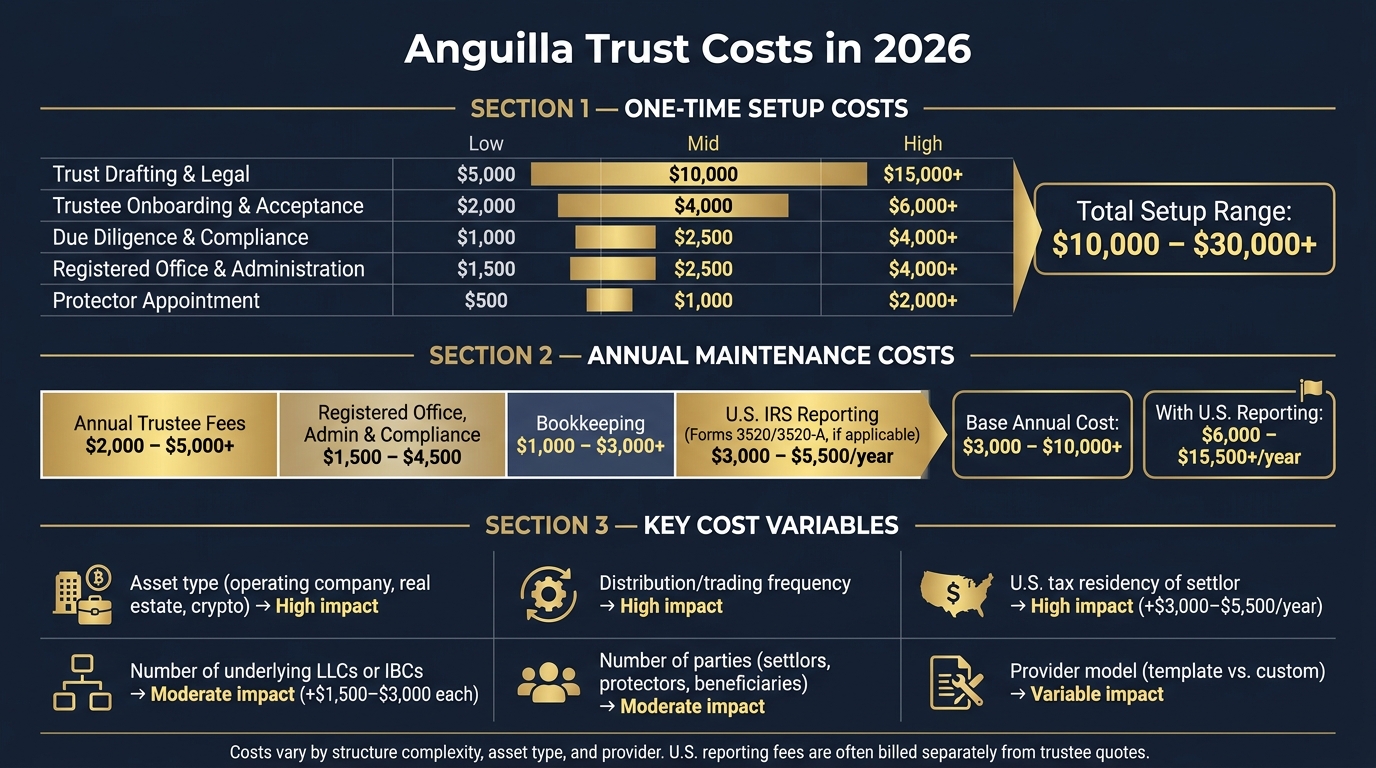
In 2026, the number that matters most is the all-in cost, not the opening trustee fee.
An Anguilla trust usually costs $10,000 to $30,000+ to set up and $3,000 to $10,000+ per year to maintain, before U.S. reporting costs. If the settlor has U.S. ties, separate IRS reporting fees often sit on top of the local trust fees.
In plain English: the bill usually comes in two parts. You pay once to get the trust in place, then you pay each year to keep it running.
One-time setup costs
Setting up an Anguilla trust usually covers legal drafting, trustee onboarding, due diligence, registered office fees, and, in some cases, a protector fee. Legal drafting alone often runs $5,000 to $15,000+, depending on how much tailoring the trust deed needs. Trustee onboarding and acceptance usually adds $2,000 to $6,000+. Required compliance due diligence tends to fall in the $1,000 to $4,000+ range. Registered office and administration fees are often $1,500 to $4,000+. If you appoint a protector, that usually adds $500 to $2,000+.
| Fee Category | Low | Mid | High |
|---|---|---|---|
| Trust Drafting & Legal | $5,000 | $10,000 | $15,000+ |
| Trustee Onboarding & Acceptance | $2,000 | $4,000 | $6,000+ |
| Due Diligence & Compliance | $1,000 | $2,500 | $4,000+ |
| Registered Office & Administration | $1,500 | $2,500 | $4,000+ |
| Protector Appointment | $500 | $1,000 | $2,000+ |
A straightforward trust usually lands in the $10,000 to $30,000+ setup range. If the structure holds an operating business, crypto, or real estate, the total can climb past that range pretty fast.
Annual maintenance and operating costs
Once the trust is live, the yearly costs usually include trustee fees, registered office and administration, compliance, and bookkeeping. Annual trustee fees often run $2,000 to $5,000+. Registered office, administration, and compliance usually add $1,500 to $4,500. Bookkeeping often costs $1,000 to $3,000+. For a simple setup, that puts the base annual total around $3,000 to $10,000+.
For U.S.-connected settlors, Forms 3520 and 3520-A usually add another $3,000 to $5,500 per year, and that charge is often separate from what the trustee quotes. That’s a detail worth checking early. Before you agree to any fee proposal, ask if U.S. tax reporting help is included or billed on its own.
The biggest variables that change total price
Costs usually jump the most when the trust holds active assets instead of passive investments. The main price drivers are the type of assets, how many entities sit under the trust, how often money moves, and whether U.S. reporting applies.
| Variable | Impact on Cost |
|---|---|
| Asset type (operating company, real estate, or crypto portfolio) | High – increases both setup and annual fees |
| Number of underlying LLCs or IBCs | Moderate – each adds $1,500 to $3,000 setup + annual agent fees |
| How often the trust makes distributions or trades | High – hourly billing adds up fast |
| Number of settlors, protectors, and beneficiaries | Moderate – more parties means more due diligence |
| U.S. tax residency of settlor | High – adds $3,000 to $5,500/year in mandatory IRS reporting |
| Provider model | Variable – template providers are cheaper but can leave out home-country legal advice |
One practical point: higher-value assets make these yearly fees easier to swallow. A $5,000 annual bill feels very different on a small pool of assets than it does on a large one.
How to decide whether an Anguilla trust fits your goals and budget
A simple decision framework for U.S.-connected founders and investors
Once you know what an Anguilla trust does and what it costs, the next step is simple: decide whether the setup makes sense for your assets, your risk, and your tolerance for paperwork.
Start with asset size. If you have less than $500,000 in assets you can realistically transfer into the trust, the yearly costs will often eat up too much of the upside. Once you get above $1,000,000, the math starts to look better. A useful rule of thumb is this: if the total annual cost stays below 0.5% of the assets being protected, the trust may make financial sense.
Then look at your liability exposure. If your worst-case risk could go beyond a standard $1 million to $2 million umbrella policy, that’s where a trust can step in and cover the gap. Put plainly, insurance handles one layer of risk. The trust is there for the layer above that.
What the trust will own matters too. If it will hold shares in an operating company, ASTrA can matter a lot because it works well for succession planning and shareholding setups. If the ownership structure is more involved, expect both setup fees and annual costs to climb.
You also need to be honest about the admin side. For U.S.-connected settlors, this is not a “set it and forget it” move. You still have annual IRS filings, FBAR reporting, and the usual back-and-forth with tax and legal advisors. Missed filings can lead to steep penalties. If the structure has a lot of moving parts, it helps to lock down a clear ownership and reporting plan before you go ahead.
Key takeaways
At the core, this is a tradeoff: protection value versus cost and compliance work.
Anguilla trusts tend to fit best for asset protection, estate planning, and multi-generation wealth transfer, especially for founders and investors with higher liability risk and more than $1,000,000 in assets that can be protected. In 2026, setup and annual costs can vary a lot depending on the structure, the type of assets involved, and the reporting work tied to it. If the trust doesn’t meaningfully improve your protection or succession plan, the cost and compliance load usually outweigh the upside.
FAQs
How long does it take to set up an Anguilla trust?
Setting up an Anguilla trust is usually pretty straightforward. The trust charter can be filed with the government registry within 24 hours.
That said, the full setup often takes longer. The timeline depends on a few moving parts: drafting the trust instrument, appointing a qualified trustee, completing due diligence, and transferring the initial trust fund.
Can I still control assets after transferring them to an Anguilla trust?
Yes. You can keep a high level of control over assets moved into an Anguilla trust.
Under Anguilla law, the settlor can act as a trustee, beneficiary, or protector. If you serve as protector, you can appoint or remove trustees. The trust deed can also include reserved powers, along with a non-binding letter of wishes that helps guide asset management and distributions.
What assets can go into an Anguilla trust?
An Anguilla trust can hold many types of assets, such as:
- cash
- real estate
- investment portfolios
- business shares
- intellectual property and royalty interests
Trustees can also manage assets across different countries, including assets that don’t produce income. In many cases, trusts use underlying corporate structures to help govern and manage a mix of holdings.
