
The short answer: since April 6, 2025, the UK no longer taxes many new arrivals by domicile. It now uses a 4-year Foreign Income and Gains (FIG) rule based on UK tax residence. If you qualify, your foreign income and gains can be exempt from UK tax for 4 UK tax years. After that, the UK taxes your worldwide income and gains.
If I were moving to the UK, leaving the UK, or sitting on offshore assets, I’d focus on four things right away:
- Eligibility: I need 10 straight tax years of non-UK residence before becoming UK resident.
- Scope: FIG can cover foreign dividends, interest, rent, business income, and non-UK asset gains.
- Limits: It does not cover UK-source income. Foreign employment income sits under Overseas Workday Relief, not FIG.
- Deadline risk: After year 4, UK tax can apply to worldwide income, gains, and some trust-related amounts.
Here’s the part many people care about most: money earned during the FIG window can usually be brought into the UK without a UK tax charge. But the relief is not automatic. I have to claim it on a UK tax return, and if I do, I give up my personal allowance and capital gains tax annual exempt amount for that year.
A few numbers matter fast:
- 4 years of FIG relief
- 10 tax years of non-UK residence to qualify
- $0 UK tax on covered foreign income and gains during the FIG period
- 12% TRF rate for certain pre-April 6, 2025 offshore amounts in 2025/26 and 2026/27
- 15% TRF rate in 2027/28
- April 5, 2028 TRF closing date
- Up to 45% income tax and 24% capital gains tax can apply after the FIG period, depending on the facts
Quick comparison
| Rule | Old non-dom system | 4-year FIG rule | After year 4 |
|---|---|---|---|
| Main test | Domicile | UK residence | UK residence |
| Relief period | Up to 15 years | 4 UK tax years | None |
| Foreign income/gains | Taxed if remitted | Exempt if claimed | Taxed as they arise |
| Bring money to UK | Could trigger tax | Usually no UK tax on covered amounts | No FIG relief |
| Trust position | Some trust protection | Limited to FIG period | More UK exposure |
| Claim needed | Yes, in some cases | Yes | Not relevant |
My takeaway: the old remittance playbook is over. Now the main job is timing: when I become UK resident, when income or gains arise, when distributions happen, and whether trust or company structures still work after the 4-year window ends.
sbb-itb-39d39a6
What changed on April 6, 2025: remittance basis is out, residence-based FIG is in
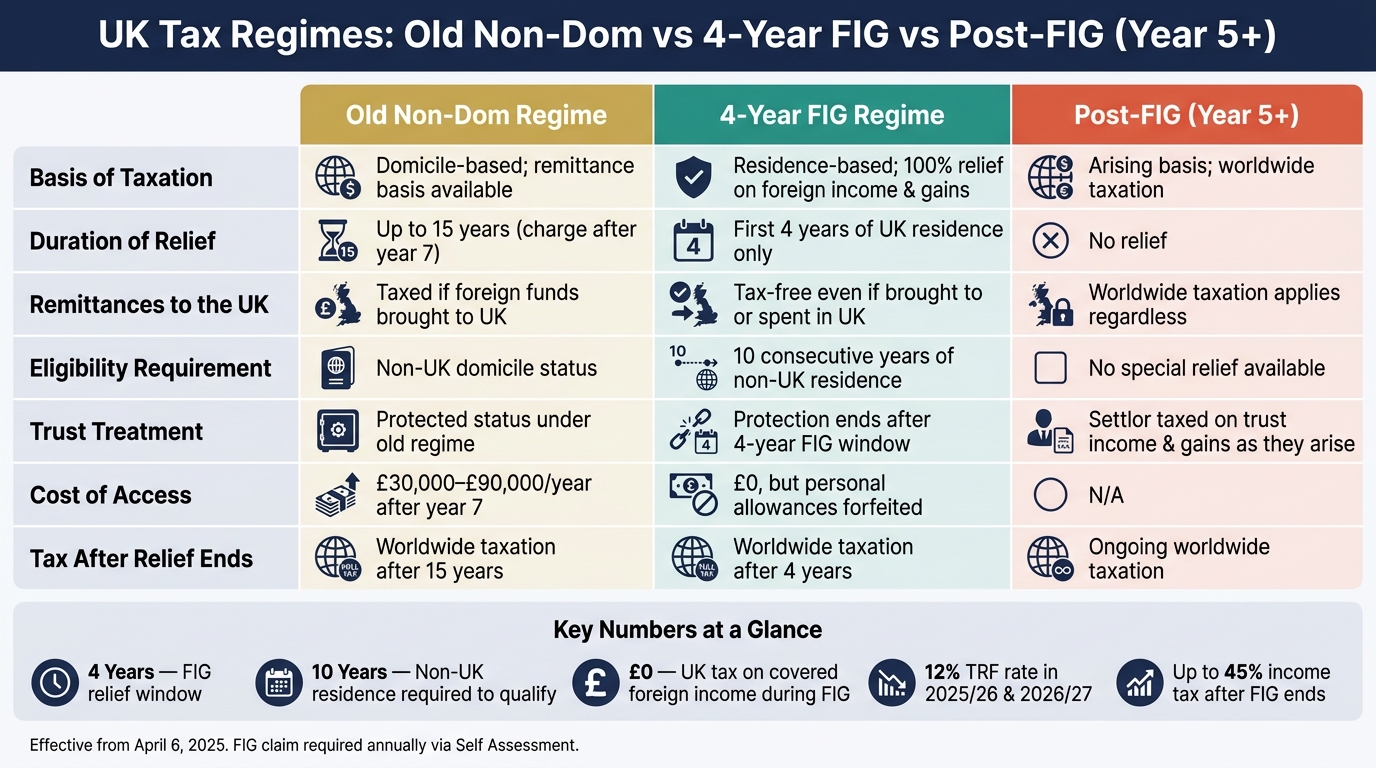
Before April 6, 2025, eligible non-doms could use the remittance basis. That system is now gone. The UK has replaced it with a residence-based 4-year FIG rule.
The big change is simple: residence now drives tax, not domicile.
How the old non-dom regime worked
Under the old model, people who were not UK-domiciled could choose the remittance basis. In plain English, that meant foreign income and gains were taxed only if they were remitted to the UK.
Some offshore trusts also kept protected status. That shielded trust income and gains from UK tax in certain cases. The relief could last for up to 15 years, although a charge of $30,000 to $90,000 per year applied after year 7.
How the new FIG rule works
Now, UK income tax and capital gains tax exposure turns on tax residence under the Statutory Residence Test.
If you qualify for the FIG regime, your foreign income and gains are fully exempt for your first four UK tax years. And during that same period, you can bring that money into the UK without a tax charge.
That’s a sharp break from the old remittance basis. Back then, bringing foreign money into the UK was the moment that could trigger tax.
After year 4, the relief stops in full. From that point, you’re taxed on worldwide income and gains on an arising basis. So tax applies when income and gains arise, no matter where the money stays.
Two practical points matter.
- The FIG regime is not automatic. You have to claim it on your UK tax return and state which foreign income and gains are covered.
- There’s a trade-off. If you claim the relief, you give up your UK personal income tax allowance and your capital gains tax annual exempt amount for that tax year.
Old regime vs. 4-year FIG vs. post-FIG taxation: a side-by-side comparison
| Feature | Old Non-Dom Regime | 4-Year FIG Regime | Post-FIG (Year 5+) |
|---|---|---|---|
| Basis of taxation | Domicile-based; remittance basis available | Residence-based; 100% relief on foreign income and gains | Arising basis; worldwide taxation |
| Duration of relief | Up to 15 years (remittance-basis charge after year 7) | First 4 years of UK residence only | No relief |
| Remittances to the UK | Taxed if foreign funds were brought to the UK | Tax-free even if brought to or spent in the UK | Worldwide taxation applies |
| Eligibility | Non-UK domicile status | 10 consecutive years of non-UK residence | No special relief after year 4 |
| Trust treatment | Protected status under the old regime; no equivalent protection after the FIG window | Protection ends after the 4-year FIG window | Settlor taxed on trust income and gains as they arise |
| Cost of access | £30,000–£90,000/year after year 7 | £0, but personal allowances are forfeited | N/A |
| Tax after relief ends | Worldwide taxation after 15 years | Worldwide taxation after 4 years | Ongoing worldwide taxation |
Next comes the part that matters most in practice: whether you qualify for the 4-year FIG window, and which income, gains, and trust distributions sit inside it.
Who qualifies for the 4-year FIG rule and what income is covered
Eligibility: new UK residents after 10 consecutive tax years outside the UK
You can use the 4-year FIG rule only if you become a UK tax resident after at least 10 straight tax years as a non-UK resident. That covers both first-time arrivals and people coming back to the UK, including returning UK citizens.
Whether you are UK tax resident depends on the Statutory Residence Test. That test looks at your days in the UK and your UK ties. For mobile founders and investors, this is now a big deal. Your residence history can shape the tax result from day one. And this is the first hurdle: if you don’t meet it, the 4-year FIG window does not open.
To use the relief, you need to claim it on your UK tax return each year and specify the foreign income and gains you want covered.
Once that part is clear, the next step is simple: what does the relief actually protect?
What foreign income and gains may be exempt during the 4 years
During the 4-year window, people who qualify can generally get a full exemption for foreign income and gains.
This usually includes:
- Foreign dividends, interest, and rental income
- Foreign business and investment income
- Capital gains on non-UK assets
- Foreign trust income, gains, and distributions from trusts you settled – a live planning issue under the new rules
One big carveout: foreign employment income is not covered by FIG. Instead, it may qualify only under Overseas Workday Relief (OWR). OWR now runs for 4 years and is capped at the lower of 30% of qualifying employment income or £300,000 per year. Under the new rules, that income no longer needs to stay offshore to qualify.
By contrast, UK-source income and gains are never covered by FIG.
What the FIG rule does not cover
FIG does not apply to UK-source income or gains at all. If you are a US taxpayer, you also still have to deal with US tax and reporting rules.
The next step is to look at how FIG works while the 4-year window is open, and what shifts once that window closes.
How the FIG rule works in practice: during the window and after it ends
During the 4-year window: overseas dividends, gains, and bringing money into the UK
Once you qualify, the big issue is how the four-year clock shapes cash flow, asset sales, and trust receipts.
For qualifying foreign income and gains earned in your first four UK tax years, the FIG regime gives full UK tax relief. Just as important, you can use that money in the UK without triggering UK tax on those amounts. That covers overseas dividends and foreign capital gains earned during the window.
To get the relief, you need to claim FIG each year through Self Assessment and list the income and gains covered by the claim.
After year 4: worldwide taxation kicks in and exposure increases
Once the four-year window ends, the position changes fast. You move onto worldwide taxation on an arising basis. From then on, worldwide income and gains are taxable in the UK when they arise, whether or not you bring the money into the country.
The risk isn’t limited to income tax. Offshore structures can also become much more exposed once FIG ends. Income that was exempt during the FIG period can then be taxed at up to 45%, and foreign capital gains can be taxed at 24% for higher-rate and additional-rate taxpayers.
If you’re the settlor of an offshore trust, there’s another pressure point. Protected trust status can end, and trust income and gains may become taxable on an arising basis after the FIG window closes. That’s why exits, distributions, and trust events often need to be lined up before the deadline passes.
Legacy issues: mixed funds and pre-2025 offshore money
Legacy mixed funds still need a close look. These are offshore accounts holding a mix of income, gains, and clean capital from different years. If those funds are remitted to the UK, the ordering rules still apply.
For pre-April 6, 2025 offshore income and gains, the government brought in the Temporary Repatriation Facility (TRF). This lets former remittance-basis users designate that pre-2025 FIG and bring it into the UK at a flat tax rate of 12% for the 2025/26 and 2026/27 tax years. The rate then rises to 15% in 2027/28. The facility closes on April 5, 2028.
For former non-doms, legacy offshore money is now a timing problem, not just a classification problem.
That makes timing, entity review, and distribution planning the next step.
How to review your UK move, structures, and timing decisions under the new rules
Timing UK entry, exits, and distributions around the FIG window
Once you’ve pinned down eligibility and covered income, timing becomes the main job.
Start by mapping your first four UK tax years before you move. The FIG window is fixed, so you need to know exactly when UK residence starts and the first tax year when that window ends. That date drives a lot more than people expect.
If you’re moving to the UK, line up income, gains, and planned distributions against that four-year period. If you’re planning to leave the UK, bring forward foreign income, gains, and distributions so they fall inside the FIG window.
Review offshore trusts, companies, and holding structures
After timing, turn to the structures that hold the income and gains.
Review offshore trusts, companies, investment accounts, and mixed-fund arrangements against the four-year window. The aim is simple: work out what can be dealt with during FIG, and what will sit outside it once UK taxation applies more broadly after year 4.
In practice, that means separating assets and arrangements into two buckets:
- items that qualify during FIG
- items that may be exposed after year 4 and need planning for the post-FIG period
This is where classification matters. Use the FIG window to sort trusts, companies, and mixed funds while the rules are more limited. Then check whether the structure still makes sense once year 4 passes.
The practical test is straightforward: do your move, your distributions, and your holding structures still fit inside the FIG window?
FAQs
How do I know if I qualify for the 4-year FIG rule?
You can use the 4-year Foreign Income and Gains (FIG) regime if you were not a UK tax resident for at least 10 straight tax years before your first year of UK tax residency. This test is based on the UK’s Statutory Residence Test, not your domicile.
If you qualify, you need to claim it every year on your UK Self-Assessment tax return. It’s not automatic. And there’s a trade-off: if you claim it, you give up your UK personal allowance and your annual capital gains tax exempt amount.
What happens after my 4-year FIG period ends?
After your 4-year foreign income and gains (FIG) period ends, you move onto the arising basis of tax.
In plain English: the UK can tax your worldwide income and capital gains as they arise, no matter where the money or assets sit.
That shift can be easy to miss, but it changes a lot. Income from overseas investments, rental property, or other non-UK sources may fall into the UK tax net once the FIG period is over.
Offshore trusts need close attention too. After year four, income and gains inside those trusts may become taxable even if nothing is paid out to you.
This is why timing matters. Before the FIG period ends, review your asset-holding structures and any tax planning already in place so you know what may be taxed next.
Should I bring offshore income or gains into the UK before year 4 ends?
Yes. During your four-year eligibility window, you can bring foreign income and gains (FIG) into the UK without paying UK tax on them. That’s a big shift from the old remittance basis. You don’t have to leave those funds offshore to avoid a UK tax charge.
If you have historic income or gains from before April 6, 2025, you may also be able to use the Temporary Repatriation Facility. This lets you bring those funds into the UK at a reduced tax rate of 12% or 15%.
