
An Anguilla LLC gets attention for 3 simple reasons: private ownership records, tax-neutral treatment, and rules that can limit what a personal creditor gets.
If I had to sum it up in one line, I’d say this: an Anguilla LLC can separate ownership, money rights, and control in a way many U.S. lawyers like for offshore asset protection planning. It is a separate legal entity formed in Anguilla, a British Overseas Territory, and its law draws from English Common Law. This foundation also makes it a popular choice when structuring offshore trusts for comprehensive protection. That makes the setup feel more familiar to many U.S. advisors than some other offshore options.
Here’s the short version:
- Privacy: member and manager names are generally not on a public register
- Creditor limits: a creditor may get only distribution rights, not voting or management power
- Tax treatment: Anguilla generally has 0% corporate income tax, 0% capital gains tax, and 0% withholding tax on member distributions
- Control: the LLC can be run by members or by managers
- Custom rules: the private operating agreement sets transfer rules, voting rules, and payout terms
- U.S. catch: U.S.-connected owners still face worldwide income reporting and may need IRS filings such as Form 5471 or Form 8865, depending on structure
A big part of the appeal is that economic rights and control rights are not always the same. So a creditor may have a claim to money if money is distributed, but that does not mean the creditor gets to run the LLC, force a sale, or take over decisions.
That is why asset protection lawyers keep coming back to it: privacy, control, and friction for creditors – all inside a legal system many U.S. planners already understand.
What is an Anguilla LLC?
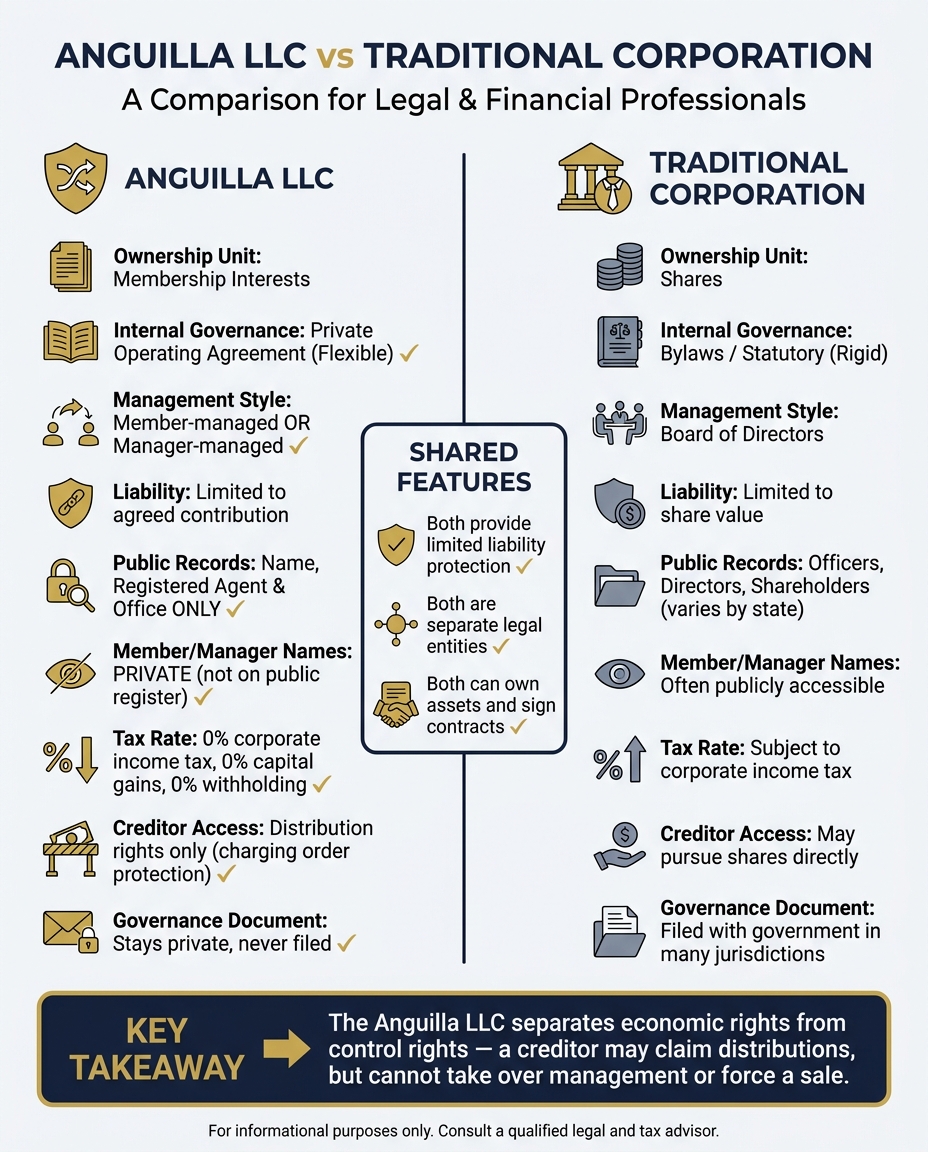
An Anguilla LLC is a private offshore limited liability company formed under Anguilla’s Limited Liability Company Act (Cap L.65). It can own assets, sign contracts, and take on obligations in its own name. That point matters because ownership, control, and liability don’t all work the same way.
Its appeal comes from the mix of limited liability and flexible private governance. It’s called a hybrid entity because it blends corporate-style liability protection with partnership-style internal flexibility. And that flexibility makes the next layer – the internal structure – a big deal.
How ownership and liability work
Members own interests in the LLC, not specific assets. Since the LLC holds assets in its own name, creditors would usually go after the LLC itself, not the member personally. They also can’t claim any specific asset the LLC owns. A member’s personal liability is usually limited to the contribution they agreed to make, plus any personal guarantees.
Why it is called a hybrid entity
It’s called a hybrid entity because it combines corporate-style liability protection with partnership-style internal flexibility. A standard corporation leans on rigid bylaws and formal governance. An Anguilla LLC, by contrast, uses a private Operating Agreement that the members draft themselves. That document sets the rules for profit distributions, voting rights, management authority, and transfer limits – and it stays private. For asset protection lawyers, that private governance matters because creditors can’t easily control how the entity is run or how interests are transferred.
| Feature | Anguilla LLC | Traditional Corporation |
|---|---|---|
| Ownership Unit | Membership Interests | Shares |
| Internal Governance | Private Operating Agreement (flexible) | Bylaws/Statutory (rigid) |
| Management | Member-managed or manager-managed | Board of Directors |
| Liability | Limited to contribution | Limited to shares |
The LLC can be member-managed, where the members run the company themselves, or manager-managed, where the members appoint specific people to handle day-to-day decisions.
Those points matter even more once you look at who runs the LLC and what information stays private.
How an Anguilla LLC is legally structured
An Anguilla LLC is set up with a very small public filing and a private operating agreement. That setup is a big reason asset protection planners watch it so closely. The company is formed under the Limited Liability Company Ordinance by filing Articles of Formation with the Registrar of Companies. But the filing itself is bare-bones. The real rules sit inside the operating agreement.
So the public record shows very little. The internal contract does the heavy lifting.
Members, managers, registered agent, and registered office
An Anguilla LLC can have one or more members, including just one owner. Members hold membership interests, not shares, and they can contribute cash, property, services, or promissory notes.
Two roles must be in place.
- The registered agent is a licensed local professional in Anguilla who handles the formation filing and acts as the official contact for the government.
- The registered office is a local Anguilla address where legal notices can be served.
Neither role gives a creditor ownership, control, or access to the operating agreement.
That matters for a simple reason: the public filing stays limited, while actual control stays inside the operating agreement.
What is public and what is private
The public filing lists only the LLC name, registered agent, and registered office. It does not list members, managers, or ownership details.
Everything else goes into the Operating Agreement. This is a private contract kept internally and not filed with the government. In practice, it’s the main internal document, and Anguilla law allows a lot of room in how it’s written.
| Feature | Articles of Formation (Public) | Operating Agreement (Private) |
|---|---|---|
| Entity Name | Yes | Yes |
| Registered Agent/Office | Yes | Yes |
| Member Names/Addresses | No | Yes |
| Manager Names/Addresses | No | Yes |
| Ownership Percentages | No | Yes |
| Profit/Loss Allocations | No | Yes |
| Transfer Restrictions | No | Yes |
Anguilla law also draws a line between an economic interest and a full LLC interest. In plain English, someone can receive distributions without getting voting or management rights. An economic interest gives distribution rights only. A full LLC interest includes voting and management rights too.
That split between economic rights and control rights is the base for charging-order protection. And it’s also why lawyers look so closely at creditor exposure next.
Why asset protection lawyers favor an Anguilla LLC
The split between economic ownership and control rights is a big reason asset protection lawyers like the Anguilla LLC. In practice, that split creates three main upsides: charging order protection, privacy, and flexible governance. Those rules shape what a creditor can actually reach – and just as important, what they can’t control.
Charging order protection and limits on creditor control
With an Anguilla LLC, a personal creditor can usually reach only distributions, not voting rights, management rights, or forced liquidation. That’s a big distinction. A creditor may have a claim on money paid out, but that doesn’t mean they get to step in and run the company.
If the LLC agreement allows it, managers can keep profits inside the entity instead of making distributions. In that case, the creditor gets paid only if a distribution is made in the first place. That can leave a creditor in a weak spot: they may have an economic claim, but little say over timing or decisions.
That setup gets even stronger when the creditor has very little public information to work with.
Privacy, offshore law, and negotiating leverage
Anguilla’s limited public filing makes ownership harder to trace and increases the cost of creditor tracing efforts. Put simply, it can be harder for a creditor to figure out who owns what and how the structure works.
Anguilla’s confidentiality rules, English Common Law framework, and the steps required to pierce the corporate veil add more friction. That extra friction can improve the owner’s negotiating position. A creditor may still pursue the claim, of course, but the path is often less direct and more expensive.
Flexible management and transfer limits
Lawyers also like the Anguilla LLC because the operating agreement can be drafted with a lot of flexibility. That gives owners room to set up control rules that fit how the company is meant to operate.
Two common tools stand out:
- Manager-managed structure: When management is vested in one or more managers, it becomes harder for a creditor to influence company decisions.
- Transfer consent requirements: A full membership interest is transferable only with the consent of other members. Without that consent, an assignee generally receives only the economic interest.
These features matter most when an owner wants to keep control while adding resistance against creditor pressure. That’s why this structure often appeals to owners who want asset separation without handing over day-to-day control.
sbb-itb-39d39a6
Who uses an Anguilla LLC, what problems it solves, and when it is a strong fit
Those features matter most when you look at how people own assets in practice.
Common use cases for entrepreneurs, investors, and high-net-worth families
The Anguilla LLC is often used by entrepreneurs, investors, family offices, and cross-border businesses that want offshore ownership with private control. In day-to-day use, it usually looks like this:
| User Type | Asset Being Protected | Main Risk | Why Anguilla LLC Fits |
|---|---|---|---|
| Entrepreneur | Digital IP or business interests | Operational lawsuits | Separates personal assets from business liabilities. |
| Investor | Foreign equities or real estate | Creditor claims | Charging order protection limits creditor control. |
| HNWI/Family Office | Global family wealth | Estate disputes/public exposure | Privacy keeps ownership out of public view. |
Problems it solves better than a simple domestic holding structure
The point isn’t just privacy. It’s the way the structure can limit a creditor’s path to the asset.
A domestic holding company keeps assets in a place where a creditor may already know the rules, the courts, and the playbook. An Anguilla LLC changes that setup by moving assets into a separate jurisdiction and putting another legal layer between the owner and the claimant.
Hypothetical example: A U.S.-based real estate developer who holds non-U.S. properties personally may face direct creditor pursuit if a lawsuit arises. If those same properties were held through an Anguilla LLC, the creditor would face a separate legal entity, no public record of ownership, and charging order protection that limits what they can actually claim.
That privacy also makes ownership harder to trace. Anguilla does not keep a public register of LLC members or managers, which can increase the cost and effort needed for tracing work.
The Operating Agreement adds another layer of control. It can spell out what happens if a member goes through bankruptcy or tries to transfer an interest. That gives owners room to set rules that a plain domestic structure may not offer.
When it may be a strong fit for a U.S.-connected owner
For a U.S.-connected owner, this setup may deserve a close look if the goal is to hold non-U.S. investments privately, ring-fence profits kept inside the LLC from operating risk, or build custom governance rules around ownership and control.
That said, U.S. owners still have worldwide-income reporting duties and may need related IRS filings, including forms such as Form 5471 or Form 8865, depending on how the entity is set up. Proper legal and tax advice from a qualified professional is needed before forming any offshore entity.
For U.S.-connected owners, the last issue is simple: can the structure be reported and maintained the right way.
Conclusion: The core reasons Anguilla LLCs remain popular for offshore asset protection
Anguilla LLCs stay popular for offshore asset protection for four main reasons working together: limited liability, charging-order protection, private ownership records, and a flexible operating agreement. That mix matters because the setup feels familiar to U.S. planners, even though it operates offshore.
For U.S.-connected owners, the biggest plus is that sense of familiarity. Anguilla’s common-law base and Privy Council appeal path give owners a legal framework that feels more familiar and stable, while the LLC still functions as an offshore structure in practice.
That said, the structure helps with planning, but it does not replace proper tax and reporting compliance. It may improve privacy and how assets are arranged, but it does not remove tax or reporting duties.
U.S. owners still have to report worldwide income, and the entity needs proper upkeep through a licensed registered agent, annual fees, and any required economic-substance filings. When used as part of a compliant asset protection plan, an Anguilla LLC can offer privacy, control, and creditor resistance without giving up compliance discipline.
FAQs
Is an Anguilla LLC legal for U.S. owners?
Yes. U.S. citizens and residents can legally set up and own an Anguilla LLC. They do not need to live in Anguilla or hold Anguillan citizenship.
That said, U.S. owners still have to follow all U.S. tax and reporting rules. This includes FinCEN Form 114 (FBAR) if offshore account balances go over $10,000.
Because offshore filings can get messy fast, it’s smart to work with a qualified tax professional.
What assets are best held in an Anguilla LLC?
An Anguilla LLC is a strong fit for assets where privacy, creditor resistance, and flexible management matter.
Common use cases include:
- International business holdings
- Investment portfolios
- Cryptocurrency
- Real estate
- Intellectual property, such as patents and trademarks
In plain English, it works well when you want to hold assets in a structure that offers room to manage them your way without putting everything on display.
How hard is it to maintain an Anguilla LLC each year?
Maintaining an Anguilla LLC is usually simple and fairly low-maintenance. There’s no required annual financial reporting or statutory audit, which cuts down on admin work.
To keep the company in good standing, you’ll need to:
- Pay annual government fees on time
- Keep accurate internal accounting records at the registered office
- Update beneficial ownership information when needed
- If it applies, file an annual economic substance declaration
