
Yes – but only in a narrow set of cases. If I want the 0% Puerto Rico rate in 2026, I generally need to become a bona fide Puerto Rico resident, have the right type of gain, and file my Act 60 investor decree application by December 31, 2026.
Here’s the short version:
- 0% can still apply in 2026 for certain post-move Puerto Rico-source capital gains
- Pre-move gain is not wiped out by moving to Puerto Rico
- U.S.-source gains can still be taxed by the IRS
- If I apply on or after January 1, 2027, new applicants generally move to a 4% Puerto Rico rate
- The decree process can take 6 to 12 months, so waiting too long can cost me the 0% result
Put another way: the move alone is not enough. I need the right residency facts, the right filing date, and the right gain timing.
Quick take: if the asset gained value after I became a bona fide Puerto Rico resident, I may get the 0% result. If the gain built up before the move, or the asset is U.S.-source, the tax outcome changes fast.
| Situation | Likely result in 2026 |
|---|---|
| Post-move Puerto Rico-source gain + decree filed by 12/31/2026 | 0% Puerto Rico tax may apply |
| New application filed 1/1/2027 or later | 4% Puerto Rico tax generally applies |
| Pre-move gain | Not covered by the 0% rule |
| U.S.-source gain | Can still face U.S. federal tax |
If I’m planning around an exit, stock sale, crypto sale, or business interest sale, the main question is simple: when did the gain happen, and where is it sourced?
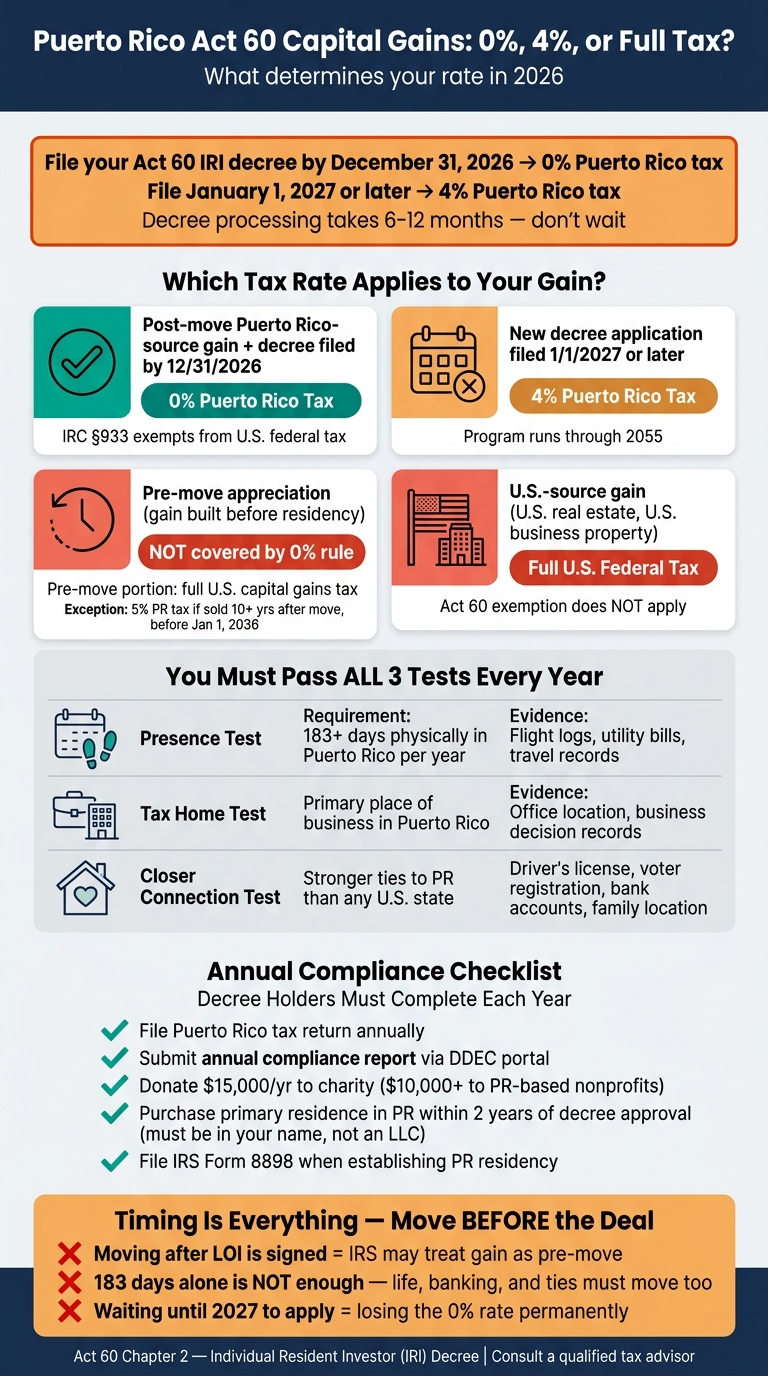
The 2026 Act 60 rules that determine whether 0% applies
Chapter 2 of Act 60 sets up the Individual Resident Investor (IRI) decree and ties the tax rate to the date you file.
What the Individual Resident Investor decree covers
The IRI decree gives a 100% Puerto Rico tax exemption on qualifying Puerto Rico-sourced interest, dividends, and capital gains. But there’s a catch: it generally protects only qualifying income that comes after you move.
So if you’re looking at capital gains, post-move Puerto Rico-source gains may qualify. Pre-move gains do not. U.S.-source income does not either. That line matters a lot when you’re trying to figure out whether a gain can get the 0% Puerto Rico tax result.
What changes for applications filed after December 31, 2026
If you already have a decree, or you file before the December 31, 2026 deadline, you’re generally grandfathered into the 0% rate for the life of the decree.
If you file on or after January 1, 2027, the rule usually changes to a 4% Puerto Rico tax on passive income, including capital gains, dividends, and interest. The program runs through 2055.
Puerto Rico tax versus U.S. federal tax
This is the part people mix up all the time: Act 60 deals with Puerto Rico tax only.
Under IRC Section 933, Puerto Rico-source income earned by a bona fide Puerto Rico resident is excluded from U.S. federal gross income. But U.S.-source gains can still be taxed by the IRS.
Before you assume a sale is tax-free, check two things:
- Is the gain Puerto Rico-sourced?
- Did the appreciation happen after you became a bona fide resident?
If either answer is no, the 0% result does not apply. After that, the analysis comes down to bona fide residency and meeting the decree’s annual compliance rules.
sbb-itb-39d39a6
Who actually qualifies: bona fide residency and decree compliance
The 0% rate applies only if you are a bona fide Puerto Rico resident. That’s the first gate. If you don’t meet it, the 0% rate is off the table.
The 3-part bona fide Puerto Rico residency test
To qualify as a bona fide Puerto Rico resident, you need to pass three tests each year: the presence test, the tax home test, and the closer connection test.
| Residency Test | What It Requires | Key Evidence |
|---|---|---|
| Presence Test | At least 183 days per year physically in Puerto Rico | Flight logs, utility bills, travel records |
| Tax Home Test | Primary place of business located in Puerto Rico | Office location, where business decisions are made |
| Closer Connection Test | Stronger social and economic ties to Puerto Rico than to any U.S. state | Driver’s license, voter registration, bank accounts, family location |
Most people fixate on the presence test. That makes sense, because the 183-day rule is easy to spot. But that’s only one piece of the puzzle. You also need to meet the tax home and closer connection tests.
That means your life has to move, not just your mailing address. Your home, banking, licenses, and family ties need to shift to Puerto Rico, including Puerto Rico-based bank accounts.
And even then, residency by itself doesn’t seal the deal. The gain also has to match the right timing and source.
The decree and annual compliance steps that matter
Getting the decree is the start, not the finish line. Each year, you have to keep up with the compliance rules.
For Individual Resident Investors, that includes buying a primary residence in Puerto Rico within two years of decree approval. The property must be purchased directly by you or your spouse, not through an LLC or holding company.
You also need to:
- File your Puerto Rico tax return each year
- Submit the annual compliance report through the DDEC portal
- Meet the annual charitable donation rule of $15,000, with at least $10,000 going to vetted Puerto Rico-based nonprofits
- File IRS Form 8898 in the year you establish Puerto Rico residency to notify the IRS of the move
In 2026, the DDEC annual compliance report may also require a certified CPA letter.
Miss one of these items, and the 0% outcome can fall apart even if the move itself was valid.
Why paper residency often fails under review
A paper move usually breaks down when your day-to-day life still points to the mainland. If the IRS decides your closer connection is still to New York or California, the whole residency position can come undone.
That review goes beyond travel days. Auditors look at where your family lives, where business decisions are made, and whether your main home, bank accounts, and personal ties actually shifted to Puerto Rico.
If you fail any part of the three-part test, you could face decree revocation and back taxes. Auditors may ask for flight records, utility bills, and proof of local ties like school enrollment or community memberships.
Once residency is in place, the next issue is what type of gain you have: pre-move, post-move, or U.S.-source.
Which capital gains face 0%, 5%, or full tax
Once residency is set, the next step is figuring out when the gain happened and where the asset is sourced.
Under Act 60, capital gains treatment turns on a simple split: was the appreciation built before the move, after the move, or tied to U.S.-source property?
Post-move gains on Puerto Rico-source assets may qualify for 0% Puerto Rico tax. But there’s a deadline attached: this treatment is available only for decree applications filed by December 31, 2026.
Post-move gains that can qualify for 0%
The cleanest setup is this: you become a bona fide Puerto Rico resident, buy an asset after the move, let it grow in value, and then sell it.
That can apply to:
- Stocks
- Bonds
- LLC interests
- Crypto
If those assets are acquired after your move, the post-move gain may be excluded from U.S. federal tax for a bona fide resident.
One detail matters a lot here: you need to document the asset’s fair market value on the date you establish bona fide residency. That’s how you separate any pre-move gain from post-move gain.
Pre-move appreciation: when 0% does not apply
A move to Puerto Rico does not wipe out appreciation that built up before residency started. That pre-move portion still faces U.S. federal tax when you sell.
There is one narrower rule to watch. Pre-move appreciation may face a 5% Puerto Rico tax if the sale happens:
- At least 10 years after residency begins
- Before January 1, 2036
If those timing rules are not met, the pre-move portion does not get 0% treatment.
Comparison table: pre-move assets, post-move assets, and U.S.-source property
Use the table below to separate timing from source.
| Asset Type | Timing of Appreciation | Puerto Rico Tax | U.S. Tax | 0% Available? |
|---|---|---|---|---|
| Stocks, bonds, LLC interests, crypto bought after move | Entirely post-move | 0% | Exempt | Yes |
| Pre-move assets sold within 10 years | Post-move portion | 0% | Exempt | Yes |
| Pre-move assets sold within 10 years | Pre-move portion | Standard rate | Full U.S. capital gains tax | No |
| Pre-move assets sold 10+ years after move, before Jan. 1, 2036 | Pre-move portion | 5% | Full U.S. capital gains tax | No |
| Puerto Rico real estate bought after move | Post-move | 0% | Exempt | Yes |
| U.S. real estate | Any | No Act 60 exemption | Fully taxable | No |
| U.S. business property | Any | No Act 60 exemption | Fully taxable | No |
Mainland U.S. real estate and U.S. business property do not get Act 60’s 0% treatment.
That’s where many investors get tripped up: the move itself isn’t enough. Timing, sourcing, and deal structure all have to line up. The next weak spot is how people time the move, decree, and sale.
Planning mistakes that block the 0% result, and what to do next
Once residency and source are clear, timing is where most deals go sideways.
The most common errors investors and founders make
Most missed 0% outcomes come down to three issues:
- Late move. If you move after the exit is already in motion, the IRS may treat the gain as pre-move. That risk gets much higher once an LOI is signed or active negotiations have started.
- Weak residency proof. Hitting 183 days by itself doesn’t do the job if your family, bank accounts, and business ties still point to the mainland.
- Wrong source assumption. Gains earned before residency starts are still subject to U.S. federal tax, no matter where you live when the sale closes.
This is the part many people underestimate. If the move happens after the sale becomes real, you’re no longer dealing with clean post-move facts. You’re dealing with a tax position that can be challenged.
How to sequence the move, decree, and asset sales
The cleanest path is simple: move first, then sell.
If a founder or investor relocates before a sale is foreseeable, it’s much easier to separate pre-move appreciation from post-move appreciation. But if that move happens after an LOI is signed, the chance of losing 0% treatment on the gain goes up fast.
The decree application takes 6 to 12 months to process manually, so filing early in 2026 leaves less room for mistakes before the December 31, 2026 deadline. At the same time, start the property search. Decree holders must buy a primary residence within two years of approval.
In plain English: don’t wait for the deal to heat up and then try to move. By then, the tax story may already be written.
When Act 60 still works in 2026
Act 60 still delivers 0% tax treatment in 2026 only if residency, timing, and sourcing all line up.
The 0% rate on passive income and post-move capital gains is available only to applicants who file by December 31, 2026. Anyone who files starting January 1, 2027 gets a 4% preferential rate instead.
FAQs
Does moving to Puerto Rico erase gains built up before the move?
No. Moving to Puerto Rico does not wipe out capital gains that built up before you became a resident.
Under Act 60, the tax break usually applies only to gains that accrue after you establish bona fide Puerto Rico residency. If an asset went up in value while you were still a U.S. resident, that earlier appreciation generally stays subject to U.S. tax.
That’s why timing and valuation matter. If you move and then sell, the IRS may look closely at when the gain accrued and how the asset was valued at the time your Puerto Rico residency began.
How do I prove I’m a bona fide Puerto Rico resident for Act 60?
To qualify, you need to pass all three IRS tests:
- Physical presence: In most cases, that means spending 183+ days per year in Puerto Rico.
- Tax home: Your main place of work or business needs to be in Puerto Rico.
- Closer connection: Your strongest personal and financial ties need to be there too.
Paperwork matters here. Keep clear records of things like travel logs, business activity, bank accounts, and proof of your primary residence. You also need to buy a primary residence in Puerto Rico within two years of getting your decree.
What happens if I file my Act 60 decree application after December 31, 2026?
If you file your Act 60 Individual Resident Investor decree application after December 31, 2026, you won’t qualify for the 0% tax rate on qualifying passive income.
Instead, you’ll generally pay a 4% preferential tax rate on interest, dividends, and capital gains generated after you become a bona fide Puerto Rico resident.
There’s one more rule new applicants need to meet: you must show that you were not a Puerto Rico resident for at least six years before you moved there.
