
If a creditor has a court judgment, your cash, bank accounts, wages, taxable investments, and extra property equity are often the first targets. By contrast, many 401(k)s, some home equity, Social Security, certain insurance values, and property titled the right way may have legal shields.
Here’s the short answer:
- Easiest to take: checking and savings balances, non-retirement brokerage accounts, wages, cars, jewelry, and non-exempt real estate equity
- Often harder to take: ERISA plans like 401(k)s, some IRA funds, homestead-protected home equity, Social Security, and some life insurance cash value
- What changes the outcome: state law, whether the debt is secured, how the asset is titled, and whether the creditor already has a judgment
- Big timing rule: moving assets after a claim appears can be treated as a fraudulent transfer and undone
- Common tools used before trouble starts: tenancy by the entirety, LLCs, irrevocable trusts, and keeping exposed assets out of your personal name where lawful
A few numbers matter right away:
- Federal wage garnishment is often capped at 25% of disposable earnings
- IRA bankruptcy protection is roughly $1.5 million
- Domestic asset protection trust waiting periods are often 2 to 4 years
- About 25 states allow tenancy by the entirety in at least some form
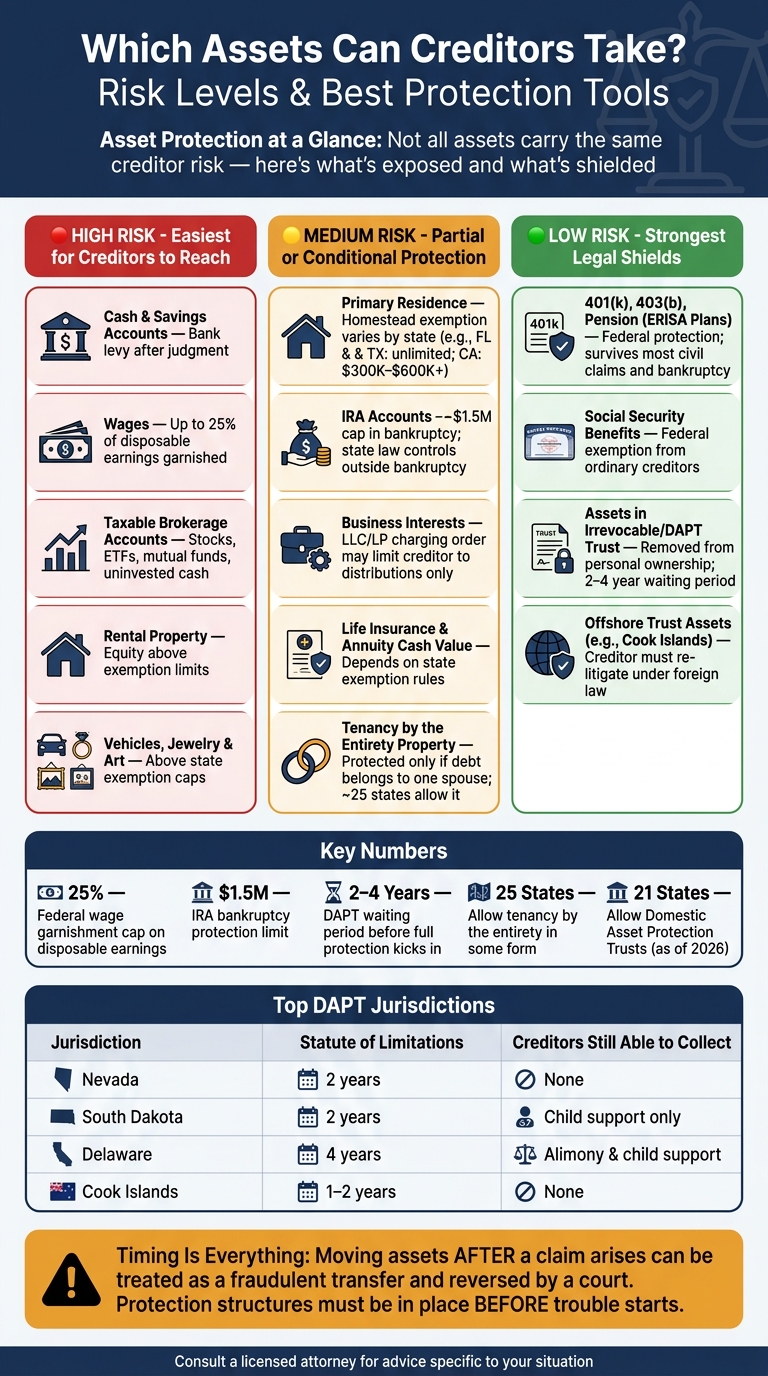
Quick comparison
| Asset type | Risk level | What usually matters most |
|---|---|---|
| Cash and savings | High | Bank levy after judgment |
| Wages | High | Garnishment limits under federal and state law |
| Taxable brokerage account | High | No retirement-law shield |
| Primary home | Medium | Homestead exemption and title |
| 401(k) / pension | Low in many civil cases | Federal retirement-law protection |
| IRA | Medium | State law outside bankruptcy |
| Rental property | High | Equity, liens, and LLC setup |
| Business interest | Medium | LLC or LP rules, charging order law |
| Social Security | Lower for many civil claims | Federal exemption, with carve-outs |
| Life insurance / annuity value | Medium | State exemption rules |
My takeaway: the law does not treat all assets the same. A $50,000 checking account is far more exposed than $50,000 inside a 401(k). So if I want less risk, I’d look first at where my money sits, how my property is titled, and whether my state gives any exemption at all.
sbb-itb-39d39a6
Assets creditors can realistically reach
Cash, wages, and taxable investment accounts
After a creditor gets a judgment, money in your checking or savings account is fair game. They can use a bank levy to freeze the account and take funds from it.
Wages get some protection, but not a lot. Under federal law, garnishment is capped at 25% of your disposable earnings or the amount by which your weekly pay is more than 30 times the federal minimum wage, whichever is less.
Taxable brokerage accounts are also exposed. That includes:
- Stocks
- ETFs
- Mutual funds
- Uninvested cash
A creditor can reach those assets too.
Real estate equity, business interests, and personal property
If you have non-exempt equity in real estate, that equity may be exposed. A creditor can record a judgment lien, and equity above the exempt amount can be at risk in a sale or foreclosure. State law makes a big difference here, which is why the next section matters.
For business owners, the setup of the business changes the picture in a big way. A sole proprietorship has no legal separation between you and the business, so business assets are fully exposed. LLCs and partnerships give more distance, but that doesn’t mean a creditor is out of luck. They may still get a charging order, which usually gives them the right to distributions instead of the underlying assets. In states with weaker protections, a creditor may be able to go past distributions and reach the ownership interest itself.
High-value personal property can also be taken. That includes vehicles, equipment, jewelry, and art when their value goes past your state’s exemption limits. Most states give only modest protection for personal property, so anything above the cap may be seized.
Some assets get partial or full protection under exemption law and ownership rules.
Assets that may be protected or partly exempt
Retirement accounts, homestead equity, and Social Security
Once you know which assets a creditor can reach, the next step is figuring out what the law may still shield. And this is where things start to vary a lot by asset type and by state.
ERISA-qualified retirement plans – like 401(k)s, 403(b)s, and traditional pensions – get some of the strongest federal protection in the system. Civil creditors usually can’t reach them, and that shield usually stays in place in bankruptcy too. Put simply: the more you build inside a 401(k), the more wealth may sit behind that federal wall.
IRAs work differently. In bankruptcy, federal law puts a cap on IRA protection at about $1.5 million in bankruptcy. Outside bankruptcy, state law controls. Some states protect IRAs without a dollar cap. Others take a narrower view. California, for example, uses a "reasonably necessary for support" standard, which gives a judge room to decide how much stays protected.
That difference matters. If you roll money from a 401(k) into an IRA, you may weaken the shield around those funds. You move from near-absolute federal coverage to whatever your state allows, and that can be far less protective. Inherited IRAs also tend to get weaker bankruptcy protection than IRAs you funded yourself.
Homestead exemptions protect equity in your main home, but the range is huge. Florida and Texas allow unlimited protection. California protects between $300,000 and $600,000-plus, based on county median home prices. If your home equity goes above the state cap, a creditor may be able to force a sale, give you the exempt amount, and take what’s left.
Social Security also has basic federal protection from ordinary creditors. But that doesn’t mean every claim stops there. IRS tax levies, federal criminal fines, and domestic support duties such as child support and alimony can still reach assets that would otherwise be exempt. That can include retirement accounts through court orders like Qualified Domestic Relations Orders (QDROs).
Life insurance, annuities, and tenancy by the entirety
Retirement funds and government benefits aren’t the only areas where the law may offer a shield. State insurance rules can also protect some policies.
Many states protect the cash value and death benefits of life insurance policies, along with annuity proceeds. But state law does most of the work here. California Insurance Code § 704.100, for instance, lays out the protections available in that state. So if your policy sits in a state with strong insurance exemptions, that cash value may be exempt from most civil creditors. At the federal level, life insurance and annuities usually get little or no protection, which means state law often decides the outcome.
Tenancy by the entirety (TBE) can also matter a lot for married couples. It’s available in about 25 states, including New York and Delaware. When property is titled as TBE, the law treats both spouses as one legal unit. That means a creditor chasing only one spouse usually can’t take the asset. But if both spouses owe the debt, that shield falls away.
Timing and title matter here. A lot. The way an asset is owned before a claim shows up can shape whether it stays protected or becomes exposed.
How to protect exposed assets before a claim arises
Titling, LLCs, and equity management to reduce easy targets
Once you know which assets are exposed, the next move is simple: make them harder to reach.
For married couples in states that allow it, tenancy by the entirety can block creditors when the debt belongs to only one spouse. That can shut the door on a direct grab of jointly held property.
LLCs can help too, but the setup matters. A common move is to use separate LLCs for each rental or operating asset so one problem doesn’t spill into everything else. In states like Nevada, Wyoming, and Delaware, a creditor’s remedy against an LLC member is often limited to waiting for distributions instead of seizing the assets inside the LLC.
Debt can also change the picture. If a property has a bona fide mortgage or a home equity line of credit, the visible equity drops. And if the visible equity drops, there’s less sitting there as an easy target.
If titling and LLCs don’t go far enough, trust planning can add another barrier.
Domestic and offshore trusts for stronger protection
An irrevocable trust removes an asset from your personal ownership by law. As of 2026, 21 U.S. states allow Domestic Asset Protection Trusts, or DAPTs, with Nevada and South Dakota used most often.
DAPTs usually include a spendthrift provision. That provision blocks both voluntary and involuntary transfers of a beneficiary’s interest. They also come with a waiting period, usually two to four years, before the protection fully kicks in.
For more involved cases, offshore trusts in places like the Cook Islands make life much harder for a creditor. Those courts do not recognize U.S. judgments, so a creditor has to start over and re-litigate the claim there under a much tougher local standard.
One point matters a lot here: the settlor should not act as trustee or keep control over distributions. Use an independent trustee or a corporate fiduciary, and don’t hold onto distribution control.
How to choose the right jurisdiction and avoid fraudulent transfers
The strength of a trust often comes down to jurisdiction. Two things matter most: the look-back period and any carve-outs that still let certain creditors collect.
| Jurisdiction | Statute of Limitations | Creditors That Can Still Collect |
|---|---|---|
| Nevada | 2 years | None |
| South Dakota | 2 years | Child support only |
| Delaware | 4 years | Alimony and child support |
| Cook Islands | 1 to 2 years | None |
There’s also a catch with real estate. For property, the law of the state where the real estate sits can control the outcome, even if the trust was formed somewhere else.
Timing is everything. These structures need to be in place before a claim is filed or even reasonably expected. Pick the setup based on the asset, the owner’s home state, and the kind of claim that could come up.
Conclusion: Match each asset to the right protection tool
The main issue isn’t whether creditors can reach assets at all. It’s which assets they can grab first and which legal tools can slow that process in a lawful way.
In most cases, creditors start with the easiest targets: liquid assets and property held in your personal name. ERISA plans, homestead equity, life insurance cash value, and TBE property can offer real protection, but that depends on state law and how the asset is titled. Timing matters too. If you move assets after a claim shows up, a court can unwind those transfers.
Use the summary below to match each asset to the weakest point in its exposure.
| Asset Type | Seizure Risk | Best Protection Tool |
|---|---|---|
| Cash / Savings | High | Keep balances low in personal accounts; use exempt or trust-owned accounts before any claim arises |
| Wages | High | Federal law generally limits garnishment to 25% of disposable earnings |
| Primary Residence | Moderate | Homestead exemption; tenancy by the entirety where allowed |
| Rental Property | High | Separate LLC for each property |
| Investment Portfolio | High | Irrevocable trust or DAPT |
| Business Interests | Moderate | LLC or LP with charging order protection |
The right shield depends on the asset, the ownership setup, and timing. A $50,000 bank account and a $50,000 balance in an ERISA plan don’t carry the same risk. That’s why it makes sense to max out ERISA contributions, check your state’s homestead exemption, title eligible marital property the right way, and add LLCs or a DAPT when the risk is high enough.
Act early. Once a claim turns urgent, your options get a lot tighter.
FAQs
Can creditors take money from a joint bank account?
Yes. A creditor can often take money from a joint bank account even if only one account owner owes the debt.
Here’s why: in most cases, both owners can use the full account balance. So if a creditor has a valid court judgment, they may be able to freeze and levy the entire account, not just half.
That said, state law can change how this works. In some states, a creditor can only go after the debtor’s presumed share of the account. Some states also give added protection to certain married couples.
If the other account owner doesn’t owe the debt, they often have to show which money is theirs. That usually means clear deposit records, such as pay stubs, bank statements, or transfer records, to prove the funds came from them.
Does bankruptcy protect the same assets as state law?
No. Bankruptcy does not protect the same assets that state law protects. Federal bankruptcy law uses its own exemption rules, and those rules often differ from state-law protections.
Bankruptcy also brings its own set of issues. For example, qualified retirement plans may get nationwide protection. And the federal Bankruptcy Code applies a 10-year lookback period to self-settled trusts.
In some cases, you have to choose either the federal exemption scheme or the state exemption scheme. You usually can’t mix both.
When is moving assets considered a fraudulent transfer?
Moving assets can count as a fraudulent transfer in two main situations.
First, it may involve actual fraud. That means the transfer was made to hinder, delay, or defraud creditors.
Second, it may involve constructive fraud. That happens when the debtor transfers assets for less than reasonably equivalent value while insolvent.
Courts usually look for signs that point to either actual fraud or constructive fraud. Common red flags include:
- Transfers to family members or other insiders
- Secrecy around the transfer
- Keeping control of the asset after the transfer
- Making the transfer while litigation is pending or threatened
