
Usually, no. If you have less than $1 million in exposed assets, an offshore trust often costs too much for what it protects.
Here’s the short answer:
- Setup can run about $15,000 to $30,000+
- Yearly costs often land around $8,000 to $12,000+
- At $250,000, that can eat up 4% of assets per year
- At $500,000, it can still cost about 2% per year
- At $1 million, the math starts to look more reasonable at about 1% per year
That’s why I’d usually look at lower-cost options first:
- Umbrella insurance
- LLCs for rentals or business assets
- State-law exemptions
- A domestic asset protection trust (DAPT) in some cases
The main thing is not just your net worth. It’s how much of your money is exposed to creditors, what kind of lawsuit risk you face, and whether the yearly trust cost takes too big a bite out of the assets you want to shield.
Quick comparison
| Option | Upfront Cost | Yearly Cost | Best fit under $1 million? | Main drawback |
|---|---|---|---|---|
| Umbrella insurance | $0 | $200 to $600 | Yes, for many people | Doesn’t cover every type of claim |
| LLC | $1,500 to $3,000 | $500 to $2,000 | Yes, for rentals or business use | Limited to certain asset types |
| DAPT | $3,000 to $15,000 | $1,000 to $5,000 | Sometimes | U.S. courts can still test it |
| Offshore trust | $10,000 to $30,000+ | $6,000 to $15,500+ | Often no, unless risk is high | High cost and heavy tax/reporting work |
My rule of thumb: if the yearly cost is over 2% of the exposed assets, I’d usually stick with insurance and domestic tools first. If the cost drops closer to 0.5% to 1%, why offshore asset protection may be worth a look for someone with high lawsuit risk.
So if you’re under $1 million, the short path is simple: use the cheaper layers first, then revisit offshore planning later if your assets or risk grow.
sbb-itb-39d39a6
How offshore trusts work and what they actually cost
What an offshore asset protection trust does
With an offshore asset protection trust, you transfer legal title to an independent foreign trustee. On paper, the assets are no longer yours. The trustee can still make discretionary distributions to you. That legal separation is the whole point, but it only makes sense if the added distance is worth the price.
A U.S. judgment does not automatically carry over in the foreign jurisdiction. If a creditor wants to go after the assets, they usually have to start over and re-litigate the case locally. Some jurisdictions also make the filing process harder for creditors.
One point matters more than most people realize: this is not a tax shelter. Under IRS rules, offshore trusts are generally treated as grantor trusts, which means all income, gains, and deductions flow through to your personal tax return as if the trust did not exist. So the structure is built for creditor protection, not secrecy and not tax reduction. If the trust doesn’t match the size of the portfolio and the level of legal risk, the math can fall apart fast.
Setup, annual, and compliance costs in USD
For smaller portfolios, cost is usually the sticking point. A fully implemented structure often runs $20,000 to $60,000 in total. That usually includes legal drafting, trustee setup, entity formation, and banking.
Then come the ongoing costs. Annual expenses often land between $7,000 and $30,000+ once you include trustee fees, tax prep, and periodic legal reviews. On top of that, U.S. owners generally need to file:
- Form 3520
- Form 3520-A
- FBAR (FinCEN Form 114)
- FATCA Form 8938
Specialist preparation for those filings often adds $3,000 to $5,500 per year. And the penalty risk is no joke. Failure to file Form 3520 can start at 35% of the gross value of assets transferred to the trust.
That cost load hits smaller estates the hardest. For a $250,000 portfolio, annual maintenance alone can eat up 2% to 4% of total assets. Even with $500,000, a $10,000 yearly bill still equals 2% of the portfolio. That’s why fixed costs matter so much here. In plain English, net worth and lawsuit exposure are the real filters.
When an offshore trust makes sense: net worth and lawsuit risk thresholds
The key question isn’t whether you can use an offshore trust with less than $1 million. It’s whether the protection is worth the price.
A common rule of thumb is that offshore trusts tend to make the most financial sense once you have about $3 million to $5 million in liquid assets that face real creditor risk. Below that range, things get less clear. That’s the gray area where lawsuit exposure can matter just as much as the size of your portfolio.
Why asset level alone does not determine whether you need one
Asset size by itself doesn’t tell the whole story.
Two people can each have $750,000 and still need very different planning. A surgeon, real estate developer, or company founder with active liability risk is in a very different spot from a salaried employee or retiree.
You also need to separate protected assets from exposed assets. Qualified retirement accounts and homestead-protected property often already have legal shielding under state law, so they shouldn’t be viewed the same way as a taxable brokerage account or non-exempt real estate. If most of your wealth is already shielded, there may not be enough exposed value left to make an offshore trust worth the cost.
Your state matters too. People who live in California or New York often have fewer domestic planning choices because local courts may be less willing to respect out-of-state trust protections. In that kind of setting, an offshore trust can become the only dependable jurisdictional barrier, even at a lower asset level.
Cost as a percentage of assets at $250,000, $500,000, and $1,000,000
Using a rough $15,000 setup cost and $10,000 per year on the low end, including trustee fees plus U.S. reporting and compliance costs, the math looks like this:
| Asset Level | Setup Cost | Setup as % of Assets | Annual Cost | Annual Cost as % of Assets |
|---|---|---|---|---|
| $250,000 | $15,000 | 6.0% | $10,000 | 4.0% |
| $500,000 | $15,000 | 3.0% | $10,000 | 2.0% |
| $1,000,000 | $15,000 | 1.5% | $10,000 | 1.0% |
At $250,000, the annual cost eats up 4% of assets. At $1,000,000, that drops to 1%.
That gap matters. A setup that feels manageable at $1 million can look pretty steep at $250,000.
The better test is not total net worth. It’s how much of your wealth is exposed to creditors, and how much legal risk sits above it.
As a rule of thumb, if the annual cost is more than 2% of liquid assets exposed to creditors, the structure is often too expensive. If the cost drops below 0.5%, it starts to look efficient.
Situations where an offshore trust is usually not justified
If your exposure is modest, simpler tools often do the job better for less money. That usually means:
- umbrella insurance
- LLCs
- proper titling
An offshore trust is also often a poor fit for a salaried employee, retiree, or passive investor with no active business risk. In those cases, a large umbrella policy can cover the most likely claims at a much lower cost.
This kind of trust is built for a narrow situation: meaningful liquid assets that are actually exposed to creditors, held by someone with a risk profile where a large judgment is a real possibility, and often in a state where domestic tools don’t work well enough.
That makes lower-cost layers the next thing to compare.
Lower-cost tools that often work better under $1 million
Umbrella insurance, LLCs, and proper titling as a first layer
If structuring offshore trusts is too expensive, start with the lower-cost layers first.
Umbrella insurance is usually the cheapest place to begin. A $1 million umbrella policy usually costs $200 to $400 per year. Each extra $1 million often adds $100 to $200. It also helps with legal defense costs, not just the claim itself.
That said, umbrella coverage has clear limits. It usually does not cover professional malpractice, business disputes, or intentional acts. So if your main risk comes from your job or from running a business, insurance alone won’t do the job.
The next layer is LLCs and proper titling. Put each rental property in its own LLC so one claim doesn’t spill into the others. Where state law allows it, holding jointly owned property as Tenancy by the Entirety can stop a creditor of one spouse from reaching shared assets. It also makes sense to fully fund ERISA-qualified retirement accounts like a 401(k). Those assets have strong federal bankruptcy protection and don’t need any extra structure to keep that protection in place.
Domestic asset protection trusts as a middle-ground option
For exposed assets between $500,000 and $1 million, a Domestic Asset Protection Trust (DAPT) can be a middle-ground choice when insurance doesn’t cover the risk. Setup usually costs $3,000 to $15,000, with annual maintenance of $1,000 to $5,000. It also avoids offshore-specific reporting.
As of 2026, more than 20 states allow DAPTs, including Nevada, South Dakota, and Wyoming. In Nevada, the future-creditor lookback period is two years. But there’s a catch: federal bankruptcy law can still reach back 10 years on transfers to self-settled trusts. And if you live in a non-DAPT state like California or New York, a local court may apply its own law instead.
One way to make a DAPT harder to attack is to add another layer. For example, you can hold assets inside a Wyoming or Nevada LLC, and then have the DAPT own that LLC. That creates two layers between you and a creditor.
How Global Wealth Protection can help you choose the right structure
The best setup depends on a few plain factors:
- Your profession
- Your state
- How much you have exposed
- Your five-year outlook
Those points give you a practical way to compare the options below.
Offshore trust vs. alternatives: a side-by-side decision framework for under $1 million
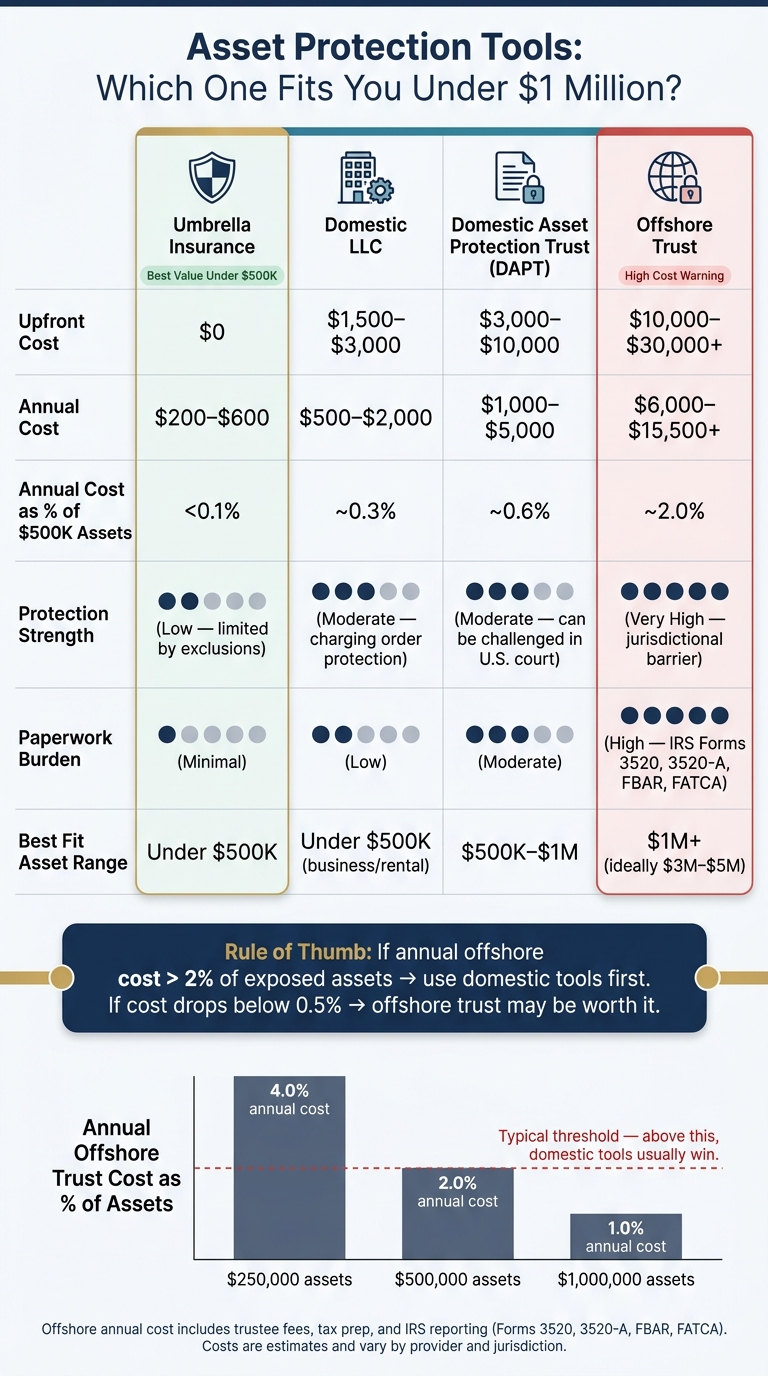
Offshore Trust vs. Alternatives: Cost & Protection Comparison for Under $1M
Comparison table: offshore trust, domestic trust, LLC, and umbrella policy
The main question is pretty simple: does the added protection of an offshore trust justify a fixed yearly bill that can run into the thousands? The best way to judge that is to compare each option by what it protects, not just what it costs.
| Tool | Primary Purpose | Upfront Cost | Annual Cost | Effectiveness | Paperwork Burden | Best Fit |
|---|---|---|---|---|---|---|
| Umbrella Insurance | Pays negligence claims | $0 | $200–$600 | Low (limited by exclusions) | Minimal | Assets under $500,000; low-risk profiles |
| Domestic LLC | Separates business and personal risk | $1,500–$3,000 | $500–$2,000 | Moderate (charging order) | Low | Business owners; rental properties |
| Domestic Asset Protection Trust (DAPT) | Shields personal wealth | $3,000–$10,000 | $1,000–$5,000 | Moderate (can still be challenged in U.S. court) | Moderate | $500,000–$1 million; DAPT-state residents |
| Offshore Trust | Jurisdictional barrier | $10,000–$30,000 | $6,000–$15,500 | Very high (harder for U.S. creditors to reach) | High (IRS Forms 3520, 3520-A, FBAR, FATCA) | $1 million+ assets; high-risk professions |
Annual offshore cost includes trustee fees, tax prep, and reporting.
Simple decision rules by asset level and risk profile
A useful way to think about asset protection is in layers. You don’t jump to the top layer just because it’s there. You move up when the risk and cost line up.
If you have under $250,000 in exposed assets, offshore planning is almost never worth the money. In most cases, umbrella insurance, proper titling, and state-law exemptions like homestead protection do the job at a much lower cost.
For those with $250,000 to $500,000, simpler tools still tend to win on cost. A domestic LLC can add a solid layer for a business or rental property without the steep yearly expense of an offshore setup. A DAPT may make sense only if you live in a DAPT-friendly state and need more protection than insurance provides.
The $500,000 to $1,000,000 range is where things get less clear-cut. This is the gray zone. A DAPT can serve as a middle-ground choice for people with moderate risk. Offshore planning may also deserve a look if you’re in a high-litigation field or run a business that puts more of your assets in the line of fire. By the time you reach $1 million, the annual offshore cost can drop to about 0.5% to 1% of the assets being protected.
A practical filter is to divide your total annual offshore cost by your protectable assets. If that number is above 2%, it’s usually smarter to stick with insurance and domestic tools. If it drops below 0.5%, an offshore trust starts to look like reasonably priced protection. For most readers with less than $1 million, that math still points to insurance and domestic tools first. It’s the cleanest screen for sorting the options.
Conclusion: For most people under $1 million, start with simpler tools and revisit offshore planning later
Using the framework above, offshore trusts can be strong creditor shields. But the cost and compliance work usually make them a poor fit for people with less than $1 million.
For many households, a large umbrella policy covers the most likely risks for a small share of what an offshore trust can cost.
If you have less than about $500,000 in protectable liquid assets, insurance and domestic tools will usually make more sense.
That leads to a pretty practical order of operations for most people under $1 million:
- Max out exemptions
- Add umbrella insurance
- Use an LLC for business or rental risk
- Think about a DAPT if you live in a DAPT-friendly state
For most people under $1 million, that mix is usually enough.
A simple rule of thumb helps here. When offshore planning costs come in under 0.5% of protectable assets, the math starts to make more sense. When the cost is above 2%, simpler tools usually come out ahead. Some advisors do not view offshore economics as compelling until roughly $3 million to $5 million in liquid assets at real creditor risk.
So for most people under $1 million, it makes sense to build the lower-cost layers first, then revisit offshore planning only if the risk and asset base later justify it.
FAQs
How do I know how much of my wealth is actually exposed?
Assess your assets based on your own risk profile, not some generic dollar amount. The goal is simple: look at the assets a creditor could reach most easily – like cash, marketable securities, and LLC interests – and stack those up against your liability exposure.
Your exposure is at its highest when a worst-case judgment could reach personal wealth that sits beyond your insurance, exemptions, or legal structures that keep personal assets separate from business or investment liabilities.
When does a DAPT make more sense than an offshore trust?
A Domestic Asset Protection Trust (DAPT) often makes more sense when your liquid assets fall between $1 million and $3 million.
Why? It usually costs less than an offshore trust. You avoid higher setup and upkeep fees, extra international tax reporting, and the hassle of foreign bank accounts.
A DAPT can also be a better fit if you live in a DAPT-friendly state and want a moderate level of asset protection while keeping your assets inside the U.S. legal and banking system.
What reporting do I have to handle with an offshore trust?
An offshore trust comes with ongoing U.S. tax and information reporting. This isn’t a one-time setup task. Once the trust exists, the reporting keeps going.
In most cases, you’ll need to file Form 3520 for key events tied to the trust, such as its creation, transfers to the trust, and distributions from it. You’ll also generally need Form 3520-A, which serves as the trust’s annual information return.
Other filings can come into play too:
- FBAR may be required if your foreign accounts go over $10,000 at any point during the year.
- Form 8938 may be required if your specified foreign financial assets are above the filing thresholds that apply to you.
This is where people often get tripped up: an offshore trust can trigger more than one filing rule at the same time.
