
If you’re a U.S.-connected crypto holder, an offshore trust can help separate your coins from your personal name – but it does not cut your U.S. tax or reporting duties.
Here’s the short version: I’d view this as an asset-protection and estate-planning tool, not a tax move. It tends to fit people with large crypto positions, lawsuit exposure, cross-border family issues, or succession concerns. It usually costs about $10,000 to $20,000 to set up, plus about $2,500 to $7,000 per year to keep in place. And timing matters a lot: if a claim is already on the horizon, a transfer can be attacked as fraudulent.
Before I’d even look at this route, I’d keep four points in mind:
- Legal ownership changes. The trustee holds title, not you.
- Tax reporting stays. U.S. persons still may need Form 3520, Form 3520-A, FBAR, and Form 8938.
- Setup matters. A trust often works best with an offshore LLC that holds wallets or exchange accounts.
- Paperwork and custody have to match. If the crypto still sits in your personal wallet or account, the structure can fail.
A few facts stand out:
- The Cook Islands is often picked for its long court record.
- Nevis is often picked for lower cost and its $100,000 creditor bond rule.
- Some reporting mistakes can lead to penalties as high as 50% of the unreported account value.
- For many people, this setup is too expensive and too strict to justify.
If I were summarizing the whole topic in one line, I’d say this: an offshore trust may make your crypto harder for private creditors to reach, but only if it’s set up early, funded cleanly, and run like a separate legal structure.
Quick comparison
| Topic | What matters most |
|---|---|
| Main purpose | Asset protection, control transfer, succession planning |
| Not for | Cutting U.S. taxes or hiding assets |
| Best fit | High-value crypto holders with legal or estate risk |
| Top jurisdictions | Cook Islands, Nevis |
| Common structure | Offshore trust + offshore LLC |
| Key risk | Keeping too much personal control |
| Main compliance issue | U.S. trust and foreign account reporting |
| Best timing | Before any claim, lawsuit, or dispute is in sight |
So if you’re thinking about this in 2026, I’d focus on three things first: jurisdiction, control of wallets/accounts, and U.S. compliance. Those three points decide whether the structure helps – or just adds cost and risk.
sbb-itb-39d39a6
Choose the right jurisdiction and legal structure
Once you’ve decided offshore asset protection fits your risk profile, the next step is simple in theory but a lot more serious in practice: where to set it up and how to structure it.
The jurisdiction matters because it shapes how hard a creditor has to push to get at the assets. That’s the core issue. Not the setup fee. Not the sales pitch. What counts is the strength of the trust law, the way local courts handle foreign judgments, and how much friction the statute puts in front of a claimant.
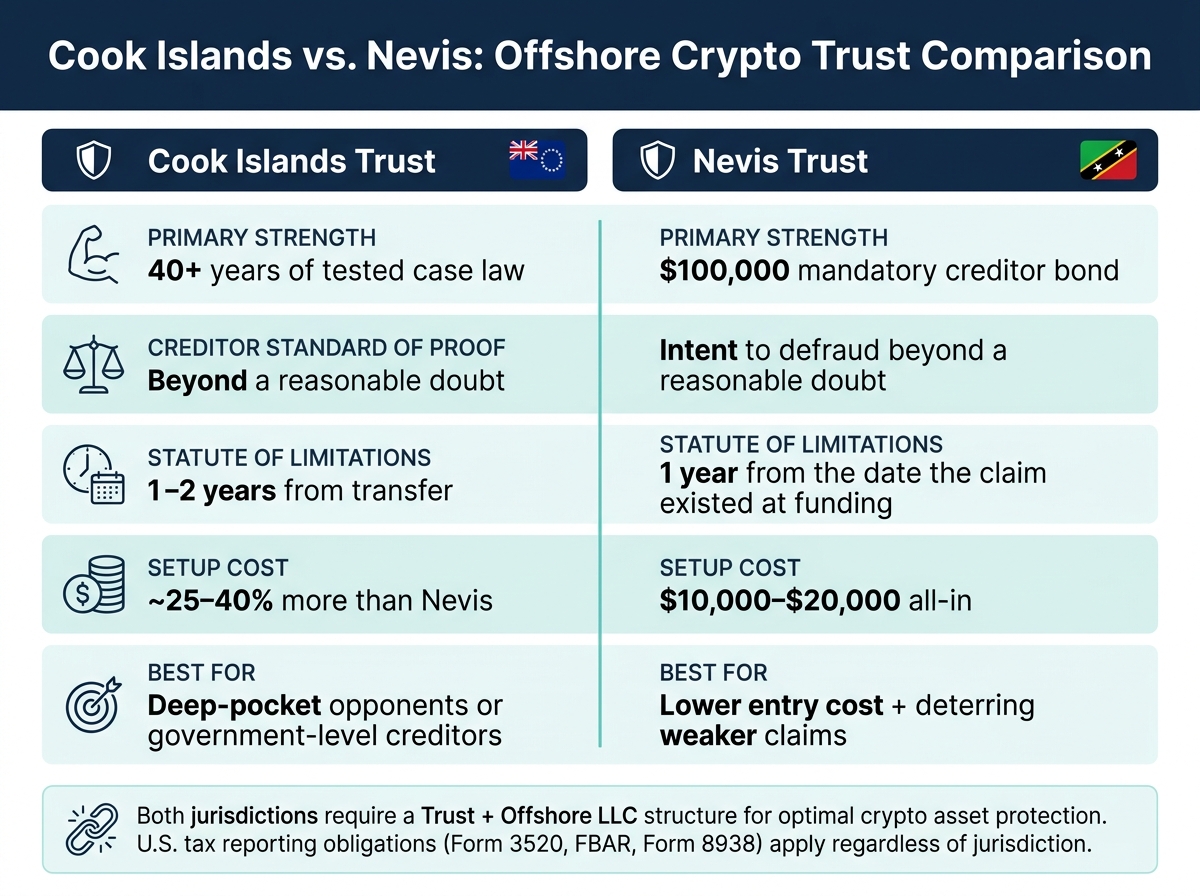
Cook Islands vs. Nevis for crypto trust planning
For Bitcoin, Ethereum, and stablecoins, jurisdiction can affect how fast a creditor is able to challenge wallet control.
The Cook Islands has been a leading asset-protection trust jurisdiction for more than 40 years. Its courts have built up a long body of case law, and licensed trustee companies there manage an estimated $12 billion to $15 billion in assets. That history is a big reason it’s often the first pick when the threat comes from a deep-pocket opponent or even a government-level creditor.
Nevis works a bit differently. A creditor has to post a $100,000 bond with the Nevis Ministry of Finance before filing a claim against a trust. And a U.S. judgment still has to be enforced in Nevis through the local system.
| Feature | Cook Islands Trust | Nevis Trust |
|---|---|---|
| Primary strength | 40+ years of tested case law | $100,000 mandatory creditor bond |
| Creditor standard of proof | Beyond a reasonable doubt | Intent to defraud beyond a reasonable doubt |
| Statute of limitations | 1–2 years from transfer | 1 year from the date the claim existed at funding |
| Setup cost | About 25% to 40% more than Nevis | $10,000 to $20,000 all-in |
A practical way to think about it: Cook Islands is often the choice when tested precedent matters most. Nevis can make sense if you want a lower entry cost and like the built-in cash barrier that can scare off weaker claims.
But jurisdiction is only half the setup. The other half is the legal form itself: should the trust hold the crypto outright, or should it own an offshore LLC that does the holding?
Trust only, or trust plus offshore LLC
Most practitioners use a trust-plus-LLC structure instead of having the trust hold crypto directly.
Here’s how it usually works: the trust owns 100% of an offshore LLC, and that LLC becomes the operating layer. It holds the exchange accounts, wallets, or custody arrangements for the trust. That setup can let the settlor manage the LLC while the trust keeps ownership, which helps keep day-to-day control in place without giving the settlor direct title. If the settlor is forced to act under pressure, a duress clause can shift control to the trustee.
That LLC layer can also make exchange onboarding and account ownership cleaner. But this part can’t be sloppy. The LLC has to function as a separate operating entity. If there’s no real separation from personal activity, a court may view the whole thing as a sham and weaken the protection.
"A wallet secures the assets; a well-structured trust secures the future." – Trust Nevis
After the jurisdiction and entity are chosen, the structure has to be funded the right way and paired with the right custody setup.
Fund the trust and set up custody correctly
Funding and custody are where asset protection stops being theory and starts being real. The trust has to own the asset, and the paperwork has to show that clearly. If a transfer is half-done, or not documented at all, the trust may not protect that asset.
Which crypto assets can go into the structure
Bitcoin, Ethereum, stablecoins, staking positions, DeFi interests, and interests in crypto-related entities can all sit inside the structure.
Each transfer should be documented in the trust deed or through a Deed of Assignment. Any later addition should also be recorded on Schedule A.
Custody models that match trust ownership
Custody needs to line up with legal title. Put plainly: the custody record should match the name that legally owns the asset.
For assets held on centralized exchanges, the account should be opened in the name of the trust or the trust-owned LLC. For self-custody holdings, move the tokens to wallet addresses controlled by the trust structure and log that transfer in the asset schedule.
A 2-of-3 multisignature wallet splits control among three parties instead of leaving everything with one person. For larger holdings, an institutional custodian may add stronger security and fiduciary oversight.
| Custody Method | Trust Alignment | Documentation Required |
|---|---|---|
| Institutional Custodian | High | Account registration in Trust/LLC name; fiduciary access docs |
| Multisig Wallet | High | Key shard distribution agreement; operational memorandum |
| Hardware Wallet | Medium | Documented transfer of title; secure storage of seed phrases |
| Exchange Account | Low/Medium | Corporate account setup; updated KYC/AML for the entity |
The trust deed should also give the trustee clear authority to take part in crypto-native activities like staking, governance votes, and claiming airdrops.
How to avoid title and control mistakes
Even a well-drafted structure can weaken fast if title and control no longer match. If assets stay in a personal wallet or personal exchange account, they remain exposed in that person’s name.
Two common problems show up here:
- Mixing personal and trust transactions
- Failing to document seed-phrase storage and recovery access
That second point matters more than many people think. If no one knows where the recovery details are, or who can use them, the structure may look fine on paper but fail in practice.
A separate operating memo can help. Keep it apart from the trust deed and update it on a regular basis. That memo gives successor trustees the practical steps they need to find and access the digital assets.
Timing matters too. Funding a trust after a legal claim has already come up can be challenged as a fraudulent transfer. Because of that, reputable trustees often ask for a solvency affidavit at the time of transfer to show the settlor remains solvent after moving the assets.
Once the assets are funded and custody is documented, the next issue is keeping the structure compliant and defensible over time.
Stay compliant and know the limits
With custody in place, the setup only holds up if the administration stays clean. An offshore trust isn’t something you set up once and forget. It’s a legal structure that needs steady attention if you want it to keep doing its job.
Ongoing administration and US compliance requirements
For U.S. persons, the reporting duties are mandatory. Form 3520 and Form 3520-A must be filed every year. Foreign financial accounts may also need to be reported on FinCEN Form 114 (FBAR) and IRS Form 8938 (FATCA) if the filing thresholds apply.
The penalty side is where people get burned. Missing these filings can trigger penalties of up to 50% of the unreported account value. And a missed Form 3520 can lead to penalties that cost more than ten years of trustee fees. U.S. persons still report trust income, gains, and any required filings.
Day-to-day administration matters too. In 2026, trustees are often subject to VASP-style AML/KYC rules for the trust’s holdings and transactions. The trust also needs written trustee approvals, current beneficiary records, and up-to-date compliance files. In plain English, the paper trail has to match what the trust is doing.
For that reason, the compliance file should include:
- Source-of-funds records
- Wallet histories
- Exchange statements
- Cost-basis analysis
For high-value structures, review wallet access every year. Periodic "fire drills" are also smart. They help confirm that a successor trustee can actually find and use the multi-signature keys or institutional custody platform if needed. If the trust holds stablecoins, expect more scrutiny around the issuer’s exposure and the custody model in use.
Main risks that can weaken protection
Even perfect paperwork can fall apart if control and timing are off. The most common reason a well-drafted trust fails isn’t some dramatic courtroom attack. It fails because the settlor kept personal control.
Courts and the IRS look for real separation between the settlor and the assets. If the settlor uses trust assets like a personal account, skips trustee approvals, or makes off-the-books decisions, the structure can be treated as a sham trust and lose its protections. That’s the heart of it: if the trust looks fake in practice, the documents won’t save it.
Timing is the other big weak spot. Funding a trust after litigation, divorce, or a tax dispute has become foreseeable can invite fraudulent transfer claims. The setup is strongest when it’s built early, while the settlor is solvent and no legal threats are in sight.
Trustee selection is another risk people often underrate. A trustee without experience in digital assets may mishandle private keys or miss governance deadlines. And once that happens, the damage isn’t just clerical. The whole structure can start to break down when control, records, custody, filings, or timing no longer show real separation.
The trust also needs clear replacement and access rules so assets don’t get stuck if the founder dies or becomes incapacitated.
Conclusion: What crypto investors can realistically expect from an offshore trust
Once the trust is funded and custody is set up the right way, the next issue is simple: what can it actually do for you?
A properly funded offshore trust creates legal distance between you and your crypto. That can make creditor recovery harder, slower, and more expensive. It can also make transfers to beneficiaries smoother, with less probate friction. The upside is stronger creditor resistance and cleaner succession, not immunity.
That protection matters, but it has limits. It stops where U.S. reporting rules and existing claims begin. It does not block criminal enforcement, sanctions, or tax liabilities. And it cannot protect assets from preexisting claims or government enforcement.
In practice, the result depends less on the trust document itself and more on how well the whole setup is carried out. Papers alone don’t protect anything. Protection breaks down when the trust is funded too late, custody is loose, or records are missing.
Build it early, line up custody with legal ownership, and keep records up to date. Built with care, it can last. Built sloppily, it falls apart.
FAQs
Can I still control my crypto after moving it into an offshore trust?
Yes, but the type of control shifts so the legal shield stays in place.
In many setups, the trust owns an underlying offshore LLC, and you serve as its manager. That means you handle the day-to-day investment calls, even though the trust sits at the top of the structure.
For added security, investors often use multi-signature wallets, with keys split among different parties, including you and the trustee. If a legal threat comes up, the trustee can remove you as manager to help protect the assets.
What happens if my crypto stays in a personal wallet or exchange account?
If cryptocurrency stays in your name on a U.S.-based exchange or in a wallet that can be traced back to you, it can be reached in personal legal disputes.
That means it may be exposed to:
- personal liabilities
- creditor claims
- divorce proceedings
Once the crypto is linked to your identity, a court can step in. It may order you to disclose your private keys, freeze exchange accounts through third parties, or force a transfer.
If you refuse, the risk gets serious. A judge can hold you in contempt of court, and other assets may be taken to cover the crypto’s value.
How do I know if an offshore trust is worth the cost for my situation?
It depends on three things: your asset base, your level of risk, and how willing you are to deal with compliance year after year.
Offshore trusts usually fit best when you have a high-six- to seven-figure portfolio and want strong, preemptive protection from future lawsuits, creditor claims, or inheritance disputes.
They can make sense if your risk is meaningful and you can justify $10,000 to $25,000 in setup costs, plus $2,500 to $7,000 per year after that. If your portfolio is smaller, those fees can eat up too much of the upside.
