
A charging order usually lets a personal creditor take only your LLC distributions – not your voting rights, management power, or the LLC’s bank account. That’s the short answer.
If I boil it down, here’s what matters most:
- It applies to your personal debt, not the LLC’s debt
- It targets payout rights, not control rights
- It does not force the LLC to make distributions
- State law can change the outcome a lot
- Single-member LLCs often get less protection than multi-member LLCs
- A strong operating agreement and entity setup can help limit damage
A simple example: if you owe $500,000 personally and your LLC has $1,000,000 in cash, the creditor usually cannot just take the LLC’s money. They may get a court order that sends your future distributions to them. If the LLC pays $0, the creditor may get $0 for the time being.
Quick comparison
| Issue | What usually happens |
|---|---|
| Personal creditor sues you | Creditor may ask for a charging order |
| LLC cash and property | Usually off-limits to that creditor |
| Your distributions | Can be redirected to creditor |
| Voting and management rights | Creditor usually does not get them |
| Single-member LLC | Protection may be weaker |
| Multi-member LLC | Protection is often stronger |
| State law | Can decide whether creditor is limited to distributions only |
In plain English, I’d say a charging order is a legal tool that helps keep a personal creditor from stepping into your business. But it is not a magic shield. The level of protection depends a lot on where the LLC was formed and how it was set up before any claim showed up.
sbb-itb-39d39a6
What a charging order is and how it works
The split between economic rights and control rights matters here. A charging order lets a creditor reach only the economic side. In plain English, it’s a court order that puts a lien on a member’s right to receive distributions and liquidation proceeds, so those payments go to the creditor instead.
The basic legal mechanics
Here’s the usual path: a creditor first wins a personal judgment, then asks the court for a charging order. If the court grants it, the LLC must send that member’s distributions to the creditor until the judgment is paid off.
That said, a charging order does not make the LLC issue distributions. If the managers decide to keep earnings inside the business, the creditor gets nothing until the LLC actually makes a distribution.
What the creditor gets and what the creditor does not get
The creditor gets access only to distributions the LLC actually pays out. That’s it.
The creditor does not become a member. They do not get voting power, management authority, or a seat at the table for business decisions. They also cannot inspect the company’s books or take LLC-owned assets.
There’s also a tax issue for creditors often called the "tax torpedo." Because LLCs are pass-through entities, income may be assigned on a K-1 even when no cash is distributed. That can leave the creditor owing tax on income they never received, which may push them to settle for less than the full amount owed.
Example: a $500,000 personal judgment against one member
Say Sarah has a $500,000 personal judgment against her, and the LLC has $1,000,000 in cash. You might think the creditor can just grab the LLC’s money. They can’t.
Instead, the creditor gets a charging order against Sarah’s LLC interest. If the LLC later distributes $50,000 to Sarah, that $50,000 goes to the creditor. But if the LLC keeps the cash in the business to buy new equipment, the creditor gets $0 and has to wait. Meanwhile, the LLC keeps running under the same management as before.
But how much protection this gives depends on state law and other LLC secrets to keep your assets safe.
How charging orders protect LLC assets and business control
A charging order helps shield the LLC because a personal creditor gets only a claim on a member’s distributions, not a claim on the company’s assets. That’s the key line here: the creditor can reach the member’s economic interest, but not step into the day-to-day life of the business.
Why a personal creditor cannot easily reach LLC assets
A membership interest does not let a creditor grab company bank accounts, take equipment, or sell LLC real estate. It gives the creditor access to distributions tied to that member’s interest and little else. Put simply, the creditor is looking at the member’s payout stream, not the LLC’s property.
That also means a creditor can’t seize company assets or take control of the business. In states with stronger LLC protection rules, the charging order is the creditor’s only remedy against the LLC interest. Courts in those states can’t allow foreclosure on the member’s interest or order liquidation of company assets.
Why management control stays with the LLC
A charging order gives a creditor a right to distributions. That’s it. No voting power, no management rights, and no power to force liquidation. The other members stay in charge, and the company can keep operating without a creditor stepping into the driver’s seat.
There’s another layer to this. Managers often still decide whether distributions will be made at all. If the operating agreement says distributions are discretionary, the LLC may keep profits in the business instead of paying them out. In that case, the creditor may have a claim on distributions but no actual cash coming in. How much protection that gives depends on state law.
Limits of charging order protection and why state law matters
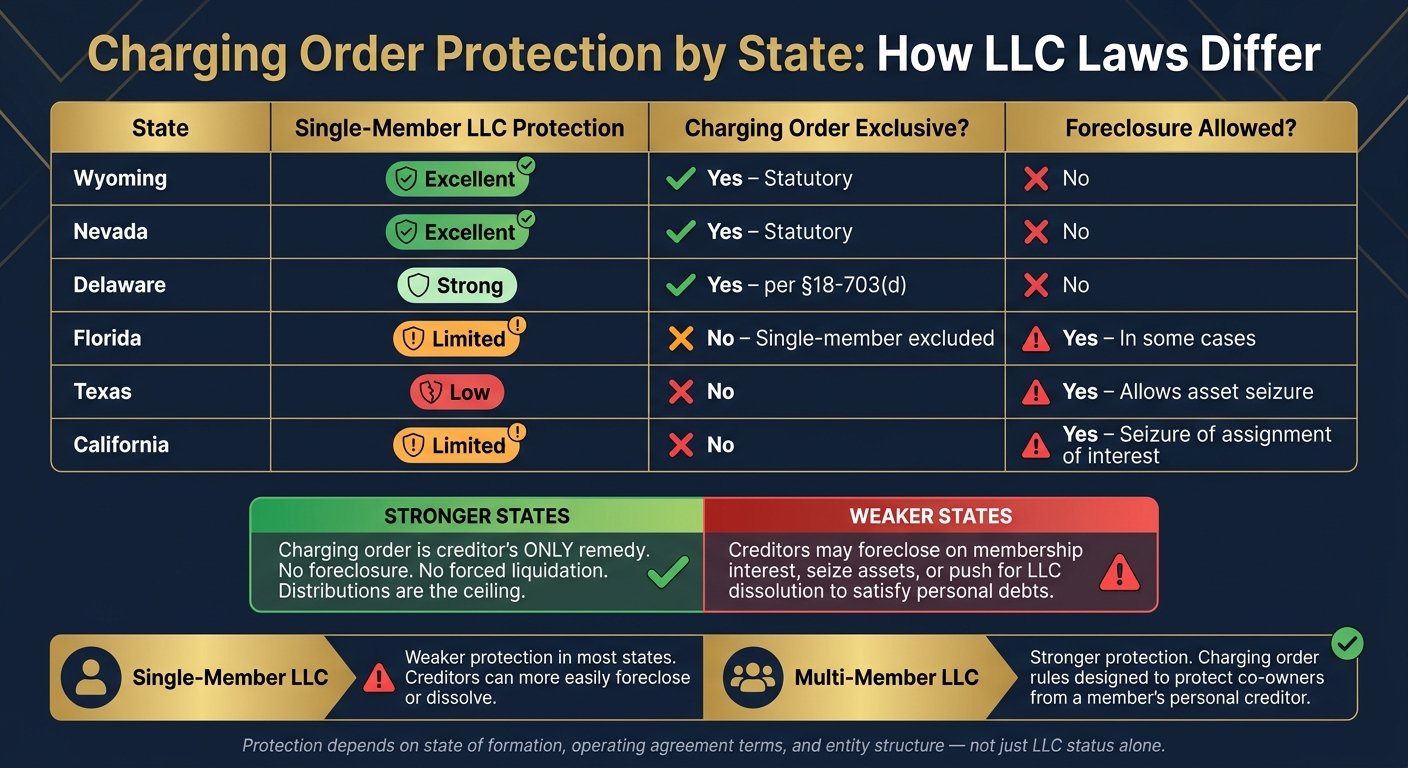
Charging orders can help protect an LLC interest, but they don’t put a force field around everything. State law draws the line, and that line isn’t the same everywhere.
What charging orders do not protect
A charging order lets a creditor reach distributions tied to a member’s LLC interest. It does not hand that creditor ownership control. And it does not give them direct access to the LLC’s assets.
Just as important, a charging order only deals with a member’s interest in the LLC. It does not shield assets you own in your own name.
There’s another limit people often miss: a charging order does not erase the LLC’s own debts. If the company gets sued over a slip-and-fall, a broken contract, or a similar claim, creditors can still pursue the LLC’s assets.
In states with weaker charging order rules, the risk goes further. A court may allow foreclosure on the membership interest or order dissolution and liquidation of the LLC to satisfy a personal debt. Other collection tools can still come into play too, including tax liens, bankruptcy, forfeiture, and certain support claims.
That leads to the next issue: whether the LLC has one owner or more than one. That detail can change the level of protection in a big way.
Single-member vs. multi-member LLC treatment
Multi-member LLCs usually get stronger charging order protection than single-member LLCs. The basic idea is pretty simple. Charging order rules were shaped, in part, to keep creditors from forcing their way into a business with other owners. When there’s only one owner, that concern carries less weight.
Because of that, creditors of a single-member LLC can often get around charging order limits more easily. In some states, they may be able to foreclose on the membership interest or ask the court to dissolve the company.
Some states have closed part of that gap by statute. Wyoming, Nevada, Delaware, Alaska, and South Dakota have amended their LLC laws to extend charging order protection to single-member LLCs.
So the key issue isn’t just whether charging order protection exists. It’s whether state law treats that remedy as the creditor’s only option or just the first stop.
Stronger vs. weaker charging order jurisdictions: a comparison
Where you form your LLC can make a major difference. In a stronger state, a charging order is often the creditor’s only practical remedy. In weaker states, creditors may have more room to pressure the LLC or go after more than distributions.
| Jurisdiction | Single-member LLC protection | Charging order exclusive? | Foreclosure Allowed? |
|---|---|---|---|
| Wyoming | Excellent | Yes (Statutory) | No |
| Nevada | Excellent | Yes (Statutory) | No |
| Delaware | Strong | Yes (per §18-703(d)) | No |
| Florida | Limited | No (for single-member LLCs) | Yes (in some cases) |
| Texas | Low | No | Yes (allows asset seizure) |
| California | Limited | No | Yes (seizure of assignment of interest) |
In plain English, state choice can decide whether a creditor is stuck waiting for distributions or can push much further. That makes entity design a big part of the picture.
How to structure an LLC to get more from charging order protection
Choose the right state and draft a strong operating agreement
State law sets the upper limit on charging-order protection. After that, structure does the heavy lifting. That’s why many owners choose a state with exclusive charging-order protection, such as Wyoming, Nevada, or Delaware.
Once you choose the state, the operating agreement does most of the work. A plain template from the internet usually won’t cut it. The agreement should make clear that distributions are made only at the manager’s discretion and are never required, require unanimous consent before any membership interest can be transferred, and block a judgment creditor from taking part in management or voting.
Those terms matter for a simple reason: they give the LLC a cleaner legal position before a creditor shows up.
The agreement can also be drafted in a way that leaves the creditor with taxable income on paper but no cash distribution.
Use separate entities for separate assets
If the owner has more at stake, one LLC often shouldn’t hold everything. Putting separate assets in separate entities helps contain the damage. Instead of giving a creditor access to the whole business, it limits them to one slice of value.
A common setup is a Wyoming holding LLC that owns the membership interests of separate operating LLCs. That way, a problem in one entity does not automatically put assets in another entity on the table.
Some high-net-worth owners also combine LLC interests with a domestic asset protection trust in states like Nevada or Wyoming to add another layer of statutory protection.
Here’s why that setup can matter in plain English:
Jennifer, a construction company owner, split her business into three entities: an operating LLC, an equipment-holding LLC, and a property-holding LLC. When a subcontractor sued the operating LLC, the creditor could only reach the operating company’s minimal accounts receivable. The $500,000 in equipment and real estate sat in legally separate entities and remained out of reach.
That’s the big idea. If one part of the business gets hit, the rest may stay fenced off.
Conclusion: what charging orders can and cannot do
Charging-order protection works best when state law, entity structure, and the operating agreement line up. One without the others leaves gaps.
Timing matters too. Set the state, agreement, and entity structure before any claim arises. Asset-protection setups put in place at least one to two years before any claim are treated more favorably than transfers made after a lawsuit is filed or a judgment is entered, which can be challenged as fraudulent transfers.
FAQs
Do I need a court order first?
Yes. A creditor has to get a court judgment against the debtor first. After that, the creditor must ask the court for a charging order against the debtor’s LLC or partnership interest.
That step isn’t optional. The creditor also can’t go straight to the LLC and take its assets without court approval.
Can a creditor force my LLC to make distributions?
Generally, no. A charging order gives a creditor only the right to receive distributions if and when the LLC decides to make them.
It does not give the creditor management, voting, or control rights. So they can’t force payments, liquidate assets, or tell the business what to do. In most cases, the LLC can keep earnings in the business while day-to-day operations continue as usual.
How can I strengthen charging order protection?
Strengthen charging order protection before any legal threat shows up. The timing matters. Once trouble is on the horizon, last-minute moves can look suspect and create legal problems.
Multi-member LLCs often provide stronger protection than single-member LLCs. If you have a single-member LLC, states like Wyoming may offer a better setup.
A few structuring choices can help:
- Use a strong operating agreement
- Keep distributions discretionary
- Restrict transfers
- Consider a holding company or irrevocable trust
Just as important, follow corporate formalities and avoid late transfers. Paperwork and timing can make all the difference here.
Because charging order rules vary by state, talk with legal counsel about the laws where your LLC is formed and where it does business.
