
A Wyoming LLC can help protect your personal assets from business debts and can limit what your personal creditors can get from your LLC interest. But it does not stop personal guarantees, fraud claims, federal tax liens, bankruptcy risks, or bad recordkeeping.
If I had to boil this down, I’d say this:
- Wyoming is strong for single-member LLC asset protection
- It keeps owner names off public filings
- It has a low annual state fee: at least $60
- It often makes sense for holding companies, IP, and multi-state structures
- It often does not make sense for a small local business that already operates in one state
- If I ignore formalities, the shield gets weak fast
Here’s the short version you can use right away:
- If you run a local active business, I’d usually look at a home-state LLC
- If you hold assets across states, a Wyoming holding LLC may fit better
- If you want privacy plus stronger single-member charging-order rules, Wyoming often beats many states
- If you are a non-U.S. owner, I’d check estate tax and Form 5472 issues before filing
A few numbers stand out:
- $100 state filing fee
- $60 minimum annual report fee
- $100 to $300 per year for many registered agents
- $25,000 minimum penalty risk for missed Form 5472 filings in some foreign-owned cases
- $60,000 U.S.-situs estate-tax threshold for many nonresident non-citizens
Quick comparison
| Option | Privacy on public filing | Single-member creditor rules | Annual state cost | Best fit |
|---|---|---|---|---|
| Wyoming LLC | High | Strong | $60 minimum | Holding assets, privacy, layered structures |
| Home-state LLC | Often lower | Varies by state | Varies | Active local business |
| New Mexico LLC | High | Less clear | $0 | Low-cost privacy |
My take: Wyoming works best when you want a clean split between you and the asset, and you’re willing to keep the paperwork straight. If not, the extra filing may just add cost.
Let’s get into what it can protect, where it falls short, and when it’s worth using.
sbb-itb-39d39a6
The legal protections that make Wyoming LLCs attractive
Building on the inside/outside liability split, Wyoming stands out because its statutory shield is strong on both fronts.
Charging order protection and the exclusive remedy rule
Under W.S. § 17-29-503, a charging order is the exclusive remedy a personal creditor can use against your LLC interest, and Wyoming makes that rule apply to single-member LLCs too. In plain English, that means a creditor can only collect distributions that would have gone to you. They can’t take the LLC’s assets, can’t take the membership interest itself, can’t vote on company matters, and can’t force the LLC to distribute money.
That last part matters a lot. The manager controls distributions. So if profits stay in the business instead of being paid out, the creditor may just sit and wait. In some cases, a creditor can even owe tax on allocated income without getting any cash. That’s one reason this remedy can be so aggravating for creditors in practice. Many end up leaning toward settlement instead of dragging out the fight.
There is one big exception: bankruptcy. In a Chapter 7 bankruptcy, a trustee may be able to reach single-member LLC assets despite Wyoming’s state charging-order rules. Federal tax liens and criminal forfeiture orders also get around charging-order protection.
Privacy, anonymity, and nominee structures
Wyoming does not require member or manager names to appear in the Articles of Organization. So in most cases, public filings do not show who owns or runs the LLC.
Some owners add another layer by using a nominee manager. That’s a trusted third party listed in public records instead of the actual owner. It creates more distance between your name and the entity. Wyoming still requires a registered agent with a physical Wyoming address, and hiring a professional registered agent when you form the LLC can help keep your home address off public records.
That said, this privacy has limits. It does not block IRS reporting, bank KYC checks, or court subpoenas. Your operating agreement and ownership records still need to show the real setup.
Where protection fails: veil piercing, personal guarantees, and other limits
The shield is not automatic. Courts can pierce the veil if they decide the LLC is just the owner’s alter ego. Common red flags include:
- Mixing personal and business funds
- Paying personal bills from the LLC account
- Not keeping a written operating agreement
- Leaving the LLC undercapitalized for the risks it takes on
Personal guarantees are another weak spot. If you sign one for a loan or line of credit, that deal can reach your personal assets no matter how the LLC is set up.
Timing matters too. Asset protection usually does not work backward. If you move assets into an LLC after a creditor claim is already on the horizon, a court may treat the transfer as a fraudulent conveyance.
There’s also a basic compliance issue that trips people up. Missing annual reports can lead to dissolution after a 60-day grace period, and losing good standing can weaken the liability shield until the LLC is reinstated.
Those limits explain why the next section looks at where a Wyoming LLC works best.
When a Wyoming LLC works well and how people use it
A Wyoming LLC tends to work best when the setup fits the asset, the state where the business or property actually operates, and the owner’s risk level. That’s the key idea.
In plain English: the best setups split ownership where it helps, without piling on extra paperwork. Once you look at it that way, the next move is pretty simple. Figure out which assets and business models gain something from that split, and which ones don’t.
Rental property, investment holdings, and brokerage-held business interests
Real estate investors often put a Wyoming holding LLC on top of separate property LLCs. That can help isolate risk. But there’s a catch: the state where the property sits still runs the show on local registration, taxes, and landlord rules. A Wyoming entity can protect the ownership interest in the property-owning LLC, but it does not directly protect the real estate itself.
That distinction matters more than people think. It’s a bit like putting a lock on the control box, not on the building.
Things can get more complicated when international ownership is in the mix. Even if the U.S. asset-protection plan looks sound, nonresident owners still need to watch for U.S. estate-tax exposure on U.S.-situs assets. A Wyoming LLC, by itself, does not fix that issue. In some cases, a blocker structure is still needed.
Intellectual property and online business structures
A Wyoming LLC can also hold intellectual property like domains, trademarks, software, or copyrights. The LLC can then license those assets to the operating company under a written agreement with market-based terms. That setup can work well, but only if the entities are kept separate in real life, not just on paper.
That means:
- Separate bank accounts
- Written intercompany agreements
- No mixing of funds or day-to-day operations
If those lines start to blur, the whole setup gets weaker.
Online sellers and remote business owners often like Wyoming for privacy and lighter admin work. For businesses that run across state lines or live mostly online, that can make the structure more appealing.
When a Wyoming LLC is the wrong choice
Sometimes a Wyoming LLC helps. Sometimes it’s just extra cost with a fancy label.
If a business has employees or active operations in one state, forming in Wyoming often means paying for Wyoming and paying to register as a foreign entity in the home state. At that point, the extra filing may add cost without adding much protection.
The same goes for a simple local business with no major privacy concerns, no major assets to shield, and no out-of-state activity. In that case, a Wyoming LLC usually doesn’t earn its keep. Put another way, this is mostly a cost-versus-benefit call: low-risk local operations usually don’t need the extra layer.
| Situation | Better Choice |
|---|---|
| Local business, one state, low liability risk | Home-state LLC |
| Multi-state real estate portfolio | Wyoming holding LLC + local operating LLCs |
| IP separation from operating business | Wyoming IP-holding LLC with formal license |
| Non-resident with significant U.S. investments | Wyoming LLC + foreign corporation blocker |
Wyoming LLC vs. home-state LLC vs. New Mexico LLC
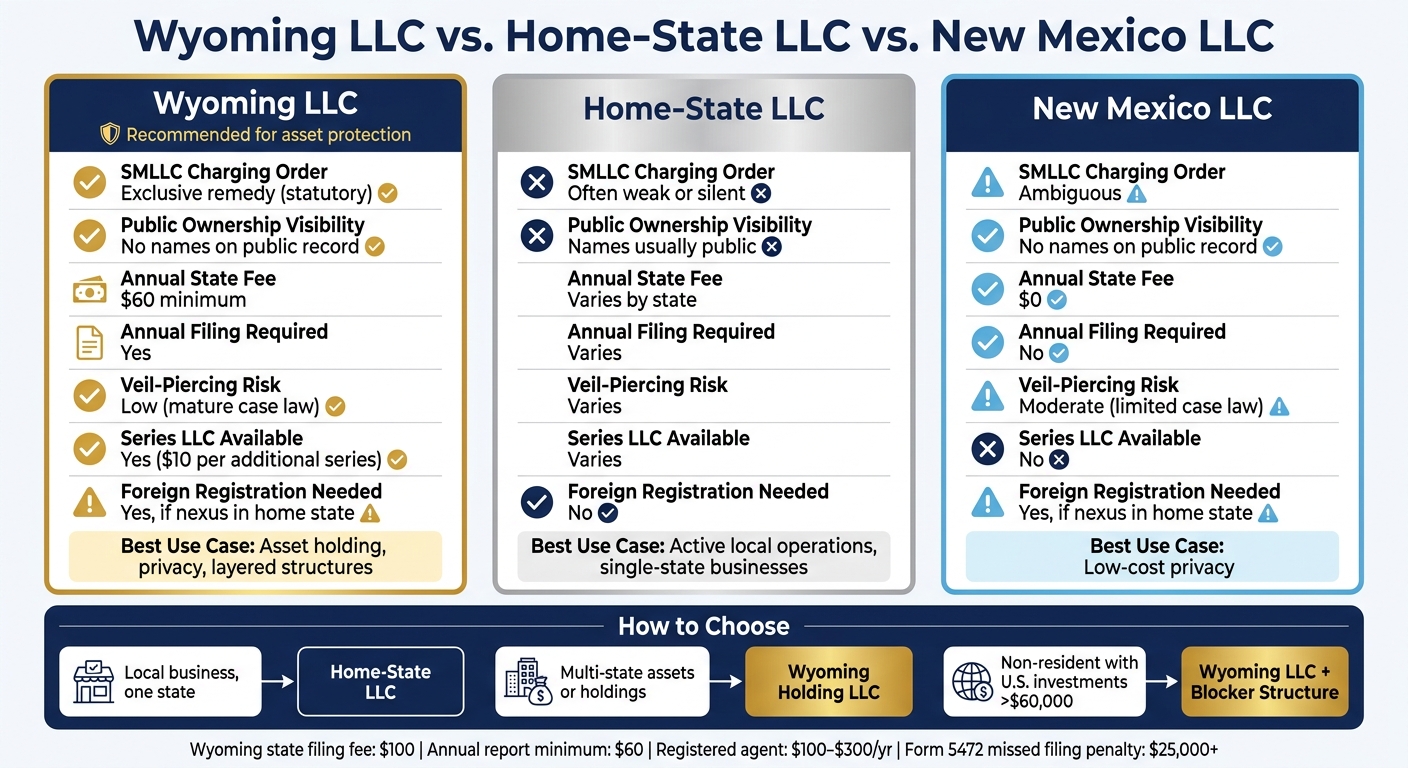
Once you know Wyoming fits your asset type, it helps to stack it up against the two options most people look at next: a home-state LLC and a New Mexico LLC. The honest answer comes down to three things: how much legal protection you want, what you want to pay each year, and where the business actually does its work.
Wyoming LLC vs. home-state LLC
The biggest differences come down to charging-order strength, privacy, and yearly cost. Wyoming gives single-member LLCs stronger charging-order protection by statute and keeps ownership details off public filings. Most home states don’t offer both.
Wyoming keeps member and manager names off the public record. In many home states, those names are usually visible. On top of that, most home states do not clearly say that a charging order is the exclusive remedy for a single-member LLC. Wyoming does.
There’s a catch, though. If the business is run in your home state, a Wyoming LLC will often mean a second filing layer and extra fees. For a California-based business, that can mean $60 in Wyoming fees plus California’s $800 franchise tax each year.
| Factor | Wyoming LLC | Home-State LLC |
|---|---|---|
| SMLLC charging order | Exclusive remedy (statutory) | Often weak or silent |
| Public ownership visibility | No names on public record | Names usually public |
| Annual state fee | $60 minimum | Varies |
| Foreign registration needed | Yes, if the LLC has nexus in your home state | No |
| Best use case | Asset holding, privacy | Active local operations |
Wyoming LLC vs. New Mexico LLC
Both states keep member names off public records, so privacy is about the same. The main split is cost and how clear the legal outcome is likely to be.
Wyoming requires an annual report. New Mexico does not. New Mexico also has no annual fee, while Wyoming charges a $60 minimum. But New Mexico’s single-member LLC creditor-remedy law is less settled than Wyoming’s, which makes the charging-order result less predictable.
If your main goal is simple privacy at the lowest cost, New Mexico can make sense. If the asset has real value and you care about more certainty around charging-order protection, Wyoming tends to be the better fit.
| Factor | Wyoming LLC | New Mexico LLC |
|---|---|---|
| SMLLC charging order | Exclusive remedy (statutory) | Ambiguous |
| Annual state fee | $60 minimum | $0 |
| Annual filing required | Yes | No |
| Veil-piercing risk | Low (mature case law) | Moderate (limited case law) |
| Series LLC available | Yes ($10 per additional series) | No |
| Best use case | Asset holding, SMLLCs | Low-cost privacy |
How to pick the right structure for your risk and wealth goals
Most people land on one of three paths.
- Path 1: Single home-state LLC. If you run a local business with employees, a storefront, or real estate in one state, form the LLC there. In that setup, adding Wyoming often means more fees without much extra protection for an active operating business.
- Path 2: Wyoming holding LLC above operating entities. If you hold multiple assets, properties, or business interests across states, a Wyoming LLC can sit on top as the holding company. This is usually where the added cost starts to make sense.
- Path 3: Wyoming LLC paired with other planning tools. Higher-net-worth owners may use a Wyoming LLC with a blocker structure to deal with U.S. estate-tax exposure on U.S.-situs assets. For non-resident aliens, the U.S. estate-tax threshold for U.S.-situs assets is only $60,000, so this issue is worth dealing with early.
After you choose the structure, the next move is getting the formation, compliance, and recordkeeping right.
Formation, compliance, costs, and final decision points
How to set up and maintain a Wyoming LLC correctly
If Wyoming comes out ahead on risk, cost, and privacy, the next step is simple: set it up the right way. Once Wyoming is the fit, the way you handle formation and upkeep decides whether the liability shield stands up.
Start by filing Articles of Organization with the Wyoming Secretary of State, naming a registered agent, getting an EIN, and opening a dedicated business bank account before moving any funds. Wyoming does not list members or managers on the state filing, which keeps filing-level privacy in place. The state filing fee is $100.
The operating agreement is where a lot of the protection is either built or lost. It should be a bespoke agreement with exclusive-remedy language, manager-controlled distributions, and transfer limits that prevent creditor substitution. A custom agreement usually costs a few thousand dollars.
You also need to stay current after formation. Wyoming requires an annual report, and the minimum fee is $60 each year. If you use a professional registered agent, plan on about $100 to $300 per year.
For foreign-owned single-member LLCs, there is one area where mistakes get expensive fast. If there are reportable transactions, the LLC must file Form 5472 with a pro forma Form 1120. Missing that filing brings a $25,000 minimum penalty. If international ownership is part of the picture, deal with that before formation as part of cross-border planning.
That matters because even basic recordkeeping mistakes can tear holes in the structure.
Common mistakes that destroy asset protection
Most breakdowns happen because of bad administration, not because Wyoming law fails.
The biggest problem is commingling personal and business money. That is the fastest way to hand a creditor an argument for piercing the corporate veil. Use a dedicated business account, and keep about 10% to 20% of annual expenses in the company as working capital so the LLC does not look undercapitalized.
Timing is just as important. If you move assets into an LLC after a legal claim is already on the horizon, a court may treat that move as a fraudulent transfer and unwind it. Put the structure in place one to two years before any claim shows up. Missing the annual report deadline can also weaken the setup. Wyoming gives a 60-day grace period before administrative dissolution.
Once the structure is in place, the last call is whether the assets at stake justify the extra paperwork and discipline.
Conclusion: key questions to answer before using a Wyoming LLC
Wyoming’s main advantages are charging-order exclusivity, filing-level privacy, and low yearly upkeep. This setup works best for asset holding, passive income, and layered structures, but only if formation, records, and compliance match the plan. The inside/outside liability shield works only when the LLC is treated as a separate entity in practice, not just on paper.
Before forming, check these three points:
- Existing creditor exposure. If a claim is already foreseeable, get legal counsel before moving any assets.
- Nexus in another state. If the LLC will operate there, include foreign registration costs and that state’s rules in the math.
- Nonresident U.S.-situs estate-tax exposure. If U.S.-situs assets are more than $60,000, a blocker structure should be part of the discussion before formation.
FAQs
Do I need to register in my home state too?
It depends on where you do business.
If your LLC has major business activity, a physical location, or employees in a state other than Wyoming, that state will usually require foreign registration.
Skip registration when it’s required, and you could run into penalties or legal trouble. On the other hand, if your activity is limited or not tied to one state, registration may not be needed.
Can a Wyoming LLC protect my rental property?
Yes, but only up to a point. A Wyoming LLC puts a line between your rental property and your personal finances, which can help shield your home and savings from liabilities tied to the property.
What it does not do is shield the property from claims against the property itself. If that property gets sued, the assets inside that LLC can still be on the line.
That’s why many investors put each property in its own LLC. It’s a simple way to keep one problem from spilling over into another property.
What mistakes can void Wyoming LLC asset protection?
Several mistakes can weaken Wyoming LLC asset protection:
- Commingling funds, or not keeping a separate business bank account
- Inadequate capitalization
- Fraudulent transfers to avoid known creditors or litigation
- Failing to follow formalities, or acting as the LLC’s alter ego
- Criminal conduct involving LLC assets
