
If I want the short answer: the best low-tax picks in 2026 are the UAE, Panama, Paraguay, Costa Rica, and – only for a small group – Portugal. But as a U.S. citizen, I still file with the IRS no matter where I live.
Here’s the part that matters most:
- UAE: 0% personal income tax, but high living costs and no foreign tax credits above the FEIE cap
- Panama: taxes local income, not most foreign income, with a strong fit for retirees and remote workers
- Portugal: no longer a tax play for most people after NHR closed; still worth a look for some tech and research workers
- Paraguay: very low-cost option with territorial tax, but weaker infrastructure
- Costa Rica: strong lifestyle pick with a best digital nomad visas and local tax breaks on foreign-source income
I’d look at these countries based on how I earn money:
- Salary or freelance income: FEIE can matter a lot
- Dividends, interest, capital gains, rental income: the IRS can still tax those
- Self-employment income: I may still owe 15.3% U.S. self-employment tax in places without a totalization agreement
And I’d keep these U.S. rules in mind from day one:
- 2026 FEIE: up to $132,900
- FBAR: file if foreign accounts top $10,000 at any point in the year
- Form 8938: may apply from $200,000 abroad for single filers
- State tax risk: states like California, New York, and Virginia may still try to tax me if I don’t break domicile
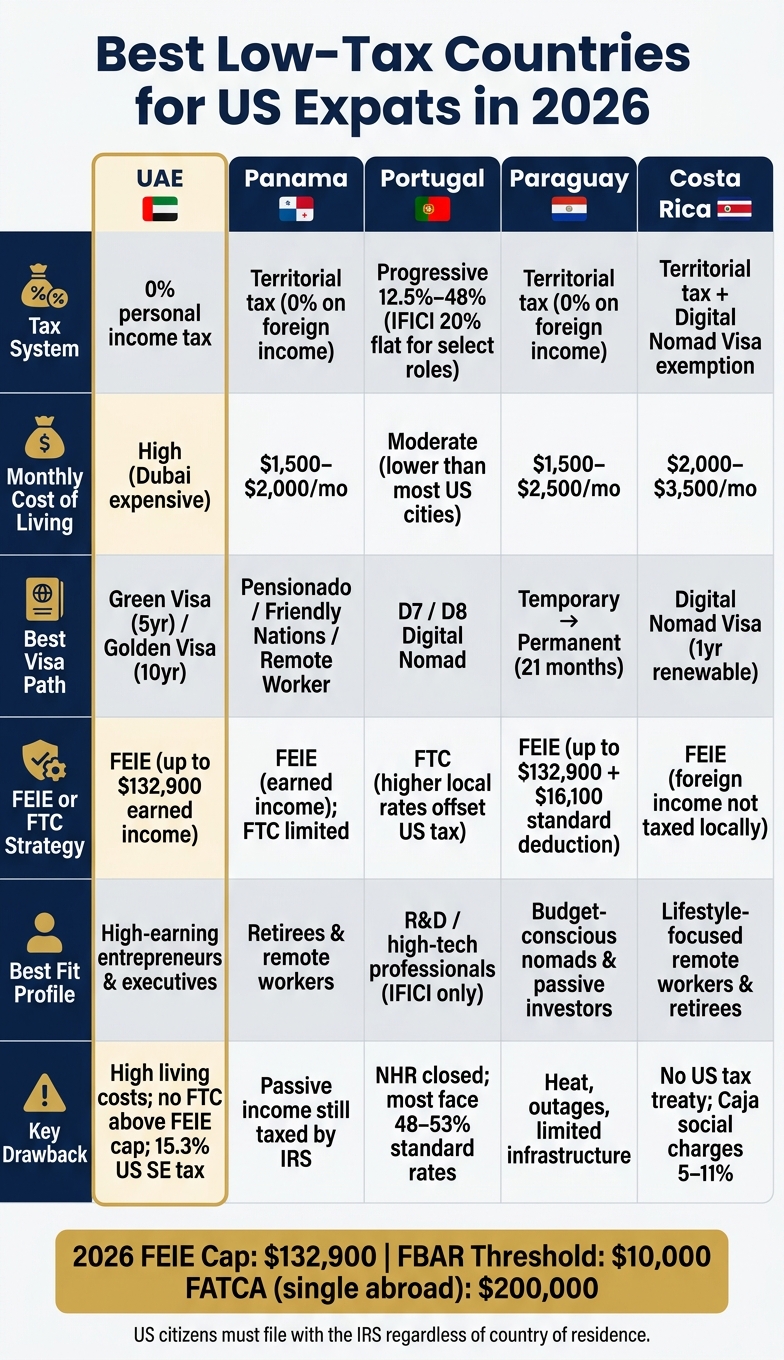
Quick Comparison
| Country | Local tax setup | Main fit | Main drawback |
|---|---|---|---|
| UAE | 0% personal income tax | High earners, founders, executives | High costs; no FTC cushion above FEIE |
| Panama | Territorial tax | Retirees, remote workers, foreign-income earners | Passive income still taxable by IRS |
| Portugal | Higher standard tax rates; IFICI for limited roles | Tech/research workers who qualify | No broad low-tax path for most new expats |
| Paraguay | Territorial tax | Budget-minded nomads, investors | Heat, outages, lighter infrastructure |
| Costa Rica | Territorial tax | Remote workers, retirees | U.S. tax still follows you; social charges can apply |
My bottom line: if I want the lowest headline tax, I’d start with the UAE. If I want a lower-cost base, I’d look at Panama or Paraguay. If I care more about day-to-day living than pure tax math, Costa Rica is a strong option. And if I’m moving to Portugal, I’d treat it as a lifestyle move first, not a tax move.
That’s the frame I’d use before I compare visas, costs, and U.S. filing rules in detail.
sbb-itb-39d39a6
1. United Arab Emirates
The UAE is one of the clearest zero personal income tax options out there. It charges 0% personal income tax on employment income, self-employment income, investment returns, and capital gains.
That setup tends to suit remote workers, consultants, and founders who care more about tax savings than cheap day-to-day living. For income that stays within the FEIE limit, a U.S. expat can owe $0 in UAE tax and $0 in U.S. federal tax on that earned income. In plain English: the UAE can be a very strong pick for high earners who can keep taxable income inside that FEIE range.
There is one catch, and it’s a big one for some people. Since the UAE doesn’t charge personal income tax, there’s no Foreign Tax Credit to use above the FEIE cap. On top of that, self-employed business owners still owe the full 15.3% U.S. self-employment tax on net earnings because the U.S. and the UAE do not have a Social Security Totalization Agreement. So while the income tax side looks great, freelancers and owners need to watch the self-employment piece closely.
For business owners, the UAE also has a 9% corporate tax on profits above AED 375,000 (about $102,000). That said, many Free Zone entities can still qualify for 0%.
On the residency side, there are a few main routes:
| Visa Type | Duration | Main Requirement |
|---|---|---|
| Digital Nomad | 1 year | $3,500/month + foreign employer |
| Green Visa | 5 years | AED 15,000/month or proof of self-employment |
| Golden Visa | 10 years | AED 2 million property or deposit |
| Employment | 2–3 years | Sponsored by a UAE-based company |
For remote workers and founders, that residency route matters almost as much as the tax rate. A country can look great on paper, but if the visa path is a headache, the math changes fast.
Cost is another part of the picture. Dubai is expensive, so the UAE tends to work better for high earners than for budget-minded retirees. Housing, school fees, and private health insurance can push living costs up in a big way. The UAE also offers long-term residency, but for most expats, it does not offer a practical path to citizenship.
The short version: zero tax, higher costs, best fit for high earners.
If lower living costs and an easier residency setup matter more, Panama is the next place to look at.
2. Panama
Panama shifts the focus away from zero tax and toward territorial taxation with lower day-to-day costs. In plain English, Panama taxes only income earned inside Panama. Foreign-source income, like remote work for overseas clients, foreign dividends, and most capital gains, isn’t taxed there.
For U.S. expats, that setup can work well with the FEIE for earned income. The FTC, though, usually doesn’t do much here because Panama generally doesn’t tax foreign-source income. Passive income like dividends, interest, and capital gains still stays fully taxable by the IRS.
Another plus: Panama uses the U.S. dollar, so Americans don’t have to deal with exchange-rate headaches in daily life.
Residency is where Panama gets even more appealing. It has a few clear paths, from a lower-bar remote worker permit to permanent residency through investment.
| Visa Route | Minimum Requirement | What You Get |
|---|---|---|
| Friendly Nations Visa | $200,000 real estate or fixed-term bank deposit | 2-year provisional → Permanent |
| Qualified Investor Visa | $300,000 real estate (until Oct 15, 2026) | Permanent from day one |
| Remote Worker Visa | $36,000 annual income from outside Panama | 9 months, renewable |
| Pensionado Visa | $1,000/month lifetime pension | Indefinite |
Living in Panama City often starts at about $1,500 to $2,000 per month. Healthcare also stands out. Punta Pacifica Hospital in Panama City is affiliated with Johns Hopkins. Put that together, and Panama tends to suit expats who want lower costs than the UAE without giving up too much comfort.
Best fit: remote workers, retirees, and entrepreneurs focused on foreign-source income.
3. Portugal
Portugal used to be a popular pick for U.S. expats because of the Non-Habitual Resident (NHR) program. But that door is now closed to new applicants. The newer IFICI regime is much narrower. It applies only to certain R&D, scientific research, and tech roles. So for most new remote workers, consultants, and retirees, Portugal is no longer a low-tax move. For many Americans, it now makes more sense as a lifestyle choice than a tax move.
If you become a standard resident, Portugal taxes income at progressive rates from 12.5% to 48%, with solidarity surcharges on top, plus uncapped 11% social security on salary. At €100,000 of income, a standard-rate resident faces a total tax and payroll load of about €48,100 per year.
That matters even more for U.S. citizens. The U.S.-Portugal tax treaty has a saving clause, which means U.S. citizens are still subject to U.S. tax. In practice, the Foreign Tax Credit is usually more useful than the FEIE for Americans living in Portugal. Why? Because Portugal’s tax rates are often higher, and the FEIE does not cover dividends, interest, or capital gains. Portugal generally taxes those at a flat 28%. Put simply, Portugal’s local tax bill often eats up much of the FEIE’s appeal, especially when you compare it with places that use territorial taxation.
The main visa paths are still fairly clear:
- The D7 visa is aimed at retirees and people with passive income, with proof of at least €870 per month.
- The D8 digital nomad visa is for remote workers earning at least four times the Portuguese minimum wage, or about €3,480 per month in 2026.
Portugal also has no wealth tax, and inheritance tax is 0% for close family members, though a 10% stamp duty applies to others.
Day to day, Portugal still has a lot going for it. It offers solid infrastructure, public healthcare, and a lower cost of living than many U.S. cities. The catch is simple: the tax upside isn’t what it used to be.
Best fit: lifestyle-driven expats, retirees, and IFICI-qualified tech or research professionals.
If you want a lower-tax option with lighter daily costs, Paraguay is the next comparison.
4. Paraguay
Paraguay mixes territorial taxation with very low living costs by South American standards. For Americans who live mostly on foreign-source income, it’s one of the cleaner low-tax setups. Only income generated inside Paraguay is taxable. Foreign dividends, capital gains on international assets, and interest from offshore accounts are generally exempt from local tax.
That said, there’s one detail you can’t ignore. Remote work for foreign clients is often outside the local tax system, but General Resolution 73/2020 changes the picture if you’re physically in Paraguay while doing the work. In that case, the income can be treated as local-source and taxed at 10%. So this setup tends to work best for people earning from foreign sources, investors, and some remote workers.
For U.S. citizens, the IRS still taxes worldwide income no matter where you live. Because Paraguay usually doesn’t tax foreign-source income, there often aren’t foreign tax credits available to offset your U.S. tax bill on that income. That makes the Foreign Earned Income Exclusion (FEIE) the main federal tax lever. In 2026, the FEIE is capped at $132,900. Add the $16,100 standard deduction for single filers, and a solo earner can shield about $149,000 from U.S. federal income tax.
One catch: self-employment tax is a separate issue. Paraguay and the U.S. do not have a totalization agreement, so the full 15.3% U.S. self-employment tax can still apply.
Residency is fairly simple and not too expensive:
- Temporary residency filing fees run about $350, while legal help usually costs $1,700 to $6,000.
- After 21 months, permanent residency costs about $500 to $700.
- One visit every three years is enough to keep residency active.
The more important piece is the Tax Residency Certificate from the DNIT. Getting one usually means showing solid physical presence or proving that Paraguay is your main center of life. That certificate is the document used to show nonresidency status to the IRS or other foreign tax authorities.
Paraguay is also one of the cheapest places in this group. A couple can live well in Asunción on about $1,500 to $2,500 per month, and one-bedroom apartments in Villa Morra or Carmelitas often rent for $400 to $550 per month.
The tradeoffs are pretty clear. Summers often reach 100 to 108°F, humidity is high, and power outages during peak heat are common enough that it’s smart to ask whether a building has backup power.
Best fit: remote workers, entrepreneurs, and investors who earn mainly from foreign sources and want a very low local tax burden with a low cost of living.
Costa Rica offers a similar lifestyle appeal, but with a different residency and tax profile.
5. Costa Rica
Costa Rica has a setup that looks a lot like other territorial-tax countries, but one thing stands out: the Digital Nomad Visa.
Because Costa Rica uses a territorial tax system, most foreign income is not taxed locally. For many remote workers, that’s the main draw. And the cleanest path is the Digital Nomad Visa, which directly exempts qualifying applicants from local income tax on foreign-source income.
To qualify, you need a minimum monthly income of $3,000 as an individual or $4,000 for a family. The visa is usually valid for one year and can generally be renewed. You also do not need to set up a local company to get that tax exemption.
There is one catch worth noting. Since late 2023, Law 10.381 taxes some foreign passive income held through certain multinational-group entities that fail substance tests. For most individual expats, though, that’s not the main issue. The bigger headache is that U.S. tax rules still follow you, requiring specific tax and residency solutions.
Costa Rica has no tax treaty and no totalization agreement with the United States. So if you’re a U.S. expat, the Foreign Earned Income Exclusion (FEIE) often matters more than the Foreign Tax Credit (FTC) here, since Costa Rica usually does not tax foreign-source income. On top of that, residents should plan for Costa Rican social security payments through la Caja, which are often around 5% to 11% of reported income.
Living costs usually fall between $2,000 and $3,500 per month, depending on where you live and how you like to live.
| Visa Type | Requirement | Best fit |
|---|---|---|
| Digital Nomad | $3,000/mo income ($4,000 family) | Remote workers wanting an explicit local tax exemption |
| Pensionado | $1,000/mo lifetime pension | Retirees with fixed pension income |
| Rentista | $2,500/mo income or $60,000 deposit | Those with stable non-employment income |
| Investor | $150,000 in real estate or business | Investors seeking direct residency |
Best fit: remote workers, retirees, and investors who earn mostly from foreign sources and want a well-established expat community with solid infrastructure. Costa Rica makes a strong lifestyle choice, even if it isn’t the cleanest pure tax move. That tradeoff is what the country-by-country comparison below weighs.
Strengths, weaknesses, and best-fit profiles by country
These five countries fit very different U.S. expat setups. The biggest dividing line is simple: how you make your money. Is it earned income, passive income, or a mix of both? That’s what changes the math most.
Here’s the shortest way to size them up:
| Country | Tax Upside | Key Tradeoffs | Best-Match Profile |
|---|---|---|---|
| UAE | 0% personal income tax on salary, dividends, and capital gains | High cost of living; no path to citizenship; strict legal restrictions | High-earning entrepreneurs and executives |
| Panama | Territorial tax (0% on foreign income); dollarized economy | Spanish needed outside cities; stricter corporate substance rules | U.S. remote workers and retirees |
| Portugal | 20% flat tax for selected research and tech roles | IFICI is very narrow post-2024; general residents face progressive rates up to 48–53% | R&D and high-tech professionals |
| Paraguay | 0% tax on foreign income; very low cost of living | Limited infrastructure; limited English outside major cities; weaker governance | Budget-conscious nomads and passive investors |
| Costa Rica | Territorial tax; Digital Nomad Visa with explicit local tax exemption | Higher VAT and corporate tax than Panama; uneven infrastructure outside major cities | Lifestyle-focused remote workers and retirees |
The UAE stands out most clearly for high earners. If your income is large and active, the 0% personal income tax on salary, dividends, and capital gains is hard to ignore. The catch, of course, is cost. Living there can get expensive fast, and there’s no path to citizenship.
Paraguay sits at the other end of the spectrum. Costs are very low, and foreign income is taxed at 0%. But there’s no free lunch. You give up a lot in day-to-day ease, from infrastructure to convenience to English access outside the main cities.
Portugal is now much more of a narrow-play option. The original NHR program closed in 2024, and the IFICI regime that replaced it is tight enough that most remote workers and retirees won’t fit. For the people who do qualify – mainly selected research and tech roles – the 20% flat tax can still work well. For general residents, though, progressive rates up to 48–53% change the picture pretty fast.
The next layer is how each country lines up with U.S. tax rules. FEIE tends to help most in zero-tax or territorial systems like the UAE, Panama, Paraguay, and Costa Rica. FTC matters more when local tax is high enough to offset U.S. tax, especially for passive income such as dividends, interest, and pensions, since the FEIE does not apply to that income.
2026 takeaway for US expats
Start with your income type.
Once you compare tax rules, residency options, and cost tradeoffs, this is the clearest shortlist.
| Profile | Best Pick | Reason |
|---|---|---|
| High-earning business owner or executive | UAE | 0% personal income tax on salary, dividends, and capital gains |
| Remote worker focused on lifestyle | Costa Rica | Digital Nomad Visa exempts qualifying foreign-source income from local tax |
| Retiree on pension | Panama | Pensionado visa offers residency plus discounts on utilities and healthcare |
| Budget-minded nomad | Paraguay | 0% tax on foreign income; very low living costs |
| R&D or high-tech professional | Portugal | 20% flat rate under IFICI for 10 years if your profession qualifies |
That said, even the best tax country only works if you handle U.S. reporting the right way.
Your tax bill is only one part of the story. U.S. filing rules still follow you abroad. The FEIE can still help, but it only applies to earned income. And two compliance rules trip people up all the time.
- FBAR: You must file FinCEN Form 114 if your foreign accounts go over $10,000 in aggregate at any point during the year
- FATCA: You must file Form 8938 if your foreign financial assets exceed $200,000 at year-end or $300,000 at any point during the year as a single filer living abroad
There’s one more piece many people miss: state taxes. If your former home state still says you’re a resident, it may keep taxing you. States that still claim domicile, such as California, Virginia, and New York, may continue to tax you until you can prove you’ve broken domicile.
FEIE, FTC, FBAR, FATCA, and state domicile rules all shape your final tax bill. Pick the country that fits your income first, then set up the move around U.S. filing rules.
FAQs
Which country is best for my income type?
Because the U.S. taxes citizens on worldwide income, the best option usually comes down to one thing: matching a low-tax or territorial-tax country with the FEIE. In 2026, the Foreign Earned Income Exclusion can exclude up to $132,900 in foreign-earned income.
Here’s the short version:
- UAE: a strong pick for high-income entrepreneurs and investors
- Panama and Paraguay: a good match for remote workers and people earning foreign-source income
- Spain: useful for salaried professionals who can use the Beckham Law
Can I still owe U.S. tax in a zero-tax country?
Yes. The United States taxes its citizens on worldwide income, so moving to a zero-tax country doesn’t make your U.S. filing duties or federal tax bill disappear.
The FEIE can exclude up to $132,900 of earned income in 2026. But it only applies to earned income. It does not cover passive income such as dividends, interest, or capital gains. And if you’re self-employed, self-employment taxes generally still apply.
How do I avoid state tax after moving abroad?
To avoid state tax after moving abroad, you usually need to sever your domicile in that state. In plain English, that means ending your old permanent-home tie there.
If you still keep a home, family, or strong money ties in that state, the state may still treat you as a tax resident. And yes, that can happen even if you’re living overseas.
In most cases, this means setting up a new permanent home somewhere else and keeping records that show you meant to leave for good. Since each state has its own rules, clear documentation matters a lot.
