
If I had to give the short answer: Mexico, Portugal, Spain, Panama, Costa Rica, the UAE, and Singapore are the top picks – but the best one depends on your budget, tax setup, visa path, healthcare needs, and how long you want to stay.
I’d break it down like this:
- Mexico: lowest costs and close to the U.S.
- Portugal: strong safety, lower costs than major U.S. cities, and an EU path
- Spain: strong healthcare and a good fit for remote workers
- Panama: simple residency for retirees and no local tax on foreign income
- Costa Rica: slower pace, public healthcare, and political stability
- UAE: 0% personal income tax, but high living costs
- Singapore: very safe, English-speaking, and a strong base in Asia
A few numbers stand out fast:
- More than 180,000 Americans moved abroad in 2025
- 57% of surveyed Americans said politics was a top reason to leave
- 37% pointed to healthcare
- In 2026, the Foreign Earned Income Exclusion is $132,900
- In many countries, spending 183+ days there can make you a local tax resident
The big point: moving abroad can cut living costs and change your lifestyle, but it does not end your U.S. tax filing. And in many cases, the visa that looks easiest is not the one that gives you the tax setup or long-term freedom you want.
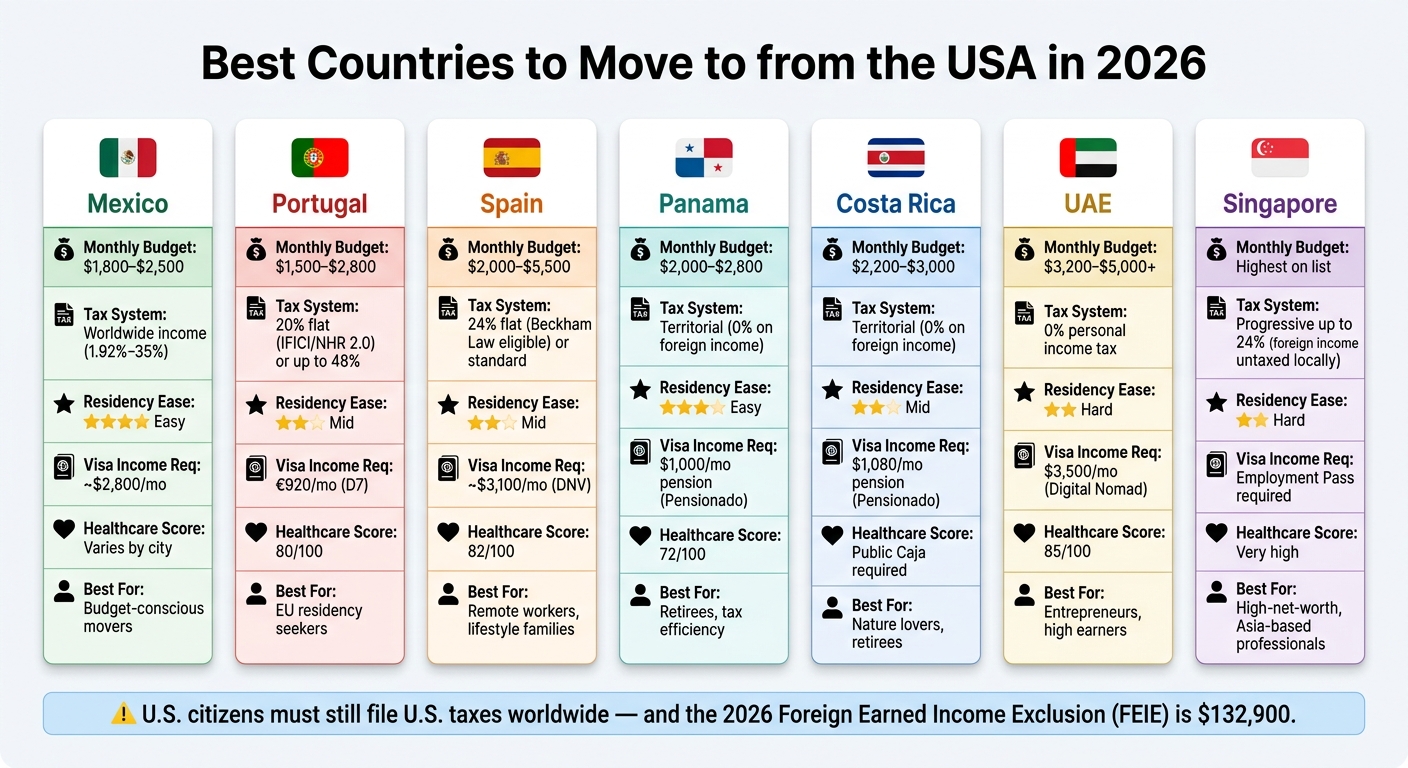
Quick comparison
| Country | Cost | Tax setup | Residency ease | Best fit |
|---|---|---|---|---|
| Mexico | Low | Taxes worldwide income if resident | Fairly easy | Budget-conscious movers |
| Portugal | Low to mid | Local tax can be high if special regime does not apply | Mid | EU-focused movers |
| Spain | Mid | Can work well for some remote workers | Mid | Lifestyle-focused families, remote workers |
| Panama | Mid | Territorial tax system | Easy for retirees | Retirees, tax-focused movers |
| Costa Rica | Mid to high | Territorial tax system | Mid | Nature-focused retirees and families |
| UAE | High | 0% personal income tax | Harder | Entrepreneurs, high earners |
| Singapore | Very high | Low local tax in many cases | Harder | High earners, Asia-based professionals |
If I were shortlisting countries for a 2026 move, I’d look at just four things first: monthly budget, local tax residency rules, visa income threshold, and healthcare access. That gets you to the right answer much faster than chasing a generic “best country” list.
sbb-itb-39d39a6
1. Portugal
Portugal is still one of the best picks for Americans in 2026. Living costs are about 35%–45% lower than in major U.S. cities, safety is much stronger than in the U.S., and residency can lead to permanent status in 5 years and EU citizenship in 10 years. The American population there grew 36.3% from 2023 to 2024, reaching 19,258.
It tends to work best for retirees, remote workers, and investors who want a base in Europe without paying big-city U.S. prices. The tradeoff is pretty clear: lower living costs usually mean spending more time in Portugal, while more freedom of movement tends to cost more. So the big choice comes down to the visa that matches your income, day-to-day life, and travel plans.
Visa & Residency
Portugal’s main visa routes are the D7 Passive Income Visa, the D8 Digital Nomad Visa, and the Golden Visa.
The D7 is aimed at retirees and people living on Social Security, pension income, or investment income. As of January 2026, the minimum income threshold is €920 per month. The D8 is meant for remote workers and freelancers, and it calls for monthly earned income at about four times Portugal’s minimum wage. Both visas come with a stay rule of at least 183 days per year in Portugal to keep residency.
The Golden Visa is the outlier. It only calls for 7 days of presence per year on average, but the entry price is much higher: a minimum investment of €500,000 in CMVM-regulated funds. Processing times also vary quite a bit. The D8 usually takes 60–90 days, while the Golden Visa often takes 7–15 months.
| Visa | Best For | Min. Requirement | Stay Requirement |
|---|---|---|---|
| D7 Passive Income | Retirees, pensioners | €920/month | 183+ days/year |
| D8 Digital Nomad | Remote workers | Monthly earned income at roughly 4x Portugal’s minimum wage | 183+ days/year |
| Golden Visa | High-net-worth investors | €500,000 (funds) | 7 days/year |
Once the visa piece is sorted out, cost usually becomes the next big filter.
Cost of Living
A couple living well in Lisbon will usually spend about €2,200–€2,800 per month, compared with roughly $4,500–$5,500 in a similar U.S. city. Porto is less expensive, with monthly budgets around €1,600–€2,100. In smaller towns like Tomar, that can drop to about €1,100–€1,500.
Food prices help a lot. Groceries are about 40%–50% lower than in the U.S. That said, housing needs close attention. In both Lisbon and Porto, annual rent increases have gone past 10% because of demand from people moving in from abroad. If you want a place in the city center, don’t assume the bargain will last forever.
Taxes for Americans
For Americans, Portugal doesn’t replace U.S. tax filing. It gets added on top of it.
Portugal’s original NHR program is now closed. It has been replaced by the IFICI regime, also called NHR 2.0, which gives a 20% flat tax rate for 10 years on qualifying work in research, tech, and other high-value sectors. If you don’t qualify for IFICI, standard Portuguese income tax rates apply, with the top rate reaching 48%.
U.S. rules still matter too. FBAR applies to foreign accounts over $10,000, so it makes sense to talk with a cross-border CPA well before the move.
Healthcare & Safety
Residents can use Portugal’s public health system, SNS. For the visa process, private insurance is often required at the start.
Day-to-day care is fairly low-cost by U.S. standards. GP visits usually cost €5–€10, and ER visits run about €15–€20. Private health insurance for working-age adults tends to cost around €70–€150 per month.
On quality-of-life measures, Portugal scores 80/100 for healthcare quality and 82/100 for safety. Its homicide rate is 0.6–0.9 per 100,000, far below the U.S. rate of 5.0–5.9.
2. Mexico
If Portugal is the Europe-first pick, Mexico is the closest and simplest option for Americans who want lower costs and easier access. For many Americans, it’s one of the easiest places to move in 2026: it’s close to the U.S., easy to enter, and much cheaper than most U.S. cities. It’s a strong fit for retirees and remote workers who want a lower-cost home base without being far from the States.
Visa & Residency
For most Americans, the Temporary Resident Visa is the main path in. It’s valid for 1 to 4 years. After four years on temporary residency, you can apply for permanent residency, which does not expire and comes with no ongoing income or stay rules.
You need to start the process at a Mexican consulate outside Mexico, and approval usually takes 3 to 6 weeks. Income rules vary by consulate, but 2026 estimates put the bar at $2,800 to $4,400 per month in income, or $46,000 to $74,000 in liquid savings held over the previous 12 months.
Once you’ve handled residency, the next big question is simple: how much does daily life cost?
Cost of Living
Mexico is one of the cheapest options on this list. A single person can live well on $1,800 to $2,500 per month, while a family of four can expect $3,000 to $4,000. Day-to-day services like childcare, private healthcare, and home maintenance can cost up to 70% less than in the U.S.
Where you live makes a big difference. Lake Chapala has the world’s largest American expat community, with an estimated 15,000 to 20,000 residents. Furnished one-bedroom apartments there rent for about $450 to $650 per month. In Mérida, monthly costs for a single person land around $1,200 to $1,800. San Miguel de Allende costs more, with monthly budgets closer to $2,000 to $3,000.
Taxes for Americans
Mexico taxes residents on worldwide income, with rates from 1.92% to 35%. You become a Mexican tax resident if you set up a home there or spend more than 183 days in the country during a calendar year. The U.S.-Mexico tax treaty and the Foreign Earned Income Exclusion (FEIE) can help limit double taxation. In 2026, the FEIE allows Americans to exclude up to $132,900 of foreign-earned income from U.S. taxes.
Healthcare & Safety
Healthcare is one of Mexico’s biggest draws. Voluntary enrollment in the public IMSS system costs about $500 to $600 per year. Private specialist visits usually run $40 to $80, and an MRI costs around $200 to $400. For retirees ages 60 to 65, basic private health insurance starts at $100 to $150 per month, while more complete plans range from $400 to $600 per month.
After cost and healthcare, safety tends to be the main tradeoff, and it depends a lot on the city. Some expat hubs, especially Mérida and San Miguel de Allende, have crime rates lower than many U.S. cities. That makes them a practical pick for retirees and remote workers who want Mexico’s lower costs without taking on the security issues tied to other parts of the country.
3. Spain
For Americans who want Europe without giving up solid healthcare, good public transit, and a clear way to stay long term, Spain should be high on the list. It works well for people who want European city life, good medical care, and lower monthly costs than big U.S. cities. It also ranks well for digital nomads.
Spain holds up across many situations. That includes retirees living on passive income, remote workers, and families that want a stable base in Europe. (Those considering other Mediterranean options might also look into the Italy Digital Nomad Visa).
Visa & Residency
Americans have two main paths in 2026.
The Non-Lucrative Visa (NLV) calls for about €2,400 per month for one applicant, plus €600 per dependent. It does not allow active work, including remote work for U.S. employers. The Digital Nomad Visa (DNV) is for remote workers and calls for about €2,850 per month, or about $3,100, for the main applicant, plus extra for dependents.
Spain’s Golden Visa ended on April 3, 2025, so buying property is no longer a path to residency. For both the NLV and DNV, you need to apply through a Spanish consulate in the U.S. before arrival.
Cost of Living
Housing costs in Madrid are 57% to 68% lower than in New York City. A single person can live well in Madrid or Barcelona on about $2,200 to $3,000 per month. In places like Valencia or Seville, that drops to around $1,650 to $2,400.
For a family of four, monthly costs in Valencia usually land between $3,300 and $4,600. In Madrid or Barcelona, that range is about $4,150 to $6,000.
Your move itself can cost about $10,000 to $25,000 once you add flights, shipping, and legal fees.
Taxes for Americans
Spain taxes residents on worldwide income once they spend more than 183 days in the country during a calendar year. If you’re retired and using the NLV, a cross-border tax advisor can help you sort out how Social Security, 401(k), and IRA distributions are handled under the U.S.-Spain tax treaty.
If you’re a remote worker on the DNV, there may be a better deal. Some people working for non-Spanish companies can use the Beckham Law. That sets a flat 24% tax rate on Spanish-source income for up to six years. It also keeps foreign-source dividends, interest, and capital gains outside Spanish tax. To get that rate, you must apply within six months of registering with Spanish Social Security.
On the U.S. side, the Foreign Earned Income Exclusion (FEIE) lets you exclude up to $132,900 in foreign-earned income from U.S. taxes in 2026.
Healthcare & Safety
Spain requires private health insurance with no copays for the visa. That usually costs about $1,000 to $2,500 per adult per year. After you have residency, you can use Spain’s public healthcare system.
That public system, the Sistema Nacional de Salud (SNS), scores 82 out of 100. Private care is also fairly priced by U.S. standards. A specialist visit usually costs $40 to $80, an MRI runs about $200 to $400, and a dental crown costs around $250 to $450.
On safety, Spain scores 80 out of 100.
4. Panama
If Spain is the more rules-heavy Europe option, Panama is the simpler tax-and-residency move in the Americas.
Panama makes a lot of sense for Americans who want lower taxes, day-to-day life in U.S. dollars, and a clear path to residency. It fits retirees especially well, but it can also work for remote workers and business owners. In plain English: Panama is often a better pick for people who want simplicity, not status.
Visa & Residency
The Pensionado Visa is the main option for retirees. It requires $1,000 per month in stable pension or Social Security income and grants permanent residency. It also includes discounts on utilities, airline tickets, restaurants, and medical costs.
For remote workers, the Remote Worker Visa requires $36,000 per year in verifiable income and allows a stay of up to 18 months. There’s also the Friendly Nations Visa, which can lead to residency through employment, a $200,000 property purchase, or a $200,000 bank deposit.
Cost of Living
Panama uses the U.S. dollar, which means Americans don’t have to deal with exchange-rate swings.
A single person in Panama City will usually spend about $1,500 to $2,500 per month. A couple with a mid-range lifestyle will often land around $2,000 to $2,800 per month.
Some of the main costs look like this:
- A one-bedroom apartment in Panama City: $800 to $1,400 per month
- A one-bedroom in smaller towns like Boquete or El Valle de Antón: $450 to $700
- Groceries for one person: $250 to $350 per month
- Utilities and internet: $120 to $180 per month
Taxes for Americans
Once you have residency, Panama’s tax setup becomes the big draw.
Panama uses a territorial tax system. That means only income earned inside Panama is taxed locally. Income from U.S. clients, remote work, Social Security, pensions, or foreign investments is generally exempt from local tax.
Panama also does not charge inheritance, gift, or estate taxes, which can make long-term planning a lot easier. For Americans, though, the U.S. side still matters. FEIE, FBAR, and FATCA can get messy fast, so working with an expat CPA is a smart move.
Healthcare & Safety
Panama City has the country’s strongest private healthcare options, and Panama’s healthcare system scores 72 out of 100. Facilities like Hospital Punta Pacífica, which is affiliated with Johns Hopkins, show the level of private care available there.
Costs are often far lower than in the U.S. A specialist consultation usually runs $50 to $80, while an MRI typically costs $250 to $450.
For a retiree ages 60 to 65, private health insurance usually costs about $220 to $370 per month for a mid-range plan. Pensionado visa holders also get discounts on some healthcare costs.
Panama has an overall safety score of 54 out of 100, but expat areas like Boquete and Coronado report minimal serious crime.
If you want another Central American option with a different lifestyle and tax setup, Costa Rica is next.
5. Costa Rica
After Panama’s simpler tax setup, Costa Rica shifts the value equation. You’ll spend more here than in Panama or Mexico, but you get stronger public healthcare, political stability, and a slower day-to-day rhythm. That mix tends to appeal to retirees, remote workers, and expats who care more about lifestyle and healthcare access than rock-bottom costs.
Visa & Residency
Americans usually look at three main options.
- The Pensionado Visa calls for $1,080 per month in steady pension or Social Security income and can lead to permanent residency.
- The Rentista Visa calls for either $2,500 per month in steady income for at least two years or a $60,000 fixed deposit in a Costa Rican bank.
- The Digital Nomad Visa calls for $3,000 per month in remote income, gives you a one-year stay, and includes a local income tax exemption.
Residency also calls for private health insurance. In most cases, the process takes about 6 to 12 months through DGME, and many applicants use a local immigration attorney to handle the paperwork.
Cost of Living
Costa Rica is the priciest Central American choice on this list. A single person living well will usually spend about $2,000 to $2,500 per month, while a couple should plan on $2,500 to $3,000.
| Expense Category | Monthly Cost (USD) | Notes |
|---|---|---|
| Rent (1BR apartment) | $500–$800 | Beach towns run $900–$1,500 |
| Groceries | $300–$400 | Local markets (ferias) offer the best value |
| Utilities & Internet | $100–$150 | Electricity runs higher in coastal areas |
| CCSS (Caja) | $70–$150 | Mandatory for all legal residents |
| Private Insurance (basic) | $120–$180 | Catastrophic coverage baseline |
San Jose and the Central Valley tend to offer the best mix of infrastructure and lower rent. Coastal towns such as Tamarindo and Jaco draw plenty of expats, but prices climb fast there.
Taxes for Americans
Costa Rica uses a territorial tax system, which means foreign-source income usually isn’t taxed locally. If you’re on the Digital Nomad Visa, the exemption is even clearer: local income taxes do not apply during your stay.
That said, Americans still owe U.S. federal taxes on worldwide income. For 2026, the FEIE lets you exclude up to $132,900 of foreign-earned income from U.S. federal tax. FBAR rules matter too. If your Costa Rican bank accounts go over $10,000 at any point during the year, you must report them.
This is one of those places where paying a cross-border tax advisor can save you a headache. That matters even more if you have IRAs, 401(k)s, or questions tied to the U.S.-Costa Rica tax treaty.
Healthcare & Safety
Costa Rica’s higher costs help fund one of the better public health systems in the region. All legal residents must enroll in the CCSS (Caja) within 90 days of residency approval. Monthly contributions usually fall between 7% and 11% of declared income, which often lands around $70 to $150 per month.
Many Americans still add private insurance on top of Caja. The reason is simple: shorter waits and easier access to English-speaking doctors and specialists. For people ages 60 to 65, premiums often run $250 to $400 per month.
Costa Rica’s homicide rate is about 11 per 100,000 as of 2026. Violent crime is lower than in many U.S. cities, but petty theft and home break-ins are still the main issues, especially in tourist-heavy spots. A smart move is to rent for 6 to 12 months before buying property. That gives you time to see how a neighborhood feels in both the dry and rainy seasons.
Costa Rica tends to work best for retirees, nature lovers, and remote workers who put stability and healthcare ahead of lower monthly spending. If you want a setup that leans more toward business and income structure, the UAE is next.
6. United Arab Emirates
For high-income Americans, entrepreneurs, and business owners, the UAE is mostly a tax play, not a budget move. In plain English: this is a fit for people who care more about tax treatment and company setup than keeping monthly costs low.
Visa & Residency
Americans usually go with one of three visa paths. The Digital Nomad Visa, also called the Virtual Working Programme, requires a minimum income of $3,500 per month. The Green Visa is for skilled professionals earning at least AED 15,000 per month – about $4,100. Then there’s the Golden Visa, which gives 10-year renewable residency to people earning AED 30,000 per month – about $8,200 – or investing at least AED 2 million, roughly $545,000, in UAE property.
Residency applications usually include a medical exam and an Emirates ID. One thing to be clear on: the UAE does not offer an easy route to citizenship. So it makes more sense to treat it as a residency setup than as a permanent second home.
Once that part is sorted, taxes become the main factor.
Taxes for Americans
The big draw is simple. The UAE charges 0% personal income tax on salary, capital gains, dividends, inheritance, and wealth. There is a 9% corporate tax, but it only kicks in on business profits above AED 375,000, or about $102,000.
For Americans, the Foreign Earned Income Exclusion, or FEIE, can also shield the first $132,900 of earned income in 2026. That mix is why the UAE gets so much attention from high earners.
Cost of Living
This is the priciest place on this list. A single person living in Dubai should plan on at least $3,200 per month. Housing is the biggest cost by far. A 2-bedroom apartment in Dubai usually runs AED 120,000 to AED 200,000+ per year, which comes out to about $32,700 to $54,500.
Families need to budget for school fees too, and those add up fast. Annual tuition ranges from AED 40,000 to AED 90,000 per child, or about $10,900 to $24,500.
Healthcare & Safety
Dubai scores 85 out of 100 for healthcare quality, and most residents use private hospitals. English is common in business and day-to-day life, which makes the move easier for many Americans.
That said, the legal and social climate is stricter than in the U.S. Personal conduct rules and social media rules can carry serious legal consequences. That’s not a small footnote. Expats should understand those limits before making the move.
If you want a similar high-income option with a different risk profile, Singapore is next.
7. Singapore
If the UAE is the tax-first pick, Singapore is the stability-first pick in Asia.
It’s a high-cost, high-barrier option that makes the most sense for high-earning professionals, founders, and families who want a stable, business-friendly base in Asia. You’re paying more, no question. But in return, you get low friction, strong systems, and clear business rules.
Visa & Residency
For most Americans, getting into Singapore usually means an Employment Pass tied to a Singapore employer. Another path is an approved business or work route linked to a real business presence in the country.
That makes Singapore a pretty clear filter. If you’re thinking about a move, you have to look hard at job access, business setup, and how much long-term mobility you want.
Cost of Living
Singapore is expensive, and housing plus schooling are the two biggest pressure points. International school fees can exceed $15,000 per child per year.
Taxes for Americans
This is where Singapore gets a lot of attention. In general, Singapore does not tax foreign-sourced income locally. Local income is taxed on a progressive scale, with the top rate reaching 24%.
At a gross salary of about $80,000, the effective tax rate is roughly 13%. Americans still have to file U.S. taxes. The Foreign Earned Income Exclusion (FEIE) lets you exclude up to $132,900 of foreign-earned income in 2026, and the Foreign Housing Exclusion can cover certain housing costs up to $39,870. Central Provident Fund (CPF) contributions are mandatory only for citizens and Permanent Residents, not for most foreign employees.
Healthcare & Safety
Singapore has strong healthcare, public safety, and infrastructure. English is widely used, which makes day-to-day life easier for Americans.
Its appeal stands out even more when you stack it against other options, especially when cost, tax treatment, and mobility tradeoffs are on the table.
How These 7 Countries Compare on the Factors That Matter Most
After the country-by-country breakdowns, this comparison makes the big tradeoffs easier to see at a glance.
No country comes out on top in every area. The best choice depends on what matters most to you: lower costs, simpler taxes, easier residency, or a stronger path to staying long term.
Visa & Residency: Mexico and Panama are the easiest to enter. Portugal, Spain, and Costa Rica fall somewhere in the middle. The UAE and Singapore are the hardest places on this list for residency access.
Cost of Living: Mexico is the lowest-cost option, with Panama and Portugal next. Costa Rica and Spain cost more. The UAE is pricey, and Singapore is the most expensive of the group.
Taxes for Americans: Panama, Costa Rica, and the UAE are the most straightforward for foreign income. Portugal and Spain give partial relief for workers who qualify. Mexico and Singapore are less simple from a tax point of view.
Healthcare & Safety: Portugal and Spain have the strongest public systems. Costa Rica requires Caja enrollment. Panama leans more on private care. The UAE and Singapore are the safest places here, though both depend more on private insurance. In Mexico, the experience can change a lot by city.
The table below gives the fastest side-by-side view.
| Country | Visa & Residency | Monthly Budget (USD) | Tax System | Healthcare & Safety | Best For |
|---|---|---|---|---|---|
| Portugal | D7 (~$1,000/mo) / D8 (~$3,800/mo) | $1,500–$2,800 | NHR-style 20% regime | Very safe; strong public systems | Families, EU access |
| Mexico | Temporary resident (~$2,800/mo) | $1,800–$2,500 | Worldwide income | Varies by city; private-care dependent | Budget-conscious movers, close to the U.S. |
| Spain | DNV (~$3,100/mo) / NLV (~$2,600/mo) | $2,000–$5,500 | Beckham Law for eligible workers | Very safe; strong public systems | Lifestyle-focused families |
| Panama | Pensionado ($1,000/mo pension) | $2,000–$2,800 | Territorial (0% foreign) | Safe; private-care dependent | Retirees, tax efficiency |
| Costa Rica | Pensionado ($1,080/mo pension) | $2,200–$3,000 | Territorial (0% foreign) | Safe; public Caja enrollment required | Nature, wellness, retirees |
| UAE | Golden Visa / qualifying role or investment | $3,000–$5,000+ | 0% personal income tax | Very safe; private-care dependent | Entrepreneurs, tax efficiency |
| Singapore | Employment Pass / business route | Highest on the list | Progressive | Very safe; private-care dependent | High earners, globally mobile families |
The next step is to weigh the practical tradeoffs of each option.
Pros and Cons of Each Country for American Movers
There’s no one-size-fits-all answer here. Each country suits a different kind of American mover, and each comes with a tradeoff.
| Country | Main Pros | Main Cons | Best For |
|---|---|---|---|
| Portugal | High safety; strong English proficiency; EU citizenship path | Heavy bureaucracy; rising rents in Lisbon and Porto; IFICI targets active professionals rather than retirees | Long-term EU residency seekers |
| Mexico | Very affordable, with mid-range monthly budgets around $1,800–$2,500; fast residency processing; close to the U.S. | Residents are taxed on worldwide income; safety varies by region | Budget-conscious retirees and families |
| Spain | World-class healthcare; Digital Nomad Visa available; Beckham Law lets qualifying workers pay a flat 24% tax on Spanish-earned income for up to six years | High taxes without Beckham Law; bureaucracy; limited English in official settings | High-earning remote workers and lifestyle-focused families |
| Panama | Uses the U.S. dollar; territorial tax system exempts foreign income; Pensionado discounts on airline tickets, restaurants, and prescription medications | Tropical humidity; Panama City traffic; slower pace outside expat hubs | Retirees and tax-efficiency focused movers |
| Costa Rica | Stable democracy; universal healthcare access; strong biodiversity and outdoor lifestyle | More expensive than neighboring countries; CAJA healthcare contributions run 7%–11% of declared income | Nature lovers and families prioritizing political stability |
| United Arab Emirates | 0% personal income tax, capital gains tax, and inheritance tax; very safe; world-class infrastructure | Roughly $3,200/month and up; extreme summer heat; strict legal climate | Entrepreneurs and high-income earners |
| Singapore | Extremely safe; English-speaking; highly efficient systems; relatively low taxes for high earners | One of the most expensive cities globally; strict laws | Corporate professionals and high-net-worth individuals |
A few patterns jump out fast.
If cost is your main concern, Mexico stands out. A mid-range monthly budget of $1,800–$2,500 is hard to ignore, and being close to the U.S. makes visits home much easier. Panama also gets attention from retirees, especially because it uses the U.S. dollar and does not tax foreign income under its territorial tax system.
If you care more about long-term status in Europe, Portugal and Spain tend to move up the list. Portugal appeals to people who want an EU residency route and strong day-to-day comfort with English, though the paperwork can be a headache and rents in Lisbon and Porto have climbed. Spain brings strong healthcare and a visa route for remote workers, but the tax side can get expensive if you don’t qualify for the Beckham Law.
For people focused on tax planning, United Arab Emirates is the headline option. No personal income tax sounds great on paper, and the infrastructure and safety are major draws. But life there usually starts around $3,200 per month, and the heat and legal rules can feel like a lot. Singapore offers safety, English use, and efficient systems, but the cost of living is among the highest in the world.
Costa Rica sits in a different lane. It tends to attract families and outdoor-minded movers who care about political stability, healthcare access, and nature. The tradeoff is simple: it costs more than many nearby countries, and CAJA contributions can run 7%–11% of declared income.
One point matters no matter where you go: U.S. citizens still owe U.S. tax on worldwide income, even when living in zero-tax countries. And U.S. Medicare does not cover treatment abroad, so you’ll need separate health coverage wherever you move.
Use this as a shortlisting tool. Once a country makes your cut, the next step is to compare it by budget, tax exposure, residency path, and lifestyle fit.
Which Country Is The Right Fit for Your 2026 Move?
Start with your main goal. Then narrow your shortlist based on the tradeoff you care about most: cost, taxes, residency, or day-to-day life.
| Profile | Best Fit | Key Reason |
|---|---|---|
| Retirees | Panama | Best for retirees seeking simple residency and foreign-income tax efficiency. |
| Budget-conscious movers | Mexico | Lowest-cost option with close access to the U.S. |
| Americans seeking an EU base | Portugal or Spain | EU residency path, strong public services, and easier long-term living in Europe. |
| Entrepreneurs focused on tax efficiency | UAE | Zero personal income tax and business-friendly structure. |
| High-earning remote workers | Spain | Best if you qualify for Spain’s special tax regime. |
| High-net-worth movers | Singapore or UAE | Low-tax, high-stability bases with strong global connectivity. |
After you have a shortlist, look closely at tax residency rules before you move. This is where people get tripped up. Legal residency and tax residency are not the same thing. In many countries, including Mexico and Spain, spending more than 183 days there can trigger worldwide tax obligations under local rules, on top of your U.S. filing duties.
The U.S. side matters too. The Foreign Earned Income Exclusion (FEIE) lets U.S. citizens exclude up to $132,900 of foreign earned income from federal tax in 2026, but it does not remove the need to file U.S. taxes.
State taxes can also follow you out the door. California and New York, for example, may keep taxing you after you leave unless you cut ties in a formal way, such as canceling your driver’s license and voter registration.
Before you commit, double-check the current visa income thresholds, how local tax residency rules line up with your U.S. obligations, and what you still need to file back home. For example, Mexico raised its temporary residency requirement to about $2,800/month in late 2025. Private insurance is also often required for visas, so review that early instead of dealing with it at the last minute.
One last step that can save you a headache: spend 4–8 weeks there in the off-season before you move.
FAQs
How do I choose the right country for my budget and goals?
Start with your main goal. Maybe you want to cut your tax bill, lower day-to-day costs, build a path to citizenship, or simply change how you live.
Then look at the numbers. Compare your income, savings, or investment capital against each country’s visa or residency rules. If a country asks for a set monthly income, a bank balance, or a property investment, you need to know right away whether it fits.
After that, line up your budget with local living costs. In lower-cost regions, you might spend about $1,000 to $1,800 per month. In premium expat hubs, that can jump to $3,000 to $5,000+ per month. That gap matters more than people think. A place can look cheap on paper and still feel expensive once rent, insurance, and daily life kick in.
You’ll also want to look past the headline price. Check the healthcare system, roads and internet, tax rules, and how hard it is to move there in practice. On paper, two countries may look close. In day-to-day life, they can feel worlds apart.
Will I still owe U.S. taxes after moving abroad?
Yes. The United States taxes its citizens on worldwide income, so in most cases you still need to file a federal tax return each year after moving abroad.
That said, filing doesn’t always mean paying the same income tax twice. You may be able to cut down double taxation with the Foreign Earned Income Exclusion and the Foreign Tax Credit.
You may also have other filing duties, including:
- FBAR
- FATCA
- State tax filings, if you can’t show that your move was permanent
This is where many people get tripped up. They leave the U.S. and assume the tax side ends there. It usually doesn’t.
Which country is easiest for Americans to get residency in?
Mexico is often the easiest option for Americans. You can stay visa-free for up to 180 days, and the temporary residency process is pretty simple. In many cases, consulates can handle it the same day.
Canada also ranks high for access. It’s close to the U.S., English is widely used, and there are work-focused routes like Express Entry.
For retirees, Panama comes up a lot because its Pensionado program can lead to immediate permanent residency.
