
If I had to give the short answer first: Cook Islands is the top pick for the hardest creditor fight, Nevis gives a lot of that protection at a lower price, Belize is the low-cost option, Cayman Islands fits complex wealth structures, and Liechtenstein is more about family control and succession than lawsuit pressure.
If you’re a U.S. person, there’s one point I’d make right away: offshore asset protection can be legal, but it does not remove IRS reporting. FBAR, FATCA, and trust filings still apply.
Here’s the plain-English breakdown of what matters most:
- Cook Islands: strongest shield, high cost, very hard for creditors to enforce
- Nevis: lower setup cost than Cook Islands, adds a $100,000 creditor bond
- Belize: low price and fast setup, but less friction for creditors
- Cayman Islands: strong legal system and trust administration, but a 6-year challenge window
- Liechtenstein: better for family governance and succession planning than last-minute lawsuit planning
I’d judge these places on four things:
- How hard it is for a creditor to win
- How hard it is for a creditor to even file
- How much privacy you get
- How much you’ll pay each year
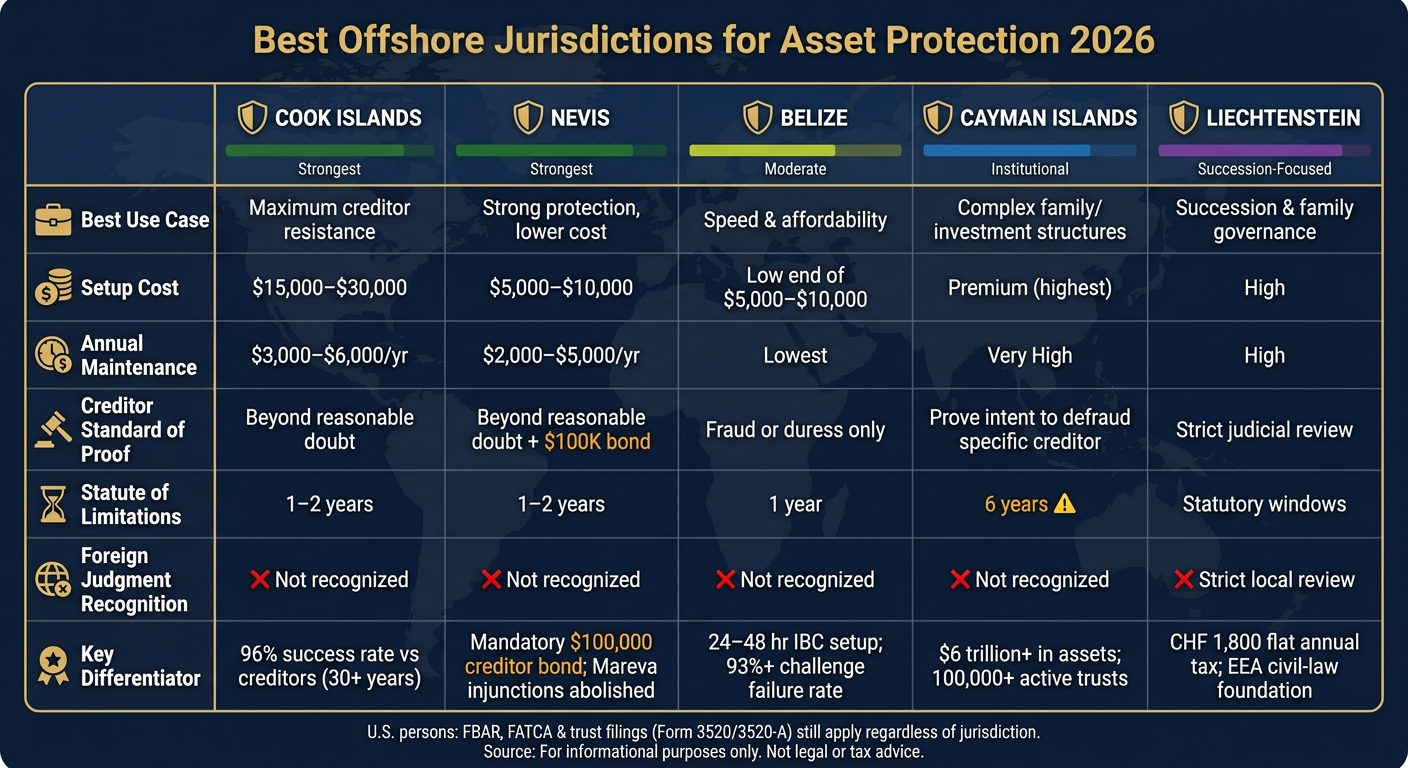
Quick Comparison
| Jurisdiction | Best Use | Main Creditor Hurdle | Cost Range | Main Trade-off |
|---|---|---|---|---|
| Cook Islands | Maximum asset protection | Foreign judgments not enforced; creditors must prove fraud beyond a reasonable doubt | $15,000–$30,000 setup; $3,000–$6,000/year | High price |
| Nevis | Strong protection at lower cost | $100,000 cash bond plus local lawsuit | $5,000–$10,000 setup; $2,000–$5,000/year | Less global prestige than Cook Islands |
| Belize | Lower-cost entry point | Local relitigation and short 1-year challenge window | Low end of offshore pricing | Less creditor friction than top-tier picks |
| Cayman Islands | Complex family and investment structures | Local court action required | Premium pricing | 6-year lookback period |
| Liechtenstein | Succession and family governance | Local judicial review and ring-fencing through foundations | High | Better for planning than urgent asset shielding |
My bottom line: if your goal is pure lawsuit resistance, I’d put Cook Islands first and Nevis second. If your goal is lower cost, I’d look at Belize. If you care more about banking access, trust administration, or multi-generation planning, I’d look at Cayman or Liechtenstein.
That’s the core answer. The rest of the article fills in the trade-offs of structuring offshore trusts for asset protection.
sbb-itb-39d39a6
1. Cook Islands
The Cook Islands is still the top offshore asset protection jurisdiction in 2026. Over the past 30-plus years, it has posted a 96% success rate against legal challenges, with only two partial wins for creditors.
Creditor protection strength
This is where the Cook Islands stands out.
Under the International Trusts Act, creditors face a steep uphill fight. They have to prove fraudulent intent beyond a reasonable doubt, which is far stricter than the U.S. civil standard. On top of that, claims against asset transfers usually have to be brought within two years of the transfer or one year from when the transfer was discovered.
The law also shields against:
- matrimonial claims
- forced heirship claims
- tax claims
Court and enforcement barriers
A U.S. judgment doesn’t simply carry over into the Cook Islands.
Local courts do not automatically recognize or enforce U.S. or other foreign judgments. That means a creditor has to start from scratch in the Cook Islands and argue the case under local law. For U.S. settlors, this matters a lot. If an independent Cook Islands trustee controls the trust, the settlor may be able to rely on a legal-impossibility defense because they can’t force the trustee to send the assets back.
Privacy and reporting burden
Privacy is one of the main draws here. Trust deeds and beneficiary records remain private, and there is no public trust registry.
That said, privacy does not mean less IRS paperwork. U.S. persons still need to file FBAR, FATCA, and Form 3520/3520-A. In plain English: the Cook Islands can help with asset protection, but it does not remove U.S. tax compliance duties.
Cost and profile fit
| Feature | Cook Islands Trust |
|---|---|
| Setup cost | $15,000–$30,000 |
| Annual maintenance | $3,000–$6,000 |
| Standard of proof for creditors | Beyond a reasonable doubt |
| Statute of limitations | 1–2 years from transfer or discovery |
| Foreign judgments | Not recognized; creditors must relitigate locally |
| Success rate | 96% over 30+ years |
This option is best suited to high-net-worth individuals and high-liability professionals.
Nevis offers a similar creditor shield at a lower setup cost, though the enforcement trade-offs are different.
2. Nevis
Nevis is a top-tier asset protection jurisdiction. It also tends to cost less than the Cook Islands. What sets it apart isn’t just privacy. It’s the simple fact that collecting is hard.
Creditor protection strength
Nevis puts more pressure on creditors from the start. But the bigger point is this: it slows them down and makes enforcement tougher.
Creditors must prove fraudulent intent beyond a reasonable doubt. That’s a very high bar. They also get only a tight window to challenge transfers, usually one to two years from the transfer date. On top of that, Nevis allows self-settled trusts, so the settlor can still be a beneficiary without losing the trust’s protection.
Court and enforcement barriers
This is where Nevis stands out most. Its main edge is enforcement friction.
Unlike places that lean mostly on privacy, Nevis adds a direct money barrier. Before a creditor can file a claim against a Nevis trust, they must post a mandatory $100,000 cash bond with the Nevis Ministry of Finance. That alone can stop weaker claims in their tracks.
Nevis has also abolished Mareva injunctions, which means creditors can’t freeze trust assets while the case is still being fought. And foreign judgments are not automatically recognized or enforced. So a creditor can’t just walk in with a U.S. judgment or another foreign court order and expect it to work. They have to start a new case in Nevis.
Nevis LLCs add another layer of resistance. In many cases, a creditor is limited to a charging order as the only remedy.
That friction gets even stronger because Nevis also limits public access to trust information.
Privacy and reporting burden
Nevis does not have a public beneficial-ownership registry. A Form T-1 must be filed within 30 days, but public disclosure stays limited. Trust proceedings are private, and disclosure is tightly restricted.
For U.S. persons, though, offshore does not mean off the IRS radar. Full IRS reporting still applies, including Forms 3520 and 3520-A, FBAR, and FATCA disclosures.
Cost and profile fit
| Feature | Nevis Trust |
|---|---|
| Setup cost | $5,000–$10,000 |
| Annual maintenance | $2,000–$5,000 |
| Government registration fee | Approximately $220 per year |
| Creditor bond requirement | $100,000 mandatory cash bond |
| Standard of proof for creditors | Beyond a reasonable doubt |
| Statute of limitations | 1–2 years from the transfer date |
| Foreign judgments | Not automatically recognized; creditors must relitigate locally |
| Mareva injunctions | Abolished |
Nevis costs less than the Cook Islands and gives you more enforcement friction than Belize. In many cases, it runs 25% to 40% less than a similar Cook Islands trust.
That makes Nevis a strong fit for entrepreneurs and high-liability professionals. And for people who want another layer of separation, some planners pair a Nevis LLC with offshore trusts and foundations.
Belize is the next step down on price, but you give up a lot of the enforcement friction that makes Nevis so hard to attack.
3. Belize
Belize is the lower-cost, faster-processing choice in this group. But there’s a tradeoff: it puts fewer roadblocks in front of creditors than the Cook Islands or Nevis. So, for clients who care most about speed and price, Belize can make sense. For clients chasing the strongest creditor shield possible, it’s more of a step-down pick.
Creditor protection strength
Belize’s 1992 Trusts Act, later amended in 2007, makes fraudulent transfer claims hard to win unless a creditor can prove fraud or duress. The statute of limitations is short too: just one year from the transfer date. On top of that, historical challenge failure rates for Belizean trusts are above 93%.
Court and enforcement barriers
Belize does not recognize or automatically enforce foreign judgments, including U.S. judgments. That means a creditor can’t just show up with a U.S. court order and collect. They have to start again in Belizean courts, which adds time, cost, and uncertainty. Belize also blocks forced-heirship claims.
Privacy and reporting burden
Beneficial ownership is not public, and trust records stay private. There is no local tax on international income. Reporting for non-residents is also light.
That said, Belize has faced scrutiny, including EU gray-listing in 2024.
Cost and profile fit
| Feature | Belize Trust |
|---|---|
| Setup cost | Low end of the $5,000–$10,000 range |
| IBC incorporation time | 24–48 hours |
| Trust formation time | As little as 2 days |
| Statute of limitations | 1 year from transfer date |
| Foreign judgment recognition | None; creditors must relitigate locally |
| Creditor bond required | No |
Belize tends to fit best as a lower-cost layer for moderate-risk assets when speed and cost matter more than maximum creditor resistance. The Cayman Islands changes the comparison by moving away from speed and price and toward deeper institutional structuring.
4. Cayman Islands
The Cayman Islands has a strong legal system and well-established institutional administration. That makes it a good match for clients who want dependable administration along with asset protection. It oversees more than $6 trillion in assets across over 100,000 active trusts. So Cayman is less about making life as hard as possible for creditors and more about giving families and investors a stable, well-supported structure.
Creditor protection strength
Cayman’s asset protection framework is solid, but it isn’t the most hard-charging option in this group. Under the Fraudulent Dispositions Law, creditors have up to six years to challenge a transfer, and they must prove there was intent to defraud that specific creditor. That’s a longer lookback period than the one- to two-year windows in the Cook Islands or Nevis.
Cayman also has statutory firewall rules that block foreign forced-heirship claims. In plain English, the trust deed governs distributions, not the inheritance rules from the settlor’s home country. This setup works better for long-term planning than for someone already dealing with active litigation.
Court and enforcement barriers
Foreign civil and tax judgments are not automatically recognized in the Cayman Islands. A creditor has to bring a new case locally and meet strict Cayman legal standards before any enforcement can move forward. Cayman courts also have a strong track record of upholding trust structures, which gives families and advisers a clearer sense of how things are likely to play out.
Privacy and reporting burden
Cayman relies on confidentiality by law, not secrecy. There is no public registry of trust deeds or beneficiaries. At the same time, the jurisdiction complies with FATCA, CRS, and FBAR rules, so U.S. persons still need to handle their normal reporting duties.
Cost and profile fit
Cayman is the premium-priced option in this comparison. A Trust Tax Exemption Certificate can lock in tax-neutral treatment for up to 50 years.
| Feature | Cayman Islands |
|---|---|
| Statute of limitations | 6 years from transfer date |
| Creditor standard | Must prove intent to defraud a specific creditor |
| Foreign judgment recognition | Not automatic; local litigation required |
| Public trust registry | None |
| Taxation | 0% income, capital gains, and estate tax |
| Key structures | STAR Trusts, Exempt Companies, PTCs |
Cayman is often the best fit for ultra-high-net-worth individuals, global investors who want steady administration and banking access, and internationally mobile families using multi-generational structures such as Private Trust Companies (PTCs) or STAR trusts. It’s not the best choice for someone who wants the most aggressive creditor protection in a short time frame. Liechtenstein goes in a different direction, leaning on civil-law foundations and private wealth structures instead of a common-law trust model.
5. Liechtenstein
After the Caribbean options, Liechtenstein changes the frame a bit. The focus here is less about making litigation harder and more about using a civil-law system built for long-term family governance. Put simply, it works best as a succession planning tool, not as a last-second asset shield. It is also one of the few civil-law jurisdictions with a mature framework for both foundations and trusts.
Creditor protection strength
A Stiftung is a separate legal entity, which means its assets are ring-fenced from both the founder and the beneficiaries. In practice, that usually keeps creditors out if the structure was set up before any claim came up and was not funded to cheat creditors. Liechtenstein also uses statutory challenge windows as part of its succession framework. That gives families more certainty than a system that depends mainly on one case after another. It can also reduce foreign forced-heirship claims by allowing the foundation charter to govern distributions.
Court and enforcement barriers
Foreign judgments do not move straight into enforcement. They must first go through strict local judicial review. Liechtenstein also refuses to enforce foreign tax judgments. It does not lean on the harsher barriers seen in some Caribbean jurisdictions. Instead, its civil-law process pushes creditors into a local proceeding they do not run, which still makes easy enforcement hard.
Privacy and reporting burden
Liechtenstein runs on regulated confidentiality. Banks are legally barred from releasing client data to third parties unless there is a court order or another strict legal basis. Beneficiary names are not listed in public records, and only foundations that carry on business must register with the government.
Cost and profile fit
This is a premium-cost jurisdiction. Setup and maintenance costs are high compared with Caribbean options. So Liechtenstein is usually a planning jurisdiction first and a litigation shield second. It tends to fit families that care most about long-term control and succession planning.
| Feature | Liechtenstein |
|---|---|
| Primary structure | Foundation (Stiftung) and trust |
| Legal system | Civil law, EEA member |
| Foreign judgment recognition | Strict local judicial review required |
| Creditor barrier | Ring-fencing and statutory challenge windows |
| Annual tax (PAS) | CHF 1,800 flat tax |
| Public beneficiary registry | None |
| Setup cost | High |
Liechtenstein is often the best match for succession-focused internationally mobile families, especially those with European ties and a need for a structure that fits neatly with EU and Swiss financial systems.
Legal and practical trade-offs side by side
Here’s the plain-English version: protection strength, how hard it is for a creditor to act, privacy, and cost all matter. The table below puts those trade-offs next to each other.
The Cook Islands and Nevis offer the strongest defenses against creditors. Belize is less expensive and faster to set up, but it’s not as tough. Cayman Islands has a strong legal and financial system, though it can be less appealing when speed matters. Liechtenstein works best for long-range planning, not last-minute shielding.
That distinction matters. Strong legal rules help, but procedural friction is often what slows collection in practice. Every jurisdiction here requires creditors to litigate locally. Nevis goes a step further by requiring a creditor bond, which creates the biggest filing hurdle of the group.
One more point: none of these jurisdictions gets rid of U.S. reporting duties. FBAR, FATCA, and trust filings still apply.
| Jurisdiction | Creditor-Defense Mechanics | Procedural Friction | Privacy Standards | Cost & Admin Intensity |
|---|---|---|---|---|
| Cook Islands | Beyond a reasonable doubt standard for fraudulent intent | Remote location; local litigation required; foreign judgments not recognized | High; no public registry; records accessible only by court order | High; typically $15,000–$30,000 to set up, with annual administration fees of $3,000–$6,000 |
| Nevis | Mandatory $100,000 creditor bond; 1–2 year statute of limitations | Bond requirement creates a high barrier to filing | High; sealed court filings, and disclosure of international trust information is a criminal offense | Moderate; setup costs are about $5,000–$10,000, with annual fees of $2,000–$5,000 |
| Belize | Short challenge window; fraud or duress claims only | Foreign judgments are not recognized; fast registration process | High; registry keeps trust deeds and beneficiary identities private | Low; setup and maintenance costs are approximately 32% lower than peer jurisdictions |
| Cayman Islands | 6-year lookback period for fraudulent transfer claims; STAR trusts add flexibility | Sophisticated legal system; foreign judgments not recognized | High; no public trust registry, and beneficial ownership records are non-public | Very high; premium administration and legal costs |
| Liechtenstein | Strict judicial review and statutory challenge limits | Local proceedings are required; no direct enforcement of foreign claims | High; no public beneficiary registry, and bank disclosure is barred without court order | High; premium European structuring costs |
Cost by itself can send you in the wrong direction. Belize is the lowest-cost entry point, but it carries less institutional weight than the Cook Islands or Cayman Islands. On the other hand, Cayman Islands offers strong banking and investment infrastructure, yet its 6-year lookback period can make it a weaker fit when immediate protection is the main goal.
The next section breaks these same trade-offs into jurisdiction-level pros and cons.
Pros and cons by jurisdiction
Every jurisdiction gives you a different trade-off between protection, cost, and complexity. The table below cuts it down to the points that matter most when you’re deciding where to set up.
| Jurisdiction | Main Advantages | Main Drawbacks | Best Suited For |
|---|---|---|---|
| Cook Islands | Beyond-reasonable-doubt burden of proof; non-recognition of foreign judgments; licensed trustee oversight | Setup costs of $15,000–$30,000; annual fees of $3,000–$6,000; requires a licensed local trustee | High-net-worth individuals who need strong creditor resistance for serious litigation risk |
| Nevis | $100,000 creditor bond; no automatic recognition of foreign judgments; fast setup | Less international recognition than Cook Islands; requires Form T-1 filing for trusts | Entrepreneurs and business owners looking to deter opportunistic lawsuits |
| Belize | Lowest setup costs; fast incorporation; 1-year statute of limitations | Moderate international reputation; weaker creditor shield than Cook Islands or Nevis | Cost-conscious individuals who need a straightforward offshore structure quickly |
| Cayman Islands | Strong banking and trust administration; STAR trusts for complex structures; zero direct taxation | 6-year lookback period for fraudulent transfers; premium pricing | Institutional investors and ultra-high-net-worth families with complex investment portfolios |
| Liechtenstein | Strong foundation-based planning under civil law; strict judicial review of foreign claims | Very high setup costs; requires specialized professional guidance | Multi-generational family offices and European-linked assets requiring long-term succession planning |
A few patterns stand out. Cook Islands and Nevis are often picked when the main goal is creditor defense. Belize is more about lower cost and speed. Cayman Islands and Liechtenstein tend to fit more complex family or institutional planning, where structure and administration matter as much as asset shielding.
There’s also an option that doesn’t rely on just one place: layering. Sophisticated investors often stack structures so creditors face two separate barriers before they can get to the assets. That adds friction at each step and makes enforcement harder.
Still, one rule stays the same across every jurisdiction in this table. If assets are transferred after a claim arises, they can still be attacked as fraudulent transfers no matter where the structure sits.
Conclusion
The trade-off is pretty clear: stronger protection usually comes with a higher price tag and more moving parts. Use the comparisons above to line up the right structure with your risk level, budget, and planning goals.
Cook Islands is the top pick for maximum creditor resistance. Nevis gives you strong protection at a lower cost. Belize makes sense when cost and speed come first. Cayman Islands is a better match when institutional banking and more complex structures matter just as much as protection. Liechtenstein stands out for multi-generational succession planning.
No matter which jurisdiction you choose, U.S. reporting duties still apply. Plan for ongoing U.S. tax-compliance support.
These structures work best when they are set up before any claim arises.
FAQs
When is it too late to set up offshore asset protection?
It’s usually too late once a claim already exists or can be reasonably expected. If you set up a structure after a lawsuit, a regulatory investigation, or a creditor threat appears, that structure is often open to fraudulent transfer claims in almost every jurisdiction, including the Cook Islands and Nevis.
The right time to act is before any threat shows up, while your legal and financial position is still clean and strong.
Should I use a trust, an LLC, or both?
Generally, both.
A common setup is to place an LLC under an offshore trust.
Here’s why that works: the trust serves as the main asset-protection layer, while the LLC holds the assets themselves. You still handle the LLC’s day-to-day management, but the trust’s independent trustee owns it.
That extra layer can create a stronger legal barrier and may discourage lawsuits. It’s a bit like putting your assets behind two locked doors instead of one.
How much ongoing IRS reporting should I expect?
As a U.S. person, you need to stay transparent with the IRS if you want your offshore structure to remain legal and protected. In most cases, that means filing Form 3520 and Form 3520-A each year for foreign trust activity.
You may also need to handle FBAR and FATCA reporting, which often includes Form 8938. And if the trust is treated as a grantor trust, all trust income must be reported on your personal U.S. tax return, and you must pay U.S. tax on that income.
