
If I had to give the short answer first: the UAE is best for taxes, Mexico is best for low living costs and distance to Canada, Spain is best for many remote workers, Portugal is best for EU residency goals, and Costa Rica is best for retirees who want foreign income left outside local tax.
I’d narrow the list to Portugal, the UAE, Mexico, Spain, and Costa Rica based on the points most Canadians care about in 2026:
- Tax burden
- Cost of living
- Residency options
- Healthcare
- Safety
- Language
- How easy day-to-day life feels
There’s also one point I would not skip: leaving Canada can trigger departure tax, and if you don’t cut Canadian residential ties the right way, you may still be taxed as a Canadian resident. So before picking a country, I’d match the move to my income source, family setup, and tax plan.
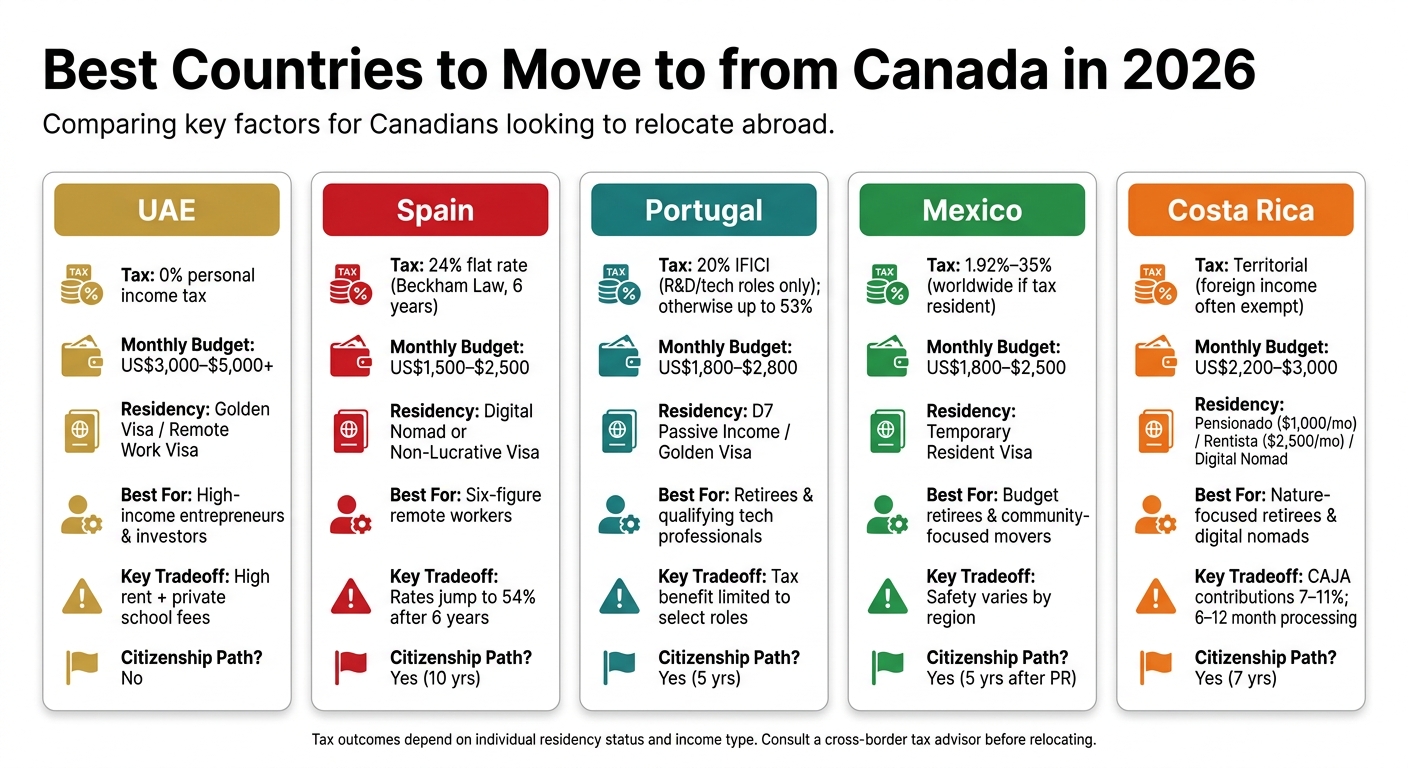
Quick comparison
| Country | Best fit | Tax angle | Typical monthly budget | Main tradeoff |
|---|---|---|---|---|
| UAE | High earners, founders, investors | 0% personal income tax | $3,000-$5,000+ | High rent, private healthcare, school costs |
| Spain | Remote workers with strong income | 24% flat tax for some expats under Beckham Law | $1,500-$2,500 | Tax can jump after the special period ends |
| Portugal | Retirees, EU-focused movers, some tech workers | 20% only for some IFICI cases; others face normal rates | $1,800-$2,800 | Tax edge is much smaller for many people |
| Mexico | Budget-minded retirees and expats who want to stay close to Canada | Up to 35% if tax resident | $1,800-$2,500 | Safety and tax rules vary by case and region |
| Costa Rica | Retirees and remote workers who want a slower pace | Territorial tax for many foreign income types | $2,200-$3,000 | CAJA payments and slower residency processing |
Here’s how I’d think about it in plain English:
- If I wanted to cut income tax as much as possible, I’d look at the UAE first.
- If I wanted to stay closer to Canada and keep costs lower, I’d look at Mexico.
- If I wanted Europe plus a strong short-term tax deal, I’d look at Spain.
- If I wanted EU access and a five-year path toward citizenship, I’d put Portugal on the list.
- If I wanted foreign income treated more lightly and a lifestyle built around weather and nature, I’d look at Costa Rica.
The main takeaway: there is no single best country for every Canadian. The right move depends on whether you care most about lower taxes, lower monthly costs, better healthcare access, or an easier residency path.
The rest of the article breaks those five options down side by side so you can see which one fits your situation.
sbb-itb-39d39a6
1. Portugal
Portugal is still one of the most practical picks for Canadians in 2026. Its cost of living index is 64, compared with Canada’s 89 (U.S. = 100). It also has a tax treaty with Canada, which can help limit double taxation.
Residency Pathways
Portugal gives Canadians a few clear ways in.
The D7 visa works well for retirees and people living on passive income. You need to show about €870 per month from sources like pensions, dividends, or rental income.
The D8 digital nomad visa is built for remote workers. To qualify, you need foreign-source income of at least €3,280 per month.
If you want an option with very little required time in-country, the Golden Visa is the main route. It now requires a minimum investment of €500,000 in qualifying funds or €250,000 in cultural projects. Real estate no longer counts after the 2023 reform. Golden Visa holders only need to spend 7 days in Portugal in the first year, then 14 days in each two-year period after that.
| Visa | Main Requirement | Best For | Path to Citizenship |
|---|---|---|---|
| D7 | ~€870/mo passive income | Retirees, passive investors | 5 years |
| D8 | Remote work income (€3,280+/mo) | Digital nomads | 5 years |
| Golden Visa | €500k (funds) / €250k (culture) | High-net-worth, minimal stay | 5 years |
Tax Burden
Portugal’s old NHR program was replaced in 2024 by IFICI. The new regime still offers a 20% flat rate for 10 years, but only for people in qualifying research, R&D, and innovation roles.
If your job doesn’t fit those rules, you’ll fall under Portugal’s standard progressive income tax system. The top marginal rate is 53% – made up of 48% plus a 5% solidarity surcharge. That’s close to Ontario’s top rate of 53.53%, so for many non-qualifying residents, the tax upside is small. New residents should also know that Portugal now taxes foreign pensions at progressive rates.
For Canadians who care more about tax savings than EU residency, Portugal may feel less attractive once IFICI is off the table.
Cost of Living, Healthcare, and Integration
Daily costs are meaningfully lower than in Canada’s big cities. A comfortable life in Lisbon costs about $1,800 to $2,800 per month, while places like Porto or the Alentejo region usually land around $1,200 to $1,800 per month.
Legal residents can use Portugal’s public healthcare system, the SNS. That said, most applicants carry private insurance until residency is approved.
Portugal also ranks among Europe’s safest countries. English is common in business settings and expat-heavy areas, which makes the move easier at first. Still, plenty of day-to-day paperwork happens in Portuguese.
Portugal makes the most sense for Canadians who qualify for IFICI, retirees using the D7, or Golden Visa investors who want EU access and a safe, steady place to live – assuming their Canadian departure tax planning is already handled.
2. United Arab Emirates
If Portugal is the EU access play, the UAE is the tax-cut play.
For Canadians who want to get rid of personal income tax altogether, the UAE is still one of the most direct options in 2026. It stands out for people who care more about tax efficiency than putting down permanent roots. There is no personal income tax, no capital gains tax, and no tax on dividends. A Canadian earning $250,000 in Ontario keeps about $148,000 to $156,000 after tax, while that same income in Dubai is untaxed.
Tax Burden
The UAE charges a 9% corporate tax on profits above AED 375,000, while qualifying Free Zone companies can still pay 0%. VAT is 5%, and the dirham is pegged to the U.S. dollar.
To break Canadian tax residency, you need to cut residential ties and show UAE residency with documents like a lease and a Tax Residency Certificate.
Residency Pathways
That tax setup matters even more because the UAE gives you several self-sponsored residency routes. You don’t need a local employer to use them.
| Visa | Requirement | Duration | Best For |
|---|---|---|---|
| Golden Visa (Real Estate) | AED 2 million in unencumbered equity | 10 years | High-net-worth investors |
| Golden Visa (Executive) | Minimum monthly salary of AED 30,000 | 10 years | Senior professionals |
| Green Visa (Skilled Employee) | Minimum monthly salary of AED 15,000 | 5 years | Skilled professionals |
| Green Visa (Freelancer) | Annual income of AED 360,000 | 5 years | Freelancers, self-employed |
| Remote Work Visa | Income from a foreign employer | 1 year | Digital nomads, remote employees |
The 10-year Golden Visa can be a strong fit for long-term asset protection and tax planning. If you’re buying property, there’s one detail you can’t miss: mortgage debt does not count toward the AED 2 million requirement. The equity has to be unencumbered.
Cost of Living, Healthcare, and Integration
Day-to-day costs like groceries and fuel are meaningfully lower than in Toronto. Rent tells a different story. A one-bedroom apartment in central Dubai costs about 38% more, and international school tuition can add AED 45,000 to AED 80,000 per child per year.
Healthcare is fully private, and insurance is mandatory. Basic plans start at about AED 320 per year, though broad expat coverage costs much more. The tradeoff is simple: you pay out of pocket or through insurance, but you usually get fast access to specialists with no waitlists. For many Canadians, that’s a sharp contrast with the public system back home.
On safety, Dubai and Abu Dhabi often rank among the top five safest cities in the world. English is the main business language in both cities, and more than 90% of the UAE population is expatriate, which makes day-to-day life easier for most Canadians. In most cases, you can settle in fast without needing Arabic for daily tasks.
The downsides are pretty clear: private healthcare, pricey international schools, extreme summer heat, and a faster work culture. Residency is renewable, not permanent, and most expatriates do not have a simple route to citizenship.
The UAE is a strong match for high-earning Canadians, entrepreneurs, and investors who want a clean break from Canadian tax residency.
3. Mexico
Mexico is a strong option for Canadians who want lower day-to-day costs, short flights back home, and a big expat community already in place. You also get a broad mix of climates, easy travel to and from Canada, and one of the largest Canadian and American expat populations in the world.
That mix gives Mexico a solid middle ground: lower living costs, a decent lifestyle setup, and an easier landing for people who don’t want to start from scratch.
Tax Burden
Mexico isn’t a tax haven. But for many residents, the Canada-Mexico tax treaty and the country’s progressive tax rates of 1.92% to 35% make it workable.
If you spend more than 183 days per year in Mexico, you generally become a tax resident. At that point, Mexico taxes your worldwide income. The treaty helps reduce double taxation by letting taxes paid in one country count as a credit in the other.
So if you’re thinking about asset protection, Mexico usually makes more sense as a lower-cost residency base than as a low-tax play.
Residency Pathways
The main path is the Temporary Resident Visa. It’s usually valid for one to four years and can lead to permanent residency.
As of 2026, applicants generally need to show about US$4,432 per month in income or US$74,687 in savings for temporary residency. Permanent residency usually requires about US$7,430 per month in income.
Visa costs also jumped. In January 2026, fees doubled, and a one-year Temporary Resident Visa reached MXN 11,140. After five years of permanent residency, citizenship may become an option.
Cost of Living, Healthcare, and Integration
Mexico stands out on cost. A mid-range monthly budget for a couple is about US$1,800 to US$2,500, and furnished one-bedroom apartments in expat-friendly places like Lake Chapala start at roughly US$450 to US$650 per month.
Lake Chapala is a good example of why many Canadians feel at home there. The area has an estimated 15,000 to 20,000 Canadian and American residents, plus English-language libraries, theater groups, and a well-built expat support network.
Healthcare is also fairly low-cost:
- Voluntary enrollment in the public IMSS system costs about US$500 to US$600 per year
- Private specialist visits usually cost US$40 to US$80
There are a few tradeoffs. If you buy property in coastal or border areas, you’ll need a fideicomiso, and annual maintenance fees usually run US$500 to US$1,000. Safety also depends a lot on the region. Mérida and San Miguel de Allende are often seen as safer picks, while other parts of the country carry more risk. And once you get outside the main expat centers, Spanish stops being optional and starts being part of daily life.
Spain offers a similar lifestyle in Europe, but costs more and comes with a different tax tradeoff.
4. Spain
Spain is a more polished European pick than Mexico. It has stronger infrastructure and a tax setup that can work very well for qualifying expats. It does cost more than Mexico, but many Canadians see the trade-off as worth it: a mild Mediterranean climate, walkable cities, and a better day-to-day lifestyle. If you qualify, the Beckham Law can also cut your tax bill.
Tax Burden
The big draw here is the Beckham Law. This special tax regime lets qualifying expats pay a flat 24% tax on Spanish-source income up to €600,000 for six years. During that same period, foreign-source dividends, interest, and capital gains are exempt from Spanish tax.
That’s a huge gap when you stack it up against top marginal rates in Ontario (53.53%) or Quebec (53.31%).
The Spain-Canada tax treaty also helps reduce double taxation. Public pensions are usually taxed in Canada, while private registered pensions are mainly taxed in Spain, with Canadian withholding capped at 15%. If you spend more than 183 days in Spain, you’ll usually become a Spanish tax resident.
There’s one catch with the DNV: timing matters. DNV holders must apply for the Beckham Law within six months of registering with Spanish Social Security. Miss that deadline, and you move into the standard progressive tax system, where rates can reach 47% to 54%.
Residency Pathways
Spain has two main routes for retirees and remote workers.
- The Non-Lucrative Visa (NLV) fits retirees or people living on passive income who do not plan to work locally. It requires proof of about €2,400 per month in income for self-support.
- The Digital Nomad Visa (DNV) is meant for remote workers and freelancers. It can be renewed for up to five years.
Cost of Living, Healthcare, and Integration
A comfortable monthly budget in Valencia or Málaga is about €1,400 to €2,200. Madrid and Barcelona usually cost more. Private health insurance, which many expats use with the public system to get faster access to specialists, runs about €50 to €100 per month.
Spain stands out for retirees because daily life is easier in ways that matter: safety, walkability, and access to healthcare. The public health system, SNS, covers legal residents, and infrastructure across most major cities is reliable and easy to use.
For Canadians who want lower costs and a slower pace, Costa Rica is the next comparison.
5. Costa Rica
Costa Rica is a strong match for Canadians who want to build their life around lifestyle first. It’s often easier on the tax side than Spain or Portugal, and it gives you more heat, greenery, and outdoor access than many places in Europe. It tends to work well for retirees and remote workers who want a slower daily rhythm, easy access to nature, and public healthcare, even if it’s not the cheapest option month to month.
Tax Burden
Costa Rica uses a territorial tax system, so Canadian pensions and investment income usually aren’t taxed there. That’s a pretty clean setup for Canadians living on foreign income and trying to avoid the extra layers that come with worldwide taxation.
Residency Pathways
The main visa routes are fairly clear.
- The Pensionado Visa needs $1,000 per month in pension income.
- The Rentista Visa needs $2,500 per month in stable income for at least two years.
- A Digital Nomad Visa is also available as a one-year permit that can be extended, and foreign earnings are exempt from local income tax.
In most cases, residency processing takes about 6 to 12 months, and legal fees usually land between $800 and $1,500.
Cost of Living, Healthcare, and Integration
A mid-range monthly budget usually falls between $2,200 and $3,000. In Central Valley towns like Atenas and Grecia, furnished one-bedroom rentals often cost $500 to $800 per month. In Pacific beach towns like Tamarindo and Nosara, that same kind of rental is more likely to run $900 to $1,500.
Compared with Mexico, Costa Rica is usually about 20% to 35% more expensive. The tradeoff is broader access to public healthcare.
Residents have to enroll in the public Caja (CCSS) system within 90 days of residency approval. Monthly contributions range from 7% to 11% of declared income. Public care is a major draw, but there’s a catch: wait times for specialists can stretch from 2 to 6 months. Because of that, many retirees use Caja for core coverage and add private catastrophic insurance on top.
Private care is still within reach for many people. Private specialist visits cost about $60 to $100, and private insurance for someone age 60 to 65 runs about $120 to $650 per month, depending on the plan. Major private hospitals in San José, including CIMA Hospital and Clínica Bíblica, have JCI accreditation and offer care that’s on par with North American standards.
Safety is generally solid, with a homicide rate of about 11 per 100,000 as of 2026. In expat-heavy areas, petty theft is the main issue. English is common in those hubs, but once you get outside them, Spanish matters a lot more.
Costa Rica belongs on the shortlist for Canadians who care most about lifestyle and simple tax treatment. The better question is what matters most to you: lower costs, an easier residency path, or stronger tax efficiency.
How the Five Countries Compare by Relocation Goal
There’s no one-size-fits-all answer here. The best country for a Canadian depends on what matters most to you: lower taxes, lower day-to-day costs, good healthcare, or a simple route to long-term residency. This table keeps the focus on the big decision points: tax, entry route, monthly budget, and who each place tends to suit best.
| Country | Tax Profile | Residency Pathway | Typical Monthly Budget | Best For |
|---|---|---|---|---|
| UAE | 0% personal income tax | Golden Visa or Remote Work Visa | US$3,000–US$5,000+ | High-income entrepreneurs and investors |
| Spain | 24% flat rate for six years (Beckham Law) | Digital Nomad or Non-Lucrative Visa | US$1,500–US$2,500 | Six-figure remote workers |
| Portugal | 20% IFICI for eligible roles; otherwise progressive tax | D7 Passive Income Visa | US$1,800–US$2,800 | Retirees and qualifying tech professionals |
| Mexico | Tax treatment depends on residency status | Temporary Resident Visa | US$1,800–US$2,500 | Budget retirees and community-focused movers |
| Costa Rica | Territorial tax; foreign-sourced income exempt | Pensionado, Rentista, or Digital Nomad Visa | US$2,200–US$3,000 | Nature-focused retirees and digital nomads |
For retirees living on a moderate pension, Costa Rica has the easiest entry point. Its Pensionado visa requires US$1,000 per month in pension income. Mexico often costs 20%–35% less, but tax residency gets trickier, and safety can change a lot from one region to another. That’s the tradeoff.
Spain stands out for remote workers with strong income. Under the Beckham Law, qualifying expats can pay a flat 24% on Spanish-source income for six years, while foreign-source investment income stays outside that system during the same period. Once that six-year window ends, standard progressive rates can climb as high as 54%.
If your main goal is paying no personal income tax, the UAE is still the clear front-runner. That 0% rate applies to salary, capital gains, dividends, and interest, with no set end date. Of course, there’s a catch: for families, private school tuition and required health insurance can add a lot to monthly spending.
Portugal is a bit more mixed. The IFICI regime gives qualifying R&D and tech workers a flat 20% rate, which is a strong deal. But most retirees and general remote workers won’t get that treatment. They’ll usually fall under progressive rates that can reach 53%. So Portugal tends to make the most sense for people who meet the IFICI rules or want long-term access to the EU, even if the tax picture isn’t as friendly for everyone else.
Pros and Cons of Each Country
After the country-by-country breakdown, this table narrows the decision to the tradeoffs that matter most.
| Country | Top Pros | Top Cons | Best Match |
|---|---|---|---|
| Portugal | 5-year citizenship path; low-stay Golden Visa | IFICI limits the 20% flat rate to R&D and tech roles; most remote workers fall into progressive tax | Passive income earners on the D7; qualifying tech professionals |
| UAE | 0% personal income tax; modern infrastructure and high safety | No citizenship path; international school fees run AED 45,000–80,000 per child per year; central Dubai rent runs roughly 38% higher than Toronto | High-income entrepreneurs and investors |
| Mexico | Lowest cost; large expat communities | Worldwide income taxed at 1.92%–35%; coastal and border property requires a fideicomiso trust at $500–$1,000 per year | Budget-conscious retirees and remote workers |
| Spain | Beckham Law: 24% flat rate; high quality of life and healthcare | Progressive rates reach 54% after the six-year window; 183-day residency requirement | Digital nomads and qualifying employees |
| Costa Rica | Territorial tax; public healthcare access | Residency approval takes 6–12 months; mandatory CAJA contributions of 7%–11% of declared income; costs run 20%–35% higher than Mexico | Families and nature-focused retirees |
The UAE stands out on taxes. But for families, school fees, rent, and health insurance can eat into that edge fast.
Conclusion
Each country comes out ahead for a different reason.
Here’s the short version. The UAE is the clearest pick if your main goal is zero personal income tax. Mexico stands out for closeness to Canada, simple travel, and a big expat community. Portugal makes sense for Canadians who want EU access and a five-year path to citizenship. Spain fits workers who qualify for the Beckham Law. Costa Rica works well for Canadians who want territorial taxation and a slower pace, but the residency setup has to be done the right way.
Don’t lock in on just one country too early. Shortlist two or three. Then match your income source to the tax rules, decide if you want a path to citizenship or just a good home base, and be honest about how much paperwork and admin you’re willing to deal with.
Once that shortlist is set, the next step is tax residency planning. Get cross-border tax and asset-protection advice before you move. Canada’s departure tax can trigger capital gains when you leave, and getting that wrong can be expensive.
In 2026, the best move is the one that fits your tax profile, residency goal, and tolerance for complexity. For Canadians in 2026, planning matters more than location.
FAQs
How do I stop being taxed as a Canadian resident after moving?
To stop being taxed as a Canadian resident, you need to end your Canadian tax residency by severing your residential ties. Just leaving Canada isn’t enough. The CRA looks at your residency status, not only where you happen to live.
That usually means cutting major ties to Canada, such as your home, bank accounts, and provincial health coverage. You’ll also need to file a departure return.
If you want the CRA’s view on your situation, you can ask for a residency status determination with Form NR73.
Which country is best if I want a path to citizenship?
If your main goal is a clear, fairly fast path to citizenship, Paraguay stands out. It offers a route to a passport in three years.
Other solid options include:
- Portugal, after 10 years of permanent status
- Mexico and Ecuador, after five years of permanent residency
- Vanuatu, through citizenship by investment in months, with no residency requirement
What hidden costs should I expect beyond rent and taxes?
Beyond rent and taxes, you also need to budget for mandatory healthcare, possible Canadian departure and withholding taxes, and immigration-related legal and government fees.
Then there’s the stuff that sneaks up on people: utilities, lifestyle creep, and dependent schooling. In some hubs, schooling can run more than $15,000 per child per year. That adds up fast.
The biggest mistake? Planning for rent alone instead of your full cost of living.
