
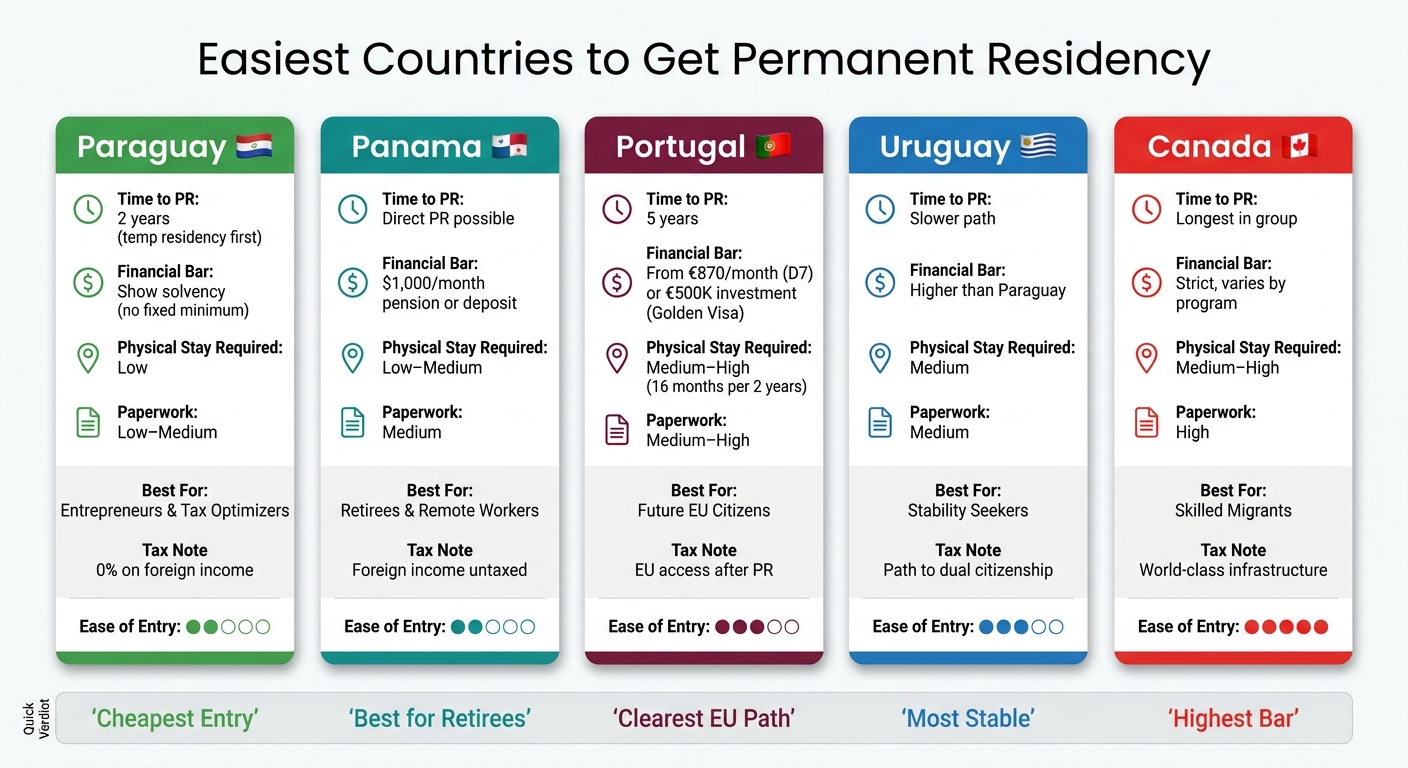
If I had to give the short answer first: Paraguay and Panama are the easiest picks for low cost and light stay rules, Portugal is the clearest long-term EU path, Uruguay is more stable but harder to enter, and Canada is the toughest of the five.
If you want permanent residency, I’d look at four things right away:
- How long it takes
- How much money you need
- How much time you must spend there
- How much paperwork you’ll face
This article compares Paraguay, Portugal, Panama, Uruguay, and Canada through that lens.
A few key takeaways stand out fast:
- Paraguay is the cheapest entry point, but PR now comes only after 2 years of temporary residency.
- Panama is one of the simplest routes for retirees and people with foreign income.
- Portugal usually takes 5 years, but the rules are more clearly laid out.
- Uruguay tends to ask for more income proof, but many people like the lifestyle and stability.
- Canada has the highest bar, the most paperwork, and the longest wait in this group.
Quick comparison:
| Country | Time to PR | Money Bar | Stay Rule | Paperwork |
|---|---|---|---|---|
| Paraguay | After 2 years of temporary residency | No fixed published minimum; must show solvency | Low | Low to medium |
| Panama | Direct PR path may be possible | Pension, job, business, or deposit | Low to medium | Medium |
| Portugal | Usually 5 years | From about €870/month or more, depending on visa | Medium to high | Medium to high |
| Uruguay | Slower path | Higher income proof than Paraguay | Medium | Medium |
| Canada | Usually the longest | Varies by program; often strict | Medium to high | High |
So if you want the easiest low-cost route, I’d put Paraguay near the top. If you want a simple retiree-friendly setup, I’d look at Panama. If your goal is EU access after a longer wait, Portugal is the one to watch.
Below, the article breaks down where each country fits, who it suits best, and what trade-off comes with it.
1. Paraguay
Paraguay ranks high for a simple reason: it keeps costs low, asks for little in-person time, and has easy-to-follow tax rules.
Since October 2022, the process has changed. Applicants now need to get temporary residency first, which stays valid for two years, and only after that can they apply for permanent residency. The old fast-track path, which required a $5,000 USD bank deposit, is no longer available.
To qualify, applicants need to show economic solvency through one of the usual paths:
- Employment
- A pension
- Investment income
- An active business
There’s no published fixed minimum, which gives this route some flexibility. On top of that, the physical presence requirement is minimal.
The tax side is a big part of the appeal. Paraguay taxes only local income, which means foreign-earned income stays outside the tax net. That includes offshore business profits, dividends, and investments.
For the right person, that can be a strong setup. It tends to fit:
- Entrepreneurs
- Investors
- Digital nomads
- Retirees
In plain terms, Paraguay works well for people who want a low-cost base in South America without getting tangled up in heavy tax rules.
There are trade-offs, though. Spanish is a must for dealing with paperwork and daily life. Infrastructure gets weaker once you leave the main cities. And summers can get brutal, with temperatures topping 100°F.
That makes Paraguay the low-cost benchmark in this comparison. The next option moves away from low-cost simplicity and into a different residency model.
sbb-itb-39d39a6
2. Portugal
Portugal is more structured than Paraguay. There are a few clear residency paths, but the standard route to permanent residency takes five years of legal residency. So compared with Paraguay, Portugal moves more slowly and asks for more paperwork. On the flip side, the long-term path is easier to follow.
The main options are the D7 visa for retirees and people with passive income, the D8 visa for remote workers and freelancers, and the Golden Visa for investors.
| Visa Type | Best Suited For | Minimum Financial Requirement | Path to PR |
|---|---|---|---|
| D7 Visa | Retirees, passive income earners | €870/month in passive income | 5 years |
| D8 Visa | Remote workers, freelancers | €3,280/month in active remote income | 5 years |
| Golden Visa | High-net-worth investors | €500,000 investment in eligible rural or development-zone projects | 5 years |
In plain English, Portugal tends to fit people who can show steady income or available capital and who are okay with a longer wait.
The D7 is aimed at retirees and passive-income applicants. If you’re applying with family, the income bar goes up by 50% for a spouse and 30% per child. The D8 is for remote employees and freelancers, and it requires proof of work status plus income equal to four times the Portuguese minimum wage.
There’s also a residency stay rule to think about. D7 holders usually need to spend 16 months in Portugal every two years to keep residency. If you travel a lot or split time across countries, that can feel a bit tight.
The Golden Visa is still available through select investments, mostly outside major-city real estate.
Taxes are another big part of the choice. Portugal changed its tax rules in 2024 when the old NHR regime was scaled back. Before applying, it makes sense to review the current U.S.-Portugal tax treaty.
3. Panama
Panama lands in the middle between Paraguay’s low-cost simplicity and Portugal’s more structured residency setup. It’s a practical pick for expats and retirees who want a clear path to residency and tax efficiency.
One big plus is the country’s U.S. dollar-based economy. That cuts out local currency risk. Panama also taxes only income earned inside the country, which means foreign income is not taxed. For people living off income from abroad, that can be a strong draw.
The main path to permanent residency is the Friendly Nations Visa. It’s open to citizens of countries with established economic or professional ties to Panama, including the United States. Qualified applicants can apply for permanent residency directly, without first going through a temporary residency period.
To qualify, applicants usually need to show economic ties through one of the following:
- Employment
- Business ownership
- A qualifying bank deposit
Compared with Portugal’s five-year path, the process can move faster. That said, the paperwork is still moderate, and legal help is often recommended to keep things on track.
Panama works well for expats, retirees, and people earning income abroad who want a straightforward legal route and a stable financial setting. The trade-off is pretty simple: more documentation than Paraguay and a higher cost of living in Panama City.
Uruguay follows with a more stable but usually more demanding path.
4. Uruguay
If Panama sits in the tax-friendly middle, Uruguay leans more toward stability and day-to-day comfort. It tends to fit applicants who want a higher standard of living, modern infrastructure, universal healthcare, and a long-term path that can lead to dual citizenship.
Uruguay’s residency route is open to many people, but it calls for more income proof than Paraguay. So while Paraguay is easier to enter, Uruguay asks for a stronger financial case. That makes Uruguay a better match for applicants who can clear that higher bar.
For people thinking long term, Uruguay gives up some ease of entry in exchange for more stability and a better quality of life.
Next comes Canada, which is more structured and usually harder to qualify for.
5. Canada
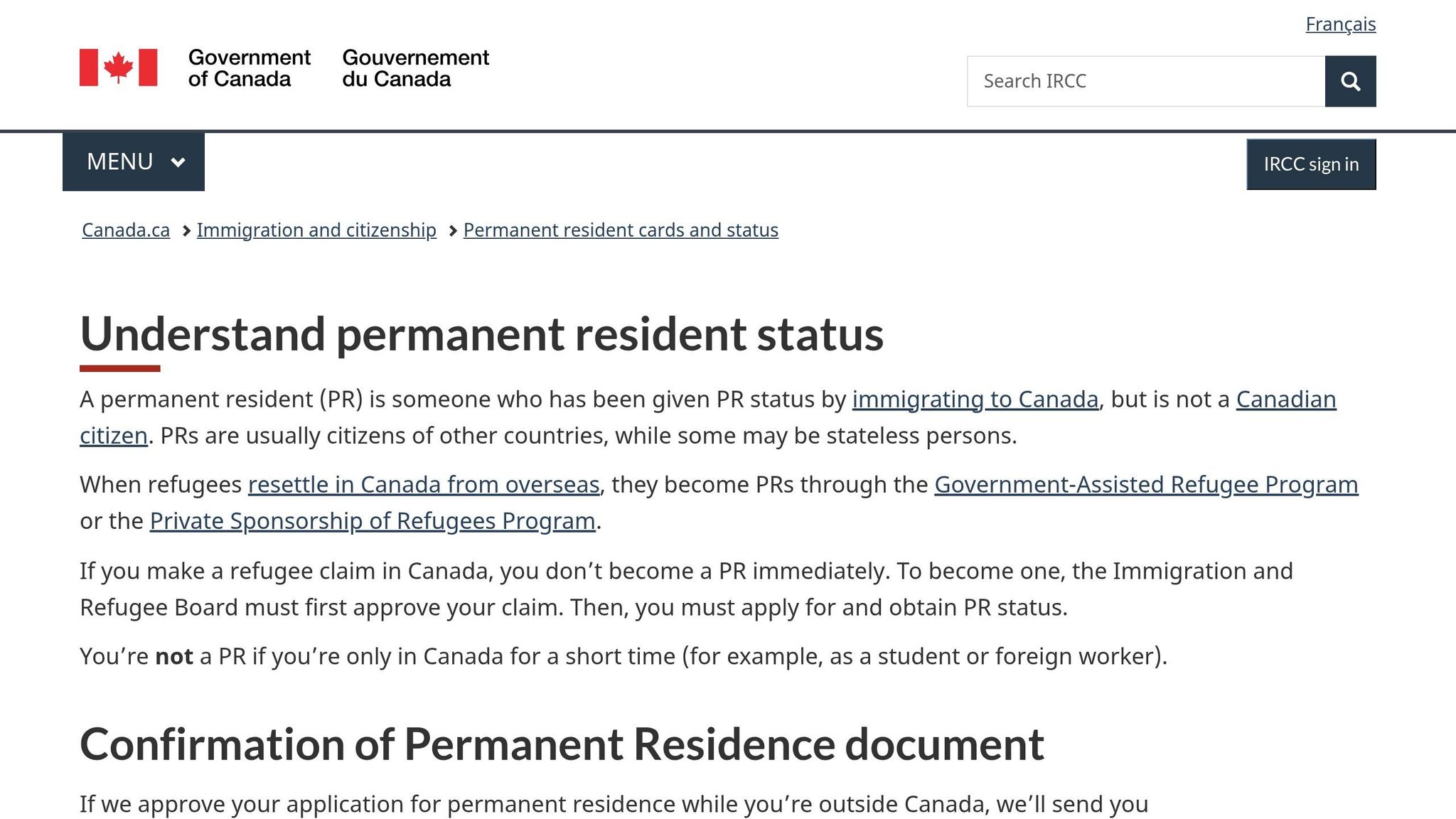
Canada is on the stricter end of the range. In this group, it’s the most structured and least accessible path, with longer wait times and tighter eligibility rules than Paraguay, Panama, Portugal, or Uruguay. That makes it a better match for applicants who can meet formal immigration standards and are ready to wait longer for approval.
Across the four core factors – timeline, cost, presence, and documentation – Canada is the most demanding. Processing takes longer. Income and language rules are tighter. And the paperwork load is heavier than in any other country on this list.
That creates a pretty clear trade-off: easier entry in Paraguay and Panama, more structure in Portugal and Canada, and stronger lifestyle stability in Uruguay.
How Each Country Compares: Strengths and Weaknesses
The main differences come down to speed, cost, physical presence, and taxes.
At a glance, Paraguay is the cheapest, Panama is the easiest pick for retirees, Portugal gives you the clearest rules-based path, Uruguay asks more from applicants but offers stability, and Canada has the toughest bar to clear.
Here’s the short version of where each country stands:
- Paraguay is still the low-cost option, but permanent residency now comes only after two years of temporary residency.
- Panama stands out for retirees. Its Pensionado Visa starts at $1,000 per month, plus $250 per dependent, and foreign income is generally not taxed.
- Portugal is more structured for people with steady income. Permanent residency or citizenship usually takes five years.
- Uruguay offers strong stability and a high quality of life, but getting in is harder than in Paraguay .
- Canada has the strongest legal and institutional setup, but it’s also the hardest to access, with the longest timelines and the tightest rules.
The table below lays out the trade-offs in plain English.
| Country | Pros | Cons |
|---|---|---|
| Paraguay | Lowest cost of entry, territorial tax system | Two-year temporary residency required before permanent status |
| Panama | Pensionado Visa starts at $1,000/month, foreign income generally untaxed | Requires qualifying pension or income proof |
| Portugal | Clear legal pathway, EU access after permanent residency | Higher income thresholds, five-year wait for permanent status |
| Uruguay | High quality of life, stable institutions, path to dual citizenship | More demanding income requirements than Paraguay |
| Canada | Strong legal protections, world-class infrastructure | Longest timelines, strictest eligibility, heaviest documentation load |
Pros and Cons of Each Country
The table below takes the big-picture comparison and turns it into a simple fit check: which country is easiest, and who is it best for?
| Country | Pros | Cons | Best Match |
|---|---|---|---|
| Paraguay | Territorial tax system (0% on foreign income), low cost of living, private health insurance from $50 to $150 per month | Two-year temporary residency required before permanent status, proof of economic solvency, language barrier, poor rural infrastructure | Entrepreneurs and investors focused on tax optimization |
| Portugal | High safety levels, clear five-year path to citizenship, passive income threshold of €820/month for the main applicant | NHR tax benefits restricted since 2024, 16 months in the first two years | Retirees and future EU citizens wanting long-term security |
| Panama | U.S. dollar-based economy, territorial tax on foreign income, Friendly Nations visa and 183-day tax rule | Banking compliance is strict, local business "substance" rules are complex | Digital nomads and remote business owners with foreign clients |
| Uruguay | High quality of life, stable institutions, path to dual citizenship | More demanding income requirements than Paraguay, longer path to permanent status | Applicants who prioritize stability and long-term quality of life over speed |
| Canada | Strong legal protections, world-class infrastructure | Longest timelines, strictest eligibility, heaviest documentation load | Applicants who meet formal immigration standards and can wait longer for approval |
Below, each country is narrowed down to its main use case and biggest trade-off.
Paraguay makes sense for entrepreneurs and investors who want the lowest cost of entry and a territorial tax system. The catch is simple: you still need to go through a two-year temporary residency period before permanent status becomes available.
Portugal is the clearest option for people who want a long-term residency route tied to EU access. The main trade-offs are the five-year timeline and the tax changes that have limited NHR benefits since 2024.
Panama works well for digital nomads and remote business owners with foreign clients. The appeal is the U.S. dollar economy and territorial taxation on foreign income, but stricter banking compliance is the part that tends to slow people down.
Uruguay and Canada ask for more patience. They are less flexible, but they stand out for applicants who care more about stability, stronger institutions, or long-range peace of mind than speed.
Conclusion
These five routes break down into three main groups: low-cost access, long-term residency, and skilled migration with a higher bar.
Paraguay is the lowest-cost way in, with light stay rules and a territorial tax system. Portugal is the clearest long-term option for people who want EU access and a defined five-year road to citizenship. Panama stands out for retirees and investors because its residency routes are fairly direct. Uruguay fits people who care more about stability than speed and don’t mind spending more time in the country. Canada gives skilled workers a clear path to permanent residency if they meet federal or provincial rules.
One thing to watch: immigration rules can shift fast. Paraguay added a two-year temporary residency step in 2022, Portugal has narrowed some property-linked routes, and income thresholds often move with local minimum wages each year. So before you send in an application, check the official immigration portal.
The best option depends on your own setup: your budget, how much time you can spend abroad, whether citizenship is part of the plan, and how much paperwork or process you’re ready to deal with. There’s no single easiest country for everyone. But there’s probably one here that lines up better with what you want.
FAQs
Which country is best for retirees?
Panama and Portugal often come up as top picks for retirees, and a big reason is their visa options.
Panama offers a Pensioner Visa for people who receive a lifetime monthly pension of at least $1,000. That gives retirees a clear path if they already have steady income coming in.
Portugal is well known for its D7 visa, which is aimed at people with stable passive income, such as pensions, real estate income, or dividends. Like Panama, Portugal gives retirees a clear legal path to long-term residency.
Can I include my family in the application?
It depends on the country and the program you pick. Many golden visa programs, along with some residency routes, let you bring a spouse and dependent children.
Digital nomad visas are a bit more mixed. Some let you add dependents. Others don’t. That’s why it pays to check the exact rules before you apply. In many cases, you’ll need to show extra income for each family member.
Does permanent residency lead to citizenship?
Yes, permanent residency can lead to citizenship, but the answer depends on the country’s laws.
In many countries, you can apply for naturalization after holding permanent residency for 3 to 10 years. But that’s not always the case. Some countries offer permanent residency without a clear route to citizenship.
That’s why the fine print matters. Check the country’s rules on things like continuous residency and physical presence, because those details often decide whether you can move from permanent resident to citizen.
