
If I had to cut this down to one line, it’s this: Switzerland and Singapore lead in 2026, Norway and Denmark are steady Nordic picks, the UAE is strong for dollar-linked cash and tax simplicity, and Luxembourg, Canada, and Austria fit more specific roles.
If I’m looking at where money may hold up best, I’d focus on four things first:
- State finances
- Bank safety
- Currency steadiness
- Rule of law
This article looks at 8 countries through that lens: Switzerland, Singapore, Norway, the UAE, Luxembourg, Denmark, Canada, and Austria.
A few points stand out right away:
- Switzerland remains the top all-around pick for wealth protection
- Singapore is the top Asian option, with $361 billion in reserves and AAA ratings
- Norway stands out for state balance-sheet strength, backed by energy wealth
- The UAE offers a U.S. dollar peg and low entry points, often from $10,000+
- Luxembourg is more about EU funds and custody than plain cash parking
- Denmark offers AAA sovereign strength and a krone linked to the euro
- Canada is stable, but the CAD is less of a safe-haven currency
- Austria is a stable eurozone option, though it lacks a separate currency shield
One thing I’d keep in mind: this is a wealth-protection comparison, not a tax or relocation guide. For personalized strategy, we offer private consultations. And if you’re a U.S. person, foreign accounts can trigger FBAR and sometimes Form 8938 reporting.
Quick Comparison
| Country | Best Known For | Currency Profile | Banking Access | Best Fit |
|---|---|---|---|---|
| Switzerland | Private banking and neutrality | CHF safe haven | Higher minimums, often in person | Long-term wealth storage |
| Singapore | Asian banking hub | Stable SGD | Often $200,000-$350,000 SGD minimums | Global cash and Asian access |
| Norway | State financial strength | NOK less stable than CHF/SGD | Conservative system | Steady developed-market holdings |
| UAE | Dollar-linked cash and low tax | AED pegged to USD | Often from $10,000+ | Mobile investors and residency-linked banking |
| Luxembourg | EU funds and custody | Euro exposure | Strong for structures, less for plain deposits | Cross-border EU investing |
| Denmark | Low-noise stability | DKK linked to euro | Plain, conservative banking | Cash parking with euro link |
| Canada | G7 banking depth | CAD moderate | Deep banking access | North American banking ties |
| Austria | Stable EU banking | Euro exposure | Compliance-first banking | European cash and investment setups |
Bottom line: if I wanted the shortest answer, I’d put Switzerland first, Singapore second, and then choose the rest based on use case: Norway or Denmark for steady rule-based systems, the UAE for dollar-linked flexibility, and Luxembourg for EU structures.
That’s the frame for the rest of the article.
sbb-itb-39d39a6
1. Switzerland
Switzerland remains the top all-around jurisdiction for wealth protection in 2026. Its long-standing neutrality gives Swiss finance a buffer against great-power rivalry, sanctions pressure, and shifting trade blocs. That mix helps explain why Switzerland is still the benchmark for the countries that follow.
Sovereign Strength
The Swiss National Bank holds large gold reserves, which help support the franc’s safe-haven status. Swiss banks held CHF 9,284 billion in assets under management at the end of 2024, and 45.5% of that came from foreign clients. That kind of scale keeps Switzerland at the center of the global market for cash holdings and custody.
Banking Safety
That strength comes with strict entry standards. Swiss banks are tightly regulated, and their standards go beyond those in most onshore jurisdictions. The trade-off is simple: tougher onboarding and higher minimums. Private banking usually starts at CHF 100,000, and many banks still require an in-person visit.
Currency Stability
The CHF is one of the world’s strongest safe-haven currencies. For wealth preservation, the appeal of CHF is stability, not yield.
Legal Protection
Swiss law still blocks banks from disclosing customer information without consent, even though the country fully takes part in the OECD’s Common Reporting Standard (CRS). In plain English, tax transparency is mandatory, but client privacy still stands.
Singapore is the closest peer, but it competes on efficiency rather than neutrality.
2. Singapore
Singapore is the top alternative to Switzerland for mobile capital in 2026. Its edge isn’t neutrality. It’s speed, regulation, and access to Asian markets.
Sovereign Strength
Singapore holds AAA credit ratings from both Standard & Poor’s and Moody’s, backed by USD 361 billion in reserves and zero net government debt. In plain English, that gives the country a strong cushion if global markets get hit. That mix of reserves and fiscal discipline also supports confidence in its banking system.
Banking Safety
MAS oversees a banking system with more than USD 2.5 trillion in assets. For nonresidents, minimum balances at major banks often start around SGD 200,000 and can rise to SGD 350,000.
The Singapore Deposit Insurance Corporation (SDIC) covers deposits up to SGD 100,000 per depositor per institution, including qualifying foreign currency deposits. If you’re holding more than that, the simple move is to spread balances across more than one bank. That same cautious, rules-first approach helps explain why the Singapore dollar has remained resilient.
Currency Stability
MAS manages the SGD against a basket of trading partner currencies through an exchange-rate band. That setup has helped keep inflation contained and the currency steady through global shocks. Singapore’s assets under management are also highly international, with 88% invested outside the country. So this isn’t a closed, inward-looking system. It’s built to connect with global capital flows while keeping a firm hand on monetary stability.
Legal Protection
Singapore uses a territorial tax system with no capital gains tax and no inheritance tax. That makes wealth structuring more straightforward and more predictable. The country is also fully CRS-compliant, and family-office tax exemptions can add value, though they require local substance.
Put it all together and Singapore stands out as one of the strongest all-around jurisdictions for holding cash and diversified assets.
3. Norway
After Switzerland and Singapore, Norway stands out for a different reason: less banking scale, more state balance-sheet strength. Its stability comes from energy wealth, low public debt, and strong institutions. If the main goal is to protect capital rather than chase yield, Norway deserves a close look.
Sovereign Strength
Norway’s energy wealth and low public debt support a strong sovereign balance sheet. Because the country produces its own energy, the economy has more insulation when outside shocks hit. That gives Norway a resource-backed Nordic stability profile among the jurisdictions covered here.
Banking Safety
Norwegian banks are tightly supervised by Finanstilsynet and remain well capitalized. Deposits are protected by the Norwegian Banks’ Guarantee Fund. That same conservative approach also helps support confidence in the krone.
Currency Stability
The krone benefits from Norway’s fiscal strength, but it is not a top-tier safe-haven currency. Put simply, it does not serve as the same kind of pure safe-haven as the Swiss franc.
Legal Protection
Norway’s rule of law makes account access, contracts, and enforcement predictable. That matters more than people sometimes think. When money is parked abroad, clear rules and steady enforcement can be just as important as returns.
It ranks below Switzerland and Singapore for offshore business use, but it remains a strong Nordic choice for stability and capital safety. For investors who want a stable developed-market jurisdiction without the Swiss or Singaporean level of intensity, Norway remains highly relevant in 2026.
4. United Arab Emirates
The UAE takes a different route to stability than Norway, Switzerland, or Singapore. Its draw in 2026 comes from zero personal income tax and a modern banking system. For people holding cash, the UAE is less about reserve-currency status and more about being a neutral place where money can be held and moved with less friction.
Sovereign Strength
The UAE’s fiscal position is backed by deep sovereign wealth. Abu Dhabi Investment Authority manages one of the largest sovereign wealth funds in the world. That balance-sheet depth lowers the country’s reliance on outside borrowing and helps support long-term financial continuity for asset holders who want to limit sanctions and political risk.
Banking Safety
UAE banks, especially in Dubai and Abu Dhabi, are closely tied to trade flows across the Middle East, Africa, and South Asia. That matters because banking strength often follows commercial activity.
For offshore accounts in Dubai, minimum deposits usually start at $10,000+. Remote account opening can be possible, but it often requires specific documents or video verification. The UAE also takes part in the OECD’s Common Reporting Standard (CRS), so the focus is on offshore asset protection, not secrecy.
Currency Stability
For money held in cash or deposits, the main point is the dirham’s steadiness against the U.S. dollar. The AED has been pegged to the dollar at a fixed rate since 1997. That removes exchange-rate swings as a risk for dollar-denominated holdings and makes capital preservation easier to plan around.
Legal Protection
The UAE offers long-term residency paths like the Golden Visa, which can support banking access and legal continuity for mobile investors holding assets in the country. In plain English, residency helps make financial relationships easier to keep in place over time. Assets can stay under a stable legal framework, while the residency side gives holders a dependable base for banking and administration.
That makes the UAE a strong fit for access and flexibility, while the next country stands out more for classic European banking depth.
5. Luxembourg
If your focus moves away from banking flexibility and toward regulated European investment setups, Luxembourg starts to make a lot more sense. It’s one of Europe’s main centers for internationally diversified assets, especially funds and cross-border structures.
Sovereign Strength
Luxembourg stands out for institutional reliability, EU oversight, and deep experience with cross-border fund structures. In plain English, it’s a solid place to hold internationally diversified assets if you want EU-based stability backed by established offshore banking and fund operations.
Banking Safety
Luxembourg’s main edge is its role as a fund domicile and its access to EU passporting. EU passporting allows authorized products to be distributed across the bloc, which makes Luxembourg especially useful for investors who want entry to European markets through one tightly regulated hub.
Luxembourg also takes part in the OECD’s Common Reporting Standard (CRS), so account holders should expect full transparency with their home tax authorities.
Currency Stability
The euro gives Luxembourg steady core exposure for investors who already hold European assets. The trade-off is simple: monetary policy is set at the Eurozone level, not by Luxembourg itself.
Legal Protection
Luxembourg’s legal framework is based on EU law, which supports strong investor protection and oversight. It works best for compliant cross-border investment structures, not secrecy or hiding cash.
For U.S. investors, FATCA and FBAR reporting still apply, and Luxembourg banks are used to handling that paperwork.
That makes Luxembourg a stronger choice for structured portfolios than for simply parking deposits. If deposits matter more than fund vehicles, the next jurisdiction is the better fit.
6. Denmark
Denmark gets less attention than Luxembourg, but it offers a lot of the same developed-market stability with less hassle. If your main goal is to park cash in a steady place and keep banking relationships simple, Denmark stands out as a clean, conservative pick.
Sovereign Strength
In 2026, Denmark’s appeal comes down to a few plain facts: stable institutions, strong rule of law, and low policy noise. Its AAA-rated sovereign balance sheet and low public debt give the country a steady fiscal base, which helps support long-term confidence for asset holders.
Banking Safety
Danish banks are well-capitalized and closely supervised. They operate in a compliance-focused system that puts stability and service quality ahead of complicated structuring. For people who want straightforward cash holdings and dependable banking relationships, that matters.
Currency Stability
The Danish krone is pegged to the euro through the ERM II mechanism, and that link has kept it very stable. If you hold euro-denominated assets, the peg cuts down most exchange-rate uncertainty and makes capital preservation easier to map out.
Legal Protection
Denmark’s rule of law ranks among the strongest in the world. That helps lower the risk of sudden policy shifts and makes account access, contracts, and enforcement highly predictable.
That makes Denmark a clean, conservative stop before moving to Canada, where scale matters more than exclusivity.
7. Canada
Canada brings North America into the mix. Its stability comes less from neutrality and more from strong institutions. It’s a stable G7 jurisdiction for cash, banking, and mixed asset holdings, though it sits below Switzerland, Singapore, and Norway when you look at neutrality and currency strength.
Sovereign Strength and Banking Safety
Canada offers predictable courts, stable institutions, and deep banking access. Its major banks carry low counterparty risk and operate under close regulatory supervision, which makes them a solid fit for plain cash holdings and cross-border banking relationships. That institutional base also supports the CAD, but only at a middle-tier safe-haven level.
Currency Stability
The CAD is stable, but it isn’t a top safe-haven currency. Compared with the CHF or SGD, it has more exposure to commodity cycles and shifts in global risk appetite. That makes it less appealing if your main goal is pure wealth preservation.
Legal Protection
The legal system where your wealth sits is an asset in its own right. Canada’s courts are independent, property rights are enforced well, and contract law is predictable. For globally mobile professionals and investors who hold assets in a stable common-law jurisdiction, that record counts.
Canada is a dependable secondary haven, not a first-choice fortress. It lands in the middle of the pack, not the top tier.
8. Austria
Austria is a stable eurozone jurisdiction for compliant cash holdings and European investment structures. That makes Austria a clear, transparent option for European assets, but not a top pick for secrecy or currency defense.
Sovereign Strength and Banking Safety
As an EU member, Austria gives you access to cross-border fund structures and conservative banking under established EU oversight. The draw here is stability and compliance, not secrecy.
Currency Stability
Austria uses the euro, which brings liquidity and scale, but less safe-haven protection than the Swiss franc. In plain English: its edge comes from stability inside the euro system, not from standing apart as its own currency shield.
Legal Protection
Austria is CRS-compliant, so account data is reported across borders. This is a transparency jurisdiction, not a secrecy jurisdiction.
Austria sits in the stable middle tier, and the next section weighs it against the other seven jurisdictions.
How These Countries Compare Across the 4 Key Criteria
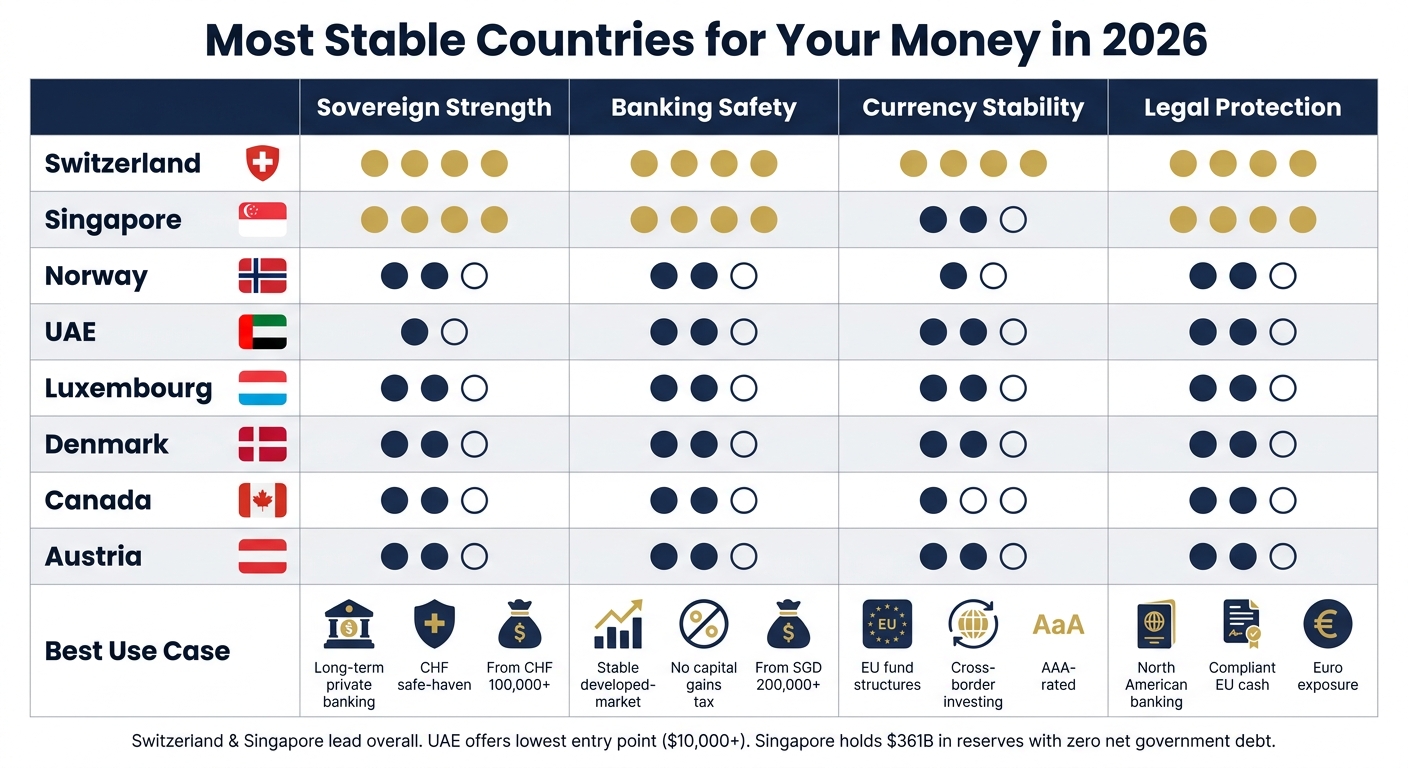
Now that the country-by-country profiles are in place, it helps to line them up side by side. That makes the trade-offs much easier to spot.
The big takeaway is simple: no single country wins across all four criteria. Each one has its own edge. The table below gives you a quick way to see where each jurisdiction stands.
Sovereign Strength
Switzerland and Singapore sit at the top here. Norway and Denmark come next. Luxembourg, Canada, Austria, and the UAE rank lower if your main goal is pure wealth protection at the state level.
Banking Safety
Switzerland leads on scale. Singapore stands out for banking depth and digital infrastructure. Luxembourg is strong for funds and custody. Canada, Austria, and Denmark lean on conservative regulation. The UAE stands out for flexible cross-border access.
Currency Stability
The Swiss franc is the strongest safe-haven currency in this group. The SGD is highly stable. The AED is pegged to the U.S. dollar. The DKK tracks the euro. The NOK tends to move around more.
For cash holdings, currency strength matters a lot. For structures, legal protection often matters more.
Legal Protection
The table below shows how all eight countries stack up across the four criteria:
| Country | Sovereign Strength | Banking Safety | Currency Stability | Legal Protection |
|---|---|---|---|---|
| Switzerland | Very High | Very High | Very High | Very High |
| Singapore | Very High | Very High | High | Very High |
| Norway | High | High | Moderate | High |
| UAE | Moderate | High | High | High |
| Luxembourg | High | High | High | High |
| Denmark | High | High | High | High |
| Canada | Moderate | High | Moderate | High |
| Austria | Moderate | High | High | High |
Legal protection is strongest where rule of law and structuring options come together. In practice, that points to Singapore for family offices, the UAE for tax simplicity and privacy, and Luxembourg for EU fund structures.
Pros and Cons by Country
The rankings above show who leads. This table shows where each country tends to work best in day-to-day use.
| Country | Best Use | Main Strengths | Main Drawbacks |
|---|---|---|---|
| Switzerland | Long-term cash and private banking | Political neutrality; CHF safe-haven status; deep private banking infrastructure | Minimums from CHF 100,000+; limited remote opening |
| Singapore | Fast digital banking and Asian market access | Strong sovereign backing and highly capitalized banks; no capital gains tax; digital onboarding | High compliance burden; minimums typically from SGD 200,000 |
| Norway | Stable developed-market cash holdings | Resource-backed sovereign strength; conservative banking supervision; strong rule of law | NOK is not a top safe-haven currency; limited global banking scale |
| UAE | Tax-light residency and capital protection | Dollar peg stability; residency-linked banking access; low minimum deposits from $10,000+ | Remote opening is limited for nonresidents; in-person requirements common |
| Luxembourg | EU fund and custody structures | Major hub for fund structures; EU passporting; established cross-border investment framework | Less suited for plain cash deposits; complex regulatory environment |
| Denmark | Conservative cash holdings in a eurozone-linked currency | AAA-rated sovereign; euro peg stability; strong rule of law | Limited global banking reach; less useful for non-European asset structures |
| Canada | North American cash and banking relationships | Stable G7 institutions; predictable courts; deep banking access | CAD has commodity exposure; below top tier for neutrality and currency strength |
| Austria | Compliant European cash and investment structures | EU membership; conservative banking under EU oversight; CRS-compliant | Euro limits currency defense; no safe-haven currency advantage |
No country does everything well. Switzerland stands out for long-term private banking. Singapore is often the go-to choice for digital access and Asian market reach. UAE can make sense if residency and lower entry deposits matter more than remote setup.
Meanwhile, places like Luxembourg and Austria are often more about structure and compliance than plain cash storage. Canada, Denmark, and Norway offer stability, but each comes with trade-offs in currency profile, scale, or cross-border use.
Use each jurisdiction for the role it does best.
Conclusion
No single country gets every part of this right. The best jurisdiction comes down to what you want to protect and how you plan to use your money. In practice, that usually points to a mix of jurisdictions, not one home base.
If safe-haven currency exposure is the main goal, Switzerland is still the clearest pick. If you care more about predictable law and smooth banking access, Singapore stands out for legal predictability and efficient banking access. If the goal is no personal income tax and trade-linked cash flows, the UAE plays a different part as a neutral hub for internationally mobile investors.
The practical takeaway is simple: split balances by function, not by habit. Don’t pile all assets into one jurisdiction just because it feels easier.
Once the structure is in place, reporting comes next. If you’re a U.S. person, every foreign account must be reported. FBAR and, when it applies, FATCA reporting still apply.
FAQs
How should I choose between Switzerland and Singapore?
Choose based on your money goals and where you want your banking ties to be.
Switzerland tends to fit people who want multi-generational wealth planning, private banking, and the stability of the Swiss franc. The trade-off is the entry point: many banks often ask for minimum deposits starting at around CHF 100,000.
Singapore is usually easier to get into. It stands out for digital banking, lower entry thresholds of about $25,000 to $100,000, and day-to-day ease for Asia-focused banking, family offices, and trade finance.
Is it safer to split money across more than one country?
Yes. Spreading money across more than one country is a smart way to protect wealth.
It can lower your exposure to problems at home, like economic trouble, political shocks, or currency swings. The basic idea is simple: when your assets sit in different places, under different legal systems, you’re less tied to the risk of any one country.
Keeping funds in several stable regions can give you a safety net. At the same time, you should still keep enough liquid assets in your home country to cover day-to-day needs, sudden bills, and other unexpected costs.
What should U.S. citizens know before opening foreign accounts?
U.S. citizens can legally open foreign bank accounts. But there’s a catch: you still have to follow U.S. tax and reporting rules.
That’s because the United States taxes worldwide income, not just money earned at home. So if you hold foreign accounts or other assets abroad, you’ll usually need to report them each year.
A few rules matter most here:
- FBAR may apply if the total value of your foreign accounts goes over $10,000 at any point during the year.
- FATCA can also require reporting, based on its own thresholds.
Miss those filings, and the penalties can be severe.
Before opening an account, it also helps to check how transparent the jurisdiction is with reporting, get your paperwork in order, and look closely at the risks. Some offshore accounts and investments can come with added tax complexity and a higher level of risk.
