
If I want the short answer: Vietnam, Georgia, Cambodia, Bulgaria, Romania, Thailand, Mexico, and Morocco are among the lowest-cost picks for expats in 2026. In this group, I’m looking at monthly living costs that range from about $620 to $2,500, depending on the country, city, and lifestyle.
Here’s the fast breakdown:
- Lowest monthly costs: Vietnam and Georgia
- Best low-cost option for healthcare: Thailand
- Best low-cost option close to the U.S.: Mexico
- Best low-cost picks in Europe: Bulgaria and Romania
- Best for easy day-to-day budgeting: Cambodia
- Best for warm weather at lower cost: Morocco
The big takeaway is simple: cheap rent alone does not decide the best country. I’d look at healthcare, visa rules for digital nomads, internet, transport, air quality, and local setup costs at the same time. A place that looks cheap on paper can cost more once I add visa runs, private insurance, car use, or flights for medical care.
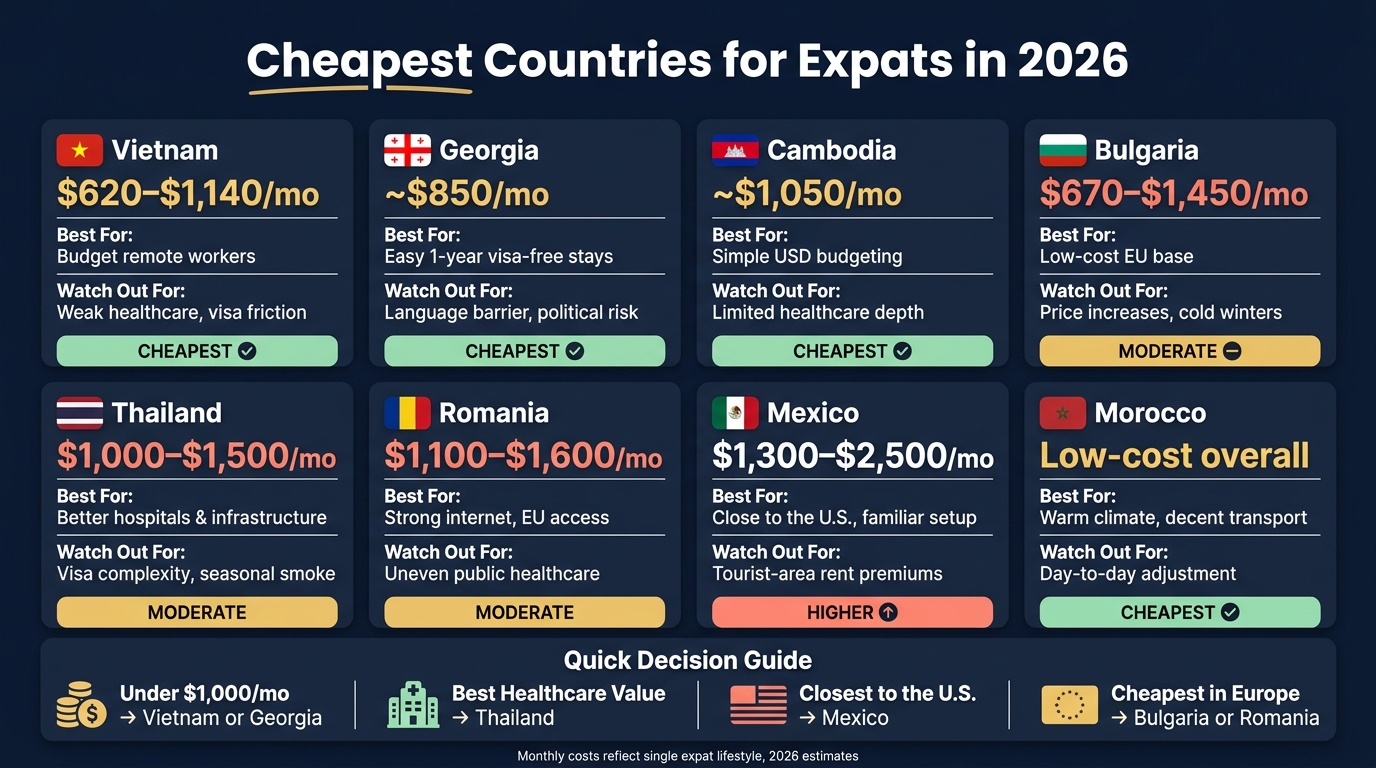
Quick Comparison
| Country | Typical Monthly Cost | Main Upside | Main Trade-off |
|---|---|---|---|
| Vietnam | $620–$1,140 single | Lowest overall cost | Weaker healthcare, visa friction |
| Thailand | $1,000–$1,500 | Better hospitals and infrastructure | Visa rules, seasonal smoke |
| Cambodia | About $1,050 | Simple budgeting in USD | Thinner infrastructure, limited medical depth |
| Georgia | About $850 | Low cost and up to 1 year visa-free for many | Language barrier, political risk |
| Bulgaria | $670–$1,450 | Low-cost EU base | Price increases, colder winters |
| Romania | $1,100–$1,600 | Strong internet, lower-cost Europe | Uneven public healthcare, cold winters |
| Mexico | $1,300–$2,500 | Close to the U.S., familiar setup | Tourist-area rent and car costs |
| Morocco | Low-cost overall | Warm climate and decent transport | More day-to-day adjustment |
My bottom line: if my budget is under $1,000 a month, I’d start with Vietnam or Georgia. If I want lower costs without giving up better medical care, I’d look at Thailand. If I want to stay near the U.S., Mexico is the easiest place to start. And if I want Europe at a lower price, Bulgaria and Romania stand out.
That gives me the short list fast, before I dig into the country-by-country details.
sbb-itb-39d39a6
1. Vietnam
Vietnam is one of the best low-cost picks for expats in 2026, with a PPP ratio of 0.30. You feel that difference fast in rent, meals, and day-to-day services.
Monthly Budget
A single expat can keep core monthly spending around $620 to $1,140, while a couple will usually spend $1,110 to $1,790 for a similar lifestyle.
| Expense | Single Expat | Couple |
|---|---|---|
| Rent (Modern 1–2 BR) | $350–$600 | $600–$900 |
| Groceries & Dining | $150–$300 | $300–$500 |
| Utilities & Internet | $40–$80 | $60–$100 |
| Transportation | $30–$60 | $50–$90 |
| Healthcare (Insurance/OOP) | $50–$100 | $100–$200 |
| Total | $620–$1,140 | $1,110–$1,790 |
That budget works because the big monthly costs stay low at the same time. Rent doesn’t eat your whole paycheck, food is cheap, and getting around is still affordable.
Housing Costs
Rent depends a lot on where you settle. Da Nang and Hanoi’s Tay Ho district offer modern one-bedroom apartments for $350 to $500 per month. In Ho Chi Minh City, the expat area of Thao Dien (District 2) runs $370 to $550 for a one-bedroom, while a three-bedroom in District 7 costs $700 to $1,000.
If you’ve spent time looking at rents in major U.S. cities, those numbers can feel almost unreal. But the city and neighborhood still matter a lot, so Vietnam isn’t “cheap” in exactly the same way everywhere.
Healthcare Quality and Value
Private care is cheap. A GP visit at a private clinic costs about $18, a specialist visit around $30, and a dental cleaning about $13. Private health insurance averages $35 to $65 per month.
The catch is quality. Vietnam scores 23 out of 100 on the healthcare quality index, compared with Thailand’s 77.5. For more serious medical issues, expats may need treatment in Ho Chi Minh City or Bangkok. So yes, routine care is low-cost, but many people still want a backup plan for bigger health problems.
Lifestyle Trade-offs
Internet is one of the easy wins here. Fiber service runs $10 to $20 per month, and Da Nang ranks among the top cities globally for digital nomads.
The harder part is visas. As of mid-2026, Vietnam does not offer one of the best digital nomad visas, so most expats rely on 90-day e-visas or business visa sponsorships that cost $300 to $600 every six months. That setup can work, but it adds friction.
Air quality is another issue, especially in the north. Hanoi’s air quality is a major drawback, with PM2.5 levels often going above 200 µg/m³ between October and March.
Best for budget-focused remote workers and couples who can tolerate visa friction and variable air quality.
For expats who want similar costs with easier long-term stays, Thailand is the natural next comparison.
2. Thailand
Thailand costs a bit more than Vietnam, but for many expats, that extra $150 to $300 per month goes toward better healthcare, smoother roads, steadier utilities, and more dependable internet. That’s a big part of the appeal. If Vietnam feels cheap but a little rough around the edges, Thailand often feels like the easier next step.
Monthly Budget
Your monthly spend in Thailand depends a lot on where you live. Chiang Mai sits near the lower end, while Phuket is one of the pricier picks.
| Location | Est. Monthly Total | Primary Appeal |
|---|---|---|
| Khlong Luang | $1,000 | Budget-friendly Bangkok outskirts |
| Chiang Mai | $1,050 | Lowest-cost major expat hub |
| Hua Hin | $1,280 | Relaxed seaside living, popular with retirees |
| Pattaya | $1,320 | Coastal proximity to Bangkok, active expat scene |
| Bangkok (Center) | $1,430 | Urban hub, best for remote workers and networking |
| Phuket | $1,500 | Higher-cost island living |
Housing Costs
A one-bedroom apartment averages about $475 in a city center and $282 outside the center. That gap matters, especially if you’re trying to keep monthly costs in check.
Property rules matter too. Foreigners can’t own landed property outright, but they can buy condos within the 49% foreign-ownership limit or lease a house for the long term. So when you compare housing options, it’s not just about rent. The legal setup matters just as much.
Healthcare Quality and Value
Healthcare is one of Thailand’s biggest draws for expats. Its Healthcare Index score of 77.5 is far above Vietnam’s 23. In plain terms, that often means easier access to private care, English-speaking doctors, and clinics or hospitals that can handle more than basic treatment.
The cost gap versus the U.S. is hard to ignore. A GP visit usually costs around $18 to $25, while the U.S. median is roughly $225. Private expat insurance often starts at about $45 to $50 per month.
Lifestyle Trade-offs
Thailand isn’t friction-free. The two big issues are visas and seasonal air quality.
For expats under 50, the Destination Thailand Visa (DTV) launched in mid-2024 and gives remote workers a 5-year multiple-entry option. It requires a bank balance of 500,000 THB, or about $13,500. At the same time, border runs have become less dependable as enforcement gets tighter.
Air quality can also be a problem, especially in Chiang Mai. During burning season, from February through April, pollution can hit hazardous levels, so an air purifier is more or less part of the setup if you plan to stay during that stretch. On the plus side, internet is strong across the country, with median fixed broadband download speeds of about 359 Mbps.
Cambodia comes next for expats willing to give up more on infrastructure and healthcare in exchange for lower costs.
3. Cambodia
Cambodia is about 65% cheaper than the United States overall, which puts it near the top of the list for people who want to keep spending low in Southeast Asia. A single expat can live on about $1,050 per month. Compared with Vietnam and Thailand, Cambodia is often simpler and cheaper, but you give up more when it comes to infrastructure and the depth of healthcare options.
Monthly Budget
One thing that makes Cambodia easy to budget for is its use of the U.S. dollar in day-to-day life. ATMs dispense USD, rent is often listed in dollars, and the Cambodian riel usually shows up as small change.
That setup removes a lot of the friction expats deal with in other countries. You don’t have to do constant currency math just to figure out what your month looks like.
Housing Costs
Low rent in Phnom Penh, Siem Reap, and Sihanoukville is a big reason many expats keep monthly costs under control. The country also has a general affordability score of 98.7 out of 100.
Lifestyle Trade-Offs
Cambodia ranked #16 globally for retirees in 2026, due in large part to its low costs and easy visa access. The catch is pretty clear: infrastructure is thinner, and high-end healthcare options are more limited than in Thailand.
For retirees and remote workers who care most about low fixed costs, Cambodia can make a lot of sense. But it tends to work best for people who are comfortable with a simpler day-to-day setup.
Georgia offers a different low-cost model, with Eastern Europe-style pricing and a stronger infrastructure profile.
4. Georgia
Georgia changes the pitch a bit. Instead of the usual Southeast Asia route, you get something closer to Eastern Europe-style city life: low monthly costs, easy long stays, and a more urban home base.
It’s one of the cheapest countries on this list, and citizens of 95+ countries can stay visa-free for one year. That makes Georgia one of the simplest low-cost long-stay picks in 2026.
Monthly Budget
A single expat can live comfortably in Georgia on about $850 per month in 2026. That budget covers rent, utilities, food, and local transportation.
Housing Costs
Tbilisi is the main expat hub. In neighborhoods like Vera, Vake, and Saburtalo, a one-bedroom apartment usually costs $300 to $600 per month.
There is a catch, though. Older buildings often come with weaker wiring and individual gas heating. That matters in winter, because utility bills can climb quite a bit, so it’s smart to ask how the heating works before you sign a lease.
Healthcare Quality and Value
Private healthcare in Georgia is a good deal for the money. Monthly private insurance costs about $50, and routine care is still affordable if you pay out of pocket.
| Service | Georgia Cost |
|---|---|
| Private Insurance/mo | $50 |
| GP Visit | $23 |
| Specialist Visit | $38 |
| ER Visit | $185 |
| Dental Cleaning | $15 |
For everyday care, the private clinic system gives you good value. For anything more serious, international medical evacuation coverage is still a smart add-on.
Lifestyle Trade-offs
For many expats, the biggest daily friction point is language. Georgian script, called Mkhedruli, is unlike what most newcomers have seen before, and English proficiency is low at 23 out of 100 on the EF EPI index. In areas outside the main expat zones, even simple errands can take extra time and patience.
Traffic in Tbilisi is another headache. Lane discipline is weak, merging is aggressive, and the roads can feel a bit like a free-for-all.
There are also some bigger-picture issues to weigh. Infrastructure scores 43 out of 100, and political risk is still part of the picture. Social views are conservative, and LGBTQ+ safety is a concern, with a score of just 15 out of 100.
If you want a close alternative with similar costs inside the EU, Bulgaria is the nearest comparison.
5. Bulgaria
Bulgaria got easier to move around after its 2026 euro adoption and Schengen access. That said, the change came with a sting: prices in many services climbed by 20% to 50%.
Monthly Budget
Bansko starts at about $670 per month, while Sofia takes at least $1,450 per month for a comfortable lifestyle. So the split is pretty simple. If keeping costs low matters most, Bansko makes more sense. If you want capital-city life, metro access, and better urban infrastructure, budget for Sofia.
Housing Costs
Housing shows the gap even more clearly. In Sofia, a one-bedroom apartment in the city center now costs about $670 to $1,000 per month. In Bansko, a one-bedroom usually lands around $280 to $450 per month.
Plovdiv and other secondary cities sit somewhere in between. They stay more affordable and haven’t seen the same speculative pressure as Sofia.
Healthcare Quality and Value
Public healthcare in Bulgaria is underfunded, with health spending at only 4% to 5% of GDP. For most expats, private care is the practical route.
The upside is cost. In Sofia, a specialist consultation usually runs about $33 to $55. Private health insurance is also mandatory for residency permits.
Lifestyle Trade-offs
One of Bulgaria’s biggest selling points is its 10% flat income tax, the lowest in the EU. For remote workers and self-employed expats, that’s a big deal.
Internet is another plus. Fiber plans with speeds of 100 to 300 Mbps cost about $11 to $17 per month. That’s the kind of small monthly expense that can make daily life feel a lot easier.
The trade-off is friction in everyday setup. Bulgarian uses the Cyrillic alphabet, which can slow down even simple tasks at first. On top of that, residency isn’t a walk-in process. You need a Type D visa from abroad, then a residence permit after arrival.
If you want a similar budget with warmer weather and a more familiar day-to-day setup, Mexico is the next comparison.
6. Romania
A single expat can live on about $1,100 to $1,600 per month in Romania. That makes it a lower-cost base in Europe, with strong internet, easy long stays, Schengen access, and solid digital infrastructure.
Monthly Budget
That range can cover rent, food, utilities, and local transport. Romania stays far below many Western European capitals on cost, but you still get a familiar city lifestyle.
Housing Costs
Romania scores 87.5 out of 100 for housing affordability. Bucharest has felt more price pressure, and tourist-heavy areas tend to cost more. But Brașov and other secondary cities are often cheaper for long-term renters.
Healthcare Quality and Value
Healthcare is the weak spot. Private clinics are affordable and clear on pricing, but the public system can be uneven.
Lifestyle Trade-offs
Fast internet and strong English use make day-to-day life easier from the start. Romania also gives you historic architecture, opera houses, and walkable city centers for much less than many Western European cities.
The main trade-off is the climate. Summers can be hot, and winters can be cold and snowy, which some expats struggle with. If you care more about reliable connectivity and livable cities than mild weather, Romania stands out in this price range.
For a similar budget with warmer weather and a more familiar daily rhythm, Mexico is the next comparison.
7. Mexico
Mexico is one of the easiest low-cost expat picks in 2026, especially for Americans. It’s close to the U.S., offers visa-free entry, and feels familiar in ways that can make a move less stressful. Its Purchasing Power Parity ratio sits around 0.60, which means $1 goes about 1.6 times farther than it does in the U.S. That’s a big part of the draw. The other part is simple: Mexico gives many Americans a nearby base without a lot of friction.
Monthly Budget
A comfortable monthly budget usually falls between $1,300 and $2,500. That range depends a lot on where you live.
Interior cities like Mérida and Querétaro tend to stay lower-cost because local demand shapes prices more than foreign demand does. By contrast, coastal hotspots and Mexico City neighborhoods like Roma and Condesa often come with a clear expat premium. In those areas, rent and many services are priced with foreign incomes in mind.
Housing Costs
A one-bedroom in prime parts of Mexico City or in beach towns usually costs $400 to $900 per month. That can sound cheap at first glance, but tourist pressure changes the math fast.
In busy visitor zones, short-term rental demand has pushed prices up by 24% to 32%. If you want to avoid that bump, it helps to look outside expat-heavy neighborhoods and away from main tourist corridors.
Healthcare Quality and Value
Private insurance usually costs $50 to $200 per month, and a doctor’s visit often runs $30 to $60. That’s one reason many expats feel comfortable here.
Private clinics are formalized and affordable, and specialist visits are available at a small share of what people often pay in the U.S.
Lifestyle Trade-offs
The biggest downside is how much conditions can change from one region to another. Safety and infrastructure aren’t the same across the country. The Yucatán Peninsula is often seen as one of the safest regions in Mexico, while northern border states bring more concern.
There’s also the transportation piece. In suburban and coastal areas, relying on a car can add $6,000 to $9,000 per year in transportation costs. That’s not a small line item. For many expats, walkable interior cities with solid transit end up offering better overall value.
If you want a base at a similar price point but with a different pace and climate, Morocco is the next comparison.
8. Morocco
Monthly Budget
Morocco is still affordable in 2026, especially for expats who want warm weather and solid value for their money. The main catch is that relocating can come with a moderate amount of friction, so lower costs don’t always mean an easy landing.
On paper, Morocco looks cheap. In practice, your experience depends a lot on how well you handle the local adjustment.
Lifestyle Trade-offs
Morocco stands out for its warm climate, deep history, and transport system that works better than many expats expect. It’s sunny through most of the year, which is a big part of the appeal, and getting around is often simpler than newcomers assume.
The trade-off is adaptation. Expats who take time to learn local customs tend to settle in faster.
Morocco is a good fit for people who want low day-to-day costs without giving up weather or atmosphere.
Next: a side-by-side look at which countries offer the best overall value, and which trade-offs matter most.
Pros and Cons by Country
Every country here has a clear upside and a clear catch. The quickest way to compare them is to look at three things: what you gain, what you give up, and who the country suits best.
| Country | Biggest Pros | Biggest Cons | Best Match Profile |
|---|---|---|---|
| Vietnam | Very low monthly costs and strong purchasing power | Severe air pollution in Hanoi and Ho Chi Minh City; healthcare scores 23/100, so complex cases may require medical evacuation | Budget-focused digital nomads and remote workers |
| Thailand | Strong private hospitals and English-speaking medical care; reliable infrastructure | Visa complexity; property ownership restrictions for foreigners | Retirees over 50 and digital nomads |
| Cambodia | Around $1,050 per month; easy budgeting because many day-to-day costs are priced in USD; straightforward residency process | Limited healthcare depth; medical evacuation is often the only option for serious conditions | Budget expats who want simple day-to-day costs |
| Bulgaria | Low-cost European city living with strong walkability; Schengen access | Language barriers in rural areas; colder winters than Southeast Asia | Expats who want affordable European city living |
| Romania | Affordable urban living with strong internet and easier day-to-day convenience; Schengen access | Not ideal for expats who want a warm-climate base | Budget-minded expats who prefer historic urban living |
| Mexico | Lower-cost interior cities with steadier prices; easy access to the U.S. | Higher prices in popular coastal zones, with tourist-area housing up 24%–32% versus pre-Airbnb levels | Americans who want low cost and easy access to the U.S. |
If you want the short version, healthcare, visa hassle, and distance from home will rule out options fast.
Thailand stands out for medical care, especially if that’s high on your list. Mexico is the easiest low-cost pick for Americans who want to stay closer to the U.S. and keep travel simple. Vietnam and Cambodia lean hard into low monthly costs, but both ask you to accept more limits around healthcare. Bulgaria and Romania make more sense if you want Europe without paying Western Europe prices, though you’ll trade tropical weather for colder winters and, in some places, more language friction.
Conclusion
Budget and healthcare will cut your list down fast.
If your monthly budget is under $1,000, Vietnam is the clearest match. Its PPP ratio of 0.30 means your money goes about three times further than it would in a mid-sized U.S. city. The downside is pretty simple: healthcare is weaker, and visas can be more of a hassle.
Thailand sits in the middle. It costs more than Vietnam, but you get stronger healthcare and better infrastructure in return. For many expats, that makes Thailand the best balance between low living costs and day-to-day comfort.
If you want a lower-cost place with an EU base, Bulgaria and Romania stand out. They make the most sense for Europeans trying to keep costs down, and their Schengen access makes travel around Europe easier without the price level of Western Europe.
If staying closer to the U.S. matters more, Mexico has a strong case. Interior cities such as Mérida are among the most practical options for Americans who want lower costs and a more familiar way of life.
Cost is the first screen. After that, residency rules decide whether the move can work over time. Your country choice also shapes tax residency, asset protection, and geographic diversification. That’s where long-term tax and asset planning starts to matter.
Pick the country that fits your budget first. Then check whether its healthcare and residency rules fit the life you want.
FAQs
Which country is cheapest for expats under $1,000 a month?
Based on the 2026 expat cost-of-living data, Georgia comes out as the cheapest option at about $850 per month for a single expat. That estimate includes rent, utilities, food, and transportation.
Vietnam is also often mentioned as a low-cost place to live, at around $900 per month. But in these results, it still sits a bit above Georgia.
How do visa rules affect the true cost of living abroad?
Visa rules can make a “cheap” country cost more than it first appears. A low monthly budget on paper can change fast once you add visa renewals, border runs, sponsorship fees, agent charges, and the cost of gathering documents or showing proof of funds.
That extra friction doesn’t stop with immigration paperwork. Visa uncertainty can also affect day-to-day life in ways people often miss.
For example:
- You may have less access to the local healthcare system, which can push you toward more expensive private care.
- Landlords may ask for stricter lease terms, larger deposits, or extra documents if your visa status feels uncertain.
So the headline cost of living might look low, but the actual cost can climb once visa-related expenses and limits enter the picture.
Which low-cost country has the best healthcare for expats?
Croatia is a strong pick if you want good care without U.S.-level prices. It pairs lower healthcare costs for expats with a high-quality system, which is why it stands out.
In the 2026 data, Croatia scores about 76/100 on WHO universal health coverage and about 77/100 overall. Costs are also much lower than in the U.S. Private insurance is far cheaper, GP visits run about $20–$35, and ER care is around $145–$300.
