
If I had to give the short answer first: Denmark, Finland, Singapore, New Zealand, Norway, Sweden, Switzerland, and the Netherlands sit near the top, while South Sudan, Somalia, Venezuela, Syria, Yemen, and Equatorial Guinea sit near the bottom.
I’d use this as a first-screen risk check for where to live, bank, invest, or set up a company. The article’s main point is simple: high CPI scores usually mean more predictable rules, while low scores often mean political favoritism, weak courts, banking friction, and more due diligence. The U.S. scored 64/100 and ranked 29th in the 2025 CPI, while the global average stayed around 42–43.
Here’s the article in one glance:
- Cleanest countries covered: Denmark (89), Finland (88), Singapore (84), New Zealand (81), Norway (81), Sweden (80), Switzerland, Netherlands
- Most corrupt countries covered: South Sudan (8), Somalia (9), Venezuela (10), Syria (12), Yemen (13), Equatorial Guinea (13)
- What this means for you:
- Low-corruption countries: better odds of steady permits, courts, tax handling, and banking access
- High-corruption countries: more risk of delays, selective enforcement, sanctions checks, PEP screening, and asset seizure
- Main takeaway: CPI is useful, but I would not use it alone. I’d pair it with FATF status, governance data, and AML risk checks.
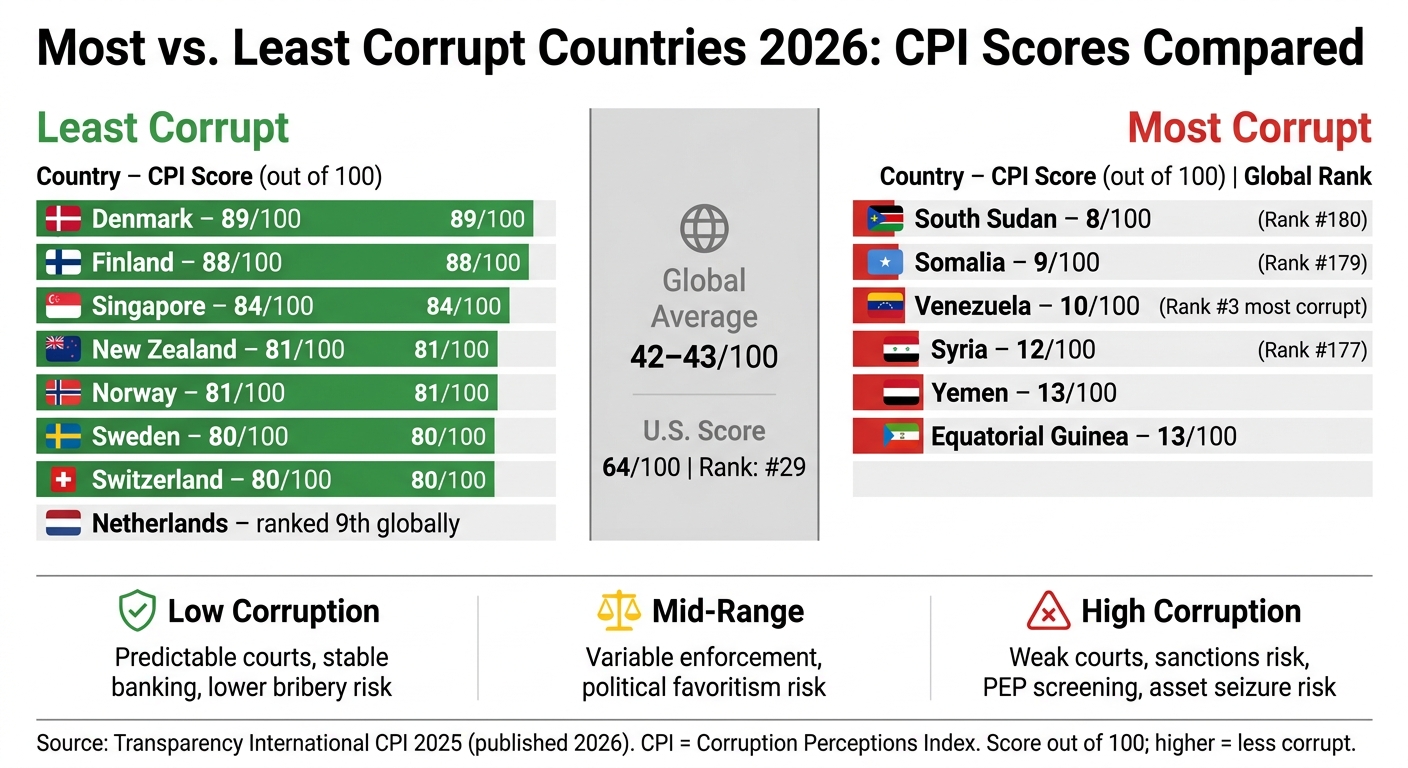
Quick Comparison
| Group | Countries in the article | What it usually means |
|---|---|---|
| Least corrupt | Denmark, Finland, Singapore, New Zealand, Norway, Sweden, Switzerland, Netherlands | More predictable public systems, tighter AML/KYC checks, lower bribery risk |
| Most corrupt | South Sudan, Somalia, Venezuela, Syria, Yemen, Equatorial Guinea | Weak enforcement, political control, unstable banking, higher legal and personal risk |
If you want the core idea in plain English, it’s this: cleaner countries are often harder on paperwork but easier to trust; more corrupt countries may look easier at first, but the legal and banking risk is much higher.
sbb-itb-39d39a6
1. Denmark
Denmark holds the #1 spot on the 2025 Corruption Perceptions Index, with a score of 89 out of 100. That puts it at the top for public-sector integrity. For investors and expats, this tends to show up in day-to-day dealings: rules are more predictable, and outcomes are less tied to who you know.
A big reason for that score is Denmark’s legal system. Permits, taxes, and procurement usually follow clear procedures instead of relationship-based shortcuts. In plain terms, that can cut down the time, friction, and legal cost that often come with dealing with the state.
For expats, that reliability has a direct, practical upside. Residency and work permit processes are still strict, and the paperwork can be heavy, so it pays to come prepared . That mix of trust on one side and close review on the other sets the baseline for how this article compares the next low-corruption jurisdictions.
For internationally mobile entrepreneurs, there’s another piece to know: Danish banks and financial institutions run tight AML and KYC checks. If you’re opening an account or setting up a company, expect close screening even if you’re a legitimate foreign client.
2. Finland
Finland sits just behind Denmark, only one point back. It ranks #2 on the 2025 CPI with a score of 88, a sign of strong public institutions shaped by rule of law, media freedom, and professional public administration.
On the ground, that often means less friction in permits, procurement, and other dealings with the state. Oversight is strong, and enforcement tends to be steady and predictable. The 2026 Freedom and Prosperity Indexes place Finland #4 out of 171, with high marks for legal clarity, judicial independence, bureaucracy, and security. For residents, companies, and investors, that usually leads to fewer unpleasant surprises.
For expats and investors, this can show up in very practical ways: smoother licensing, simpler tax filing, and less messy dispute resolution. That said, the CPI looks at perceived public corruption. It does not measure private misconduct or cross-border financial risk, so sector-specific due diligence still matters before you invest.
3. Singapore
In 2026, Singapore ranks #3 in the world on Transparency International‘s 2025 Corruption Perceptions Index (CPI), with a score of 84 out of 100. That puts it just behind Denmark and Finland.
Singapore is still the cleanest major financial center in the region, ahead of other major Asian economies. It’s also the only Asian country in the global top 10, and that matters a lot for banking access, company formation, and dispute resolution. In Asia-Pacific, it’s the clearest match to the Nordic leaders that come next.
For U.S. expats, investors, and business operators, this often means faster permits, cleaner licensing, more predictable tax administration, and stronger contract enforcement, backed by transparent administration and strong courts. Put simply, the legal and regulatory setting tends to feel more predictable, with less day-to-day uncertainty than in lower-ranking jurisdictions.
That said, Singapore is a major financial hub, so it also faces pressure from cross-border illicit funds. Investors should weigh Singapore’s strong governance alongside separate sanctions and rule-of-law checks when reviewing banking and asset-protection risk. That mix of trust and scrutiny helps explain why Singapore remains a top benchmark before moving on to the next low-corruption jurisdictions.
4. New Zealand
New Zealand remains in the same top tier as Denmark, Finland, and Singapore, though its legal setup and geography are different. In the 2025 Corruption Perceptions Index used for these 2026 rankings, New Zealand scores 81 out of 100 and ranks #4 globally, tied with Norway. In Asia-Pacific, it sits in second place, behind only Singapore.
That score points to strong trust in public institutions and steady enforcement of integrity rules.
For expats and businesses, the big advantage is predictability. Licensing, tax administration, contract enforcement, and dispute resolution tend to work with a level of consistency that cuts a lot of the day-to-day friction you often see in lower-ranked places.
New Zealand also performs well beyond corruption rankings. It scores 9.02 out of 10 on the GeoCompass Wealth Protection Index, putting it tied for #6 globally for property rights protection and the maturity of structuring offshore trusts for asset protection. For asset protection, that carries weight. Clean governance paired with a strong legal framework makes New Zealand a solid choice for long-term asset protection. At the same time, banks and trustees still need to screen with care – even clean jurisdictions can be used to launder illicit funds.
5. Norway
Norway matches New Zealand at 81 out of 100 on the 2025 Corruption Perceptions Index, tying for #4 globally. That puts it just behind Denmark, Finland, and Singapore, and far above the global average.
What stands out here is simple: Norway is rich in natural resources, yet it has kept corruption low through strong oversight and tight procurement controls. That matters. In many resource-rich countries, money from oil, gas, or minerals can invite rent-seeking. Norway’s institutional setup has, for the most part, kept that pressure in check.
For business operators, the result is lower friction in permits, public-facing transactions, and procurement. Contract enforcement is dependable, supported by courts that carry weight and a professional public administration. Compliance is also often lighter than in lower-ranked countries, which can trim both cost and day-to-day hassle.
For residents and investors, this often means fewer surprises in licensing, offshore banking reviews, and property-related filings. Still, the CPI works best as a first filter. It doesn’t replace sector-specific due diligence. Sweden follows a similar model, though its institutional strengths differ a bit.
6. Sweden
Sweden scores 80 out of 100 in the 2025 CPI, ranking 6th globally and tying with Switzerland. For expats and investors, that usually means fewer surprises when dealing with banks, licenses, and government paperwork.
For expats and businesses, permits, taxes, and dispute resolution tend to follow clear rules and move with less friction. That kind of predictability matters most when banks and regulators review foreign clients.
At the same time, Sweden’s stability can attract illicit capital, so banks apply strict AML and KYC checks.
Sweden also supports asset protection through strong property-rights protections and easy cross-border capital movement. The takeaway is simple: low corruption can make access easier, but it doesn’t remove compliance risk.
7. Switzerland
Switzerland ranks 5th globally on the 2025 Corruption Perceptions Index, released in February 2026, tied with Luxembourg and Norway. It sits just behind Denmark, Finland, Singapore, and New Zealand in the latest low-corruption rankings. That matters most in areas like banking, licensing, and contract enforcement.
For expats, investors, and business owners, this points to a highly trusted institutional setting. Switzerland stands near the top for rule of law and public trust, and its federal system, along with strong courts, helps keep regulation predictable. That trust supports stability for residents and investors, but it also comes with strict AML/KYC scrutiny.
Transparency International warns that even top-scoring countries can still attract illicit capital. That helps explain why Switzerland remains a strong jurisdiction for asset protection and wealth management, backed by strong property-rights protections.
Switzerland is among the least corrupt countries, but its financial strength also attracts illicit funds. Next comes the Netherlands.
8. Netherlands
The Netherlands ranks 9th globally on the 2026 Corruption Perceptions Index. That puts it just behind Sweden at 8th and ahead of Ireland and Luxembourg in the top 10 least corrupt jurisdictions worldwide. In plain English: the Netherlands sits firmly in the low-corruption group.
Public-sector corruption risk is very low. The country offers strong rule of law, deep institutions, and fiscal stability, which makes it a dependable place for long-term residency, company formation, and asset protection. Its legal system and services base also support long-term residency and wealth structuring.
That said, this isn’t a light-touch setup. Dutch banks and trust providers still apply strict AML/KYC checks because clean jurisdictions remain attractive to actors seeking to move illicit wealth. So the appeal is clear, but so is the paperwork. The Netherlands can be an attractive base, just one with heavy compliance from day one.
The next countries sit at the opposite end of the spectrum, where corruption risk becomes a daily operational problem.
9. Somalia
At the bottom of the list, Somalia shows what corruption can look like when a state cannot enforce its own rules in a steady way. On the 2026 CPI, Somalia ranks 179th out of 180 countries and scores 9 out of 100. That score has stayed flat at 9 from 2024 through 2026.
Since the 1991 collapse of the Siad Barre regime, clan patronage, armed groups, and political interference have kept the state weak. The result is a government with chronic problems in revenue collection, courts, and public services.
For expats, investors, and entrepreneurs, the risk is extreme. State revenue is often diverted, courts are often subject to political control, and personal safety remains a major concern because armed groups still hold influence. Financial institutions that handle Somalia-linked entities usually apply enhanced due diligence, including checks for politically exposed persons (PEPs) and sanctions lists. That can make legitimate cross-border business hard to carry out.
South Sudan ranks even lower, with similar instability and even weaker state capacity.
10. South Sudan
South Sudan ranks last on the CPI in 2026, with a score of 8 out of 100 and a global rank of 180th. That marks another drop from 9 in 2025 to 8 in 2026.
The problem runs deep. Political and military elites control state institutions for private gain, oil revenue is managed with little transparency, and oversight bodies barely function. You can see the damage in public spending alone: of the $2.2 billion set aside for a national roads program, $1.7 billion could not be accounted for, and 95% of the planned roads are still unfinished.
For investors and expats, this creates a hard operating climate. Contract enforcement is weak, the judiciary is politicized, banking access can be unstable, and personal risk is higher. In practice, even routine deals call for enhanced due diligence, including PEP screening. Media suppression and intimidation of whistleblowers add another layer of personal risk.
11. Venezuela
At the other end of the spectrum, Venezuela shows what happens when corruption and state breakdown feed each other. The country scores 10 out of 100 on the 2026 Corruption Perceptions Index, which makes it the 3rd most corrupt country in the world. It sits just above South Sudan and Somalia, and below Syria and Yemen. For expats and investors, that points to unstable rules and weak enforcement.
Venezuela’s corruption is tied to centralized authoritarian rule and policy failure. Under the Chávez and Maduro administrations, power was concentrated in the Boliburguesía, a politically connected elite that controls state-owned enterprises and public institutions. Currency and price controls also created room for officials to profit from exchange-rate arbitrage and import licenses. At the same time, the judiciary operates under political control, which leaves elites facing little risk of prosecution.
That setup spills straight into business activity. Banking, contracts, and capital controls are all shaped by politics. As a result, contracts, licensing, and asset recovery are exposed to political interference.
For expats and investors, the day-to-day risks are serious:
- Hyperinflation
- Banking instability
- Shortages of food and medicine
Venezuela is also one of the 47 countries that recorded its lowest-ever CPI score in the latest reporting cycle. These conditions have driven large-scale emigration, and whistleblowers and claimants face intimidation with little recourse .
12. Yemen
Yemen scores 13 out of 100 on the 2026 Corruption Perceptions Index. That puts it as the 5th most corrupt country in the world, tied with Libya, Eritrea, and Equatorial Guinea.
Corruption in Yemen runs through long-standing elite patronage networks. Anti-corruption agencies are on the books, but enforcement is weak because the judiciary remains under political control. In practice, contract enforcement is unreliable, and bribery is still common among civil servants and police.
The damage goes far beyond paperwork and permits. Corruption has siphoned off oil revenue and aid, fed currency manipulation, and helped fuel smuggling networks. That makes wealth tracing, account access, and cross-border transfers hard to manage. It also puts more strain on financial stability while pushing poverty and food insecurity even deeper.
Accountability is also limited by the lack of a free press, along with intimidation aimed at journalists and whistleblowers. For anyone thinking about residency, banking, or asset protection, Yemen stands out as a high-risk jurisdiction. Residency, personal safety, banking, contract enforcement, and asset protection all come with elevated risk.
Syria ranks a bit higher, but it still falls into the same high-risk group.
13. Syria
Syria scores 12 out of 100 on the 2026 Corruption Perceptions Index. That makes it the 4th most corrupt country in the world and puts it at 177th out of 180 countries globally. In plain terms, Syria sits in the same bottom group as South Sudan, Somalia, and Venezuela.
For expats and investors, that score points to major friction around banking, residency, and asset recovery. The picture behind the ranking is harsh: a system shaped by political monopoly, weak institutions, and isolation tied to sanctions.
The core issue is state capture. The Ba’ath Party’s monopoly on power gives political and business elites room to use state institutions for private gain, while weak courts and limited judicial independence reduce accountability.
For businesses, the day-to-day risk is high. Heavy sanctions, legal uncertainty, and unreliable enforcement can turn even routine transactions into a slog. Contracts may not hold up, public services are poor, and weak institutions make banking, contract enforcement, and asset recovery especially hard.
Low public pay, opaque institutions, and pressure on journalists and whistleblowers help keep bribery and resource diversion in place. Syria’s score of 12 leaves it among the world’s lowest-ranked countries on corruption.
Equatorial Guinea follows with a similar level of corruption risk, though the setup there leans more on oil wealth and elite control.
14. Equatorial Guinea
Equatorial Guinea scores 13 out of 100 on the 2026 Corruption Perceptions Index. That makes it the 8th most corrupt country in the world, tied with Libya, Eritrea, and Yemen, and far below the global average of 43.
The story here looks different from places like Somalia or South Sudan. Equatorial Guinea’s corruption does not stem from state collapse. It comes from concentrated oil wealth and tight elite control. Since 1982, President Teodoro Obiang has overseen a kleptocratic system that channels oil revenue away from public use and toward the ruling class.
On paper, the country ranks among Africa’s richest. In daily life, the picture is much harsher: more than 60% of the population lives on less than $1 a day. That’s the part that matters. A high GDP per capita can look good in a headline, but it doesn’t mean the legal system works well or that banks operate in a way foreign investors can rely on.
For investors and expats, the main concerns are straightforward:
- political capture
- weak courts
- opaque contracts
- systemic bribery
Banks and compliance teams also treat Equatorial Guinea as high risk for AML and KYC purposes. That feeds straight into the next section on residency, banking, and asset protection.
How Corruption Rankings Shape Residency, Banking, and Asset Protection Decisions
A country’s CPI score is not just an abstract number. Banks use it in day-to-day risk reviews. Compliance teams rely on CPI scores to set country-risk ratings and apply corruption controls. If a country scores low, that can lead to enhanced due diligence (EDD) and sometimes slower or rejected account openings for people or businesses tied to that place.
That helps explain a common disconnect: a country may look appealing for residency, yet be tough for banking.
Take Denmark and South Sudan. Denmark’s top-tier governance points to more predictable enforcement. South Sudan’s score points the other way, where weak oversight and elite capture can make contracts shaky and asset protection hard to trust. You see the same split in banking. Singapore offers wealth management and regulatory certainty, while Venezuela’s controls and political dominance make asset protection much harder.
FATF gray-list status can add another layer of friction. It may limit banking access, slow transfers, and trigger extra checks.
Here’s how corruption levels often shape practical decisions:
| Corruption Level | Residency | Business | Banking | Asset Protection |
|---|---|---|---|---|
| Low (e.g., Denmark, Singapore) | High; stable legal and social infrastructure | High; transparent laws, minimal bribery risk | High; strong AML compliance, global access | Excellent; independent judiciary protects property rights |
| Mid | Moderate; risk of political favoritism | Variable; tenders often favor political insiders | Moderate; may face EDD or international fund freezes | Moderate; vulnerable to judicial capture and shifting rules |
| High (e.g., Venezuela, South Sudan) | Low; high physical and legal insecurity | Very low; systemic bribery and elite capture | Low; sanctions risk, PEP screening, and hyperinflation | Poor; high risk of arbitrary seizure and expropriation |
In practice, corruption rankings work less like abstract scorecards and more like filters. They influence where capital goes, where people relocate, and where institutions feel safe doing business. And even cleaner jurisdictions don’t get a free pass. Because they attract illicit capital, they often apply stricter source-of-funds and KYC checks.
Pros and Cons of Low-Corruption vs. High-Corruption Jurisdictions
Low-corruption and high-corruption jurisdictions come with different tradeoffs. In day-to-day practice, the gap shows up in compliance, court reliability, and capital mobility.
At first, high-corruption jurisdictions can look appealing. Informal networks may help deals move faster, and weak oversight can make it easier to get things done. But that early convenience often comes with a nasty sting later. In South Sudan, $1.7 billion of a $2.2 billion roads program was unaccounted for, and 95% of the roads remained unfinished.
Working in a high-corruption setting also increases exposure to sanctions, PEP checks, asset freezes, and personal-security risk. And the human cost is hard to ignore. Journalists and whistleblowers in these places often face state repression.
Here’s the pattern in plain English:
| Jurisdiction Type | Key Advantages | Key Disadvantages | Best Fit For |
|---|---|---|---|
| Low-Corruption (e.g., Denmark, Singapore) | Predictable rules, strong property rights, and reliable banking. | Stricter compliance requirements and intense source-of-funds scrutiny. | Institutional investors, risk-averse expats, and transparent corporations. |
| High-Corruption (e.g., South Sudan, Venezuela) | Fewer formal checks, but much higher legal and banking risk. | Extreme legal and financial risk, bribery demands, sanctions exposure, and collapsing infrastructure. | Only operators willing to absorb extreme legal and security risk. |
That’s the lens to use for the final takeaway.
Conclusion
The pattern across 2026’s rankings is hard to miss. Denmark, Finland, and Singapore sit at the top, while South Sudan (CPI score: 8), Somalia (9), and Venezuela (10) remain at the bottom.
What explains the gap? It comes down to institutional quality. Places with lower corruption usually have stronger rule of law and more stability. The weakest-scoring countries, by contrast, are often defined by state capture, broken public services, and legal systems that shield elites. For anyone dealing with banking, contracts, or relocation, that difference isn’t abstract. It hits where it counts.
These rankings also carry weight in day-to-day life. Corruption isn’t some far-off policy issue. It’s an operating condition. For expats, investors, and entrepreneurs, it can shape bank access, contract enforcement, and the long-term safety of assets.
That said, the CPI is only a first screen. It helps narrow the field, but it shouldn’t be used on its own. Pair it with World Bank governance data, FATF status, and the Basel AML Index for a fuller risk check.
Corruption rankings work best as an early filter for judging where legal rights, bank access, and assets are more likely to hold up – and where they may not.
FAQs
How reliable is the CPI on its own?
The Corruption Perceptions Index (CPI) is one of the most widely used tools for judging public-sector corruption. And for good reason: it pulls together data from multiple independent sources and uses the same standards across countries.
Still, the CPI measures perceptions, not direct proof of every corrupt act. That matters. It works best when you read it alongside other governance measures, such as World Bank reports or indicators of judicial independence, to get a more complete view.
Why do clean countries still have strict banking checks?
Even countries that score well on the Corruption Perceptions Index still need strict banking checks. Why? Because those countries often serve as financial hubs, and that draws illicit funds from all over the world.
A strong system at home doesn’t stop foreign kleptocrats or criminal networks from trying to move money through local banks. Tight compliance can help block dirty money and protect the financial system from international corruption, environmental crime, and state capture.
What should I review besides corruption rankings?
Don’t rely on corruption rankings alone. Look at the country’s legal and regulatory framework, the strength of the rule of law, judicial independence, and its political and economic stability.
It also helps to look at the tax regime, immigration options, and the quality of local professional services and infrastructure. Then go a step further and review broader safeguards, such as press freedom, civic space, human rights, and whistle-blower protections.
