
If I cut straight to the answer: Mauritius looks like the best digital nomad visas and the cheapest options in 2026 for many U.S. remote workers when I look at total first-year cost, not just the visa fee. Uruguay has the lowest government fee at about $22 for year one, while Ecuador has the lowest stated income floor at $1,446/month.
Here’s the short version:
- Cheapest overall: Mauritius
- Lowest government fee: Uruguay
- Lowest income requirement: Ecuador
- Best for short tax-light stays: Japan
- Lowest-friction path: Georgia
The big point is simple: a visa that costs $0 to apply for can still cost $1,000+ in year one once I add insurance, translations, apostilles, ID cards, and tax risk after 183 days.
Quick comparison
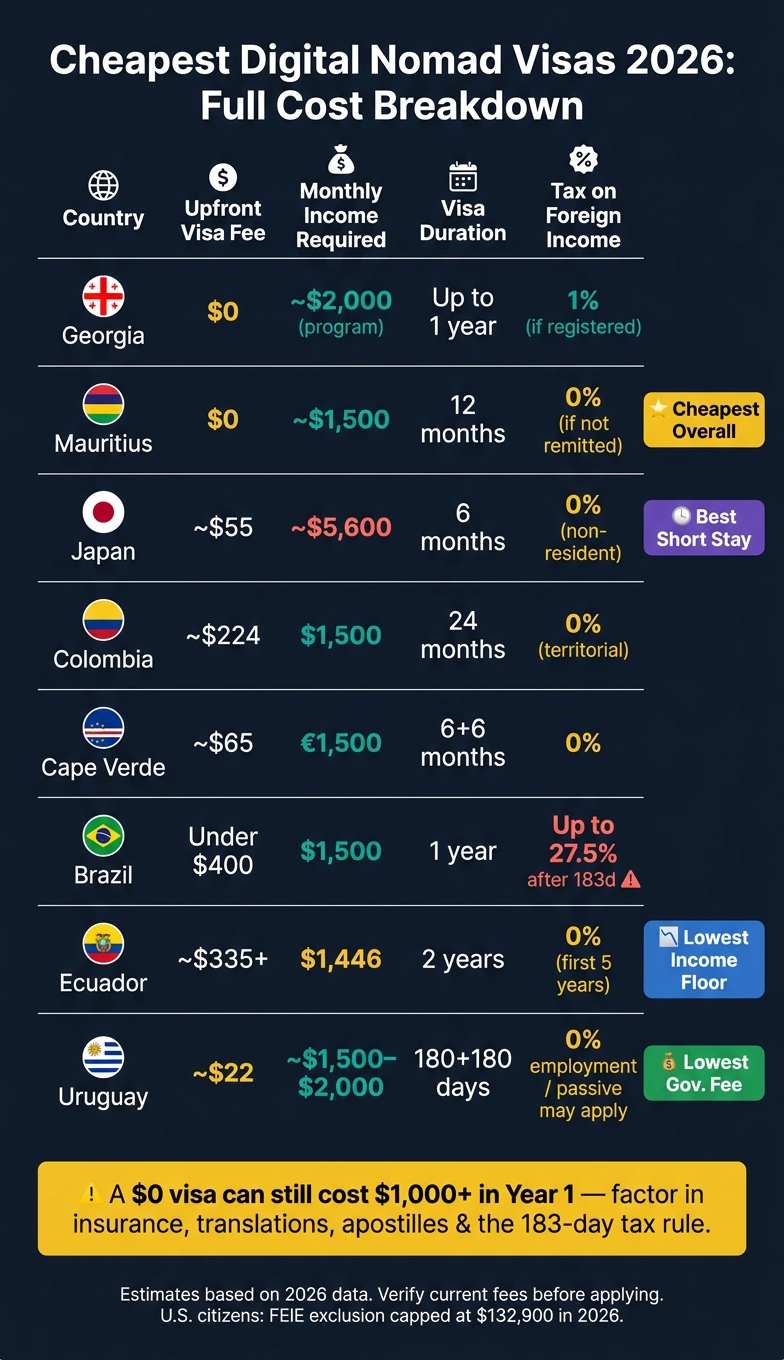
| Country | Upfront visa/government cost | Monthly income target | Stay length | Main cost issue |
|---|---|---|---|---|
| Georgia | $0 visa-free | No fixed floor / $2,000 for program | Up to 1 year route | Tax setup may add $100–$200 |
| Mauritius | $0 standard visa | About $1,500 | 12 months | Insurance at $100–$250/month |
| Japan | About $55 | About $5,600 | 6 months | Very high income bar |
| Colombia | About $224 + extras | $1,500 | 24 months | EPS/insurance can add a lot |
| Cape Verde | About $65 | €1,500 | 6 months + 6 months | Short stay |
| Brazil | Under $400 before extras | $1,500 | 1 year | Insurance, translations, tax after 183 days |
| Ecuador | About $335 + document costs | $1,446 | 2 years | Apostilles, FBI check, translations |
| Uruguay | About $22 first year | No fixed floor | 180 days + 180 days | Insurance and tax on some passive income |
My takeaway: if you want the lowest all-in first-year cost, I’d put Mauritius first, Uruguay first for pure government fees, and Georgia near the top if you want the least paperwork. After that, the main thing to watch is the 183-day tax line.
If I were comparing these visas for myself, I’d focus on three numbers first: the visa fee, the insurance cost, and the income threshold. That gets you most of the answer fast.
sbb-itb-39d39a6
1. Georgia digital nomad route
Georgia is one of the simplest and lowest-cost digital nomad routes on this list. If your main goal is to keep first-year costs down, it’s a strong place to start.
There are two low-cost ways in. The first is visa-free entry for eligible nationalities. That route comes with a $0 application fee and no set income floor. The second is the formal Remotely from Georgia program, which asks for $2,000 per month in foreign income. That low bar is a big reason Georgia ranks so well for remote workers who care less about flashy visa labels and more about what they’ll spend in year one.
You’ll also need private health insurance, which runs about $50 per month. And if you want access to Georgia’s low-tax setup, you’ll need to register as an Individual Entrepreneur, which adds about $100 to $200 in one-time fees.
One of the biggest draws is Georgia’s 1% Small Business Status. For registered entrepreneurs, it can cut taxes sharply on up to roughly $185,000 in annual turnover. There is one thing to watch: if you stay more than 183 days, you may become a tax resident. For U.S. citizens, the FEIE (Form 2555) can still exclude up to $132,900 of income in 2026.
And then there’s everyday life. Tbilisi stays pretty affordable, which helps keep total first-year spending low.
2. Mauritius Premium Visa
After Georgia’s very low entry cost, Mauritius stands out for remote workers who want a free visa and strong tax treatment on foreign income. It’s one of the lowest-cost picks in this group, especially if you earn abroad and keep that income outside Mauritius. The big draw is simple: a free standard visa and 0% tax on foreign income that isn’t sent to a local bank account.
Application cost
Mauritius offers two versions of the Premium Visa. The standard 12-month permit has no application fee. There’s also a 10-year renewable option with a one-time $1,500 fee.
If you just want to try life there first, the free 12-month version is the clear place to start. Processing usually takes 2 to 4 weeks, and you can apply either from inside or outside Mauritius.
Income threshold
Mauritius doesn’t set a fixed minimum income for this visa. Instead, you need to show you have enough money to support yourself, usually through bank statements and income records.
A practical benchmark is about $1,500 per month. That puts Mauritius in roughly the same band as Colombia and Brazil.
Insurance and add-ons
Private health insurance is required and usually runs about $100 to $250 per month.
Tax and renewal cost
For many remote workers, this is where Mauritius gets interesting. Premium Visa holders are not taxed on foreign-sourced income, so the effective rate is 0% in most cases.
After 183 days, you may become a tax resident. Even then, foreign income is taxed only if it is remitted to a Mauritian bank account. Using foreign credit or debit cards for daily spending does not count as a remittance.
| Feature | Detail |
|---|---|
| Application Fee | Free (standard) / $1,500 (10-year option) |
| Income Threshold | ~$1,500/month |
| Visa Duration | 12 months (renewable) or 10 years |
| Tax on Foreign Income | 0% if not remitted to a local bank |
| Health Insurance | $100–$250/month |
| Renewal Cost | Free (standard annual version) |
3. Japan digital nomad visa
After Mauritius’s free, low-bar visa, Japan flips the deal: the fee is low, but the income bar is much higher.
Japan’s digital nomad visa looks cheap at first glance. But qualifying is the hard part. The application fee is small, the income requirement is the highest on this list, and the stay tops out at six months.
Application cost
The visa fee is about $55 (¥8,200).
Income threshold
To qualify, you need ¥10 million per year, about $67,000, or around $5,600 per month. That’s the highest income requirement on this list. The visa is also limited to nationals from about 49 visa-waiver countries that have tax treaties with Japan.
Insurance and add-ons
Private health insurance is required for the main applicant and for each dependent.
Tax and renewal cost
Because the stay is capped at six months, you stay under Japan’s one-year tax residency line. That means foreign-source income is not taxed during the stay.
There are a couple of catches. The visa can’t be renewed, and if you want to apply again, you need to spend six months outside Japan first. It also doesn’t come with a residence card, which can make things like opening a bank account or getting a long-term phone plan more difficult.
| Feature | Detail |
|---|---|
| Application Fee | ~$55 (¥8,200) |
| Income Threshold | ~$67,000/year (~$5,600/month) |
| Visa Duration | 6 months, non-renewable |
| Tax on Foreign Income | 0% (non-resident status) |
| Health Insurance | Mandatory for applicant and dependents |
| Renewal Cost | N/A – must exit for 6 months before reapplying |
So Japan fits high earners who want a short stay and a light tax setup, not people looking for a cheap full year abroad. The next options are easier to get into, but they give up Japan’s tax-friendly short-term setup.
4. Colombia digital nomad visa
Colombia isn’t the cheapest if you look at fees alone. But the picture changes once you factor in its moderate income requirement and territorial tax system. It costs more to get started than Georgia, but it’s easier to carry than higher-fee options like Japan. And the 24-month visa term helps a lot, because you don’t face renewal as soon and the first-year cost feels less heavy.
Application cost
Government fees come to about $224 in total. That includes a $54 non-refundable study fee and a $170 issuance fee.
On top of that, expect to pay another $100 to $300 for certified translations and apostilles. There’s also about $65 for the Foreigner ID card, or Cédula de Extranjería.
Income threshold
To qualify, you need to show at least $1,500 per month in income. That’s about three times Colombia’s monthly minimum wage.
Insurance and add-ons
Health insurance is required, and it must include medical evacuation and repatriation coverage.
This is where costs can start to climb. The visa itself may look fairly low on paper, but mandatory insurance and EPS enrollment can push up the first-year total. If you’re self-employed, EPS costs 12.5% of declared income. At $2,000 per month, that’s about $250 per month.
Tax and renewal cost
Colombia uses a territorial tax system, which means foreign income is not taxed locally. That’s a big draw for many remote workers.
There is a catch, though. If you stay more than 183 days in any rolling 365-day period, you can become a tax resident. At that point, you may need to report worldwide income to DIAN. Also, your income must come from foreign clients or employers.
| Feature | Detail |
|---|---|
| Application Fee | About $224 total ($54 study fee + $170 issuance fee) |
| Income Threshold | $1,500/month |
| Visa Duration | 24 months |
| Tax on Foreign Income | 0% under the territorial system |
| Health Insurance | Mandatory; must include medical evacuation and repatriation coverage |
| EPS (if self-employed) | 12.5% of declared income; about $250/month at $2,000 income |
| Foreigner ID Card | About $65 |
| Document Prep | $100–$300 for certified translations and apostilles |
Next comes Cape Verde, where the fee structure and income proof shift again.
5. Cape Verde remote working program
Cape Verde (Cabo Verde) is one of the cheapest options on this list to get started with. Upfront costs come to about $65, but there’s a catch: this program is built for shorter stays.
Application cost
The application fee is €54, plus a €5 airport tax.
Income threshold
You’ll need to show income starting at €1,500 per month.
Tax and renewal terms
Foreign income is tax-free under the program.
| Feature | Detail |
|---|---|
| Application Fee | €54 |
| Airport Tax | €5 |
| Income Threshold | €1,500/month |
| Visa Duration | 6 months, renewable for 6 more |
| Tax on Foreign Income | 0% |
Cape Verde sits in the low-cost group, though its shorter stay limit makes the next option a better fit if you plan to stay longer.
6. Brazil digital nomad visa
Brazil costs more than Cape Verde, but you get a longer stay in return—similar to the Portugal digital nomad visa. It still lands on the lower-cost side when you compare it with pricier long-stay visas. Government fees usually stay under $400 before insurance, translations, and other local costs.
Application cost
The consular fee is $100 to $250, depending on your nationality, plus an $80.90 eVisa fee for U.S. citizens. You also need to register with the Federal Police within 90 days to get the CRNM card. That card costs R$204.77 and is required to keep your legal status in place.
Income threshold
You need to show at least $1,500 per month from foreign sources. If you don’t meet that with monthly income, a bank balance of $18,000 can work instead. Bringing a dependent adds $60 per month per person to the income requirement.
Insurance and add-ons
Private health insurance is required for your full stay. Monthly premiums usually range from about R$500 to R$2,000 – roughly $90 to $360 – based on the city and the level of coverage. On top of that, all foreign documents must be apostilled and translated into Portuguese by a certified translator.
Tax and renewal cost
In 2026, income up to R$5,000 per month is tax-free. Income above that is taxed on a sliding scale, up to 27.5%. The visa lasts one year and can be renewed for one more year, which gives you more time to spread out the upfront costs. Stay in Brazil for more than 183 days during a 12-month period, and you may trigger Brazilian worldwide tax residency.
So Brazil sits in the middle. It costs more to set up than the cheapest visas, but the longer stay can make the math work better for remote workers who plan to settle in for a while.
| Expense | Estimated Cost |
|---|---|
| Consular Fee | $100–$250 |
| U.S. eVisa Fee | $80.90 |
| CRNM Card | R$204.77 |
| Health Insurance | R$500–R$2,000/month |
| Income Threshold | $1,500/month or $18,000 savings |
| Tax-Free Threshold | Up to R$5,000/month; up to 27.5% above |
7. Ecuador nomad visa
Ecuador’s Rentista for Remote Work visa gives you two years of residency with a low government fee and a $1,446 monthly income requirement. That puts it a bit under the $1,500 mark used by Colombia and often treated as the working floor in Mauritius. So if you’re comparing lower-cost options, Ecuador sits in a similar range to Colombia and Brazil, but with a longer initial stay.
Application cost
The direct government fees are $320 total: $50 for the application and $270 for the visa grant, plus about $15 for the Cédula once you’re approved. On top of that, you’ll likely need certified Spanish translations, which usually cost $160 to $270, and apostille fees for U.S. documents like an FBI background check, which can add $20 to $100.
This is where the process can get a little tricky. The FBI background check is only valid for 180 days, and the federal apostille process can take 8 to 12 weeks. In plain English: paperwork timing can make or break your application.
If you use legal help, expect the full cost to land around $1,120 to $1,720. One rule is easy to miss: the $50 application fee must be paid by 11:55 p.m. Ecuador time on the same day you submit the application, or the application gets deleted.
The fee itself isn’t the hard part. The main issue is showing steady income.
Income threshold
The minimum income requirement is $1,446 per month, which is based on three times Ecuador’s 2026 Salario Básico Unificado (SBU) of $482. If your income goes up and down, there’s another path: you can qualify with $34,704 in savings for the full two-year period.
Each dependent adds $250 per month to the income requirement. For U.S. applicants, the usual proof package includes:
- Three straight months of bank statements
- A remote work contract or client letters
- A federal FBI background check
Insurance and add-ons
Ecuador requires proof of health insurance that stays valid in Ecuador for the full two-year visa term. Private coverage usually costs $100 to $300 per month.
Tax and renewal cost
If you stay more than 183 days within a 12-month period, you may become a tax resident. New residents may also register for a Temporary Tax Regime, which generally exempts foreign-source income from local taxes for the first five years.
Because the visa lasts for two years, there’s no annual renewal fee to budget for during that first term.
| Item | Estimated Cost / Requirement |
|---|---|
| Application Fee (non-refundable) | $50 |
| Visa Grant Fee | $270 |
| Cédula ID Card | ~$15 |
| Certified Spanish Translations | $160–$270 |
| Apostille Fees | $20–$100 |
| Health Insurance | $100–$300/month |
| Income Threshold | $1,446/month or $34,704 savings |
| Dependent Income Requirement | +$250/month per person |
Next: Uruguay, which uses a different model for lower-cost remote work residency.
8. Uruguay digital nomad permit
Uruguay has the lowest government fee on this list, which makes it stand out right away. But the deal only makes sense if it lines up with how long you want to stay.
The permit costs about $11 to apply and another $11 to renew once, so first-year government fees come to roughly $22. You apply online, but the fee must be paid from inside Uruguay. The permit is valid for 180 days and can be renewed one time, bringing the total stay to 12 months. You also need valid health insurance for your full stay.
Income threshold
There isn’t a fixed minimum income for this permit. Instead, applicants self-certify that they have enough funds to support themselves. In practice, the usual benchmark is around $1,500 to $2,000 per month.
Tax and renewal cost
If you stay in Uruguay for more than 183 days in a calendar year, you may become a tax resident. If that happens, foreign employment income remains tax-free, while foreign passive income may be taxed.
| Item | Estimated Cost / Requirement |
|---|---|
| Total Government Fees (First Year) | ~$22 |
| Income Recommendation | $1,500–$2,000/month |
| Health Insurance | Required for full stay |
| Tax on Foreign Employment Income | 0% |
| Tax on Foreign Passive Income | May apply after 183 days |
That sets up the last comparison: which visa costs the least for short stays, longer stays, and different income levels.
Best Cheap Visa by Budget and Work Situation
There’s no one-size-fits-all pick here. The best visa depends on three things: how much cash you can put down at the start, how long you want to stay, and how much tax and insurance admin you’re willing to deal with. That’s why the rankings below look at first-year cost, not just the headline application fee.
| Scenario | Strongest Match | Runner-up | Main Cost Advantage | Main Drawback |
|---|---|---|---|---|
| Lowest Upfront Fee | Mauritius Premium Visa | Uruguay Digital Nomad Permit | $0 application fee | 1-year duration; no path to PR |
| Lowest Income Requirement | Ecuador Digital Nomad Visa | Colombia V NOMADAS | $1,446/month threshold | Apostilles, translations, and legal processing push real first-year cost higher |
| Best Full-Year Value | Colombia V NOMADAS | Brazil Digital Nomad Visa | Low application cost and territorial tax treatment on foreign income | Mandatory EPS health insurance adds about 12.5% of declared income monthly |
| Lowest Tax and Compliance Risk | Mauritius Premium Visa | Georgia digital nomad route | 0% tax on foreign income if not remitted to a local bank | 183-day tax-residency trigger still applies |
If your income is on the lower end, Ecuador Digital Nomad Visa stands out. It has the lowest stated income floor at $1,446 per month. That said, the listed threshold doesn’t tell the whole story. Apostilles, translations, and legal processing can add a fair bit to your first-year total.
If you’re planning to spend a full year abroad and want to keep upfront costs in check, Colombia V NOMADAS looks strong. The application fee is modest, and Colombia uses territorial tax treatment for foreign income. Its 2-year term also works well for someone planning a one-year stay, since it gives you extra breathing room. The tradeoff is the mandatory EPS health insurance, which can add about 12.5% of your declared income each month.
For U.S. citizens, there’s one more thing that can throw off your timeline: the FBI background check with a federal apostille for applications in Colombia or Ecuador . That step can take 8 to 12 weeks, so if you already have a move date in mind, don’t leave it until the last minute.
The next section breaks down the tradeoffs behind each low-cost option.
Pros and Cons of Each Visa
No single option is the cheapest across the board. This table makes it easier to see what actually drives the cost in each case.
| Country | Main Pros | Main Cons | Cost Takeaway |
|---|---|---|---|
| Georgia | $0 entry path; low-tax setup if structured correctly | 183-day tax risk; insurance and entrepreneur registration add cost | Lowest-friction option |
| Mauritius | $0 application fee; ~$1,500/month income requirement; 0% tax on non-remitted foreign income | Foreign-income tax depends on whether funds are remitted locally | Cheapest overall |
| Japan | Low fee (~$55); 0% tax as a non-resident | High income bar; non-renewable; no residence card | Low fee, high barrier |
| Colombia | Territorial tax system keeps foreign income untaxed; 2-year validity | Mandatory EPS health insurance adds about 12.5% of declared income monthly | Moderate; insurance is the real cost |
| Cape Verde | Low upfront fee; foreign income tax-free | Short 6-month term; only one renewal | Best low-cost short-stay option |
| Brazil | One-year term; renewal adds cost and paperwork | Worldwide taxation can apply after 183 days; apostilled documents and certified translations add upfront cost | Good long-term value if you can manage the tax risk |
| Ecuador | Lowest income threshold at $1,446/month | Apostilles, FBI checks, and certified translations can push startup costs to $1,120–$1,720 | Real first-year costs exceed the headline fee |
| Uruguay | ~$11 permit fee; no fixed income requirement | 180-day validity with one renewal; foreign passive income may be taxed after 183 days | Lowest upfront cost |
The biggest cost drivers are usually tax residency, mandatory insurance, and document legalization.
Ecuador is a good example. On paper, the fees look low. But once you add translations, apostilles, and background checks, the first-year cost climbs fast. Brazil has a similar paperwork load.
Colombia works differently. Its territorial tax system keeps foreign income untaxed even after 183 days. Brazil does not give you that same shield. That’s why the tax side can matter more than the headline visa fee.
These tradeoffs set up the final ranking by budget and work style.
Conclusion
Once you stack up fees, income floors, insurance, and tax exposure, Mauritius comes out as the lowest-cost option overall. Uruguay ranks next on government fees, but not on total first-year cost.
On income requirements, Ecuador has the lowest floor at $1,446 per month, with Colombia at $1,500 and Mauritius at a practical benchmark of about $1,500. Japan stays tax-light because the visa ends before local tax residency rules usually kick in, which makes it a solid short-stay pick for higher earners.
The clearest low-cost hierarchy by total first-year cost:
- Mauritius – lowest overall entry cost
- Uruguay – lowest government fee
- Ecuador – lowest income floor
- Japan – short, tax-light stays for higher earners
Mauritius and Colombia also stand out for foreign-income tax treatment, and that can matter more than the upfront price tag. Across all eight options, including the Italy digital nomad visa, total cost often comes down to insurance, legalization, and residency rules.
Check current 2026 fee schedules before you apply. Income thresholds tied to local minimum wages, like Ecuador’s, can change every January. U.S. citizens also need to plan for IRS rules no matter where they live, including the Foreign Earned Income Exclusion, capped at $132,900 for 2026.
For most remote workers, the best pick is the visa that keeps first-year cash outlay low without adding tax trouble or extra paperwork.
FAQs
How do I estimate the true first-year cost of a digital nomad visa?
Please share the visa or residency section you want rewritten.
Right now, I only have the instruction block and not the source article text with the fees, insurance rules, proof-of-funds amounts, tax details, or renewal terms. I need that source content to:
- add up government and application costs
- include prorated health insurance for the full stay
- include proof-of-funds or income amounts
- include tax or social-insurance costs tied to tax residency or the 183-day rule
- include renewal fees only if the first year needs a renewal
Paste the section, and I’ll return the revised version inside `<section>
Which visa is cheapest for stays over six months?
For stays longer than six months, Brazil is the cheapest digital nomad visa right now.
The bar is pretty low: you need either $1,500 per month in income or $18,000 in savings. On top of that, total consular and registration fees are usually under $400.
A few other lower-cost options are also worth a look:
- Colombia: $1,100 to $1,200 per month
- Ecuador: $1,446 per month and about $320 in fees
- Mauritius: $1,500 per month and no application fee
How does the 183-day rule affect digital nomad visa costs?
The 183-day rule can have a big effect on your costs because it often decides whether a country treats you as a local tax resident.
If you spend 183+ days in one country, you may lose the tax treatment tied to your visa and end up owing local taxes on your worldwide income. That can change your budget fast.
If you stay under that line, you’ll usually remain a nonresident. In many cases, that means lower taxes on foreign income, or no tax on that income at all, which can help keep your total cost of living abroad lower.
