
If I had to cut this down fast, I’d say this: in 2026, the best digital nomad visas depend on three things – income requirement, local tax rules, and how long you want to stay.
More than 50 countries now offer some form of remote-work or digital nomad visa. But they are not equal. Some are built for a short stay. Some work better for families. And some look good at first, then get expensive once the 183-day tax rule kicks in.
If you want the short version, here’s how I’d think about it:
- Best all-around EU pick: Portugal
- Best for lower taxes in Europe: Croatia and Malta
- Best zero-tax option: UAE
- Best territorial-tax option in Latin America: Costa Rica, Panama, and Colombia
- Best low-income entry points: Thailand, Malaysia, Colombia, Brazil, and Mauritius
- Best for families: Portugal, Spain, Costa Rica, Greece, Bahamas, and Antigua & Barbuda
- Best for a short tax-light stay: Japan, Iceland, Estonia, and Barbados
The main point: I’d never pick a visa based on the income threshold alone. A visa with a low bar can still cost more later if local tax starts after 183+ days, if family rules are weak, or if the visa can’t be renewed.
Before I shortlist any country, I’d check:
- Minimum income
- Application cost
- Tax on foreign income
- Initial stay length
- Renewal rules
- Family eligibility
- Whether it leads to residency or citizenship
Quick Comparison
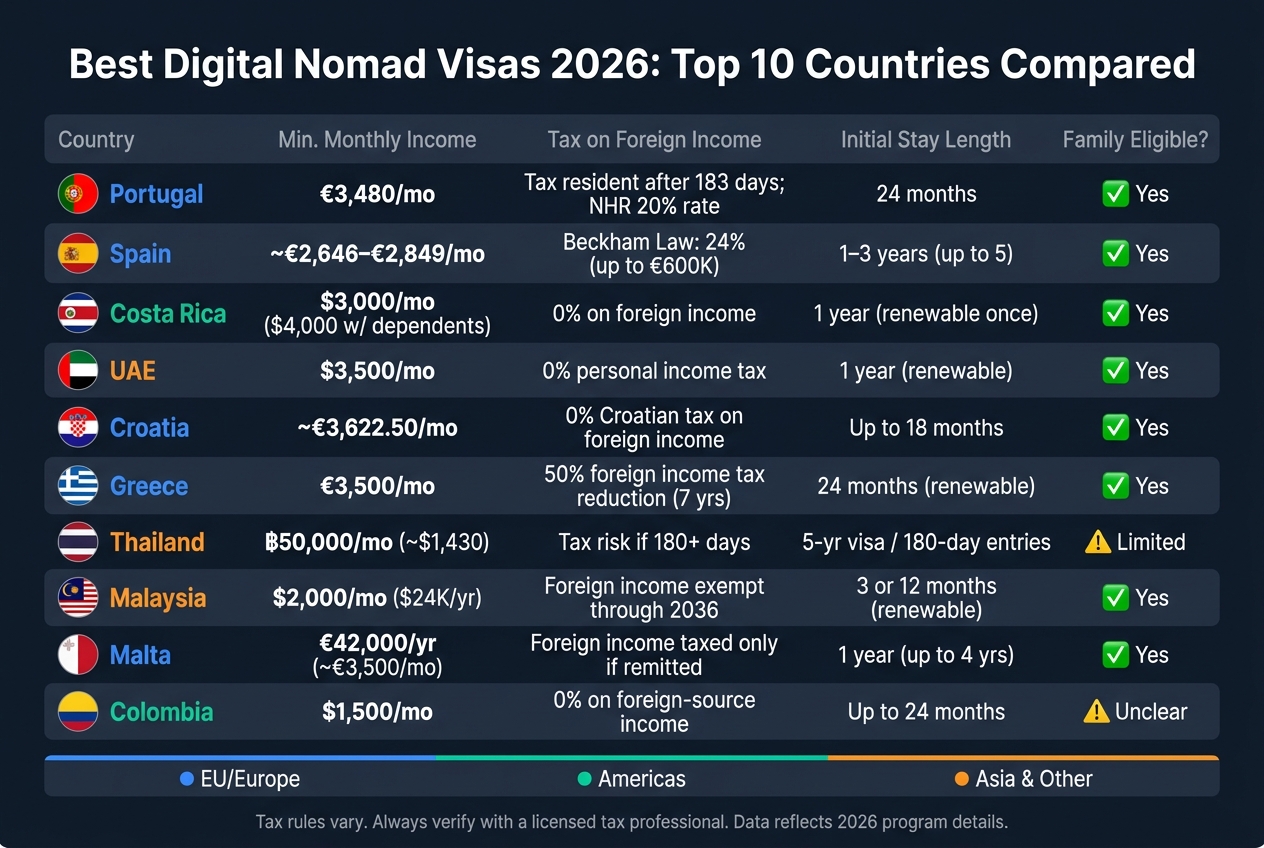
| Country | Income Floor | Tax Angle | Stay Length | Family | Best Fit |
|---|---|---|---|---|---|
| Portugal | €3,480/month | Tax residency after 183 days; NHR-style relief may apply | 24 months, renewable | Yes | Long-term EU base |
| Spain | ~€2,646 to €2,849/month | Beckham Law may cut tax to 24% | 1 to 3 years, renewable up to 5 | Yes | EU stay with lower income bar |
| Costa Rica | $3,000/month or $4,000 with dependents | Foreign income generally not taxed locally | 1 year, renewable once | Yes | Latin America with simple tax rules |
| UAE | $3,500/month | 0% personal income tax | 1 year, renewable | Yes | Zero-tax base (though you should still understand tax residency and reporting rules) |
| Croatia | ~€3,622.50/month | 0% Croatian tax on foreign-source income under the permit | Up to 18 months | Yes | Europe with low local tax |
| Greece | €3,500/month | Foreign income tax cut may apply for residents | 24 months, renewable | Yes | Family-friendly EU stay |
| Thailand | ฿50,000/month (~$1,430) | Tax risk if you stay 180+ days | 5-year visa window with 180-day entries | Not the main selling point | Low income bar, long visa window |
| Malaysia | $24,000/year | Foreign-source income exemption through 12/31/2036 in many cases | 3 or 12 months, renewable | Yes | Asia with lower tax friction |
| Malta | €42,000/year | Foreign income taxed only if remitted | 1 year, renewable up to 4 | Yes | English-speaking EU base |
| Colombia | $1,500/month | Foreign-source income generally taxed at 0% | Up to 24 months | Less clear | Low-income Latin America option |
So if you’re trying to narrow this list fast, I’d sort countries into four buckets:
- Long-stay Europe: Portugal, Spain, Greece, Malta
- Low-tax Europe: Croatia, Malta
- Low-tax Americas: Costa Rica, Panama, Colombia, Uruguay
- Asia budget picks: Thailand, Malaysia, Mauritius, Sri Lanka
That framework makes the rest of the list much easier to scan.
sbb-itb-39d39a6
1. Portugal Digital Nomad Visa
Portugal’s D8 visa is still one of the best all-around picks for remote workers who want a clear income threshold and a path to long-term residence.
Income Requirement
The minimum monthly income is €3,480, which is set at four times Portugal’s national minimum wage. The application fee is €180. You’ll also need proof of accommodation, such as a 12-month lease or a property deed.
Tax Treatment
If you spend 183+ days in Portugal during a calendar year, you become a tax resident. Under the updated NHR regime, qualifying Portuguese employment and self-employment income is taxed at 20% for 10 years. Foreign income may be exempt when a tax treaty applies. Without NHR, progressive tax rates range from 14.5% to 48%. Self-employed workers also pay 21.4% social security on 70% of self-employment income.
For U.S. citizens, the U.S.-Portugal tax treaty can help soften the blow. You can claim the Foreign Tax Credit (Form 1116) to reduce double taxation. You still need to file Form 1040, and you must file an FBAR if your foreign accounts go over $10,000 at any point during the year.
Length of Stay and Family Eligibility
The D8 visa is first issued for 24 months and can be renewed. Time spent on the D8 counts toward the 5-year mark for permanent residency and later citizenship. To apply for citizenship, you must pass a basic Portuguese language test at the A2 level, known as the CIPLE exam.
You can add a spouse, dependent children, and dependent parents in the same application.
Portugal sets a high bar for long-stay remote work in Europe. Spain’s digital nomad visa is the closest match for people who want a similar way of life but are weighing different tax trade-offs.
2. Spain Digital Nomad Visa
Spain’s International Teleworker Visa is a strong pick if you want a lower income bar than Portugal’s. You generally need to show about €2,646 to €2,849 per month, based on the year’s calculation. Application fees usually fall between €60 and €200.
Income Requirement
That lower income bar comes with tighter screening. You need either a degree or 3+ years of relevant experience. Spain also tightened screening in 2026 to curb fraud.
Tax Treatment
Here’s the trade-off: Spain can be easier on the income side, but harder on approval and taxes.
If you qualify and elect it, the Beckham Law lets eligible residents pay 24% on income up to €600,000 for the first six years. To use it, you must not have been a Spanish tax resident during the previous five years. Income above that amount is taxed at 47%.
If you don’t use the Beckham Law, Spain’s regular progressive tax rates range from 19% to 47%.
For U.S. readers, the main ways to cut double taxation are the Foreign Earned Income Exclusion (FEIE) and the Foreign Tax Credit (Form 1116). The FEIE cap for 2026 is $132,900. You’ll still file Form 1040, and you may also need FBAR reporting if your foreign account balances go over $10,000. On top of that, a bilateral U.S.-Spain agreement may let U.S. remote workers stay in the American social security system for up to 24 months.
Length of Stay and Family Eligibility
The visa lasts 12 months if you apply through a consulate, or 3 years if you apply from inside Spain. It can be renewed up to 5 years total and may lead to permanent residency. Citizenship usually takes 10 years.
Spain also allows family inclusion, so spouses and dependent children can be added to the application.
For a warmer, simpler option in the Americas, Costa Rica is next.
3. Costa Rica Digital Nomad Visa
Costa Rica is a solid pick for remote workers who want territorial taxation and up to two years in the country. The main draw here isn’t the lowest income threshold. It’s the tax and residency solutions.
Income Requirement
Individual applicants need to show $3,000 per month in stable foreign-source income. If you’re bringing a spouse or other dependents, that rises to $4,000 per month. The application fee is about $250, and document legalization and apostille costs can add another $150 to $300. You should also be ready to provide at least six months of stamped bank statements to show steady income.
That said, the bigger selling point is how Costa Rica handles foreign remote income.
Tax Treatment
Costa Rica taxes only income earned inside the country. That means foreign salary, freelance income, and investments held abroad are exempt. Law No. 10,008 makes that exemption explicit, which helps cut down the gray area around long stays and tax risk.
Costa Rica also has no capital gains tax, wealth tax, or inheritance tax on foreign assets.
That clear tax setup goes hand in hand with a simple stay period and the option to bring family.
Length of Stay and Family Eligibility
The visa is valid for one year and can be renewed once for a second year, for a maximum stay of 24 months. Visa holders also get duty-free entry for work equipment, can open local bank accounts, and may use a home-country driver’s license during the visa term. Spouses and dependent children can be included in the same application.
If you want a lower income threshold, the older Rentista route requires $2,500 per month, but it also comes with mandatory Caja enrollment.
Next up is a very different model: a higher-income, residency-light option in the UAE.
4. Dubai/UAE Virtual Work Residence Visa
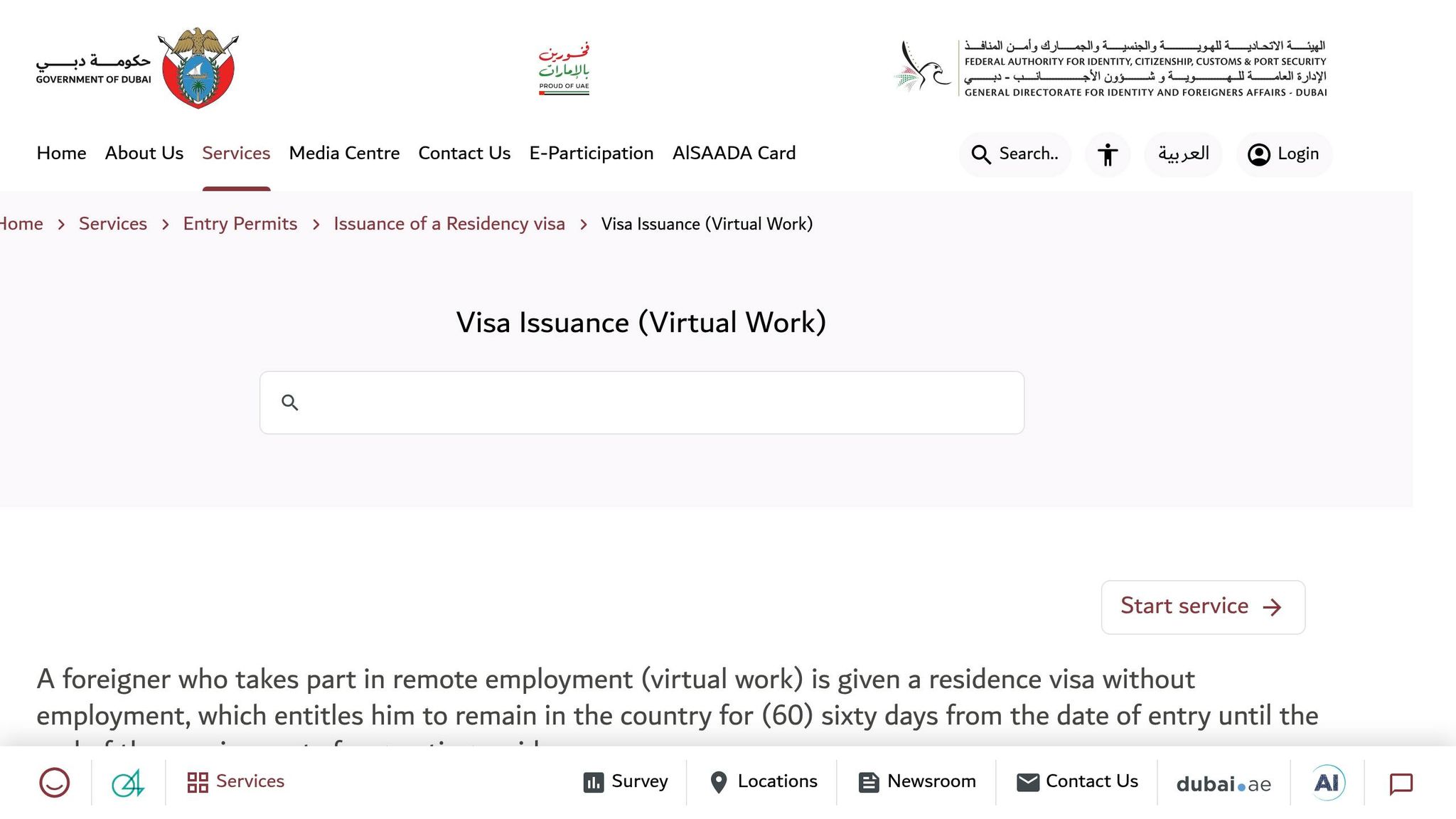
If you want zero personal income tax and a fairly clean application, the UAE is one of the strongest options on the table. The UAE’s Virtual Work Residence Visa is a one-year, renewable permit built for remote workers.
Income Requirement
To qualify, you need at least $3,500 per month from a foreign employer or your own foreign-registered business. You also need a one-year contract, or proof that you own the business, plus health insurance.
There are two main application routes:
- The federal route costs about $100 to $300
- The Dubai Virtual Working Programme costs about $600 and includes an Emirates ID and required medical testing
That setup is part of the appeal. The paperwork is fairly direct, and the income bar is lower than in some other remote work visa programs.
Tax Treatment
The big draw is simple: the UAE charges 0% personal income tax on salaries, dividends, capital gains, and investment income.
There is also a 9% corporate tax, but it only applies to self-employed business activity above AED 1 million in annual turnover. So if you’re a standard remote employee working for a foreign company, this usually doesn’t hit you.
For U.S. citizens, though, the story doesn’t stop there. The U.S. taxes citizens on worldwide income no matter where they live, so UAE residency does not end your IRS filing duties. You still need to file, and you may be able to use Form 2555 to claim the Foreign Earned Income Exclusion, capped at $132,900 in 2026.
Length of Stay and Family Eligibility
Spouses and children can be included on the visa, which makes the program more workable for families. The permit itself does not lead straight to permanent residency. That said, visa holders can later move to other UAE visa tracks, such as the UAE Golden Visa, if they meet that program’s separate rules.
If you want a lower-bureaucracy EU option after this, Estonia is the clearest side-by-side comparison.
5. Estonia Digital Nomad Visa
After the tax-free simplicity of the UAE, Estonia feels stricter. But it’s also a very streamlined EU path for remote workers.
Income Requirement
Estonia’s digital nomad visa has one of Europe’s highest income thresholds, and it’s set up for shorter remote stays rather than open-ended relocation. You need at least €4,500 per month in income before tax, or about $4,900.
The Type D visa costs €120, plus about €20 in VFS fees. You also need private health insurance with at least €30,000 in coverage.
That higher income bar gives you a clean, tightly defined visa with less long-term tax risk.
Tax Treatment
If you stay under 183 days, you’ll usually avoid Estonian tax residency. Go past that line, and Estonia may tax your worldwide income.
For anyone thinking about a deeper stay, that changes the picture. Estonia works better as a short-term base than a long-term one.
Length of Stay
The visa allows up to 365 days of continuous stay, with a hard cap of 548 days within any 730-day period. In plain English, that usually means an initial 12-month stay, with room for one extension.
Family Eligibility
Family members aren’t included by default. In most cases, they’ll need separate proof of funds or their own visa.
6. Greece Digital Nomad Visa
Greece is a solid middle-ground pick if you want a longer EU stay than Estonia and a setup that works well for families. You get Mediterranean living, a 24-month remote-work visa, and a tax break on foreign income.
Income Requirement
The minimum monthly income is €3,500, and the application fee is €150. Bringing family? The income threshold goes up by 20% for a spouse and 15% for each dependent child.
Tax Treatment
If you become a Greek tax resident, your foreign-source income may qualify for a 50% tax reduction for seven years. Social security may also apply after 183 days, unless a bilateral agreement with your home country says otherwise.
Length of Stay
The visa is issued for 24 months and can be renewed for two more years.
Family Eligibility
Spouses and dependent children can join the main applicant. Everyone also needs private health insurance for their stay in Greece.
If you’re leaning toward a lower-cost option in Asia, Thailand is the next place to look.
7. Thailand Destination Thailand Visa (DTV)
Thailand’s DTV is one of the better Southeast Asia picks for remote workers, especially if you want a lower income threshold and a long runway. The big draw is simple: a five-year visa window without needing sky-high earnings.
Income Requirement
Applicants need to show a minimum monthly income of ฿50,000 (about $1,430), backed by six months of bank statements. The application fee is ฿10,000 (about $285), and each 180-day extension costs ฿5,000 (about $142).
Length of Stay
The DTV is a five-year multiple-entry visa. Each time you enter Thailand, you can stay for 180 days. You can then extend that stay once for another 180 days at a local immigration office.
So in plain English, that means you can stay for up to 360 days per entry cycle. One thing to watch: the DTV sits under the tourist visa category, so time spent on it does not count toward permanent residency or naturalization.
Tax Treatment
If you stay in Thailand for 180 days or more during a calendar year, you may become a tax resident. At that point, foreign income remitted into Thailand may be taxed at rates from 5% to 35%.
The simplest way around that issue is to keep your stay under 180 days. That said, this isn’t the kind of detail you want to guess on. Track your days with care, because your tax status hinges on residency.
8. Malaysia DE Rantau Nomad Pass
Malaysia is another Southeast Asia pick for remote workers who want a lower income bar and a more direct foreign-income tax setup. The DE Rantau Nomad Pass is aimed at eligible digital professionals, and it can work well if you want a base in Southeast Asia or explore digital nomad opportunities in Latin America without the higher income rules you often see in Europe.
Income Requirement
You need to show at least $24,000 per year ($2,000 per month), along with six months of bank statements. Application costs are about RM 1,000 ($220 to $250), plus immigration pass fees.
The program is run by MDEC and is open to eligible professionals in IT, digital marketing, and digital creative fields. One thing to note: it covers Peninsular Malaysia only.
Length of Stay
The pass can be issued for 3 months or 12 months. You can renew it once for another 12 months, which brings the maximum stay to 24 months. It does not lead to permanent residency.
Tax Treatment
Foreign-source income is generally exempt from Malaysian tax through December 31, 2036, under Budget 2025. There’s an important catch, though: that income must have been taxed in its source country. If your income is routed through a zero-tax jurisdiction, it may not qualify.
That’s why it makes sense to check your tax position with care if your setup runs through a zero-tax location. For the right applicant, DE Rantau is a strong fit for a short- to mid-term stay with limited local tax exposure.
Family Eligibility
You can include a spouse and dependent children on the same application.
9. Croatia Digital Nomad Residence Permit
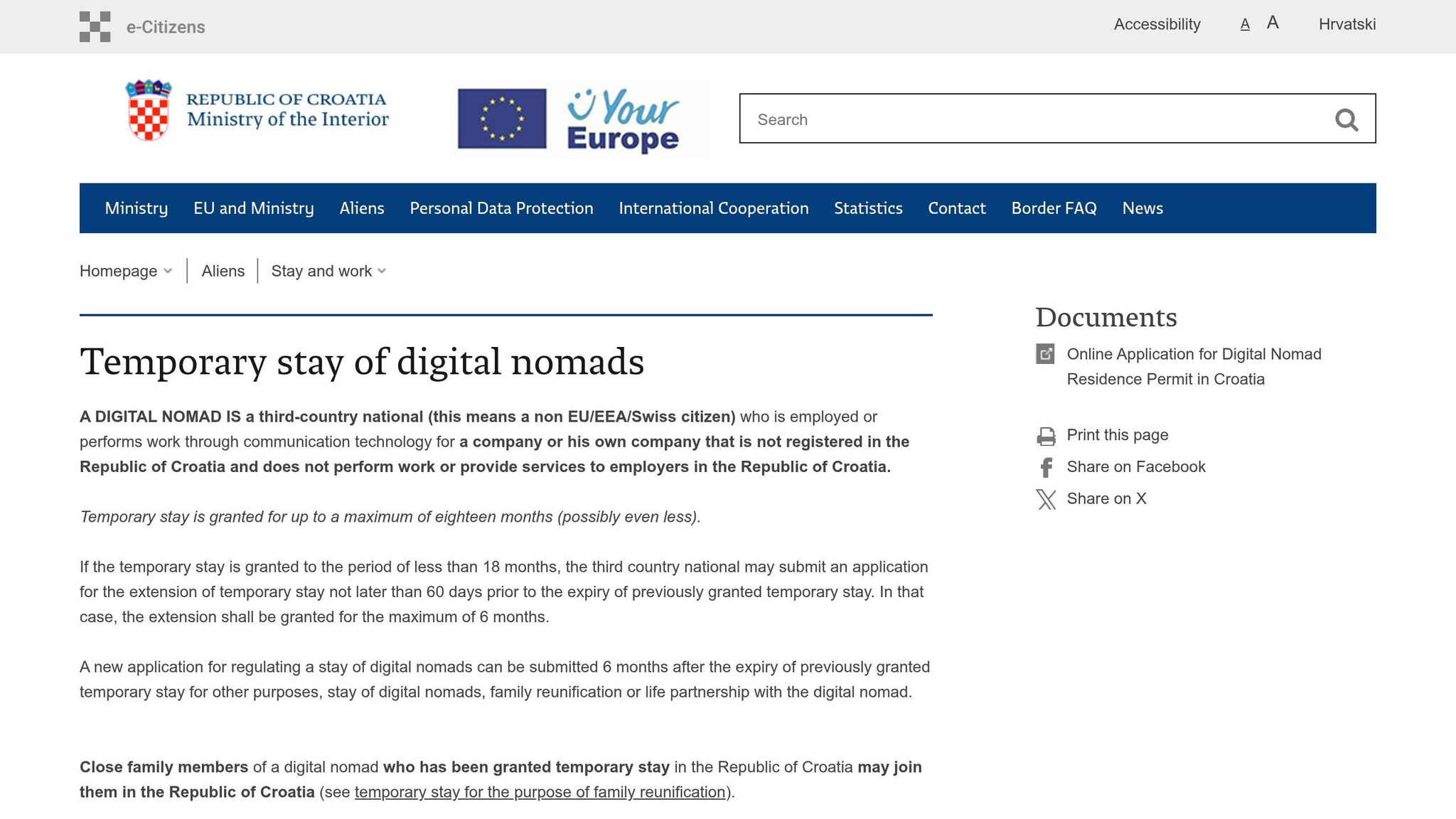
Croatia sits in the mid-to-high cost range for EU nomad visas , similar to the Italy Digital Nomad Visa, but the tax side is where it stands out.
The deal is pretty clear: day-to-day life isn’t cheap, yet the tax rules for remote workers are unusually clean.
Income Requirement
The minimum monthly income is about €3,622.50. That equals 2.5 times Croatia’s average net monthly salary.
If your income goes up and down, Croatia also lets you qualify through savings instead. You’ll need about €43,470 for a 12-month stay or €65,205 for an 18-month stay. Application fees are about €70 to €100.
Tax Treatment
Permit holders pay 0% Croatian tax on foreign-source employment income and foreign-source business income. They also do not owe Croatian social security contributions on that income.
For U.S. citizens, that usually means the Foreign Earned Income Exclusion (FEIE) matters more than the Foreign Tax Credit, since Croatia isn’t taking a local tax bite out of that foreign income.
There is one hard line here: do not work for Croatian clients or employers. If the income is Croatian-source, Croatia taxes it at 20% to 30%.
Length of Stay
A 2025 amendment extended the top stay length to 18 months.
That said, you can’t renew this permit back-to-back. You must leave Croatia for at least six months before you apply again. This program also does not lead to permanent residency.
Family Eligibility
You can add family members to the application. Just note that adding family also pushes the financial threshold higher.
10. Italy Digital Nomad Visa
Italy is a more regulated EU option than Croatia. The screening is tighter, especially around your work history and credentials, and the tax angle is less favorable if your main goal is to keep taxes low.
Italy’s digital nomad visa is aimed at highly specialized non-EU remote workers. It also splits applicants into two paths: employees and self-employed workers.
Income Requirement
The income rules can vary by consulate. Instead of one simple cutoff, the process tends to be document-heavy, with more focus on the paperwork you provide.
Tax Treatment
Italy will usually treat you as a tax resident after 183 days in a calendar year. Once that happens, your worldwide income can become taxable there.
For U.S. remote workers, the Foreign Tax Credit using Form 1116 can help offset Italian tax. Long-term work in Italy while employed by a foreign company can also create permanent establishment risk for the employer.
That means Italy tends to make more sense for people planning a longer stay and ready to deal with a stricter tax setup, not for those looking for the lowest-tax path.
Length of Stay
The permit is issued for one year and can be renewed if you still meet the visa conditions.
11. Malta Nomad Residence Permit
Malta is a solid pick if you want an English-speaking base in the EU without the same tax drag you may run into in Italy. The main draw is its remittance-based tax system. Put simply, foreign income is taxed only if you bring that money into Malta. That gives remote workers more say over how much income becomes taxable locally.
Income Requirement
To qualify, you need a minimum gross annual income of €42,000, or about €3,500 per month. The permit is open to non-EU/EEA remote workers whose income comes from outside Malta.
Tax Treatment
Under Malta’s rules, foreign income is taxed only when remitted into the country. Foreign card spending does not count as remittance. That said, tax residency can still create exposure to worldwide taxation, depending on your facts and filing status.
Length of Stay
The permit starts with a one-year term and can be renewed up to three times, which means a total stay of up to four years. If you prefer the South Pacific, consider the New Zealand digital nomad visa. In most cases, it does not lead to permanent residency or citizenship.
Family Eligibility
You can include a spouse and dependent children in the application, though you’ll need to meet a higher income threshold to do that.
12. Cyprus Digital Nomad Visa
Cyprus is another Mediterranean pick for remote workers. It offers a similar lifestyle setup to other options in the region, but with a simpler entry point on income. The big draw is the €3,500 monthly income threshold, which makes Cyprus a straightforward EU base for people who work online.
Income Requirement
The standard income threshold is €3,500 per month.
Tax Treatment
If you spend more than 183 days in Cyprus, you may become a tax resident. That means your worldwide income could be taxed there. For remote workers looking at Europe, this is often the main thing to watch: Cyprus tends to make the most sense if you stay under the tax-residency limit.
Length of Stay
The permit is issued for one year and can be renewed for up to two additional years.
Family Eligibility
Spouses and dependent children can be included in the application.
13. Hungary White Card
Hungary’s White Card is a one-year remote work permit for non-EU applicants. It fits somewhere in the middle: less rigid than some EU permit paths, but without the tax perks you’ll find in a few of the options ranked above it.
Income Requirement
Applicants need to show €3,000 in net monthly income, and that income must have been held for at least six months before the application.
Tax Treatment
The trade-off here is pretty straightforward. Hungary keeps the permit process fairly clean, but it does not offer a special tax break for White Card holders. If you spend 183+ days in the country, you may trigger tax residency. That can make a big difference if you’re thinking beyond a short stay.
Length of Stay
The White Card is valid for one year and can be extended once, which means the maximum stay is two years.
Family Eligibility
Family inclusion is generally not available.
14. Romania Digital Nomad Visa
Romania sits in the same EU travel lane as Hungary and Croatia, but its public 2026 rules are less clearly published.
That lack of public detail makes Romania harder to compare with better-documented EU options. It’s tougher to line it up on the points most people care about, like income thresholds, length of stay, and whether family members can join.
What still matters, though, is the tax side. A visa does not override tax residency, and staying 183 days or more can still trigger local tax exposure.
So even if Romania looks appealing on the surface, the limited public 2026 information makes it harder to place above EU options with clearer rules.
15. Czech Republic Freelancer/Digital Nomad Route
The Czech Republic is a more limited EU option than the broader remote-work routes mentioned above. It has a narrow digital nomad path for qualified IT and marketing professionals from a short list of eligible countries, including the U.S. This route applies to both eligible foreign employees and freelancers.
Income Requirement
There isn’t one published income minimum for everyone. Instead, eligibility depends on showing ongoing remote work, such as an employment contract or signed client agreements.
Tax Treatment
If you stay 183 days or more during a calendar year, you may become a Czech tax resident.
This is a niche route for specialized remote workers, not a general-purpose nomad visa.
16. Germany Freelancer Residence Permit
Germany is stricter and comes with more paperwork than the Czech freelancer route. But for established self-employed workers who want a major EU base, it can be a good fit.
Germany’s Freelancer Residence Permit is aimed at self-employed remote workers.
Income Requirement
There isn’t a published fixed minimum income amount. Instead, approval depends on showing that your freelance business is viable and that you have enough money to support yourself.
Tax Treatment
Once you become a German tax resident – usually after 183 days in a calendar year – Germany taxes your worldwide income. If you’re a U.S. citizen, you still need to file Form 1040. You may be able to cut double taxation by using the Foreign Earned Income Exclusion (FEIE), capped at $132,900 in 2026, or the Foreign Tax Credit through Form 1116.
Germany also applies rules that may tax some foreign companies you control. On top of that, it’s worth checking whether a Totalization Agreement can help you avoid paying social security taxes in both countries.
Length of Stay
The permit is often issued for one to three years and can be renewed if you still meet the freelance activity and income rules.
Family Eligibility
Spouses and dependent children can usually join the permit holder, subject to standard German family reunification rules.
Germany makes the most sense for self-employed workers who are ready to commit to a major EU base and deal with a heavier tax and admin load. If that sounds like more than you want, Iceland offers a lighter-touch EU path and comes next.
17. Iceland Long-Term Remote Work Visa
If you want a colder, lower-commitment base in Europe, Iceland is one of the better short-stay picks.
Iceland’s remote work visa lets non-EU/EEA/EFTA nationals live in Iceland while working remotely for a foreign employer or foreign clients. It’s remote work only, so you can’t take a local job there. And it’s meant for a short stay, not a long move. In plain English: this is a low-commitment option, not a path for settling down.
Length of Stay
The visa can be granted for up to 180 days if you apply from outside the Schengen Area. If you’re already inside Schengen, the stay is usually capped at 90 days.
Family Eligibility
Family members can be included in the application. That makes the visa more workable for couples and families who want to spend a short stretch in Iceland together.
For people who want a temporary Nordic base, Iceland fits that role well.
18. Norway Independent Contractor Visa
Norway is one of the stricter Nordic picks for contractors who want to stay longer.
Income Requirement
Norway does not list a fixed minimum income amount. Instead, you need to show that you earn enough to support yourself without using public funds.
Tax Treatment
A stay of about 183 days can trigger Norwegian tax residency. Once you become a tax resident, Norway can generally tax your worldwide income.
19. Georgia Remotely from Georgia Program
For remote workers who want a cheaper, simpler base than the Nordic routes, Georgia is a strong next option. It’s free to apply, which makes it one of the lowest-cost nomad paths in 2026. If your goal is low-cost, low-friction remote work with a clean one-year stay, Georgia fits well.
Income Requirement
Applicants need to show a minimum monthly income of $2,000 or a bank statement with at least $24,000.
Tax Treatment
Georgia generally treats you as a tax resident after 183 days, and the visa does not override that rule. In plain English, that means Georgia tends to work better for shorter stays or careful tax planning than for an open-ended move.
For longer stays, Georgia’s Individual Entrepreneur regime may help with residency planning.
Length of Stay
The program lets remote workers live and work in Georgia for up to one year. Citizens from 95 countries, including the U.S. and EU member states, can apply.
Family Eligibility
Spouses and children may be included under the program. Required documents include:
- A passport with at least 3 months remaining
- Proof of remote work
- Health insurance
Low cost, broad eligibility, and family inclusion make Georgia a practical match for the core comparison points this article tracks.
20. Albania Unique Permit for Digital Mobile Workers
Albania is one of the newer Balkan options, but the public details for 2026 are still pretty thin compared with nearby programs.
From what’s currently available, Albania seems to follow the standard 183-day tax residency rule, and the source material does not point to any special tax break for digital nomads. The key details people usually want first, like the 2026 income requirement, length of stay, renewal rules, and whether family members can be included, have not been clearly published.
For now, it makes more sense to treat Albania as a watchlist option instead of a top-tier choice until official guidance is confirmed.
21. Montenegro Digital Nomad Program
Montenegro is one of several new digital nomad locations, but public details are still thin. That makes it harder to rank than the programs above with clearer rules.
Right now, there’s no verified minimum income requirement published. Tax residency is the main concern. If you stay 183 days, that can trigger tax residency, and visa status does not override physical-presence rules.
There’s also no verified public guidance on stay length, renewals, or family rules. So for shortlist planning, it makes sense to treat Montenegro as unconfirmed.
When you compare it with nearby Balkan options that spell out income, tax, and stay rules more clearly, Montenegro is much harder to assess. At this stage, it can’t compete with programs that publish those details up front. Because the public rules are incomplete, Montenegro is less useful for shortlist planning than the better-documented visas in this guide.
22. Turkey Digital Nomad Visa
Turkey sits below the best-known EU programs when it comes to clear rules. Public 2026 program details don’t confirm a minimum income requirement or a set stay length, so it’s tough to judge cost or plan far ahead.
That lack of detail makes Turkey harder to compare with EU options that spell things out more clearly. If you’re trying to build a shortlist fast and want rules you can check without second-guessing, the next option deserves a closer look.
23. Mexico Temporary Resident Visa for Remote Workers
Mexico’s 2026 Temporary Resident Visa is getting tougher at the consulate stage, especially in Mexico City. In some cases, officials are asking for higher income proof as they tighten screening in high-pressure neighborhoods. So Mexico now looks less like a visa-light nomad option and more like a residency-first path.
Compared with the most nomad-friendly programs, Mexico stands out more for lifestyle fit than for easy approval.
Income Requirement
Consulates are using tighter financial screening in 2026, with extra pressure in Mexico City.
Tax Treatment
A Temporary Resident Visa does not automatically make you a Mexican tax resident. But tax residency can still start after roughly 183 days in the country, which may make your worldwide income taxable.
Length of Stay
Mexico is also taking a harder line on overstays, which makes formal residency a cleaner long-term route than repeated border runs.
For remote workers in Mexico, the main draw here isn’t easy entry. It’s the chance to set up a more stable long-stay base.
24. Panama Short-Stay Visa for Remote Workers
Panama stands out for one big reason: simple tax rules. It’s not the best pick for families, and it doesn’t lead to a long stay. But for solo remote workers who want a fairly straightforward setup, it can make sense.
Income Requirement
You need to earn at least $36,000 per year from foreign sources. You also need to show proof that you work remotely for foreign clients or employers.
The government fees add up to $300 total:
- $250 for the application
- $50 for the visa card
There’s one extra hurdle here: you must file through a licensed Panamanian attorney. Attorney fees usually run from $800 to $2,000.
Tax Treatment
This is the main draw. Panama taxes only income earned from Panama sources, which means foreign remote-work income is not taxed locally.
If you’re a U.S. citizen, though, that doesn’t get you off the hook with the IRS. The U.S. taxes citizens on worldwide income. The Foreign Earned Income Exclusion (FEIE) can reduce what you owe, but it’s capped at $132,900 for the 2026 tax year.
Length of Stay
The visa is valid for 9 months and can be extended one time for another 9 months, for a maximum stay of 18 months.
Family Eligibility
Family members can’t be included under this visa.
25. Colombia Digital Nomad Visa
Colombia’s V NOMADAS visa stands out for one simple reason: the income bar is low compared with many other visas on this list. That makes it a solid pick in Latin America for remote workers who don’t earn a huge monthly income but still want more time than a lot of short-stay visa options allow.
Income Requirement
The minimum income is $1,500 per month. To apply, you’ll need three months of bank statements plus proof of an employment relationship or a contract with a foreign company. Application fees usually fall between $170 and $230.
Tax Treatment
Colombia uses a territorial tax system. In plain English, that means foreign-source income is generally taxed at 0% by Colombia.
Length of Stay
The V NOMADAS visa is valid for up to 24 months. It does not offer a direct route to permanent residency or citizenship.
Family Eligibility
As of 2026, public guidance does not clearly explain income rules for dependents. Because of that, solo applicants have the clearest path.
Argentina is the next Latin America option to compare.
26. Argentina Digital Nomad Visa
Next up is Argentina. It’s still one of the more affordable places to base yourself, and the first stay is on the shorter side. Argentina rolled out its digital nomad visa in May 2022 and, as of 2026, it still draws remote workers who want a lower-cost setup.
Income Requirement
Argentina doesn’t list a fixed minimum income. That said, most applicants tend to show at least $2,500 per month. The fee is $200, and processing usually takes 10 to 45 days. You’ll also need health insurance that covers your full stay.
Tax Treatment
Argentina does not provide a special tax break for digital nomads. If you stay 183 days or more, you may become a tax resident.
Length of Stay
The visa is valid for an initial stay of 6 to 12 months.
Family Eligibility
Dependents can come with you if you show enough income and health insurance for each person.
If you’re comparing options in Latin America and want a longer stay with a lower tax hit, Brazil is the next big one to look at.
27. Uruguay Digital Nomad Permit
Uruguay is one of the lower-cost options in South America for remote workers. The administrative fee is about $11. The main draw here is simple: low cost and a fairly easy process, not the longest stay on the list.
Income Requirement
There’s no fixed legal minimum income. That said, most applicants tend to show around $1,500 to $2,000 per month in monthly income.
Tax Treatment
Foreign-source wages and salaries are exempt from local tax. In 2026, residents who don’t qualify for a tax holiday pay 12% on foreign passive income, including dividends, interest, and capital gains.
Length of Stay
The permit starts with 180 days of stay and can be renewed one time, for a total maximum stay of 12 months.
Family Eligibility
Rules for bringing family members are not clearly published.
Brazil is the next regional option for readers comparing long-stay South American remote-work visas.
28. Brazil Digital Nomad Visa
Brazil is a practical pick in South America if you want a lower bar for entry and don’t mind the usual tax residency rules. The application fee is $100.
Income Requirement
You’ll need to show $1,500 per month in income or $18,600 in savings. You also need three months of bank statements, proof of foreign employment, health insurance, and a criminal record check from your home country.
Tax Treatment
Brazil does not offer a territorial tax setup for remote workers. If you spend more than 183 days in the country, you’ll generally become a tax resident and may owe tax on your worldwide income. If you’re a U.S. taxpayer, you may also be able to use the FEIE, which is capped at $126,500 for 2026.
So while Brazil is easier to get into than some programs in Europe, it’s usually less tax-friendly than territorial-tax options elsewhere in the region.
Length of Stay
The visa is issued for one year and can be renewed for one more year.
Family Eligibility
Spouses and dependent children can usually be included.
29. Ecuador Rentista/Remote Worker Route
Ecuador is another option in Latin America, but the public 2026 details are thinner than the better-documented programs listed above.
Ecuador’s Rentista route is meant for people with steady foreign income, such as wages, pensions, investments, or rental income. The 2026 income threshold is not published in the source material, so applicants should expect to show consistent foreign income through documents like bank statements and contracts.
The source material also does not confirm Ecuador’s current tax treatment for this route. Details on stay length, renewals, moves into longer-term residency, and family eligibility are also not confirmed in the source material.
30. Peru Digital Nomad-Compatible Stay Options
Tax Treatment
Peru falls into a similar tax pattern as Ecuador and Colombia, so how long you stay matters more than whatever the visa is called. The main thing to watch is tax residency. If you plan to stay for an extended period, keep a close eye on the 183-day threshold.
Belize is the next option for remote workers who want an English-speaking base in Central America.
31. Belize Work Where You Vacation Program
Belize is a niche pick for remote workers who want an English-speaking base, a Caribbean way of life, and easy access to North America. It doesn’t get as much attention as some of the bigger Caribbean programs, but it still makes sense if location and English-language convenience are high on your list.
Income Requirement
The program requires a minimum annual income of $75,000.
Tax Treatment
Belize uses a territorial tax system. So if your income is foreign-source and earned outside Belize, it isn’t subject to local income tax.
Length of Stay
The program is valid for one year and can be renewed.
Next up is Barbados, a more established option with a higher income bar.
32. Barbados Welcome Stamp
Barbados is a solid Caribbean pick if you want a clear foreign-income exemption and terms that work well for families. It scores well for simple tax rules, family access, and fast approval.
Income Requirement
You need $50,000 in annual foreign-source income from salary, freelance work, or business ownership. You also have to certify that you’ll meet that level over the next 12 months. Use the current $50,000 application threshold, not the older statutory figure.
Tax Treatment
Welcome Stamp holders are treated as non-residents for Barbados tax purposes. That means Barbados does not tax foreign-source income under this visa. The usual 183-day rule does not apply here.
There’s one big catch: if you take local employment, you lose both the visa and the tax exemption.
If you’re a U.S. citizen, the U.S. still taxes your worldwide income. That said, the Foreign Earned Income Exclusion may help. For 2026, that amount is $126,500.
Length of Stay
The visa is valid for 12 months and can be renewed for one more 12-month period. Processing usually takes 5 to 7 business days.
Family Eligibility
Spouses and dependent children can be added through a family bundle. The fee is $2,000 for an individual application and $3,000 for the family bundle.
You’ll also need health insurance that covers all applicants for the full stay.
Bermuda is next for readers who want another English-speaking Caribbean option with a different entry structure.
33. Bermuda Work From Bermuda Certificate
Status: Bermuda’s Work From Bermuda Certificate is closed to new applicants as of 2026, so it is not an active option for new remote workers. Bermuda is no longer open, but it still works as a useful benchmark for zero-tax remote-work programs.
Tax Treatment
Bermuda’s personal income tax rate is 0%. While the program was active, remote workers were not subject to local income tax on their earnings.
Income Requirement
The program did not set a specific annual income threshold. Instead, applicants needed to show proof of sufficient funds.
Length of Stay and Family Eligibility
The program no longer accepts applications, so stay length and family rules don’t matter for new applicants.
That makes the next active programs more relevant if you’re still narrowing down 2026 options.
34. Curaçao @Home in Curaçao Program
Among Caribbean choices, Curaçao stands out for one simple reason: there’s no fixed income floor. Instead of hitting a set earnings target, you only need to show that you have enough money to support yourself and that you work remotely for a foreign employer or client. That gives the program a nice middle-ground feel for remote workers who want a Caribbean base without a steep income hurdle.
Income Requirement
There’s no set minimum income. You’ll need to submit bank statements or proof of remote work. The application fee is about ANG 535 ($300) per applicant, and processing usually takes about two weeks.
Tax Treatment
Permit holders are treated as non-residents for tax purposes, which means foreign-source income is exempt from local tax. The key detail is simple: keep your work tied to foreign clients or employers. If you take on local work, you can lose that tax break. U.S. citizens still owe U.S. tax, though the FEIE can offset part of that bill.
Length of Stay
The permit is valid for 6 months and can be renewed once for another 6 months, for a maximum stay of 12 months. It does not lead to permanent residency.
Family Eligibility
Spouses and dependent children can be included in the same application.
If you want a similar Caribbean lifestyle but with a different income test and a longer-term setup, the next option is Antigua and Barbuda.
35. Antigua and Barbuda Nomad Digital Residence
Antigua and Barbuda’s Nomad Digital Residence (NDR) gives remote workers one of the longest first stays in the Caribbean: two years. That alone makes it stand out. It also stacks up well against other Caribbean picks if you care about simple taxes and bringing family with you.
Income Requirement
To qualify, you need at least $50,000 per year from foreign-source remote work. The application fee depends on how many people are applying:
- $1,500 for a single applicant
- $2,000 for a couple
- $3,000 for a family of up to four
- $650 for each extra dependent
Tax Treatment
Antigua and Barbuda has 0% personal income tax. There’s also no capital gains, inheritance, or wealth tax. If you stay 183 days or more, you may become a tax resident, but that still doesn’t change the 0% personal tax treatment.
Length of Stay
The NDR is valid for two years and can’t be renewed.
Family Eligibility
You can include your spouse and dependent children in the application.
If you want another English-speaking Caribbean option, the Bahamas is next.
36. Bahamas Extended Access Travel Stay
The Bahamas is another English-speaking Caribbean pick worth a look. The Bahamas Extended Access Travel Stay (BEATS) program lets remote workers and students live in the country for up to 12 months. That makes it a solid middle-ground choice for people who want a stay they can renew, but don’t want to deal with a posted income minimum.
Income Requirement
BEATS does not list a fixed 2026 income minimum. Instead, applicants need to show proof of remote-work income along with proof of employment and an employer letter, or proof of self-employment income.
Tax Treatment
The Bahamas does not tax personal income. So if you earn remote income from abroad, that income is not taxed locally. That said, U.S. citizens still owe U.S. tax on worldwide income no matter what visa or permit they hold. In some cases, the FEIE and the Foreign Tax Credit can help cut double taxation.
Length of Stay
BEATS is valid for up to one year. It can also be renewed, with a total stay of up to three years.
Family Eligibility
You can include a spouse and dependent children in the application.
37. Cayman Islands Global Citizen Concierge Program
The Cayman Islands Global Citizen Concierge Program closed in 2024 and isn’t open to 2026 applicants. Use it ONLY as a past reference. For a 2026 shortlist, stick with programs that are open now.
Skip closed programs and compare only visas with current application windows.
38. Dominica Work in Nature Visa
If you want a Caribbean base with more time on the ground and a cleaner tax setup for foreign income, Dominica sits in a solid middle spot. The Work in Nature (WIN) visa costs $900 for one applicant. That breaks down into a $100 application fee and an $800 visa fee. It gives you up to 18 months in Dominica, and there’s no renewal option.
Income Requirement
You need to show $50,000 per year in income, which is lower than Montserrat’s $70,000 bar.
Tax Treatment
This is where the WIN visa stands out. Holders get a statutory waiver on foreign-source employment income, dividends, and capital gains. That matters because Dominica’s normal top tax rate is 35%. Without the waiver, that rate could take a big bite out of your income.
For U.S. citizens, there’s still a catch: you continue to owe federal income tax to the IRS on worldwide income. The Foreign Earned Income Exclusion (FEIE) can soften that hit, with a cap of $132,900 for 2026.
Length of Stay
The WIN visa allows a stay of up to 18 months. It is non-renewable.
Family Eligibility
Spouses and dependent children can be added for $1,200.
39. Montserrat Remote Workers Stamp
Montserrat sets a higher bar than Dominica, but the upside is pretty clear: foreign-source income is exempt from local income tax. That makes it one of the more premium Caribbean picks for remote workers who can meet the income threshold. The Remote Workers Stamp costs $500 for single applicants, $750 for families of up to four, and $250 for each extra dependent.
Income Requirement
To qualify, applicants must earn $70,000 per year from a foreign employer, a foreign-registered business, or freelance contracts based overseas.
Tax Treatment
Stamp holders receive a statutory exemption from Montserrat income tax on foreign-source earnings. For U.S. citizens, that doesn’t wipe out tax across the board. You still owe U.S. tax on worldwide income, so this break only cuts your local tax bill.
Length of Stay
The permit is valid for 12 months and can be renewed if you still meet the program rules. Applications are submitted online, and processing usually takes seven working days.
Family Eligibility
Spouses and dependent children can be included in the same application.
40. Cape Verde Remote Working Program
Cape Verde is one of the less-documented remote work options for 2026. And that makes it tough to compare with the programs above on cost, tax, or how useful it is for a longer stay.
Right now, public rules do not confirm key details like:
- a minimum income threshold
- the initial stay period
- renewal terms
- family eligibility
Because those details still aren’t published, Cape Verde is harder to assess than the other programs already covered. For now, treat it as a watchlist option, not a shortlist option.
41. Mauritius Premium Visa
Mauritius is a free-to-apply and fairly easy option for remote workers, with a minimum income of $1,500 per month. Compared with island visa programs that can feel vague or thin on details, Mauritius is pretty clear about income rules, taxes, and renewals.
Income Requirement
The minimum monthly income is $1,500.
Tax Treatment
If you stay for fewer than 183 days, Mauritius does not tax your foreign earnings locally.
Once you pass 183 days, Mauritius applies a remittance basis. That means foreign-source income is taxed only if you transfer it into Mauritius. If you use a foreign bank card to pay for things while you’re in Mauritius, that does not count as a remittance.
For income that is remitted, the tax rates are:
- 0% on the first MUR 500,000
- 10% on the next MUR 500,000
- 20% on income above MUR 1 million
Length of Stay
The visa is valid for 12 months, can be renewed, and does not lead to permanent residency or citizenship.
Family Eligibility
Spouses and dependent children can be included in a single application.
| Feature | Detail |
|---|---|
| Minimum Monthly Income | $1,500 |
| Application Fee | Free |
| Initial Stay | 12 months (renewable) |
| Tax Basis | Remittance-based after 183 days |
| Family Included | Yes – spouse and dependents |
| Path to PR | No |
42. Seychelles Workcation Retreat Program
Seychelles is a good fit for readers who want a low-friction island setup with territorial taxation. But there’s a catch: it’s less hands-off than it sounds because of the monthly visit rule.
There’s no fixed income floor. Applicants need to show foreign employment or self-employment income, bank statements with enough funds, health insurance, and a clean criminal record. The fee is about €45.
Tax Treatment
Seychelles taxes only Seychelles-source income. That means foreign remote-work income stays exempt. There’s also no capital gains tax or inheritance tax.
Length of Stay
The permit lasts up to 12 months and can be extended by 6 months. To keep it active, you need to make one visit to Seychelles each month. There’s no path to PR or citizenship.
43. South Korea Workation Visa
South Korea’s Workation Visa is a one-year remote work option for people who want a base in East Asia. The big catch is the income bar: applicants need to show earnings at about twice South Korea’s GNI per capita.
Tax Treatment
If you stay 183 days or more, you may become a tax resident. So while this visa gives you a way to live and work from South Korea, it does not mean tax-free status.
Length of Stay
The visa starts with an initial stay of one year and can be renewed for one additional year, which brings the maximum total stay to two years.
Family Eligibility
Spouses and children under 18 can come as dependents. Japan is the next useful comparison for readers who want an East Asia base with different entry trade-offs.
44. Japan Digital Nomad Visa
Japan sits at the premium end of East Asia’s short-stay options. Compared with South Korea, it gives you less wiggle room, but the trade-off is simple tax treatment and a more fixed set of rules.
Japan offers its digital nomad visa through a Designated Activities status for remote workers. It also has the highest income threshold among the tax-free programs in this guide: at least ¥10 million per year, or about $67,000 to $68,000.
Tax Treatment
For this six-month visa, Japan generally treats holders as non-residents. That means foreign-source remote income is usually not taxed in Japan.
Length of Stay
The visa is valid for up to six months and cannot be renewed or extended. Once it ends, you must leave Japan for at least six straight months before applying again. This program also does not lead to permanent residency.
There’s another catch here: Japan does not issue a residence card for this visa. In plain English, that can make things like local banking and longer mobile phone plans harder to set up. This setup tends to fit higher earners who care more about tax clarity than staying for a long stretch.
Family Eligibility
Spouses and children can come with the main applicant. But each person needs to meet the private health insurance rule on their own and must hold a passport from an eligible visa-waiver, tax-treaty country.
45. Taiwan Employment Gold Card
After Japan and South Korea, Taiwan is one of Asia’s stronger picks if your goal is residency, not just a short stay. And that’s the key difference here.
Unlike the nomad visas mentioned above, Taiwan’s Employment Gold Card is built for high-skill professionals. It bundles a work permit, residence visa, Alien Resident Certificate (ARC), and re-entry permit into one application. It’s aimed at people in fields like tech, finance, law, and the arts, so it tends to suit skilled professionals more than remote workers looking for an easy-entry visa.
Income Requirement
There’s no fixed public minimum for 2026. Approval depends on your field and your salary history.
Tax Treatment
Taiwan uses the standard 183-day residency test, which means visa status by itself does not decide tax residency.
Length of Stay
The Gold Card is issued for one to three years and can be renewed. That gives it one of the longer initial stay periods among Asia’s professional visa options.
Family Eligibility
Spouses and dependent children can be included in the application. That puts Taiwan in line with other Asia options that allow family members to come too.
46. Indonesia Remote Worker/E33G Visa
Indonesia sits squarely in the short-stay Southeast Asia category. It can work well for remote workers, but there’s a clear line to watch: tax residency. Once you go past 183 days, that becomes the big issue.
Indonesia’s E33G visa is meant for a temporary remote-work stay.
Tax Treatment
Indonesia uses the 183-day tax residency test. If you stay 183 days or more in a calendar year, Indonesia may tax your worldwide income.
Length of Stay
The E33G visa does not lead to permanent residency.
47. Sri Lanka Digital Nomad Route
Sri Lanka is another option in Asia if you want a middle-of-the-road income requirement and the ability to bring family along. You need $2,000 per month in foreign income, and eligible remote workers usually don’t pay local tax on that income.
The visa is valid for 12 months, can be renewed, and lets you include a spouse and dependent children.
48. Namibia Digital Nomad Visa
Namibia has a digital nomad visa aimed at remote workers, freelancers, and business owners who can work from anywhere. For most people, the big things to check are pretty simple: how much income you need, how long you can stay, and what happens to your taxes.
Income Requirement
The source material does not give a fixed public income threshold.
Tax Treatment
This is where things get more serious. The visa itself does not cancel or replace Namibia’s tax residency rules. If you stay 183 days or more, you may become a Namibian tax resident, which can mean your worldwide income falls into Namibia’s tax net.
In plain English: getting the visa and becoming a tax resident are not the same thing, but a long enough stay can connect the two.
Length of Stay and Family Eligibility
Public guidance on length of stay, renewals, and family eligibility is not confirmed in the source material.
49. Anguilla Work Remotely Programme
Among Caribbean options, Anguilla stands out for one simple reason: it offers a fixed 12-month permit and no local tax on foreign income. The Anguilla Work Remotely Programme gives remote workers a one-year Caribbean base with a simple tax setup.
Tax Treatment
Anguilla has no personal income, capital gains, or inheritance tax.
Length of Stay and Renewals
The permit is valid for 12 months. There is no renewal option.
That’s the main trade-off. You get a clear one-year stay, but not a path to extend under the same program.
Who It’s Best For
Anguilla is best for remote workers who want a zero-tax Caribbean base and a fixed 12-month stay.
So which one do you actually pick?
Not the one with the lowest income bar. Not the one your favorite YouTuber moved to last year.
Work backward from your life, not forward from a spreadsheet. How long do you actually want to stay in one place? What tax residency are you already stuck with, no matter where you go? And what does your income look like on paper, not just in your bank account?
That last question matters more than people think.
A digital nomad visa tells a country you’re allowed to live there while you work for someone else, somewhere else. It says nothing about how your income is taxed back home, how your business is actually structured, or whether the way you’re getting paid holds up if a consulate officer, a bank, or your own government ever asks for the paperwork behind it.
Nobody puts that part in the marketing.
If your remote income is still running through your own name, no entity, no paper trail, most of these visas will still let you in the door. But you’re carrying more risk than the person applying next to you with a real business structure behind their income.
You don’t need to solve that before you pick a country. You do want to solve it before you sign a 24-month lease in Lisbon or wire six months of bank statements to a consulate in Bangkok.
Pick the visa that matches the life you actually want. Then, when you’re ready to make it official, let a formation service handle the compliance work so the business behind your passport is as solid as the passport itself.
FAQs
Which visa is best for taxes?
For tax-conscious remote workers, the best visas are often in places with 0% personal income tax, territorial tax systems, or tax breaks on foreign-source income.
Good examples include the UAE and Barbados, along with Costa Rica, Panama, Mauritius, Croatia, Spain, and Greece.
But here’s the catch: a visa by itself does not mean tax-free living. Tax residency rules can still kick in, and they matter a lot. And if you’re a U.S. citizen, the IRS still taxes your worldwide income no matter where you live.
Which visas are easiest to qualify for?
The easiest digital nomad visas to qualify for usually come with lower income thresholds or faster approval times.
A few standouts:
- Colombia’s V NOMADAS visa: $1,500 per month
- Mauritius Premium Visa: no application fee and $1,500 per month
- Barbados Welcome Stamp: approval in 5–7 business days
Mexico and Georgia are also known for straightforward, low-barrier entry processes.
Which visas lead to residency?
Several digital nomad visas, or similar permits, can lead to permanent residency and, in some cases, citizenship. Portugal’s D8 and Spain’s digital nomad visa are two clear examples.
Costa Rica’s Rentista category and Greece can also lead to residency over time. On the other hand, programs in Thailand, Estonia, Barbados, and the UAE do not offer a direct path to residency through the nomad visa itself.
