
If you want the short answer: Spain’s digital nomad visa needs about €2,849 per month for one person in 2026, and the tax rate most remote workers look at is 24%, not 15%.
If I were checking this visa for myself, I’d focus on four things first:
- Income floor: about €2,849/month for a single applicant
- Who can apply: non-EU/EEA/Swiss nationals, including U.S. citizens
- Spain-source income limit: no more than 20%
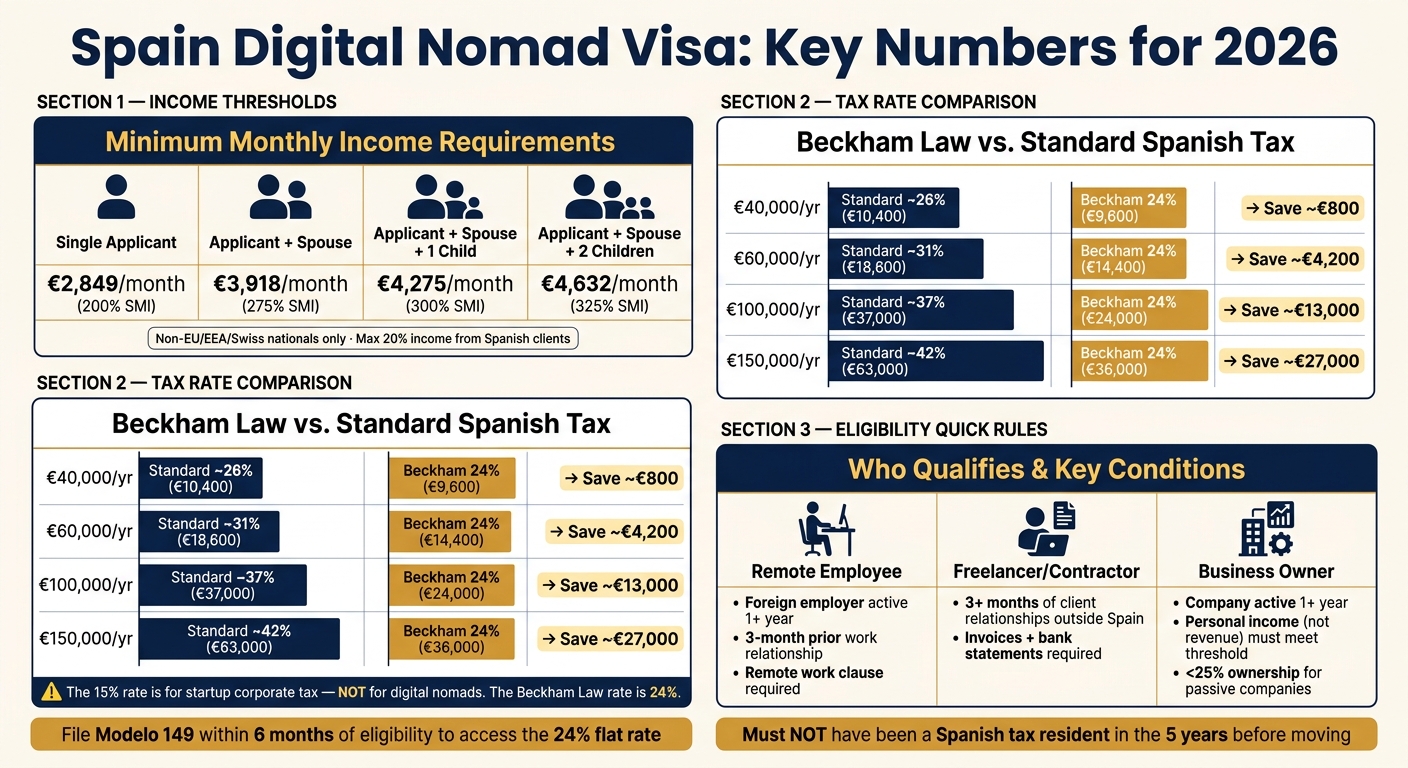
- Tax rule: the often-cited 15% is for startup corporate tax, while many qualifying remote workers look at the Beckham Law’s 24% flat rate on income up to €600,000
Here’s the plain-English version: you need remote work tied to foreign employers or clients, proof that your income is steady, and a clean path into Spain’s tax rules if you want the flat-rate option. Employees, freelancers, and business owners can all qualify, but the proof is different for each one.
A few points matter more than the rest:
- Employees need a foreign employer that has been active for at least 1 year
- Employees and freelancers usually need at least 3 months of prior work history with that employer or client base
- Family members push the income threshold higher
- Modelo 149 must be filed within 6 months if you want the expat tax regime
- If you miss that tax window, you may fall into Spain’s standard progressive tax system, which can reach 47% to 50%
| Topic | Key number |
|---|---|
| Single applicant income | €2,849/month |
| Spouse add-on | +75% of SMI |
| Each child add-on | +25% of SMI |
| Max Spain-source income | 20% |
| Beckham Law rate | 24% |
| Beckham Law cap | €600,000 |
| “15%” headline | Startup corporate tax, not personal tax |
Bottom line: if you earn enough, work remotely for non-Spanish clients or a foreign employer, and file the tax paperwork on time, Spain can still be a fit. But the 15% claim is often the wrong number for digital nomads, and that mistake can skew your budget from day one.
Who qualifies for Spain’s digital nomad visa
Before Spain looks at your income or tax setup, it looks at how you work. That’s the first hurdle: show that your job or business fits the visa rules, then show that you make enough.
This visa is only for non-EU, non-EEA, and non-Swiss nationals, which means U.S. citizens can apply. (Those looking for alternatives often compare this to the Portugal digital nomad visa). To qualify, you must work remotely for a foreign employer, foreign clients, or your own company, and you must meet Spain’s education or experience rule. Spain also limits local work: no more than 20% of your professional income can come from Spanish clients or companies.
You’ll also need one of these:
- A university or postgraduate degree from a recognized institution
- At least three years of relevant professional experience in your field
Remote employees of foreign companies
Remote employees can qualify if their foreign employer has been in continuous, active operation for at least one year. You also need to show that you’ve had a professional relationship with that employer for at least three months before applying.
Freelancers, contractors, and remote business owners
Freelancers and contractors can qualify if they show at least three months of ongoing client relationships outside Spain. If you’re newly freelance, Spain may ask for IRS records like Letter 147C or Form 1040-ES to prove that your freelance work is active.
Business owners can also qualify, but there’s one detail that trips people up: Spain looks at your personal qualifying income, not your company’s total revenue. Your company must have been operating for at least one year, and you’ll need to show your appointment as a manager along with payslips that prove your own income meets the threshold.
| Applicant Type | Prior Relationship | Company History | Spanish Income Cap |
|---|---|---|---|
| Remote Employee | 3 months with current employer | 1+ year of operation | Max 20% |
| Freelancer / Contractor | 3 months with clients | N/A | Max 20% |
| Business Owner | 3 months as director/manager | 1+ year of operation | Max 20% |
Once you fit into one of these applicant types, the next step is simple: your income documents need to clear Spain’s monthly threshold.
sbb-itb-39d39a6
Income requirements and acceptable proof of income
Spain sets this threshold in euros, not U.S. dollars. The minimum income rule is tied to the Salario Mínimo Interprofesional (SMI), Spain’s national minimum wage. This is a core requirement of the Spain digital nomad visa. So when the SMI changes, the income floor changes too. If you meet the applicant rules, Spain then checks whether your income proof is above that floor.
Minimum income thresholds for single applicants and families
The main applicant needs to show 200% of the SMI. If you’re bringing family, the amount goes up. A spouse or partner adds 75% of the SMI, and each dependent child adds 25%.
| Family Composition | SMI Multiple | Monthly Threshold (Approx.) |
|---|---|---|
| Single Applicant | 200% | €2,849 |
| Applicant + Spouse | 275% | €3,918 |
| Applicant + Spouse + 1 Child | 300% | €4,275 |
| Applicant + Spouse + 2 Children | 325% | €4,632 |
These numbers are based on the 2026 SMI converted to a 12-month figure. If your income is paid in USD, GBP, or CAD, many immigration lawyers suggest showing at least €3,000 per month. That extra margin can help if exchange rates move against you.
Documents employees, freelancers, and business owners need to prepare
Hitting the threshold is only part of it. Spain also wants proof that your income is stable, consistent, and easy to verify. Your bank statements need to line up with the income you declare. If they don’t, that’s a common reason applications get denied.
Any document that isn’t in Spanish needs a sworn translation by a traductor jurado. The paperwork also changes depending on how you earn your income.
| Applicant Type | Primary Proof | Supplementary Proof | Common Weak Points |
|---|---|---|---|
| Remote Employee | Employment contract; remote work authorization letter | Last 3 to 6 months of payslips; bank statements (3 to 6 months) | Missing "remote work" clause in the contract; no Social Security Certificate of Coverage |
| Freelancer / Contractor | Client service agreements (3+ months old); invoices (last 3 months) | Bank statements showing matching deposits; U.S. tax returns (Schedule SE) | Income averaging below the threshold; contracts that don’t explicitly permit remote work |
| Business Owner | Corporate registry documents; certificate of manager appointment | Personal payslips or distribution records; IRS Letter 147C; Form 1040-ES | Personal salary not clearly separated from business revenue |
For freelancers, there’s one detail that matters a lot: Spain can accept irregular or project-based income if the average over the previous 3 to 12 months meets the threshold. In plain English, one shiny new contract usually won’t carry the whole case. You still need past invoices and bank deposits to show a pattern of income.
Income proof gets you to the visa threshold; tax treatment for digital nomads is a separate test.
How Spain’s expat tax regime works for digital nomads
Once you meet Spain’s visa income rules, the next step is simple: can you use the Beckham Law or not?
Spain’s inbound-worker tax regime, known as the Beckham Law, can cut taxes for qualifying digital nomad visa holders. For most people, that’s the whole game. It’s not enough to know the tax break exists. You need to know whether you fit the rules.
The statutory rate, the six-year window, and the main eligibility conditions
Under the Beckham Law, qualifying individuals pay a flat 24% tax rate on salary and freelance income up to €600,000 per year. Income above that limit is taxed at 47%. The regime applies for the year of arrival plus the following five tax years, so the full window is six fiscal years.
There are a few rules that matter most.
- You cannot have been a Spanish tax resident at any point in the five years before relocating.
- If your work creates a Spanish business presence, you’re usually blocked from the regime.
- You must file Modelo 149 within six months of becoming eligible.
Miss that filing window, and Spain moves you onto its standard progressive tax system instead. Those rates can go as high as 47–50%.
If you clear the tax-residency test, the next thing to check is pretty practical: the rate, the deadline, and the type of income the regime covers.
One part many people miss: beneficiaries do not pay Wealth Tax on assets held outside Spain, and they do not need to file Modelo 720, the overseas assets declaration.
Where the 15% figure comes from and when it misleads
A lot of people see 15% online and assume that’s the Beckham Law rate. It isn’t.
The actual headline rate under the Beckham Law is 24%. The 15% figure comes from the reduced corporate tax rate for qualifying new startups under Law 28/2022, which is a different rule entirely. Foreign passive income is generally exempt under the regime.
That mix-up trips people up all the time. It sounds close enough to be believable, but it points to a separate tax rule.
Tax comparisons for employees, freelancers, and high earners
The table below uses 2026 estimates to show the gap.
| Annual Income | Standard Spanish tax | Beckham Law (24%) | Estimated savings |
|---|---|---|---|
| €40,000 | ~€10,400 (~26%) | €9,600 | ~€800 |
| €60,000 | ~€18,600 (~31%) | €14,400 | ~€4,200 |
| €100,000 | ~€37,000 (~37%) | €24,000 | ~€13,000 |
| €150,000 | ~€63,000 (~42%) | €36,000 | ~€27,000 |
Savings go up as income rises.
For remote employees, the setup is fairly direct. The 24% flat rate applies to employment income, and foreign passive income stays exempt. Freelancers were added under the 2023 reform, but there’s a catch: they also pay income-linked social security contributions ranging from €230 to over €500 per month. Business owners can qualify as directors if they own less than 25% of a passive company, and there is no ownership cap for operating companies.
Use the checklist next to confirm your status, documents, and filing window before moving. If you are still weighing your options, you might also consider the Italy digital nomad visa as an alternative.
How to check your eligibility and prepare before moving to Spain
A qualification checklist and document plan
Use this checklist to pressure-test your case before you move to Spain.
Start with income. Check that your gross monthly income meets Spain’s current minimum, then add the extra amount needed for any spouse or child included in the application.
Next, make sure your income setup fits the right visa track: employee, freelancer, or business owner. Then check two other rules that can trip people up: the required relationship length and the 20% cap on Spanish-source income. For employees, the foreign employer must have been operating for at least one year, and you need proof of an existing remote-work relationship before you apply.
After that, review your documents line by line. Your bank deposits should match your payslips or invoices. If the numbers don’t line up, that’s where problems often start. You’ll also need sworn Spanish translations and any apostilles required for the file.
Once the visa file is in order, set your tax deadline early. If you want the tax regime, file Modelo 149 within six months of becoming eligible. You also must not have been a Spanish tax resident at any point during the five years before your move.
If you earn money from more than one source, write each one down and check that your Spanish-source income stays under the 20% limit.
FAQs
Can I qualify if some of my income comes from Spain?
Yes, but only up to a point.
For Spain’s digital nomad visa, no more than 20% of your total professional income can come from Spanish clients or work done in Spain. That means at least 80% of your income should come from clients or companies outside Spain.
Think of it as a simple split: Spain can be part of your client base, just not the main part.
If you go past the 20% cap, you may no longer meet the visa rules. You could also lose access to the favorable tax treatment under the Beckham-style regime.
What if my income changes month to month?
If your income goes up and down, authorities usually focus on your average income over time, not one strong month. For freelancers, they may check your average net income from the past 3 to 12 months to make sure you still meet the rule.
A short dip of 1 or 2 months may not cause an immediate issue. But if your income stays lower for longer, you could fall out of compliance.
It helps to keep clear records, such as:
- Invoices
- Bank deposit records
If your situation changes in a major way, contact the authorities as soon as you can.
What happens if I miss the Modelo 149 deadline?
If you miss the six-month deadline to file Modelo 149, you lose access to the special tax regime for your entire stay. The rule is strict. There are no exceptions.
And because the regime can’t be applied retroactively, you’ll be taxed under Spain’s standard progressive resident tax system instead. Filing later usually won’t fix it, and switching after the fact is often very hard or not possible at all.
